DeepSeek's Engram tackles AI compute waste with conditional memory breakthrough


5 Sources
[1]
Deepseek research touts memory breakthrough, decoupling compute power and RAM pools to bypass GPU & HBM constraints -- Engram conditional memory module commits static knowledge to system RAM
DeepSeek has released a new technical paper, which details a new method for how new AI models might rely on a queryable database of information committed to system memory. Named "Engram", the conditional memory-based technique achieves demonstrably higher performance in long-context queries by
[2]
New AI method lets models think harder while avoiding costly bandwidth
Engram supports asynchronous prefetching across multiple GPUs with minimal performance overhead DeepSeek, in collaboration with Peking University, introduced a new training method called Engram, designed to decouple memory storage from computational processes. Traditional large language models
[3]
DeepSeek's conditional memory fixes silent LLM waste: GPU cycles lost to static lookups
When an enterprise LLM retrieves a product name, technical specification, or standard contract clause, it's using expensive GPU computation designed for complex reasoning -- just to access static information. This happens millions of times per day. Each lookup wastes cycles and inflates
[4]
Decoding DeepSeek's Solution to China's Compute Shortage | AIM
DeepSeek's new research enables retrieval using computational memory, not neural computation, freeing up GPUs. Ahead of the highly anticipated launch of its v4 model, DeepSeek has published research that could fundamentally reshape how large language models handle knowledge, and potentially
[5]

DeepSeek's Engram Conditional Memory Shows How to Reduce AI Compute Waste
Are transformers really the pinnacle of AI innovation, or are they just an overengineered way to solve simple problems? Prompt Engineering explores how the innovative DeepSeek Engram challenges the dominance of transformer-based architectures by proposing a bold alternative: treating transformers
Share
Copy Link
DeepSeek unveiled Engram, a conditional memory technique that separates static information retrieval from complex reasoning tasks. The method allows AI models to bypass GPU memory constraints by committing knowledge to system RAM, reducing reliance on expensive high-bandwidth memory while improving performance on long-context queries.
DeepSeek introduces conditional memory to address AI efficiency challenges
DeepSeek has released a technical paper detailing Engram, a conditional memory-based approach that fundamentally changes how AI models handle knowledge retrieval and reasoning. Co-authored by DeepSeek CEO Liang Wenfeng, the research tackles a critical inefficiency in Transformer models: the wasteful use of GPU cycles for simple lookups that could be handled through direct memory access
1
3
. When enterprise AI systems retrieve basic information like product names or technical specifications, they currently use expensive GPU computation designed for complex reasoning tasks, wasting cycles millions of times per day and inflating infrastructure costs3
.The research arrives as organizations face mounting pressure to deploy more capable AI systems while navigating GPU memory constraints and rising hardware costs. This HBM bottleneck is widely recognized as a key reason DRAM prices rose by 5X in just 10 weeks, as hardware demand spiked to support large AI models
2
. For Chinese AI labs operating under US export controls on GPUs, Engram offers a potential path forward by optimizing algorithmic efficiency rather than relying on brute-force compute scaling4
.How Engram separates static lookups from dynamic reasoning
Engram works by decoupling compute power from memory storage, allowing models to efficiently look up essential information without overloading GPU memory
2
. The system uses N-grams—statistical sequences of words—integrated into the model's neural networks and placed into a queryable memory bank1
. This enables models to remember facts rather than having to reason them out through computationally expensive neural computation each time.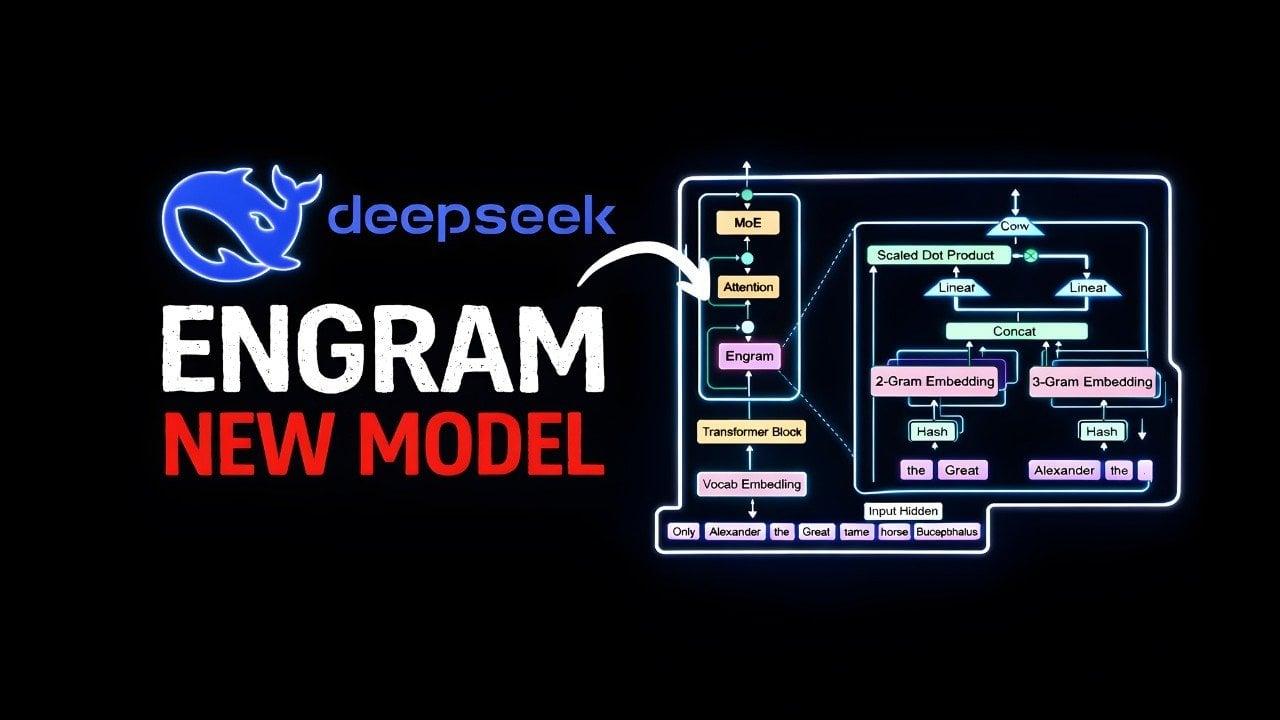
Source: Geeky Gadgets
The mechanism relies on hash-based lookups for static information retrieval. Token combinations extracted from input text are hashed to retrieve embeddings from a pre-trained lookup table stored in system RAM
5
. A standard Mixture of Experts (MoE) model might have to reconstruct these pieces of data every time they're referenced in a query through conditional computation, calling on expert parameters to assemble and reason the data even when focusing on certain parts1
. Engram allows the model to simply ask "Do I already have this data?" rather than accessing the parts of the model that deal with reasoning.To prevent errors, Engram employs a context-aware gating mechanism that filters retrieved patterns. A hash lookup for "Apple" might collide with unrelated content, or the word might mean the fruit rather than the company
3
. The model's current understanding of context acts as a filter—if retrieved memory contradicts the current context, the gate suppresses it; if it fits, the gate lets it through. This design allows models to handle long-context handling more efficiently and supports system-level prefetching with minimal performance overhead [2](https://www.techradar.com/pro/deepseek-may-have-found-a-way-to-solve-the-ram-crisis-by-eliminating-the-need-for-expensive-hbm-for-ai-inference-and-training-yes, the very reason why dram prices went up by 5x in 10 weeks).Optimal parameter allocation reduces computational waste
Through systematic experiments, DeepSeek discovered the optimal balance between computation and memory: 75-80% of sparse model capacity allocated to dynamic reasoning tasks and 20-25% to static lookups
3
. Tests showed that reallocating around 20-25% of the parameter budget to Engram yields better performance than pure MoE models, maintaining stable gains across different scales [2](https://www.techradar.com/pro/deepseek-may-have-found-a-way-to-solve-the-ram-crisis-by-eliminating-the-need-for-expensive-hbm-for-ai-inference-and-training-yes, the very reason why dram prices went up by 5x in 10 weeks).
Source: VentureBeat
An Engram-based model scaled to nearly 27 billion parameters demonstrated measurable improvements across standard industry benchmarks
1
. Complex reasoning benchmarks jumped from 70% to 74% accuracy, while knowledge-focused tests improved from 57% to 61%, with improvements measured across Big-Bench Hard, ARC-Challenge, and MMLU3
. Memory slot expansion provides predictable improvements without additional computational cost, confirming the scalability of conditional memory as an independent axis for sparse models [2](https://www.techradar.com/pro/deepseek-may-have-found-a-way-to-solve-the-ram-crisis-by-eliminating-the-need-for-expensive-hbm-for-ai-inference-and-training-yes, the very reason why dram prices went up by 5x in 10 weeks).Related Stories

Infrastructure implications and hardware efficiency gains
Engram's deterministic retrieval mechanism allows memory capacity to scale linearly across multiple GPUs while supporting asynchronous prefetching during inference [2](https://www.techradar.com/pro/deepseek-may-have-found-a-way-to-solve-the-ram-crisis-by-eliminating-the-need-for-expensive-hbm-for-ai-inference-and-training-yes, the very reason why dram prices went up by 5x in 10 weeks). The approach works with existing GPU and system memory architectures, potentially avoiding costly high-bandwidth memory (HBM) upgrades. It also aligns with emerging CXL (Compute Express Link) standards, which aim to overcome GPU memory constraints in large-scale AI workloads [2](https://www.techradar.com/pro/deepseek-may-have-found-a-way-to-solve-the-ram-crisis-by-eliminating-the-need-for-expensive-hbm-for-ai-inference-and-training-yes, the very reason why dram prices went up by 5x in 10 weeks).
The technique may relieve pressure on expensive memory hardware, particularly in regions where HBM access lags behind competitors like Samsung, SK Hynix, and Micron [2](https://www.techradar.com/pro/deepseek-may-have-found-a-way-to-solve-the-ram-crisis-by-eliminating-the-need-for-expensive-hbm-for-ai-inference-and-training-yes, the very reason why dram prices went up by 5x in 10 weeks). Engram differs from solutions like Nvidia's KVCache, which offloads context data to NVMe memory with BlueField-4
1
. While KVCache acts as short-term memory for recent conversations, Engram provides persistent access to pre-calculated data—essentially storing the whole encyclopedia rather than just handwritten notes.Chris Latimer, founder and CEO of Vectorize, notes that conditional memory solves a different problem than agentic AI memory systems: "It's more geared towards squeezing performance out of smaller models and getting more mileage out of scarce GPU resources"
3
. Early validation suggests models can expand parameter scale and reasoning capacity while managing memory demands more efficiently, potentially reducing sharp DDR5 DRAM price swings [2](https://www.techradar.com/pro/deepseek-may-have-found-a-way-to-solve-the-ram-crisis-by-eliminating-the-need-for-expensive-hbm-for-ai-inference-and-training-yes, the very reason why dram prices went up by 5x in 10 weeks). Organizations should monitor how Engram performs in production deployments and whether its approach to reduce computational waste becomes standard practice for optimizing AI infrastructure costs.References
Summarized by

Navi
[3]
Related Stories
DeepSeek V4.1 Flash Outperforms Flagship V4-Pro at Fraction of Cost with Revolutionary Architecture
10 Sept 2026•Technology

DeepSeek's AI Breakthrough: Expertise Trumps Raw Compute in Model Development
28 Jan 2025•Technology

DeepSeek Unveils Experimental AI Model with 'Sparse Attention' to Slash Processing Costs
29 Sept 2025•Technology

Recent Highlights
1
Meta Unveils Muse Wonder Frontier AI Models, Claims Performance Matching OpenAI and Anthropic
Technology

2
IMF Report Warns AI Market Correction Could Spark Global Financial Crisis With $1.4T at Risk
Business and Economy

3
Eight States Sue OpenAI Over ChatGPT Safety Concerns and Unlawful Collection of Children's Data
Policy and Regulation

Recent Highlights
Today's Top Stories











Don’t drown in AI news. We cut through the noise - filtering, ranking and summarizing the most important AI news, breakthroughs and research daily. Follow topics that matter to you and stay ahead.


