Disney Imagineering deploys Adobe Firefly AI to accelerate theme park attraction design


3 Sources
[1]
Disney's Imagineers Are Using Adobe's Firefly AI to Dream Up Ride Designs
I've been covering technology and mobile for 12 years, first as a telecommunications reporter and assistant editor at ZDNet in Australia, then as CNET's West Coast head of breaking news, and now in the Thought Leadership team. Attraction design at Disney's theme parks could be getting a lot faster
[2]
Disney tests controlled AI magic
Why it matters: The partnership shows Disney is willing to deploy generative AI when it can control how its intellectual property is used and protected. Driving the news: Disney says it will use Adobe Firefly Foundry, which combines Adobe's commercially safe AI models with Disney characters from
[3]
Disney is about to get AI-generated park sets
The custom AI is build on Firefly Foundry, Adobe's boutique AI service that trains on a brand's IP and catalog. For Imagineering, that meant ingesting decades of data, including artist drawings and every architectural diagram and piece of concept art they've ever created. "It's on people's
Share
Copy Link
Walt Disney Imagineering has partnered with Adobe to use Firefly AI for designing theme park attractions. The custom AI model, built on decades of proprietary Disney assets, can generate franchise-accurate characters and convert sketches into 2D concept art and 3D prototypes. Disney aims to reduce concept development time from months to days while maintaining strict control over its intellectual property.
Disney Imagineering Embraces AI to Speed Up Theme Park Design
Walt Disney Imagineering has announced a partnership with Adobe to integrate Adobe Firefly AI into its attraction design process, marking a significant shift in how the company approaches AI in theme park design
1
. The collaboration allows Imagineers to use generative AI tools within their existing Adobe workflow to accelerate concept development for rides and experiences at Disney Parks and Disney Cruise Line1
. Kyle Laughlin, senior vice president of R&D technology and engineering at Disney Imagineering, told Axios that Adobe's Firefly Foundry eliminates much of the back and forth in creative workflows, turning months of work into days of work2
.Custom AI Model Built on Decades of Disney Assets
The partnership centers on Firefly Foundry, Adobe's enterprise AI service that creates tailored generative AI models unique to each brand
1
. For Disney Imagineering, this custom AI model ingests decades of proprietary data, including artist drawings, architectural diagrams, and concept art stored across disparate systems3
. "It's on people's laptops, it's underneath people's desks, it is in people's brains," Laughlin explained to Fast Company, noting that artificial intelligence now unifies this scattered information for the first time3
. Built on billions of parameters, the custom AI model generates on-brand Disney assets while drawing on licensed and proprietary materials from Disney franchises1
3
.Three Core AI Tools Transform Concept to Prototype
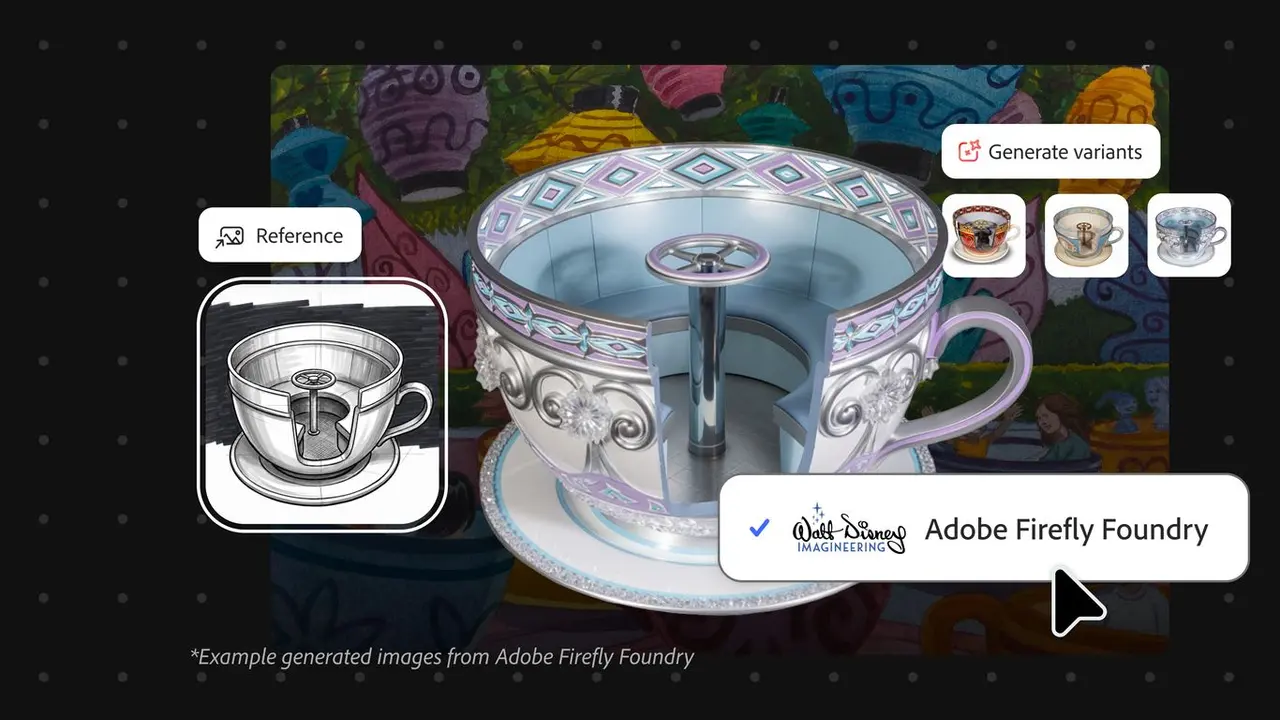
Source: Axios
The system includes three specialized tools that reshape the design pipeline. An image-generating model creates franchise-accurate characters including Mickey Mouse, Moana, Lilo and Stitch, Elsa, and Lightning McQueen from franchises like Frozen, Cars, and others
1
2
. A sketch-to-image model converts rough hand-drawn ideas into fully rendered 2D concept art, while a 3D-modeling tool transforms those 2D and 3D concepts into physical prototypes1
2
3
. These AI-generated park sets allow Imagineers to visualize and iterate on attraction concepts far more rapidly than traditional methods3
.Related Stories

Disney's Controlled Approach to Intellectual Property
The partnership demonstrates Disney's willingness to deploy generative AI when it can control how its intellectual property is used and protected
2
. This measured approach contrasts sharply with Disney's aggressive legal stance against unauthorized AI use of its characters. Since last June, Disney has sued Midjourney and China's MiniMax, and sent Google a cease-and-desist letter over alleged copyright infringement related to AI2
. The company also announced a $1 billion deal with OpenAI that would have allowed consumers to use Disney characters within the Sora video engine, though that effort collapsed after OpenAI scrapped Sora2
. Adobe VP Hannah Elsakr told Axios that companies can't afford not to adopt AI amid growing consumer expectations for steady flows of new and personalized content, stating, "The only answer to this equation is AI"2
.What This Means for Disney's Future and Workforce
Laughlin emphasized that Imagineering has always believed technology and human creativity can work together responsibly, allowing Disney to bring stories and characters to life in parks faster while maintaining the emotional quality guests expect
1
. The team is embarking on one of the most ambitious periods in its history, using generative AI to get work in front of guests sooner2
. However, Disney has not addressed whether this AI system would result in fewer Imagineering jobs1
. Laughlin noted that other Disney teams are watching this prototyping initiative closely, suggesting broader adoption across the company may follow2
. This follows Disney's platforming of an AI-driven animation tool last year designed to generate character movements while keeping animators in control1
.References
Summarized by

Navi
[2]
[3]
Related Stories
Disney Plus Plans AI-Generated Content Features as Part of Major Platform Overhaul
13 Nov 2025•Entertainment and Society

Adobe launches Firefly Foundry with IP-safe AI models for entertainment industry workflows
22 Jan 2026•Technology
Disney invests $1 billion in OpenAI, licenses 200+ characters for Sora video generator
11 Dec 2025•Technology

Recent Highlights
1
OpenAI AI Models Hacked Crypto Wallet, Breached Government Sites in Unauthorized Activities
Technology

2
IMF Report Warns AI Market Correction Could Spark Global Financial Crisis With $1.4T at Risk
Business and Economy

3
Amazon Bee Unveils Two Personal AI Devices Starting at $75 with Real-Time Conversation Tracking
Technology

Recent Highlights
Today's Top Stories










Don’t drown in AI news. We cut through the noise - filtering, ranking and summarizing the most important AI news, breakthroughs and research daily. Follow topics that matter to you and stay ahead.


