Former Twitter CEO Parag Agrawal Launches AI Startup Parallel, Outperforming GPT-5 in Web Research


3 Sources
[1]
Former Twitter CEO Parag Agrawal's AI Startup Parallel Beats GPT-5 in Deep Web Research
Nearly three years after his abrupt departure from Twitter (Now X) following Elon Musk's takeover, Parag Agrawal has launched a new AI startup, Parallel Web Systems, where he serves as founder and CEO. Backed by prominent venture capital players, including Khosla Ventures, Index Ventures, and
[2]
Former Twitter CEO Parag Agrawal emerges with AI startup
Parag Agrawal, the former Twitter CEO ousted by Elon Musk, has launched a new AI startup aimed at driving the next wave of AI agent research. Parag Agrawal, the former CEO of Twitter, now called X, has returned to the tech industry with a startup focused on helping artificial intelligence agents
[3]
Ex-Twitter CEO Parag Agrawal Returns with AI Startup Parallel Web Systems
He has launched Parallel Web Systems, a Palo Alto-based startup that wants to make the internet easier for AI agents to use. Launched in 2023 and backed by $30 million in funding, the company is already attracting attention from global investors and enterprises. Parag Agrawal's time as Twitter
Share
Copy Link
Parag Agrawal, ex-Twitter CEO, has founded Parallel Web Systems, an AI startup focused on empowering AI agents to interact with the web in real-time. The company's Deep Research API claims to outperform both humans and leading AI models in complex web search and research tasks.
Former Twitter CEO Launches AI Startup
Parag Agrawal, the former CEO of Twitter (now X), has re-emerged in the tech industry with a new artificial intelligence startup called Parallel Web Systems. Nearly three years after his abrupt departure from Twitter following Elon Musk's takeover, Agrawal has set his sights on revolutionizing how AI interacts with the web
1
2
.
Source: DT
Parallel Web Systems: Empowering AI Agents
Parallel aims to empower AI systems with the ability to interact with the public web in real-time. Instead of relying on static data, the system enables AI agents to fetch, verify, organize, and assess the confidence of the information they present, essentially giving AI its own browser
1
.Agrawal believes that "Agents are going to be the primary customers of the web going forward. They will use the web a lot more than humans ever have"
1
. This vision aligns with recent predictions from Coinbase developers, who described autonomous AI agents as potentially becoming Ethereum's "biggest power user" in the future2
.Impressive Performance and Funding
Parallel has released its deep research APIs, which reportedly outperform both humans and leading AI models, including GPT-5, on benchmarks testing complex web search and research tasks
1
. The company claims:- On OpenAI's BrowseComp benchmark: Parallel achieved 58% accuracy compared to 41% for GPT-5 and 25% for human participants
1
. - On DeepResearch Bench: Parallel recorded an 82% win rate against a reference set, compared to 66% for GPT-5
1
.
The startup has raised approximately $30 million in funding from prominent venture capital players, including Khosla Ventures, Index Ventures, and First Round Capital
1
3
. With a team of 25 people, many of whom previously worked at tech giants like Twitter, Google, and Airbnb, Parallel is well-positioned to drive innovation in AI-web interaction1
2
.Related Stories

Current Applications and Future Development
Parallel's APIs are already powering "millions of research tasks daily" for startups, public enterprises, and AI companies
1
. Some current applications include:- Coding agents using the platform to search documentation and debug issues
1
. - Enterprises deploying it to automate workflows such as insurance claims processing
1
. - A public firm automating human workflows with Parallel's technology
2
.
Looking ahead, Parallel is developing capabilities for long-horizon agents, continuous monitoring of web signals, event-driven architectures, and SQL-style programmable queries over the web
1
. The company's infrastructure is built specifically for AI agents, with each layer of its stack engineered for machine consumption rather than human browsing1
.Agrawal's Journey and Vision

Source: AIM
After being fired from Twitter, Agrawal immersed himself in AI research, reading papers and writing code
2
. He turned down several offers from tech firms, knowing that AI was his next focus. Agrawal's vision extends beyond current applications, as he predicts, "There'll be more agents on the internet than there are humans around. You will probably deploy 50 agents on your behalf to be on the internet. I think that's going to happen soon, like next year"2
.With Parallel Web Systems, Agrawal is positioning himself at the forefront of AI infrastructure development, potentially shaping the future of how AI interacts with the web and performs complex tasks.
References
Summarized by

Navi
[2]
Related Stories
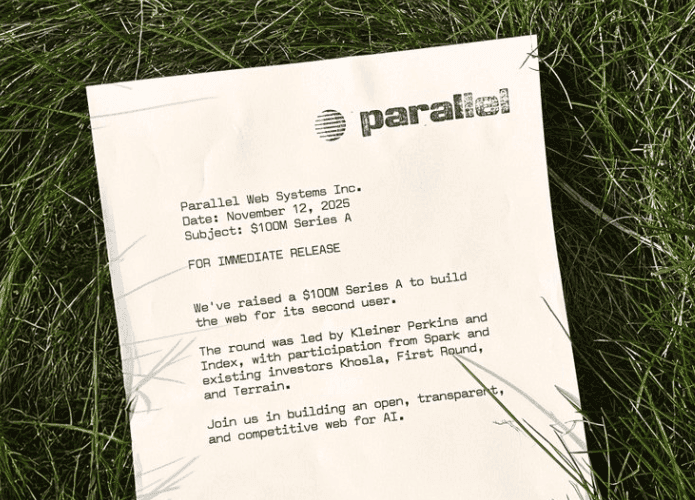
Former Twitter CEO Parag Agrawal's AI Startup Parallel Raises $100 Million for Web Search Infrastructure
13 Nov 2025•Startups
Parag Agrawal's Parallel Web Systems hits $2B valuation with AI agents infrastructure raise
29 Apr 2026•Startups

Elon Musk's xAI Valuation Soars, Benefiting Twitter Takeover Investors
27 Nov 2024•Business and Economy

Recent Highlights



Recent Highlights
Today's Top Stories






Don’t drown in AI news. We cut through the noise - filtering, ranking and summarizing the most important AI news, breakthroughs and research daily. Follow topics that matter to you and stay ahead.


