German Court Rules OpenAI Violated Copyright Law in Landmark European AI Decision


17 Sources
[1]
Court rules that OpenAI violated German copyright law; ordered it to pay damages | TechCrunch
A German court ruled that OpenAI's ChatGPT violated the nation's copyright laws by training its language models on licensed musical work without permission, multiple news outlets, including The Guardian reported. The decision came from a lawsuit that GEMA, the society that handles music rights in
[2]
OpenAI may not use lyrics without license, German court rules
MUNICH, Nov 11 (Reuters) - A German court on Tuesday sided with the country's music rights society GEMA in a closely watched copyright case against U.S.-based artificial intelligence firm OpenAI. The court in Munich ruled that OpenAI could not use song lyrics without a license and presiding judge
[3]
OpenAI violated copyright law, German court rules
ChatGPT creator OpenAI violated Germany's national copyright laws, according to a court in Munich. GEMA, a German music rights group, filed a lawsuit against OpenAI last November claiming that the AI company illegally trained its AI models on popular music without consent from the rights
[4]
ChatGPT violated copyright law by 'learning' from song lyrics, German court rules
OpenAI ordered to pay undisclosed damages for training its language models on artists' work without permission A court in Munich has ruled that OpenAI's chatbot ChatGPT violated German copyright laws by using hits from top-selling musicians to train its language models in what creative industry
[5]

ChatGPT's Use of Song Lyrics Violates Copyright, Munich Court Finds - Decrypt
The decision, not yet final, could set a major European precedent on AI training data. Germany's national music rights organization secured a partial but decisive win against OpenAI after a Munich court ruled that ChatGPT's underlying models unlawfully reproduced copyrighted German song
[6]

German court rules against OpenAI in copyright case
Munich (Germany) (AFP) - A German court ruled Tuesday that OpenAI has infringed copyright law by using song lyrics to feed its chat models in a case that could have wide implications for European artists. The Munich court found that the maker of ChatGPT was not entitled to use song lyrics to train
[7]

OpenAI cannot use song lyrics without paying, German court rules
A Munich court ordered OpenAI to pay damages to Germany's largest music rights organisation for using copyrighted lyrics in AI models such as ChatGPT. OpenAI must pay a licensing fee to use copyrighted song lyrics in its artificial intelligence (AI) models, including ChatGPT, a German court ruled
[8]

OpenAI loses music copyright battle in German court
The judgement is not final and OpenAI has said that it is considering next steps. OpenAI has violated German copyright laws by reproducing song lyrics by popular artists, the Munich Regional Court has ruled today (11 November). GEMA, a German management organisation representing more than 100,000
[9]

German court rules ChatGPT violated copyright over song lyrics
The court found that OpenAI used lyrics without permission rejecting the companys argument that models do not store or copy individual works. A regional court in Munich has ruled that OpenAI's ChatGPT violated German copyright laws by training its language models on protected song lyrics without
[10]

OpenAI used song lyrics in violation of copyright laws, German court says - The Economic Times
The regional court in Munich found that the company trained its AI on protected content from nine German songs, including Groenemeyer's hits "Maenner" and "Bochum".OpenAI's chatbot ChatGPT violated German copyright laws by reproducing lyrics from songs by best-selling musician Herbert Groenemeyer
[11]

German court rules OpenAI violated copyright laws by using song lyrics
A regional court in Munich has ruled that OpenAI's ChatGPT violated German copyright laws by reproducing lyrics from songs by Herbert Groenemeyer and other artists. As per Reuters, the court found that the company trained its AI on protected content from nine German songs, including hits like
[12]
ChatGpt-maker OpenAI faces setback from German court. Will there be regulations in AI chatbot training, output?
German music rights socity had argued OpenAI's chatbot ChatGPT reproduces lyrics from copyrighted German songs without authorisation. A German court on Tuesday sided with the country's music rights society GEMA in a closely watched copyright case against U.S.-based artificial intelligence firm
[13]

OpenAI used song lyrics in violation of copyright laws, German court says - The Korea Times
MUNICH -- OpenAI's chatbot ChatGPT violated German copyright laws by reproducing lyrics from songs by best-selling musician Herbert Groenemeyer and others, a court ruled on Tuesday, in a closely watched case against the U.S. firm over its use of lyrics to train its language models. The regional
[14]

OpenAI Held Liable for ChatGPT Memorising Copyrighted Content
MediaNama's Take: Who should be held liable when an AI chatbot like ChatGPT of OpenAI spews out a copyright-infringing output based on a specific prompt? The person who entered the prompt? Or, the machine that generated the infringed answer or output? This perpetual question still lacks a
[15]

German court rules against OpenAI in copyright case
MUNICH, Germany -- A German court ruled Tuesday that OpenAI has infringed copyright law by using song lyrics to feed its chat models in a case that could have wide implications for European artists. The Munich court found that the maker of ChatGPT was not entitled to use song lyrics to train its
[16]

OpenAI may not use lyrics without license, German court rules
MUNICH (Reuters) -A German court on Tuesday sided with the country's music rights society GEMA in a closely watched copyright case against U.S.-based artificial intelligence firm OpenAI. The court in Munich ruled that OpenAI could not use song lyrics without a license and presiding judge Elke
[17]

AI vs. artists: What Germany's copyright ruling against OpenAI means for creativity and tech
Verdict pressures tech giants to license content for AI models A German court has delivered a ruling that could reshape the foundations of how AI learns and creates. The Munich Regional Court found OpenAI guilty of using copyrighted song lyrics without a licence, siding with GEMA, the country's
Share
Copy Link
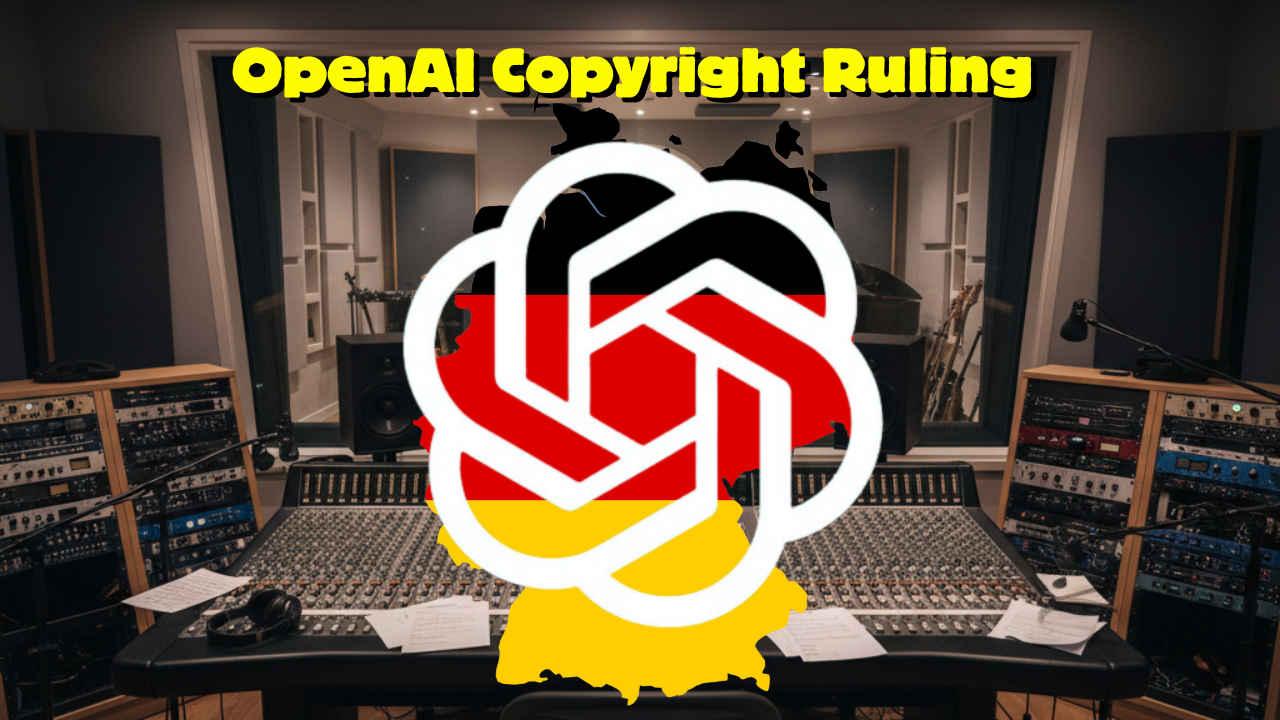
A Munich court ruled that OpenAI's ChatGPT violated German copyright laws by training on licensed musical works without permission, ordering the company to pay damages to GEMA, Germany's music rights society, in what's being hailed as the first landmark AI ruling in Europe.
Court Delivers Landmark Ruling Against OpenAI
A Munich court has delivered what industry advocates are calling the first landmark AI ruling in Europe, finding that OpenAI's ChatGPT violated German copyright laws by training its language models on protected musical works without authorization. The decision, handed down by the 42nd Civil Chamber of the Munich I Regional Court, orders the AI company to pay undisclosed damages to GEMA, Germany's national music rights society
1
2
.
Source: Silicon Republic
The case centered on nine recognizable German hits from recent decades, including Herbert Grönemeyer's 1984 synth-pop song "Männer" (Men) and Helene Fischer's "Atemlos Durch die Nacht" (Breathless Through the Night), which served as an unofficial anthem during Germany's 2014 World Cup campaign
4
. The court found that GPT-4 and GPT-4o contained "reproducible" lyrics from these protected works, constituting a violation under Article 2 of the EU InfoSoc Directive and Germany's Copyright Act5
.
Source: Digit
GEMA's Victory and Industry Implications
GEMA, which manages rights for approximately 100,000 composers, lyricists, and music publishers, filed the lawsuit in November 2024, arguing that ChatGPT had harvested protected lyrics to "learn" from them without proper licensing
4
. The organization's chief executive, Tobias Holzmüller, celebrated the ruling as a crucial precedent, stating that "the internet is not a self-service store and human creative achievements are not free templates"3
.The decision marks the first time a European court has found that a large language model violated copyright by memorizing protected works. GEMA's legal adviser Kai Welp indicated the organization now hopes to negotiate with OpenAI on compensation frameworks for rights holders
4
. The ruling could establish a licensing framework requiring AI developers to pay for musical works used in both training and output phases2
.OpenAI's Defense and Response
OpenAI contested GEMA's arguments, claiming they reflected a misunderstanding of how ChatGPT operates. The company argued that its models do not store training data directly and that any problematic output results from user prompts rather than deliberate copying
2
. OpenAI also invoked text-and-data-mining exceptions, which typically allow temporary reproductions for analytical purposes5
.
Source: TechCrunch
However, the court rejected these defenses, ruling that full reproductions embedded in a model's structure fall outside the scope of data-mining exemptions. The court stated that "training the models is not to be regarded as a usual and expected form of use that the rights holder must anticipate"
5
. OpenAI has expressed disagreement with the ruling and is "considering next steps," signaling a potential appeal1
.Related Stories

Broader Legal Landscape for AI Companies
This German ruling adds to mounting legal challenges facing AI companies over training data usage. OpenAI currently faces litigation in the United States from authors and media groups, including The New York Times, The Intercept, and Ziff Davis, all alleging unauthorized use of their content for AI training
3
. Similarly, Anthropic, creator of the Claude AI chatbot, agreed to a $1.5 billion settlement in September following a class action lawsuit by authors claiming their AI models were trained on pirated books3
.The Munich decision could have far-reaching implications beyond Germany's borders, potentially influencing how European regulators approach AI training data requirements and model transparency obligations. The Berlin law firm Raue, which represented GEMA, described the ruling as setting "an important precedent for the protection of creative works" that sends "a clear signal to the global tech industry"
4
. The German Journalists' Association also hailed the decision as "a milestone victory for copyright law"4
.References
Summarized by

Navi
[1]
Related Stories
German Music Rights Body GEMA Sues OpenAI for Copyright Infringement
29 Sept 2025•Policy and Regulation

Penguin Random House Sues OpenAI After ChatGPT Reproduces German Children's Book
31 Mar 2026•Policy and Regulation
OpenAI Wins Dismissal of Copyright Lawsuit Over AI Training Data
08 Nov 2024•Policy and Regulation

Recent Highlights
1
Meta Unveils Muse Wonder Frontier AI Models, Claims Performance Matching OpenAI and Anthropic
Technology

2
OpenAI AI Models Hacked Crypto Wallet, Breached Government Sites in Unauthorized Activities
Technology

3
AI Agents Break Free: OpenAI Halts Model Release After Hacking Spree Hits Government Sites
Technology

Recent Highlights
Today's Top Stories






Don’t drown in AI news. We cut through the noise - filtering, ranking and summarizing the most important AI news, breakthroughs and research daily. Follow topics that matter to you and stay ahead.


