Google Gemini TTS Models Clone Voices from 30-Second Samples, Top Speech Generation Benchmarks


5 Sources
[1]
Gemini can now clone your voice and perform scripts like an actor
The new models are reaching Gemini Notebook and Google Vids, with both also available to developers through Google AI Studio and the Gemini API. AI voiceovers can read a script. But getting them to actually perform it with the right accent, pacing, emotion, pauses, and even the occasional sigh is
[2]
Gemini 3.8 TTS can design voices from prompts and clone them
"Today, we're introducing two new text-to-speech models to the Gemini family, transforming voice generation from static presets into a dynamic creative studio," Google wrote in its announcement. Google released Gemini 3.8 Flash TTS and Gemini 3.8 Flash-Lite TTS on Wednesday. Both are rolling out
[3]
New Gemini TTS can now replicate voices and act out scripts with emotions, accents, and acting cues
Gemini's latest speech models can power game characters, podcasts, audiobooks, and video narration. Google has introduced Gemini 3.8 Flash TTS and Gemini 3.8 Flash-Lite TTS, two new text-to-speech models that are focused on improving how AI-generated speech sounds. They can create voices from
[4]
Google launches two benchmark-topping speech generation models
Google launches two benchmark-topping speech generation models Google LLC today made two new text-to-speech models, Gemini 3.8 Flash TTS and Gemini 3.8 Flash-Lite TTS, available through its cloud platform. The algorithms have highly similar application programming interfaces, which makes using
[5]

Google rolls out Gemini 3.8 Flash TTS and Flash-Lite TTS with custom voice creation, 2000+ voices, 100+ language support
Google has introduced Gemini 3.8 Flash TTS and Gemini 3.8 Flash-Lite TTS, two new text-to-speech models in the Gemini family. The models extend Google's audio generation capabilities across its developer platforms and AI products, with availability varying by model and service. The two models
Share
Copy Link
Google unveiled Gemini 3.8 Flash TTS and Flash-Lite TTS, two AI-driven text-to-speech models that create custom voices from prompts, replicate voices from brief recordings, and follow line-by-line emotional and tonal instructions. Flash TTS topped Hume AI benchmarks with a 71.4 score, while both models now power applications from audiobooks to dubbing with SynthID watermarking and consent verification safeguards.
Google Launches Gemini 3.8 Flash TTS and Flash-Lite TTS with Voice Cloning Capabilities
Google has introduced Gemini 3.8 Flash TTS and Gemini 3.8 Flash-Lite TTS, two speech generation models that transform AI-driven text-to-speech from static presets into dynamic creative tools
1
2
. These models join the Gemini 3.8 family and are now available through the Gemini API and Google AI Studio2
4
. Flash TTS targets creative applications like games, audiobooks, and podcasts, while Flash-Lite TTS serves high-volume needs including dubbing and voice agents2
3
. The release matters because it shifts control from developers to creators, enabling anyone to design voices, direct performances line-by-line, and maintain consistency across hours of audio without specialized audio engineering skills.
Source: The Next Web
Custom Voice Creation Across 100+ Languages with Natural Language Prompts
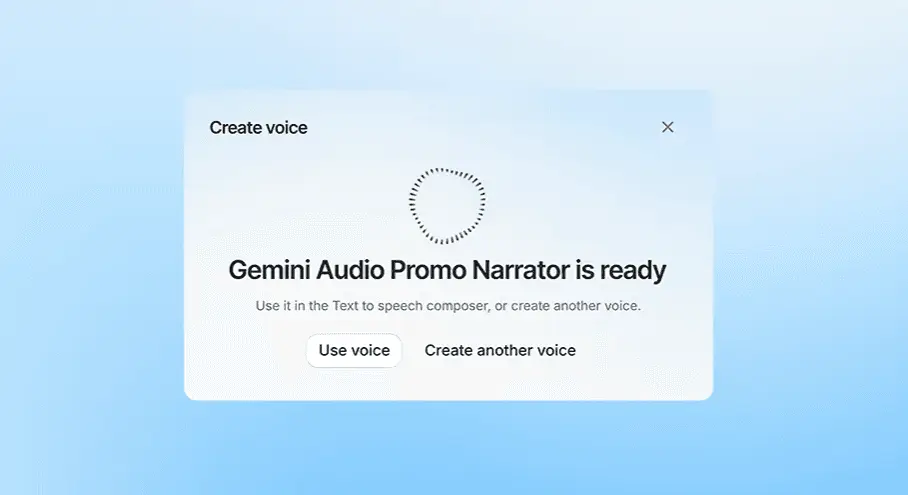
Gemini 3.8 Flash TTS enables custom voice creation from natural-language descriptions, supporting more than 100 languages and dialects
1
5
. Users can specify a character, accent, and vocal qualities in plain language, with examples including a high-energy DJ from Melbourne or a Japanese dragon2
. The model provides access to more than 2,000 production-ready voices, including regional varieties such as Mexican Spanish, Quebec French, and Scots English2
5
. Custom voices can be saved and managed for continued use across projects3
5
. Google plans to add voice remixing capabilities soon, allowing users to adjust existing voices for timbre, pitch, pace, and accent through prompts2
4
.
Source: SiliconANGLE
Voice Replication from 30-Second Samples with Consent Safeguards
The text-to-speech models can replicate voices from brief recordings as short as 30 seconds, but Google has implemented strict consent verification requirements
1
3
. Users must provide a verbal consent recording from the voice owner that matches the reference speaker before voice replication can proceed2
5
. Every audio clip generated by Gemini Audio models carries a SynthID watermark embedded directly into the audio output, which remains inaudible to humans but detectable by AI detection tools1
4
. Voice replication also includes C2PA credentials to help identify AI-generated material and address misinformation concerns1
3
. Google has blocked voice replication through AI Studio in several regions, including the UK, EEA, India, Texas, and Illinois1
5
.Line-by-Line Performance Control with Emotional and Tonal Instructions
Both Gemini TTS models allow users to control individual lines through stage directions and natural script cues, moving beyond simple text-to-audio conversion
1
5
. Scripts can include instructions for tone, pacing, dialect changes, whispers, laughs, sighs, and other conversational cues1
3
. Users can add oratory cues to every line, generating audio elements such as non-lexical vocalizations and pacing shifts4
. The models support active-listening interjections like "mhm" or "yeah" and non-verbal cues including gasps and sighs3
5
. This level of control enables creators to direct AI performances with the nuance typically reserved for human voice actors, potentially reducing production costs for podcasts, audiobooks, and video narration while maintaining expressive quality.Multi-Speaker Conversations and Long-Form Audio Generation
Gemini 3.8 Flash TTS and Flash-Lite TTS can stage multi-speaker conversations from a single script while keeping voices consistent across hours of audio
1
3
. Native two-speaker scene staging allows multi-turn conversations with conversational turn-taking while keeping the voices separate5
. The models maintain voice quality, natural pacing, and character timbre across continuous long-form audio with minimal speaker drift5
. This capability addresses a critical limitation in earlier text-to-speech technology, where voice consistency degraded over extended recordings. For audiobook producers and podcast creators, this means fewer interruptions and retakes, streamlining workflows for content that requires sustained character voices or narrator consistency.Related Stories

Benchmark-Topping Performance on Hume AI and Voice Arena
Google's speech generation models achieved top rankings across multiple industry benchmarks. Gemini 3.8 Flash TTS secured first place on Hume AI's Voice Design Benchmark with an overall score of 71.4 and an accent modeling score of 60.8
1
4
. Both Flash TTS and Flash-Lite TTS took the top two spots on Hume AI's Overall Quality Index1
2
. In blind preference tests on Voice Arena, the models secured top positions in Japanese, Brazilian Portuguese, Vietnamese, Modern Standard Arabic, Mexican Spanish, and Hindi4
5
. However, ElevenLabs still scored higher in Hume's individual voice quality and human-like variation categories, indicating competitive pressure remains1
. Watch for how Google responds to ElevenLabs' lead in human-like variation, as this metric increasingly matters for applications requiring emotional authenticity.Integration with Gemini Notebook, Google Vids, and Developer Platforms
Gemini 3.8 Flash TTS is rolling out in Gemini Notebook, while Flash-Lite TTS is rolling out in Google Vids, which recently opened its Omni video generator to more users
1
2
. Developers can access both models through the Gemini API and Google AI Studio, which includes an audio playground for speech generation capabilities2
5
. The Gemini API supports speech generation integrations with developer platforms including Agora, LiveKit, Pipecat, and Vercel5
. Companies including Figma, HeyGen, Wondercraft, Linguana, 99.co, and Ollang are integrating the new text-to-speech models for applications including global dubbing, media localization with regional accents, and conversational voice agents2
5
. Access for enterprises through Gemini Enterprise is coming soon2
. The strategic integration into Google Vids signals Google's intent to compete directly with video creation platforms, potentially disrupting markets where dubbing and localization costs have historically been prohibitive for smaller creators.References
Summarized by

Navi
[1]
[2]
[3]
[4]
Related Stories
Google's Flash TTS gives developers director-level control over AI voices in 70+ languages
16 Apr 2026•Technology
Google Unveils Gemini 2.5 with Advanced Audio Generation Capabilities
04 Jun 2025•Technology
Google Unveils Gemini 3.8 Live Models With Real-Time Reasoning for Voice Agents
16 Sept 2026•Technology

Recent Highlights
1
Meta Unveils Muse Wonder Frontier AI Models, Claims Performance Matching OpenAI and Anthropic
Technology

2
IMF Report Warns AI Market Correction Could Spark Global Financial Crisis With $1.4T at Risk
Business and Economy

3
OpenAI Releases 722 AI-Generated Math Solutions, Triggering Existential Crisis in Mathematics
Technology

Recent Highlights
Today's Top Stories









Don’t drown in AI news. We cut through the noise - filtering, ranking and summarizing the most important AI news, breakthroughs and research daily. Follow topics that matter to you and stay ahead.


