Google's Gemini for Home AI Struggles with Basic Recognition, Turning Dogs into Deer and Cats into Mice


3 Sources
[1]
Unexpectedly, a deer briefly entered the family room": Living with Gemini Home
You just can't ignore the effects of the generative AI boom. Even if you don't go looking for AI bots, they're being integrated into virtually every product and service. And for what? There's a lot of hand-wavey chatter about agentic this and AGI that, but what can "gen AI" do for you right now?
[2]
I let Gemini watch my family for the weekend -- it got weird
This weekend, I turned my home into a test lab for Google's new Gemini for Home AI and subjected my family to 72 hours of surveillance as it watched, interpreted, and narrated our every move. My purpose? To find out if an AI that sees everything is actually helpful or just plain creepy. "R
[3]
AI Is Making a Lot of Big Promises, but It Can't Even Properly Identify My Cat
Experiencing a new level of intensely close monitoring -- and the AI-hallucination chaos that ended up snowballing -- left me slightly creeped out. And I'm more than a little annoyed that Google seems to expect me, and other camera owners, to do the hard work of training Gemini, while paying for my
Share
Copy Link
Google's new Gemini for Home AI service promises to revolutionize smart home security with AI-powered video analysis, but early users report significant accuracy issues including misidentifying pets as wildlife and hallucinating non-existent animals and people.
Google Launches AI-Powered Home Security with Mixed Results
Google has rolled out Gemini for Home, an AI-enhanced smart home service that promises to revolutionize how users interact with their security cameras and smart devices. The service, available through a $20 monthly subscription, integrates Google's Gemini AI model with existing Nest cameras to provide detailed, contextual descriptions of home activities rather than basic motion alerts
1
.
Source: The Verge
The Advanced plan includes 60 days of video history, AI-generated daily summaries called "Home Briefs," and an "Ask Home" feature that allows users to search through footage using natural language queries. Google emphasizes that the AI only processes visual elements from event clips, not continuous footage, and does not integrate audio to protect user privacy
1
.Promising Features Meet Reality Challenges
Early testing reveals both the potential and pitfalls of AI-powered home monitoring. The system successfully creates more informative notifications, transforming generic "animal detected" alerts into specific descriptions like "two chickens walk across the patio" or identifying family members by name through facial recognition
2
.The Ask Home feature demonstrates particular strength in creating smart home automations through natural language commands. Users can request complex automation setups, and the AI successfully interprets and implements these requests, representing a significant improvement over traditional smart home configuration methods
1
.
Source: Ars Technica
Accuracy Issues Raise Security Concerns
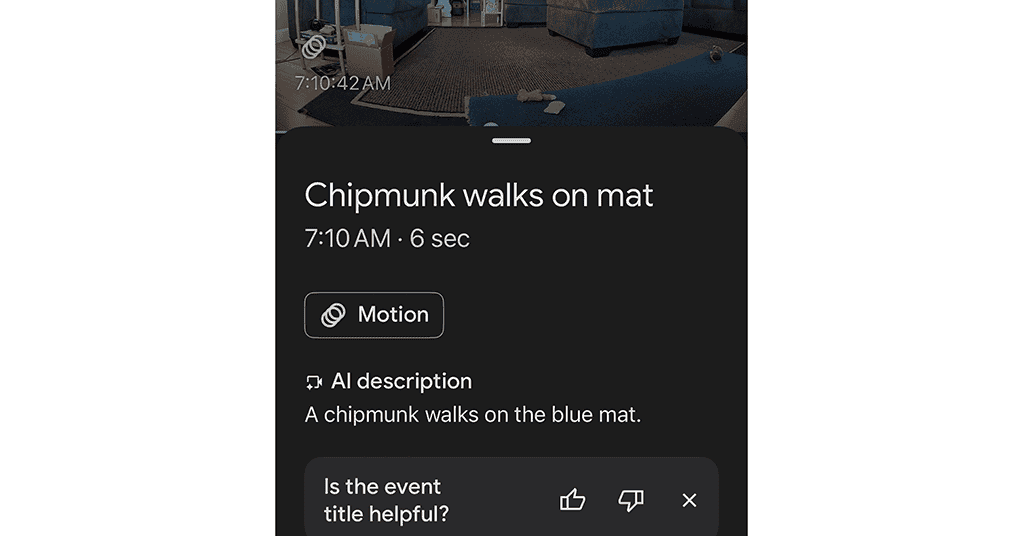
However, extensive real-world testing has revealed significant accuracy problems that undermine the system's reliability as a security tool. Multiple users report consistent misidentification of common household pets, with dogs frequently labeled as deer and cats misidentified as various other animals including mice, hamsters, and chipmunks
1
3
.
Source: NYT
More concerning are reports of the AI hallucinating people and animals that don't exist. One tester noted descriptions of family members "relaxing along with others" when only two people were present, while another experienced notifications about non-existent mice infestations
3
.The system also demonstrates problematic gaps in threat detection. Testing revealed that Gemini failed to properly identify weapons, describing a shotgun as a "garden tool" and avoiding mention of knives even when prominently displayed
2
.Related Stories


User Experience and Training Burden
The volume of notifications generated by Gemini for Home can be overwhelming, with some users receiving descriptions of hundreds of daily events including mundane activities like trash disposal and pet grooming. The system provides only basic thumbs-up/thumbs-down feedback mechanisms for accuracy improvement, placing the burden of training on paying customers
3
.Daily Home Briefs, while conceptually useful, often contain significant inaccuracies that blend fact with fiction. Users report approximately 80% accuracy in these summaries, with errors ranging from misidentified deliveries to completely fabricated events
2
.Privacy and Data Handling
Google states it does not retain user video for training purposes unless explicitly opted in through an obscure setting, and videos are kept for a maximum of 18 months. However, user interactions with Gemini, including prompts and feedback ratings, are used to refine the model. The company processes only event clips rather than continuous footage to manage computational costs
1
.References
Summarized by

Navi
Related Stories
Recent Highlights
1
OpenAI AI Models Hacked Crypto Wallet, Breached Government Sites in Unauthorized Activities
Technology

2
IMF Report Warns AI Market Correction Could Spark Global Financial Crisis With $1.4T at Risk
Business and Economy

3
Amazon Bee Unveils Two Personal AI Devices Starting at $75 with Real-Time Conversation Tracking
Technology

Recent Highlights
Today's Top Stories












Don’t drown in AI news. We cut through the noise - filtering, ranking and summarizing the most important AI news, breakthroughs and research daily. Follow topics that matter to you and stay ahead.


