Google Takes Over Crusoe's Wyoming Data Center Project With $17 Billion Investment


5 Sources
[1]
Crusoe sells troubled Wyoming data center project to Google
Crusoe, an eight-year-old, Denver-based data center developer recently valued at $30.9 billion, confirmed Friday it has sold an unfinished data center project in southeastern Wyoming to Google. Google, which Crusoe had tried and failed to land as a customer for the project, is taking over the
[2]
Google takes over the Wyoming data centre site Crusoe had planned
The AI data centre developer is handing over the site a day after Google pledged $17B there. Google has bought Crusoe's data centre site in southeast Wyoming and will build the project itself, after pledging $17B there. Bloomberg had reported Crusoe was pushed aside after failing to sign
[3]
Google acquires Wyoming data center site from AI infrastructure firm Crusoe
Google has acquired Crusoe's data center site in southeast Wyoming, the AI infrastructure developer said on Friday, a day after the Alphabet unit announced a $17-billion investment in the project. Here are some details: Google announced the investment on Thursday to build its first data center in
[4]
Google Buys Crusoe's Wyoming Site in USD 17 Billion AI Infrastructure Push
Google has acquired Crusoe's southeast Wyoming data-centre site and will develop the USD 17 billion AI campus itself, taking control after Crusoe completed pre-development work and failed to secure customers. Google acquired Crusoe's data-centre site in southeast Wyoming, taking direct control of
[5]

Google acquires Wyoming data center site from AI infrastructure firm Crusoe
Nov 6 (Reuters) - Google has acquired Crusoe's data center site in southeast Wyoming, the AI infrastructure developer said on Friday, a day after the Alphabet unit announced a $17-billion investment in the project. Here are some details: o Google announced the investment on Thursday to build its
Share
Copy Link
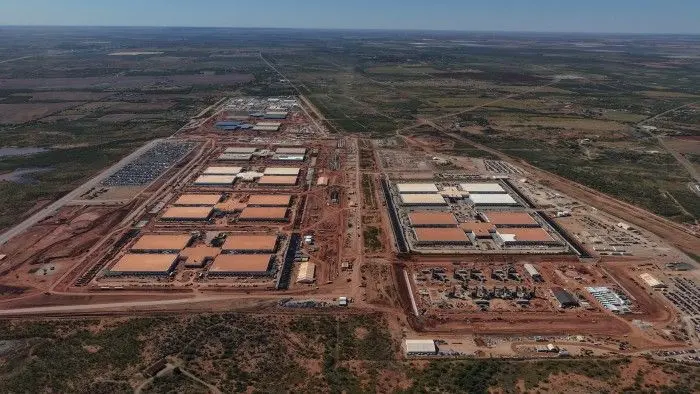
Google acquired Crusoe's troubled Wyoming data center site and will develop the $17 billion AI campus itself. The AI infrastructure firm Crusoe completed pre-development work but failed to secure customers, prompting Google to step in and take direct control of the project in Laramie County.

Google Steps In After Crusoe Struggles
Google has acquired the Wyoming data center site from AI infrastructure firm Crusoe, taking direct control of a project the Denver-based developer struggled to complete
1
. The deal, announced Friday, comes one day after Google pledged a $17 billion investment to build its first data center in Wyoming2
. Neither company disclosed the financial terms of the acquisition, but the transaction marks a significant shift in Google's AI infrastructure expansion strategy.Crusoe, recently valued at $30.9 billion, confirmed it completed the pre-development phase of the data center project, which included site selection, securing government approvals, and developing a power strategy for the computing campus
3
. The eight-year-old company had initially announced the project with Blackstone-backed Tallgrass Energy in July 2025, planning to eventually scale it to 10 gigawatts of power capacity.Why Crusoe Lost Control of the Project
Reports indicate Crusoe faced mounting challenges in delivering the Wyoming data center project on time and within budget. Bloomberg reported in June that Google was pushing Crusoe aside after the developer failed to sign customers for the facility
2
. Google, which Crusoe had tried and failed to land as a customer, raised concerns about project costs and construction timelines under Crusoe's management1
.The deal highlights how difficult it can be for independent data center developers to deliver massive projects given the challenges of securing equipment, compute power, and sufficient power supply. Growing opposition from local communities further complicates development. Voters rejected data centers in 40 of 41 local ballot measures during recent elections, and several newly elected governors have promised to rein in such projects
2
.Google's Partnership Strategy for AI Workloads
Google will now build the facility in Laramie County in partnership with Tallgrass Energy, Black Hills Energy, American Electric Power, and Related Digital
3
. These partnerships will be critical as the company scales power supply for one of its largest planned AI facilities to support AI model inference and other demanding workloads4
.The transaction reflects a broader trend among hyperscalers who increasingly want direct ownership of critical data center assets instead of relying entirely on third-party developers to build and operate them
4
. By taking control, Google can ensure the campus meets its specific requirements for AI infrastructure without depending on external timelines or cost structures.Related Stories

Crusoe's Remaining Pipeline and Customer Base
Despite the Wyoming setback, Crusoe CEO Chase Lochmiller said the company has more than 6 gigawatts of contracted capacity and over 40 gigawatts in its development pipeline
5
. Crusoe is still developing another data center campus for Google near Amarillo, Texas, which it announced earlier this year1
.Crusoe's largest projects serve some of the biggest names in AI. Its campus in Abilene, Texas, is being built in phases for Oracle and OpenAI, and the company is constructing a separate 900-megawatt campus next door for Microsoft, with its first building expected to come online in mid-2027
1
. Meta is also a customer, and Bloomberg reported that trading firm Jane Street signed a $13 billion, five-year cloud deal with Crusoe.The Wyoming deal didn't stop Crusoe from raising a $3.9 billion round in September at the $30.9 billion valuation
1
. Crusoe makes money by leasing data center space to customers that bring their own GPUs, by renting out its own GPUs, and by selling compute power used to run AI models.What This Means for AI Infrastructure Development
The acquisition signals that major tech companies are willing to take on development risk directly rather than wait for third-party providers to deliver critical infrastructure. As AI workloads continue to grow exponentially, control over power supply, construction timelines, and facility specifications becomes increasingly valuable. Watch for other hyperscalers to follow Google's lead in acquiring troubled or delayed projects from independent developers, especially as competition for power capacity intensifies and local opposition mounts across the United States.
References
Summarized by

Navi
[4]
[5]
Related Stories
Crusoe Raises $3.9 Billion to Build Modular AI Data Centers at $30.9 Billion Valuation
18 Sept 2026•Startups

$3.4 Billion Joint Venture to Build Massive AI Data Center Campus in Texas
16 Oct 2024•Technology

Crusoe Secures $1.4 Billion in Funding, Valuation Soars to $10 Billion Amid AI Infrastructure Boom
24 Oct 2025•Business and Economy
Recent Highlights



Recent Highlights
Today's Top Stories






Don’t drown in AI news. We cut through the noise - filtering, ranking and summarizing the most important AI news, breakthroughs and research daily. Follow topics that matter to you and stay ahead.


