7 Sources
[1]
SpaceXAI launches Grok Bot as the agent race moves to office work
The agents sign into your apps, share context with each other and run without APIs, arriving as SpaceXAI and Cursor merge into one company SpaceXAI has launched Grok Bot in beta, AI agents that sign into apps and websites, retain context between tasks and coordinate with each other. Access is limited at first to SuperGrok Heavy, Cursor Ultra and Cursor Teams Premium subscribers, with an enterprise waitlist. SpaceXAI has released Grok Bot, software that hands work to groups of AI agents running on their own machines. The agents sign into apps and websites, keep context between tasks, and pass work back only when they need a human decision. It went into beta on Tuesday. Access is restricted at first to SuperGrok Heavy, Cursor Ultra and Cursor Teams Premium subscribers, with a waitlist for enterprise customers. It runs on macOS, Windows, Linux and iOS, with Android to follow. The selling point is that the agents work through interfaces rather than APIs, signing in the way a person would, and that several can run at once and share what they know. SpaceXAI says it has been using them internally across engineering, growth and marketing, citing overnight sales research, expense receipts pulled out of email, and bug fixes. TNW reported in July that Cursor was building a general-purpose office agent, codenamed Sand, aimed at Claude Cowork and ChatGPT Work. Grok Bot arrives in that same territory, as SpaceXAI and Cursor merge into a single company. SpaceX agreed a $60bn all-stock deal for Cursor's parent Anysphere in June, days after its own listing, in what was reported as the largest startup acquisition on record. Cursor's coding tools already run inside much of the Fortune 500. The product is Musk's answer to having fallen behind in agents. SpaceXAI shipped its first coding agent in May, then followed with Grok 4.5, built with Cursor, in July. Rivals are circling the same idea. OpenAI's Sam Altman discussed agents coordinating with one another when he met lawmakers in Washington last month. Handing sign-in credentials to autonomous software raises an obvious question for this company in particular. Cursor's Grok Build tool was found to be uploading entire Git repositories, committed secrets included. The commercial pressure now sits with SpaceX. Musk told investors on last week's earnings call that AI work was progressing and that Grok 4.6 could ship within days. Grok's slow adoption in Washington has already weighed on the IPO story.
[2]
Grok Bot is xAI's new 24/7 coworker that keeps working while you sleep
Elon Musk's xAI wants Grok to do more than answer questions. Its new Grok Bot can take control of a computer and carry out digital work on its own, even after the user steps away. Each Bot gets a dedicated computer in the cloud, giving it a way to operate software directly. It can work inside the tools where the actual job needs to happen. That makes Grok Bot different from an AI assistant that simply produces text or suggests the next step. It is designed to execute multi-step jobs and return only when it needs human approval. The beta is available on desktop and iOS for SuperGrok Heavy, Cursor Ultra, and Cursor Teams Premium subscribers. Enterprise users can join a waitlist for future access. The biggest technical difference sits beneath the chatbot interface. Grok Bot gains access to its own virtual computer and can interact with applications without requiring an API or MCP connection for every service. That could address a major limitation facing today's AI agents. Many workplace tools were never designed for autonomous software to control them. Grok Bot can instead work through existing interfaces much like a human operator. It can navigate websites, enter information, and continue through a task without waiting for another prompt. The computer-based approach also lets the Bot handle longer chains of work. Instead of stopping after generating a document, it can continue working inside the relevant application. That distinction matters when a task involves several actions that people normally perform manually. xAI says Grok Bot aims to complete those final steps instead of leaving users with an unfinished result. Grok Bot can also operate as part of a larger group of AI teammates. Multiple Bots can work on different parts of the same project while sharing context between them. A group chat can bring several Bots into one project, with one Bot coordinating work between the others. Bots can also pass assignments among themselves without requiring the user to manage every handoff. Grok Bot can learn workflows through demonstrations as well. A person can show a Bot how a task works, after which the system can save that process as a reusable routine. Later corrections can influence how the Bot handles similar work. That could reduce the need to repeatedly explain the same process. Memory gives Grok Bot another layer of autonomy. It can retain information from previous conversations and corrections when returning to unfinished work. The Bot can also follow up when a conversation stalls or an assigned task remains incomplete. xAI says it can become more proactive over time and recognize when human approval is necessary. That changes the user's role from constant operator to supervisor. Instead of repeatedly prompting an AI model, someone can delegate a job and wait for the system to return with the result. For US businesses, the computer-use approach could prove useful because many companies rely on software without dedicated AI integrations. An agent that can operate those interfaces directly would not need every vendor to build a new connection first. Grok Bot remains in beta, so its reliability across complicated workflows will need broader testing. Giving an AI agent its own computer nevertheless pushes Musk's favorite Grok toward a model where AI can perform digital work instead of simply explaining how people should do it.
[3]
Grok Bot is an all-new iPhone and Mac app from SpaceXAI and Cursor
SpaceXAI and Cursor are in the process of becoming a single company, but first, the two firms are releasing an all-new iPhone and Mac app called Grok Bot. According to SpaceXAI's announcement, Grok Bot is a new kind of AI agent described as "AI teammates you can give real work to." Each Bot gets its own computer, then signs into the apps and services you already use to take on work across inboxes and other tools. SpaceXAI says Bots can complete jobs end to end, only returning when approval is needed. You can message one "like a colleague," the company says, and the agent will remember conversations, learn preferences, and improve with more use. Grok Bot launches in beta today on Mac and iOS. Windows and Linux desktop versions are also available. Android is listed as coming soon. Access is initially restricted to SuperGrok Heavy, Cursor Ultra, and Cursor Teams Premium subscribers. You can learn more from the official announcement here.
[4]
Grok Bot Brings Always-On AI Agents to macOS and iOS
Elon Musk's SpaceXAI today announced the launch of Grok Bot, a "team of always-on agents" that can complete tasks using tools, websites, and apps. Grok Bot can work in the cloud, so jobs keep running when your laptop is closed. The feature is tied to Cursor, the AI coding company that SpaceX is acquiring for $60 billion. Grok subscribers can send a message to a bot from their phone or desktop app using natural language. SpaceXAI says that while other tools may require building workflows and routines, Grok Bot gets a task done with a chat. It is able to sign into websites (even those with no API), but SpaceXAI hasn't given details on how authentication works. Multiple bots can be used in parallel, with one managing others and specialists for different tasks. Bots can join a group chat where they can coordinate on their own, passing work, assigning ownership, and only drawing in the user for judgment calls. Users can teach Grok Bot a workflow. It watches as a task is completed, saves the routine, and then can run it solo the next time by following the same steps. SpaceXAI says bots learn over time and can eventually start working "before you need to ask." There are several Grok Bot examples on the SpaceXAI website, like a sales bot updating the CRM with call transcript notes, an ops bot onboarding new hires and processing invoices in Gmail, and an engineering bot reproducing a bug in the product UI, filing a ticket, and handing the fix task off to a debugging bot. Grok Bot is in beta and available for SuperGrok Heavy, Cursor Ultra, and Cursor Teams Premium subscribers on macOS and iOS. Enterprise users can join a waitlist for future access.
[5]
SpaceX's Grok Bot turns agents into persistent digital coworkers that can operate your apps for $120-per-month
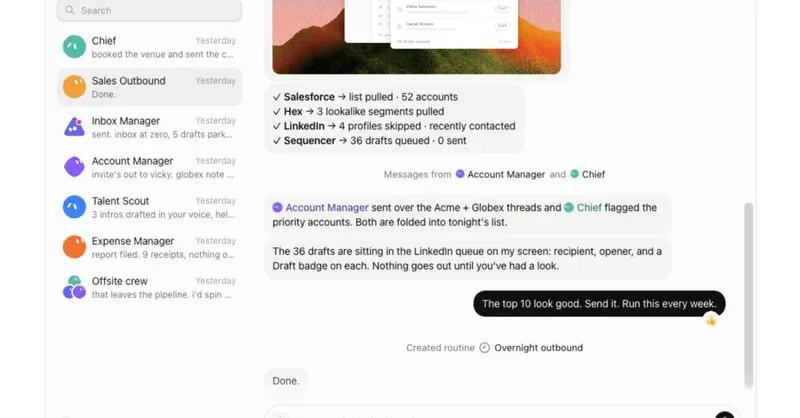
SpaceXAI, the division of SpaceX formerly known as xAI, is launching an early beta version of Grok Bot, a new agent designed to move AI assistants beyond answering prompts and toward continuously executing work across the software employees already use. The central idea is straightforward: instead of opening an AI assistant whenever a task arises, users create persistent Bots with specific jobs, give them access to applications and websites, and delegate work much as they would to a teammate. Each Bot operates through its own computer environment, can continue working when the user's laptop is closed, and can return when it needs approval or has finished the assignment. SpaceXAI says the system began as an internal prototype before spreading across the company, where teams created Bots for sales outbound, marketing campaigns, office operations, bug fixes and other work. The company is now turning that internally developed workflow into a product for external users. "Bots are AI teammates that do real work for you," the company said in announcing the product. "They sign in to your tools, use them just like you do, and come back with finished work." The company did not release benchmarks for Grok Bot's performance on agentic tasks. And it arrives amid an increasingly crowded marketplace of first-party AI agents that attempt to reliably complete real, enterprise workflows by interfacing with a user's other applications and devices. Anthropic introduced computer use for Claude in 2024, allowing models to inspect screens and operate interfaces through mouse and keyboard actions, and continued expanding with the launch of the developer focused Claude Code harness in early 2025 and the more non-technical, white collar focused Claude Cowork agent early this year. Meanwhile, OpenAI gave its Codex harness the ability to control other computer apps in April, launched agentic Workspace Agents that can also connect to third-party applications and use them autonomously, and recently debuted a new ChatGPT Work environment for longer, multi-step tasks and finished deliverables. Grok Bot seeks to join the party with its own management model for agents: persistent workers with responsibilities, memory, learned routines and the ability to hand work to one another. Pricing and availability: Grok Bot starts at $120 per seat per month for teams, $200 per month for individuals Grok Bot is available beginning today, August 11 in beta for SuperGrok Heavy, Cursor Ultra and Cursor Premium Teams subscribers (recall SpaceX acquired Cursor for $60 billion back in June). The product arrives for macOS, Windows, Linux and iOS, with Android listed as coming soon. According to its product page on xAI.com, Grok Bot is included with Cursor Ultra at $200 per month for individuals. The plan includes a computer for Grok Bot, access to users' tools, scheduled routines, desktop and mobile operation, and extended AI-token limits. For organizations, Cursor Premium Teams costs $120 per seat per month and adds centralized billing and settings, a team marketplace for skills and plugins, shared usage analytics and SAML/OIDC single sign-on. Existing SuperGrok Heavy ($300 per month) subscribers also receive access. However, for organizations wishing to sign up today, SpaceXAI is directing them to a waitlist for future access. Those prices make Grok Bot a substantially different purchasing decision from a low-cost general AI subscription. The economic question for companies will be whether persistent Bots can replace enough manual work or conventional automation infrastructure to justify the per-user cost -- and how usage limits affect total cost once agents begin running continuously. From prompting an AI to managing one SpaceXAI describes Grok Bot as a team of "always-on agents." Users can create multiple Bots, assign each a role and let them work simultaneously. The company provides examples including Sales Outbound, Talent Scout, Paid Media, Expense Manager, Product Performance, Bug Reproduction, Account Health and Chief of Staff. A sales Bot, for example, can research accounts, score prospective contacts, prepare email and LinkedIn outreach in the user's voice, and assemble the results for human approval. Promotional materials show SpaceXAI using the system internally for substantially longer chains of work. One sales Bot can add call-transcript notes to a CRM and draft follow-up messages. An operations Bot can seat new hires and process invoices arriving through Gmail. An engineering Bot can reproduce a bug in the product interface, file a ticket and then hand the repair to a debugging Bot. The architecture could make Grok Bot particularly relevant for workflows that span systems that were never designed for AI automation. Rather than requiring every application to expose an API specifically for an agent, Grok Bot can sign into applications and websites and operate their interfaces. SpaceXAI says Bots have their own computers and can continue working 24/7. The company explicitly says this includes websites and applications that have "no clean API or MCP," an important distinction for enterprises with legacy software, fragmented SaaS environments or internal systems that have never been instrumented for agent access. Instead of limiting automation to formally integrated services, Grok Bot is designed to work through the same software interfaces a human employee would use. The company says early users are already applying Bots to jobs including vendor negotiations, e-commerce customer support and continuously updating CRM systems. Another feature attempts to reduce the engineering required to automate repeatable business processes. Users can demonstrate a workflow while a Bot follows along. Grok Bot can then save the process as a routine and execute it later without requiring the user to reproduce every instruction. SpaceXAI says the Bot can also incorporate corrections into those learned routines, allowing the workflow to change as the user teaches it how a particular process should be handled. That potentially changes the deployment model from explicitly programming an automation to teaching an agent how an employee performs the job. The company is also claiming a more persistent form of behavioral memory than simply retaining a chat transcript. According to the launch announcement, Bots remember prior conversations, learn preferences such as a user's writing voice and edge cases, and gradually learn when they should interrupt for approval versus continue independently. SpaceXAI says they can later resume dropped threads, nudge stalled handoffs and pick up work from earlier conversations. It further says Bots can become proactive over time, sometimes identifying work before the user explicitly asks for it. That is a more ambitious claim than conventional scheduled automation and will put additional pressure on permission controls and escalation rules if the system is deployed against production applications. Bots can delegate work to other Bots Grok Bot also supports multiple agents operating together. Users can place several Bots into the same thread, where the agents can pass work between one another. The company's demonstration includes specialized Research, Communications, Chief of Staff and Travel Bots coordinating tasks. SpaceXAI says those Bots can independently message one another and share context within threads. Users can also put multiple Bots into a group conversation where they assign ownership, transfer work and coordinate among themselves, bringing the human back in primarily for judgment calls. Internally, the company says employees sometimes place a Chief of Staff Bot above specialist Bots responsible for functions such as inbox management, recruiting, expenses, operations and bug fixes. That makes the product's orchestration model more explicit: the user does not necessarily have to serve as the routing layer between every specialized agent. Initial reactions are extremely positive Lenny Rachitsky, host of the popular vlog and podcast Lenny's Podcast and author of newsletter Lenny Letter, received early access to Grok Bot and loved using it. As Rachitsy wrote on X : "I haven't been this excited about a new AI product in a while. It's like OpenClaw, but super easy, reliable, and less scary to use. I think this will be a huge new product line for Cursor/Grok/SpaceX." Similarly Matt Shumer, an AI entrepreneur who said he tested Grok Bot for several weeks before launch, highlighted this orchestration as one of the product's strongest features. "The best way I can describe it is an agent for everything, not just code," Shumer wrote on X. In one test, Shumer said he created separate researcher and writer Bots, then created a Chief of Staff Bot and instructed it to coordinate the other two on a project. He expected the workflow to break down. "It worked out of the box," he wrote. His main criticism involved model selection. Unlike systems where developers or advanced users explicitly select the underlying model, Shumer said Grok Bot automatically routes tasks to models on the backend. "You don't choose a model for your Grok Bot," he wrote. "It's all done automatically on the backend." Shumer said the model router "wasn't great" during his testing, although he said he was subsequently told it had improved. SpaceXAI's expanded announcement still does not identify which underlying models the router uses, nor does it document a mechanism for users to select, pin or switch to a particular xAI or third-party model. As a result, the model layer remains largely abstracted from users in the publicly supplied launch material. That abstraction represents an important tradeoff for enterprise deployments. Automatic routing can remove a significant configuration decision for ordinary employees, but advanced users may want explicit control over model cost, latency, reliability and behavior -- particularly for repeatable production workflows. The agent market is moving toward longer-running work Grok Bot enters a market increasingly focused on agents that can do more than generate text or code. Anthropic's computer-use capability established a mechanism for Claude models to interact with software through screenshots, cursor movements, clicks and typing. Its broader Claude product also connects with workplace services and remote MCP servers. OpenAI, meanwhile, now describes ChatGPT Work as an agent for "longer, multi-step work and finished deliverables," while keeping Codex focused specifically on software development. OpenAI's enterprise agent economics can also incorporate usage-based credits, making task complexity and token consumption part of deployment cost calculations. Grok Bot's differentiation is therefore less about proving that AI can operate software than packaging computer use, persistence, workflow learning and multi-agent coordination into something resembling a workforce interface. SpaceXAI's announcement sharpens that distinction by emphasizing completion rather than assistance. One company product employee, identified only as Roman, describes the difference as closing the gap between work that is nearly finished and work actually completed inside the destination application: "Grok Bot can finish the swing, because the work lands where a human would put it, in the actual tool." That distinction will ultimately depend on reliability. A chatbot producing a bad answer creates a correction problem. An autonomous agent operating CRM records, support queues, vendor conversations or other production systems can create an operational problem. Grok Bot's success will therefore depend not only on model intelligence, but also on permissions, predictable execution, escalation behavior, memory accuracy and how reliably agents recognize when human approval is necessary. That challenge becomes more significant if Bots act proactively, resume forgotten work and coordinate with one another without the user serving as an intermediary. Those capabilities reduce the amount of supervision required when they work correctly, but they also expand the consequences of an incorrect assumption, stale context or improperly scoped permission. The interface may matter as much as the models Shumer described the product's interface as feeling like iMessage, an intentionally familiar metaphor for a system whose underlying architecture -- autonomous computers, persistent memory, agent orchestration and automatic model routing -- could otherwise be difficult for nontechnical users to configure. SpaceXAI makes essentially the same usability argument in its launch announcement. Rather than asking users to construct workflows before getting started, it says users can simply message a Bot from a phone or desktop, hand it work and later continue the same conversation from either device. That simplicity is part of the product strategy. Grok Bot is trying to hide much of the conventional machinery of automation -- workflow builders, explicit integrations, agent routing and orchestration -- behind an interaction model that resembles messaging a coworker. That may prove to be the larger bet behind Grok Bot. The AI industry has spent several years making models increasingly capable of using tools and completing multi-step tasks. Grok Bot attempts to turn those capabilities into an organizational abstraction people already understand: give someone a job, teach them how you work, and let them coordinate with the rest of the team. If that abstraction proves reliable, the enterprise agent competition may increasingly shift away from which assistant produces the best individual response and toward which platform can most reliably manage fleets of agents performing ongoing work.
[6]
Grok Bot wants to take work off your plate, not just answer your queries
SpaceXAI and Cursor's new Grok Bot app treats AI as a working teammate. SpaceXAI and Cursor just released Grok Bot. It's built around AI agents called Bots or "teammates," if you will. Designed to complete real work and only check in with you when something is in the final phase and needs your approval, Grok Bot is currently available in beta on Mac, iOS, Windows, and Linux. An Android version, as well as an enterprise version, are coming soon. So what does Grok Bot actually do? The pitch is quite simple. You can create different Bots and give them different tasks, as you would otherwise delegate to a teammate. Then, they take care of the entire project from start to finish. Recommended Videos Suppose you have four different streams of tasks at the start of a day, you can assign them to four different Bots inside the app or the web version. Each Bot runs on its own dedicated computer (a dedicated virtual workspace) and can log into whatever apps and services you already rely on (such as email, messaging, project management software, etc). It works across your inbox and other connected tools rather than staying boxed inside a single chat window like regular AI chatbots, only surfacing to check in with you when it needs a decision or approval. You can also ask a Bot to follow along as you're completing a task on the screen, save it as a routine, and then perform it on its own, or put multiple Bots in the same workflow and ask them to collaborate on a task. SpaceXAI says it remembers past conversations (or has a memory) and picks up your preferences or working style over time. Who gets access? Early examples shared by the Grok Bot team include negotiating directly with vendors using your own voice, handling customer support for an online store, and keeping a CRM updated automatically without anyone manually entering data. For now, access is limited to SuperGrok Heavy ($300 per month), Cursor Ultra ($200 a month), and Cursor Teams Premium ($120 per seat per month) subscribers. In short, this isn't reaching a general audience just yet. Grok isn't the only one to have launched something like that. We already have ChatGPT Agent, Claude Cowork, and Perplexity Computer all racing toward the same service: agentic outsourcing.
[7]
SpaceXAI launches Grok Bot AI teammates for business tasks By Investing.com
Investing.com -- SpaceXAI announced Tuesday the release of Grok Bot, an artificial intelligence tool designed to complete work tasks independently across multiple applications. The company said Grok Bot operates on its own cloud-based computer and can access tools, applications, and websites to complete assigned tasks from start to finish. The system returns to users only when approval is needed. Users communicate with Grok Bot through messaging, similar to texting a colleague. The system stores conversation history and adapts to user preferences over time. SpaceXAI developed Grok Bot as an internal prototype before releasing it to external users. The company said its teams used the tool for sales outreach, marketing campaigns, office operations, and bug fixes. Grok Bot is available in beta for SuperGrok Heavy, Cursor Ultra, and Cursor Teams Premium subscribers on desktop and iOS platforms. Enterprise users can join a waitlist for future access. The system allows users to run multiple bots simultaneously, with one bot managing others. Bots can message each other independently and share information in threads. Users can also place bots in group chats where they coordinate tasks without user intervention. The tool includes a feature that allows bots to learn workflows by observing users complete tasks. The system saves these workflows as routines for future use. SpaceXAI employees have used Grok Bot for tasks including updating customer relationship management systems with call notes, processing invoices from Gmail, and reproducing software bugs in product interfaces. This article was generated with the support of AI and reviewed by an editor. For more information see our T&C.
Share
Copy Link
SpaceXAI released Grok Bot in beta, introducing AI agents that operate independently across applications and websites. Each agent gets its own cloud computer, signs into tools like a human would, and coordinates with other agents to complete multi-step workflows. Available for SuperGrok Heavy and Cursor subscribers at $120-per-month for teams.
SpaceXAI launched Grok Bot in beta on Tuesday, marking its entry into the competitive AI agents market with software designed to function as persistent digital coworkers
1
. The autonomous AI agent operates through its own cloud-based computer, signs into applications and websites without requiring API connections, and continues working even when users close their laptops2
. This release arrives as SpaceXAI and Cursor merge into a single company following SpaceX's $60 billion all-stock acquisition of Cursor's parent company Anysphere in June, reported as the largest startup acquisition on record1
.
Source: 9to5Mac
Access is initially restricted to SuperGrok Heavy, Cursor Ultra, and Cursor Teams Premium subscribers, with enterprise customers joining a waitlist for future access
3
. The platform launches on macOS, Windows, Linux, and iOS, with Android support listed as coming soon4
.Grok Bot represents a shift from prompt-based AI assistants to agent-based systems that execute work autonomously. Each Bot receives a dedicated computer environment in the cloud, giving it the capability to operate software directly and interact with applications through existing interfaces rather than waiting for vendors to build new integrations
2
. This computer-use approach addresses a limitation facing many AI-driven automation tools, as numerous workplace applications were never designed for autonomous software to control them2
.The system can sign into websites and applications the same way a person would, even those with no API, though SpaceXAI has not provided detailed information on how authentication works
4
. Users communicate with Grok Bot through natural language commands, delegating work much as they would to a teammate5
. The agents retain context between tasks, remember conversations, learn preferences, and improve with continued use3
.Multiple Bots can work simultaneously on different parts of the same project while sharing context between them
2
. These AI teammates can join group chats where they coordinate independently, passing work assignments and ownership among themselves, only drawing in users for judgment calls4
. One Bot can manage others, with specialists assigned to different tasks within multi-step workflows4
.
Source: Digital Trends
Users can teach Grok Bot to automate office workflows through demonstrations. The system watches as a task is completed, saves the routine, and can then run it independently by following the same steps
4
. Later corrections influence how the Bot handles similar work, reducing the need to repeatedly explain the same process2
. SpaceXAI says Bots can become more proactive over time and eventually start working before users need to ask4
.SpaceXAI has been using Grok Bot internally across engineering, growth, and marketing teams, citing use cases including overnight sales research, expense receipts pulled from email, and bug fixes
1
. The company provides examples of agents configured for specific roles: a sales Bot updating CRM systems with call transcript notes, an operations Bot onboarding new hires and processing invoices in Gmail, and an engineering Bot reproducing bugs in the product interface, filing tickets, and handing repair tasks to a debugging Bot4
.These examples demonstrate how Grok Bot can autonomously perform digital tasks across systems that were never designed for AI automation
5
. For US businesses relying on software without dedicated AI integrations, an agent that operates interfaces directly would not need every vendor to build new connections first2
.Related Stories
Grok Bot is included with Cursor Ultra at $200-per-month for individuals, while Cursor Premium Teams costs $120 per seat per month for organizations
5
. Existing SuperGrok Heavy subscribers at $300 per month also receive access5
. These prices position Grok Bot as a substantially different purchasing decision from low-cost general AI subscriptions, with the economic question for companies being whether persistent Bots can replace enough manual work or conventional automation infrastructure to justify the per-user cost5
.Grok Bot enters an increasingly crowded marketplace of AI agents attempting to reliably complete enterprise workflows. Anthropic introduced computer use for Claude in 2024 and launched Claude Cowork for white-collar work earlier this year, while OpenAI gave Codex the ability to control computer apps in April and recently debuted ChatGPT Work for multi-step tasks
5
. OpenAI's Sam Altman discussed agents coordinating with one another during meetings with lawmakers in Washington last month1
.Handing sign-in credentials to autonomous software raises security concerns for this company in particular. Cursor's Grok Build tool was previously found uploading entire Git repositories, including committed secrets
1
. As Grok Bot remains in beta, its reliability across complicated workflows will need broader testing2
. The commercial pressure now sits with SpaceX, as Musk told investors on last week's earnings call that AI work was progressing and that Grok 4.6 could ship within days1
.Summarized by
Navi
[2]
[4]
1
Technology

2
Science and Research

3
Technology