7 Sources
[1]
Halliday's New Smart Glasses Skip the Camera
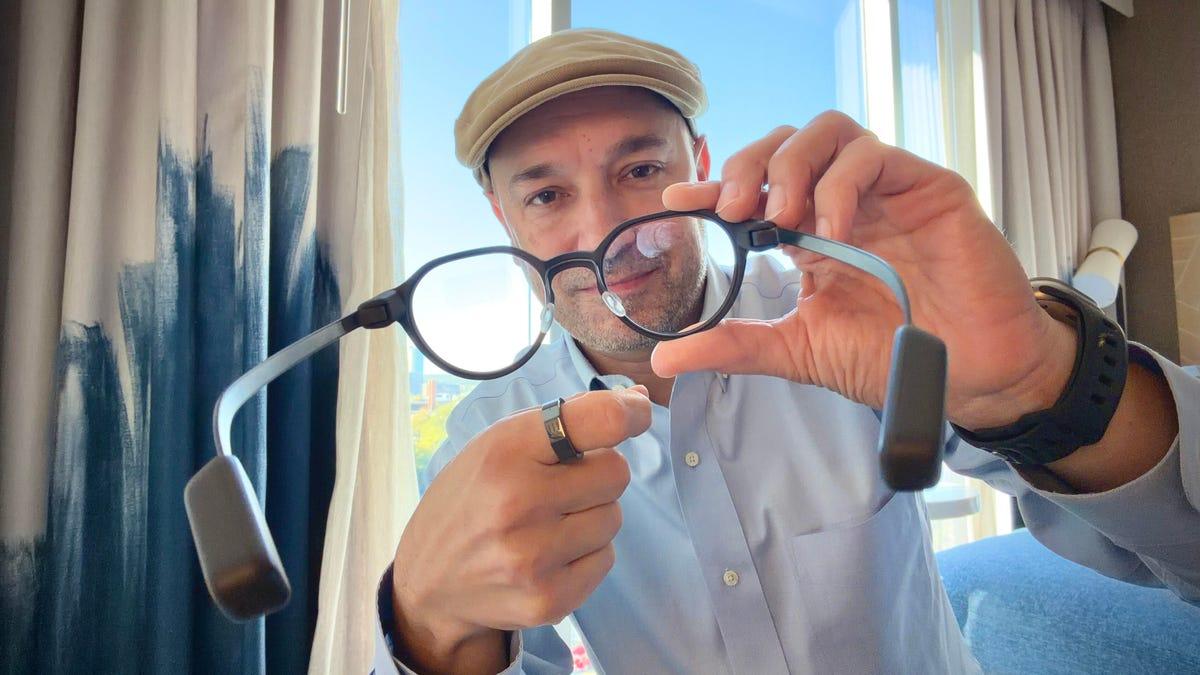
There's a new pair of camera-less smart glasses in town: the Halliday G2, designed to listen to workplace meetings, absorb what happens, and summarize all the interesting bits, much like always-listening wearables. Halliday says the mics can be turned on for meetings, using AI voice commands, or making phone calls, but switch off when not in use. They're normal-ish looking glasses, meant to blend into a professional environment, namely by not having cameras on them. They cost $599, with first shipments planned for September 2026. There are paid subscription tiers for the AI services that range from $10 per month to $99, but users can choose a free tier that offers 120 minutes of recording time. Halliday's glasses might not be met well by one of its competitors. Smart glasses brand Even Realities launched its G2 glasses late last year, proudly focusing on the lack of cameras in its eyewear; Halliday's G2 shares the same name and channels the same mantra, not to mention a striking resemblance. (In both cases, G2 is short for Generation 2, so it's indicating the stage of the device, not necessarily a specific brand name.) Building smart glasses without cameras seems to be growing more popular. The market is still dominated by Meta's Ray-Ban smart glasses, even though those have garnered the "pervert glasses" moniker because the device's built-in cameras have been abused to capture pictures and video of people (mostly women) without them realizing it. Eager to differentiate, some companies have shipped ways to cover up their cameras, or, like Even Realities and now Halliday, are skipping them entirely. Still, those glasses are all-in on recording the audio around you. In its press release, Halliday says that unlike smart glasses with cameras in them, the G2 is meant to be "a professional tool for real-world work and social environments. With no camera, the glasses are better suited for meetings, client conversations, secure workplaces, and other spaces where recording devices may be unwelcome." That acknowledgement aside, Halliday's G2 glasses do not have an indicator light or other method to inform people around the wearer that the glasses are recording audio. Wearable devices like Bee's Pioneer emit a light to indicate they are recording, though the device is so obscure that most people may still not realize. "The user should disclose to the room that the recording is in progress, as it is required by any other recording device," wrote a Halliday media contact in response to questions from WIRED. The G2s are the second iteration of Halliday's glasses. The company introduced its first pair at CES 2025, which received mixed reviews and wound up in the "Don't Bother" category of WIRED's smart glasses guide. They have also garnered criticism on sites like Reddit and had to field lots of frustration on the original Kickstarter-backed version of its device. Halliday is back for round two, aiming to boost the specs -- and the price -- of its previous offering. The G2 glasses are aimed squarely at "high-performance professionals" like founders, CEOs, or really anyone with enough disposable cash to cop a pair of $600 glasses for their meetings. The glasses have a display field toward the top of the lens, meaning the wearer can look up to see text on the screen. Microphones embedded in the frame listen to what's happening nearby and can translate spoken language into text subtitles right in the wearer's field of vision. It's a handy use case that, in theory, can be a great tool for helping hard-of-hearing or deaf people capture conversations. Halliday says the display can also handle translation in 45 languages and notifications for messages and phone calls. Halliday's focus for its G2 glasses is on the meeting room. Like a bevy of other AI-powered note-taking devices, the goal is to have a device that can listen in and track all the details your coworkers are going on about. It's powered by the company's AI recording and transcription service, called Meeting Flow. The mics on the glasses listen in on a meeting, and then the AI helps organize and summarize what people are saying. Some of those insights will pop up on the display so the wearer can see them mid-meeting. After the meeting ends, Meeting Flow aims to summarize, transcribe, and pull out what it figures are the most pertinent topics from the conversation. Halliday says the AI is specifically focused on the important bits of a meeting, keeping track of the topics even if people wander off course. Features called Thread Tracker, Decision Confirmation, and Commitment Check aim to sort the useful stuff into an overall view of what was said. Full transcripts and post-meeting summaries are available in a companion app. There are features built into the device to make it blend into the background, like a "Stealth mode" that automatically reduces the display's light in dark rooms so as not to distract the wearer or others around. A teleprompter mode called Cheatsheet keeps bullet-point-style reminders of what the AI deems important details of your day on the screen for easy access. (Anduril founder Palmer Luckey has said he has used a similar function in Even Realities' G2 glasses to help him stay on track during a TED talk.) The smart glasses market is getting more refined, with smaller companies entering the second iteration of their product lifecycles. They're aiming to establish some foothold before the giant tech companies, like Samsung, Google, and Apple, move in and sweep up most of the market.
[2]
Halliday's latest smart glasses feature a much-improved display
I first slipped on Halliday's original smart glasses at CES 2025. I was not a fan. The glasses had a tiny, movable display window embedded into the frame that was incredibly finicky to see, and my 30-minute demo left me with achy eyeballs. It was an interesting concept with terrible execution, especially compared to the several other smart glasses on the show floor. So I was skeptical when a few weeks ago, Halliday reached out to say its second attempt at smart glasses was much better. Well, having tried the Halliday Gen 2, I'm happy to report these are better glasses. That secret display window is gone, replaced by more traditional but discreet waveguides. They're not like the Meta Display's nigh-invisible screens. You can still spot the reflection if angled just right, but they're considerably easier to see. And inside of a single-lens display, the Gen 2 has one for each eye, giving you a much larger screen to look at. Spec-wise, the Gen 2's displays are monochrome green, with a maximum brightness of 1,600 nits and 600 by 300 pixel resolution per eye. On my face, the Gen 2 has a nondescript design but is very lightweight compared to other display glasses I've tried. The display was also easily visible inside a dark bar, though I didn't get a chance to see how it'd fare in direct sunlight. The four-mic array was able to pick up commands despite the ambient noise, and Halliday told me that it gets about 12 hours of typical use. That's partly because these aren't camera glasses. The exclusion of the camera was a deliberate choice, both for privacy and to extend battery life. That's because these are more so meant to be a tool for work meetings. With the Gen 2, Halliday is launching a feature called Meeting Flow. It's meant to help you follow along in a conversation, using AI to surface context or facts without needing to look at your laptop or phone. I've seen this in other smart glasses to varying degrees of success. (Mostly non-success.) More interesting are the so-called Thread Tracker, Decision Confirmation, and Commitment Check features. The idea is to provide real-time updates about what decisions have been made in a meeting, what items need following up on, and a visualization of a meeting's overall conversation flow. For example, Thread Tracker might show that a team meeting started off talking about budget allocations, before moving on to potential new hires and timelines for those hires. Decision Confirmation might show that the meeting concluded that all new hires should be finished by a specific date. Lastly, Commitment Check verifies if action items have been assigned (and to whom) with a clear deadline. The glasses will also provide post-meeting transcripts and summaries. I saw a brief glimpse of what this could look like at my demo, albeit a product interview is less conducive to these kinds of features than a typical planning meeting. That said, the glasses also support more general-use AI features like captioning, real-time translations for over 45 languages, the ability to take phone calls, and teleprompters/notecards for public speakers. Users can also make use of the Halliday AI assistant for voice control. Overall, this is a much more tightly focused vision for a pair of smart glasses than Halliday's original glasses. That said, we'll have to see if the AI features are all that useful. So far, I've had little success with AI wearables successfully intuiting what I actually need surfaced in a conversation, or deriving the correct conclusions for to-do items. And at $599, the Gen 2 comes with a pretty steep price tag for the average person. That's not including any extra costs for prescription lenses. (Halliday claims it'll be able to handle my prescription, which is -10 in one eye and -8.75 in the other with monster astigmatism. We shall see!) The Halliday Gen 2 are available for preorder starting today with a $10 deposit and a subsequent $100 discount on the final price. The glasses are expected to ship in September.
[3]
Halliday's camera-free G2 smart glasses bet on meetings
Last year Halliday made what several reviewers called the worst smart glasses of 2025. Now it is back with a second pair, and the pitch has flipped: no camera, no gimmicky ring, and an AI aimed squarely at your work meetings. The early verdict is that it has fixed the worst of it. It is rare that a crowdfunded hardware startup gets a second shot at a first impression. Halliday is taking it. The company unveiled the G2 on Tuesday, priced from $499, shipping in September. A brutal first act The original glasses were panned. Engadget scored them 54 out of 100, one of the lowest marks in its history. Android Police gave 5 out of 10 and called them a "buzzword-laden curiosity." The culprits were a fiddly projector display mounted by your eye, tinny speakers, and a laggy control ring. Chief operating officer Carter Hou owns it. He told Engadget the company made "many mistakes," and has since rebuilt its engineering and supply-chain teams. What changed The G2 drops the tricks. The projector is gone, replaced by waveguide displays, one per eye, at 1,600 nits. The much-hated ring is gone too, swapped for a touchpad on the arm. So is the fussy charging port, and there is still no camera, by design. The early hands-ons are kinder. The screen is easier to see, and a four-mic array caught commands in a noisy bar. The Verge, no fan of the original, now calls the G2 "better glasses." The real pivot: meetings The bigger change is the point of the thing. Halliday has aimed the G2 at work meetings. Its Meeting Flow runs AI agents live during a conversation: one tracks threads, another flags decisions, a third nudges you for commitments before everyone leaves the room. A summary lands in the app afterwards. Hou's argument is that rivals like Plaud only help after the meeting. Everyday features round it out, including translation in 45 languages, a "Hey Halliday" assistant, an auto-scrolling cheatsheet, calls, and music. The catches Two stand out. The best features run on credits, from a free tier up to $99 a month, echoing the subscription creep across wearables and smart glasses. And a headset that transcribes every meeting raises the same questions as any always-listening device, camera or not. Then there is the startup risk. Halliday wants a $10 deposit now and the rest on shipping, the same crowdfunding model that left first-generation backers waiting. Whether a screen-free, AI-first pair of glasses finds a real job, rather than another buzzword bingo card, is what the G2 has to prove.
[4]
These camera-free smart glasses want to give you a secret advantage in meetings
The Halliday G2 is available for initial pre-sale today with a $10 refundable deposit for a $100 discount off the $599 retail price. Full shipments and prescription options launch in September 2026. While we've seen early concepts like the original Pip-Boy-esque Halliday AI glasses show off what micro-display tech could do, the smart eyewear market has overwhelmingly trended toward camera-toting frames. Today, Halliday has announced the Halliday G2, a new pair of lightweight AI smart glasses equipped with a binocular waveguide display, designed to put live meeting intelligence right in your field of view while still skipping the camera hardware entirely. The Halliday G2 trades in its predecessor's single-eye near-eye display for an upgraded binocular waveguide optical system. The setup uses dual micro-LED projectors capable of reaching up to 1,600nits of peak brightness, with a 600 × 300 resolution per eye. Placed in the upper field of view for quick glanceability, the display features auto-dimming functionality for darker environments. To capture meeting room audio, the frame of the Halliday G2 glasses packs a four-microphone array offering up to two-meter voice recognition. Halliday also targets a total frame weight of under 50g, alongside a battery life of over 12 hours in typical use. By deliberately omitting a camera, the G2 avoids workplace privacy restrictions that could be a big problem for upcoming rivals like Meta's experimental "super sensing" frames or Samsung's leaked Galaxy Glasses design. It also offers a lighter form factor that is comfortable to wear for longer and improves battery life. The centerpiece of the Halliday G2's software experience is "Meeting Flow," an AI feature set designed to deliver heads-up, contextually relevant data during live conversations. The software claims to offer live translation (in over 45 languages), quick research lookups, and captioning. To help guide discussions, tools like Thread Tracker, Decision Confirmation, and Commitment Check surface unresolved topics and confirm action items before a meeting closes. Afterwards, the companion app automatically generates post-meeting transcripts and structured summaries. Outside of meetings, the G2 claims to offer daily utility features including phone call handling, music playback, notification cards, a "Cheatsheet" teleprompter mode, and hands-free interaction via the "Hey Halliday" wake word for the Halliday AI Assistant. The Halliday G2 is available for "initial pre-sale" starting today directly on Halliday's official store. Early buyers can reserve a pair with a refundable $10 deposit, which unlocks a $100 discount off the final $599 retail price. Full retail shipments and prescription lens options are scheduled to launch in September 2026.
[5]
Halliday G2 smartglasses skips the camera for something better, in-lens displays
Halliday, the brand behind the unusual Halliday Glasses smartglasses released last year, is back with its second generation product called the Halliday G2. Rather than targeting the ongoing success (and controversy) of the Ray-Ban Meta, the Halliday G2's have the Even Realities Even G2 in its sights, sharing both the name and its headline AI feature. A new display The first Halliday smartglasses used an unusual display type it called the DigiWindow, which sat on the upper part of the frame and housed a tiny display where you could see basic information. It was a clever idea, but in reality it was difficult to see and even harder to optimize. For the Halliday G2 it has switched to a binocular waveguide display and dual micro-LED projectors, putting 600 x 300 pixel displays in each lens with a 1,600 nit brightness. Like the Even G2, the Halliday G2 doesn't have a camera, ensuring they won't run into privacy problems related to the feature, and are lighter than models with one too. Halliday's targeting a weight below 50 grams with the lenses. A workplace AI feature Without a camera, the Halliday G2's headline feature uses AI, and it'll be familiar to anyone who has used the Even Realities Even G2. It's called Meeting Flow, and follows meetings and discussions, identifies action points, and creates to-do lists afterward. While similar to the Even G2's Conversate feature, it does build on the Proactive AI feature seen in the original Halliday Glasses, but this time focused on business activities rather than general conversation. Halliday co-founder and COO Carter Hou said: The stylish Halliday G2 AI Glasses deliver discreet intelligence into the conversation itself, channeling the flow of information into real-time display cards that appear in front of people's eyes so they can stay focused, recall what matters, respond with confidence and become more informed, natural conversation connoisseurs wherever the day takes them. The feature will show captions for the conversation on the screen, perform quick research in real time, help gain context in the event of a break, and then provide advice on decisions that have been taken, action points, and any unresolved items. Like Even Realities Conversate, it's a very specific feature, and it won't prove useful to everyone. It'll be interesting if Halliday's AI manages to elevate Meeting Flow beyond Conversate or not. Other Halliday G2 features In addition to the Meeting Flow feature, the Halliday G2's micro-LED display will show notifications, different dashboard cards, and reminders, plus the AI will provide translation from 45 different languages, and access to the Halliday AI assistant. One interesting feature is Stealth mode, which dims the brightness of the display so it won't be noticeable in low-light surroundings. Halliday has decided not to bring back the smart ring it offered with the original Halliday Glasses. Even Realities does offer the Even R1 smart ring with the Even G2 smartglasses, but while it's a good idea, in reality the control method isn't always ideal. The Halliday G2 have hands-free voice activation, and can be used for phone calls too. How much will the Halliday G2 cost? The Halliday G2 will be available to pre-order from July 21 with an expected price of $599 when they're released in September. Those who place a $10 deposit will get a $100 discount on the final price. The cost does not include prescription lenses, which can be ordered at an extra cost.
[6]
I went hands-on with the Halliday G2 -- the smart glasses made for meetings
Are smart glasses too ... smart? Rather than creating a jack-of-all trades pair of specs, the new Halliday G2 smart glasses are aimed at one thing: Making your meetings more focused and productive. To that end, these glasses don't have a camera, but instead a set of mics and an AI that can act as your assistant to look up data, create action items, and help keep people accountable. I went hands-on with the Halliday G2 a few weeks back and here's everything they can do, as well as my initial impressions on how they compare to the best smart glasses. Price and availability The Halliday G2 will cost $599 (the same price as the Even Realities G2, but $200 less than the Meta Ray-Ban Display), and is expected to ship in September. Preorders begin today (July 21) at www.hallidayglobal.com; those who secure a preorder with a $10 deposit will get $100 off the regular price of the glasses. The G2s will be available with prescription lenses. Design and display While the Halliday G2 has a display, it feels a lot more stripped-down than the Meta Ray-Ban Displays or the Snap Specs, but that's by design. For one thing, there's no camera. In addition to making the glasses simpler, it was also done to put others at ease, company reps told me. (They can record audio, but still.) While the G2 has a built-in display, it's much more basic than what you'll find on the Meta Displays, and more like that on the Even Realities G2 or Rokid Glasses: a green, monochrome readout. Unlike the first-gen Halliday, the G2's display is brighter and clearer, and appears virtually in front of both your eyes, rather than on just the right side. The image appears to hover a few feet in front of you, which made it much more natural to look at when holding a conversation with others. The G2's feature dual micro-LED projectors with a resolution of 600 x 300 in each eye, and a peak brightness of 1,600 nits. I wore the G2's for a few minutes during a hands-on session, and found them to be as comfortable as the Ray-Ban Metas, as well as my regular non-smart glasses. The G2's weigh under 50 grams, which put them in the same tier as the Ray-Ban Meta (51 grams), the Rokid Glasses (48 grams), but heavier than the Even Realities G2, which weigh just 35 grams. A touchpad on the right temple lets you navigate the G2's interface with swipes and taps; it'll take some practice to get the hang of things. Similar to most smart glasses, the Halliday G2s can also deliver notifications, phone calls, play music, and let you use the Halliday AI Assistant. Made for meetings The biggest differentiator between the Halliday G2 and other smart glasses is its focus on making meetings more productive. To that end, its biggest feature is called Meeting Flow, which has several facets: * Understanding the conversation (literally): The glasses support real-time translation in over 45 languages, and can pick up voices using its 4-mic array, which work in up to a 2-meter radius. * Quick Summary: If you lose focus or get distracted, the glasses can catch you up on what was just said. * Quick Research: If you need to look up a fact or information, Meeting Flow can dig up relevant information based on the conversation taking place at the time of your query. * Thread Tracker: Often, conversations can drift off on tangents; this feature tracks how things evolved, so you can get back to the original subject. * Decision Confirmation: This helps make sure that if something was decided, it gets remembered, and also prompts the G2 wearer if something was left open-ended. * Commitment Check: If someone in the meeting says they're going to do something, this feature will prompt the wearer to not only confirm that, but also give the person the information they need to complete the task. * Open-item tracker: If things are left unresolved, this feature will make note of them, and put them in a checklist. * Summary and transcript: Like all other AI assistants, Meeting Flow will create a summary and transcript of the meeting. Outlook At a time when there's a lot of concern around privacy and smart glasses -- just look at the issues around Meta's smart glasses -- the idea of having a camera-free set of specs will no doubt be appealing to many. The idea of having a set of smart glasses hyper-focused around a particular activity could appeal to those who spend a lot of time in meetings, and need a smart way to not only make them more productive, both during and after the fact. However, I have no doubt that many will look to the broader appeal of the upcoming Samsung smart glasses (and other Android XR devices), which could cost around the same, but offer more functionality. We'll reserve our final judgment until September, when the Halliday G2 glasses -- and Meeting Flow -- rolls out. Follow Tom's Guide on Google News and add us as a preferred source to get our up-to-date news, analysis, and reviews in your feeds. Subscribe to Tom's Guide on YouTube and follow us on TikTok.
[7]
Halliday's New Gen 2 AI Glasses Have a Monochrome HUD Designed for Work
Flagship "Meeting Flow" app is designed to make meetings more productive. San Francisco-based smart glasses company Halliday just dropped a ton of details about its Gen 2 smart glasses, a set of waveguide display spectacles that project an AI-powered overlay into users' field of view. The glasses are expected to ship in September. They retail for $599, and they're available for pre-order now. Unlike Meta's Ray-Ban and Oakley glasses, the Halliday G2 glasses have no camera -- the selling point is their monochrome display, which overlays a field of green text onto your field of view -- think of it more like a personal video game-style heads-up display than a video player. If you're worried about being called out for wearing smart glasses in public, this pair is stealthy, and even fairly fashionable. But fashion isn't the point either; the focus is on practicality and productivity. "We're not building a tool for entertainment," Halliday's COO and co-founder Carter Hou told me. "It's a tool to help our users improve the efficiency of their work life and their life-life." Halliday G2 glasses are designed for productivity While these glasses come with translation software and other expected utilities, the main selling point is "Meeting Flow," an app that provides real-time AI assistance for work meetings. Switch the app on before your 2:30 staff meeting, Halliday promises, and the glasses will monitor the conversation, provide helpful tips, and keep a transcription of what's being said. You'll also be able to automatically "rewind" 30 seconds, so if you miss something that was said, you can instantly catch yourself up -- which is great if you tend to zone out. Another feature Halliday is touting: quick research. With a tap, you'll be able to ask the AI to go over the last few minutes of the meeting, determine if there are any open questions, and provide answers on the fly, without you having to glance down at your phone. Other features aim to use AI tools to help keep your meetings on topic and note when important talking points don't get covered in the meeting. "Meetings are only the beginning," Hou mused. "In the future we can make interviews more efficient, networking sessions easier, and more. We can take it out of the workspace, like to your next doctor visit, so you can ask your doctor the right questions and know exactly the definitions of any words they use." Hou sees a future where AI agents embedded in your glasses can listen to all your interactions, determine their purpose, and help you figure out what to do next -- so if you happen to be stopped by a cop on the drive home from your productive meeting, it could provide a roadmap of how to best navigate the encounter. How the Halliday G2 glasses fit into the smart glasses market Halliday's G2 glasses seem to slot into the same category as the Even Realities G2 glasses -- they even have the same name. Both pairs of glasses have a monochrome display that uses waveguide technology, and they're both designed for productivity and everyday use. In my opinion, the Even Realities G2 glasses' signature "Conversate" app sounds a lot like "Meeting Flow," but Halliday is trying to take the concept further. If it works as intended, the company could be giving Even Realities some serious competition in the display-style glasses niche. (Halliday's G2s also feature built-in speakers, while Even Realities' glasses are silent.) On the negative side, Even Realities G2 glasses feature an app store with a slew of third-party apps for everything from bird watching to reading the Bible. At launch, Halliday G2 glasses will only support the apps that come pre-loaded.
Share
Copy Link
Halliday unveils its second-generation smart glasses, the G2, priced at $599 with shipments planned for September 2026. The camera-free design targets professional environments with Meeting Flow AI that tracks conversations, identifies action items, and provides real-time translations in 45 languages. After a rocky debut with its first-generation glasses, the company has rebuilt its approach with upgraded binocular waveguide displays and workplace-focused AI features.
Halliday is taking another shot at the smart glasses market with its Halliday G2, a camera-free device aimed squarely at work meetings and professional environments. Priced at $599, the glasses are available for pre-order with a $10 refundable deposit that unlocks a $100 discount, with full shipments and prescription options launching in September 2026
1
4
. The move comes after the company's first-generation glasses received brutal reviews, with Engadget scoring them 54 out of 100 and Android Police calling them a "buzzword-laden curiosity"3
. Chief Operating Officer Carter Hou acknowledged the company made "many mistakes" and has since rebuilt its engineering and supply-chain teams3
.

Source: Wired
The original Halliday glasses featured a fiddly DigiWindow projector display that left testers with "achy eyeballs" after just 30 minutes of use
2
. The Halliday G2 abandons this approach entirely, instead using a binocular waveguide display with dual micro-LED projectors capable of reaching up to 1,600 nits of peak brightness and 600 by 300 pixel resolution per eye2
4
. Positioned in the upper field of view for quick glanceability, the monochrome green displays feature auto-dimming functionality for darker environments2
5
. Early testers from The Verge, who were not fans of the original, now call the G2 "better glasses," noting the display was easily visible inside a dark bar2
.
Source: Android Police
The centerpiece of the Halliday G2 is Meeting Flow, an AI feature set designed to deliver contextually relevant data during live conversations
4
. The glasses use a four-microphone array with up to two-meter voice recognition to capture meeting room audio4
. Three specialized AI-driven features work in tandem: Thread Tracker visualizes a meeting's conversation flow, showing when discussions shift from budget allocations to new hires, for example. Decision Confirmation surfaces what decisions have been made during the meeting, while Commitment Check verifies if action items have been assigned with clear deadlines2
4
. After meetings end, the companion app automatically generates post-meeting transcripts and structured summaries4
.Hou argues that rivals like Plaud only help after the meeting, while Halliday runs AI agents live during conversations
3
. The glasses also support real-time translation in over 45 languages, phone calls, and a voice assistant activated by saying "Hey Halliday"4
5
.Related Stories
By deliberately omitting a camera, the Halliday G2 positions itself as "a professional tool for real-world work and social environments" where recording devices may be unwelcome
1
. This approach mirrors Even Realities, which launched its G2 glasses late last year with the same camera-free philosophy and, notably, the same G2 name1
5
. The decision also helps the glasses avoid workplace privacy restrictions that could affect camera-equipped rivals like Meta's experimental "super sensing" frames or Samsung's leaked Galaxy Glasses design4
. Without camera hardware, the G2 achieves a lighter form factor targeting under 50 grams and over 12 hours of battery life in typical use2
4
.However, privacy concerns haven't disappeared entirely. The Halliday G2 lacks an indicator light or other method to inform people nearby that the glasses are recording audio
1
. A Halliday representative told WIRED that "the user should disclose to the room that the recording is in progress, as it is required by any other recording device"1
.The glasses come with subscription tiers for AI services ranging from a free tier offering 120 minutes of recording time to paid plans from $10 per month up to $99
1
3
. This echoes the subscription creep across wearables and AI smart glasses3
. Beyond Meeting Flow, the G2 offers daily utility features including notification cards, a "Cheatsheet" teleprompter mode for public speakers, music playback, and a Stealth mode that automatically reduces the display's light in dark rooms1
5
. The company has dropped the smart ring that came with the original Halliday glasses in favor of hands-free voice activation and a touchpad on the arm3
.

Source: Tom's Guide
Whether AI wearables can successfully intuit what users actually need surfaced in conversations remains an open question. The real test for the Halliday G2 is whether its screen-free, AI-first approach finds genuine utility in professional settings or becomes another failed experiment in the crowded smart glasses market
3
.Summarized by
Navi
[3]
[4]
12 Nov 2025•Technology

31 Jul 2025•Technology

26 Mar 2026•Technology

1
Technology

2
Policy and Regulation

3
Science and Research