3 Sources
[1]
Centre to back 20 sovereign AI models
This includes 30 billion and 105 billion parameter models by Sarvam AI, a speech-to-speech model by Gnani.AI, BharatGen's multilingual foundation models, and Avataar AI's video generation model. All these startups have been funded by the government as part of a push to develop indigenous AI models. Of the 20 models, five have been released so far. The Centre has identified 20 indigenous sovereign model proposals for support, comprising 12 large and 8 small language models, the Ministry of Electronics and Information Technology (MeitY) told parliament on Wednesday.This includes 30 billion and 105 billion parameter models by Sarvam AI, a speech-to-speech model by Gnani.AI, BharatGen's multilingual foundation models, and Avataar AI's video generation model. All these startups have been
[2]
Govt identifies 20 indigenous AI foundation model proposals under IndiaAI Mission: Parliament
India's government is supporting twenty indigenous sovereign AI model proposals. These include twelve large and eight small language models for development. The IndiaAI Mission aims to create economic opportunities and address AI risks. Significant progress includes supporting AI models, infrastructure, and talent development initiatives. The nation is establishing AI Centers of Excellence and releasing governance guidelines. The government has identified 20 indigenous sovereign Artificial Intelligence (AI) model proposals, including 12 Large Language Models (LLMs) and 8 Small Language Models (SLMs), for support under the IndiaAI Mission, Parliament was informed on Wednesday. In a written reply in the Lok Sabha, Union Minister for Electronics and Information Technology Ashwini Vaishnaw said the IndiaAI Mission is aimed at creating economic opportunities and employment for youth while addressing risks associated with artificial intelligence. He stated, "The Government of India is supporting Indian startups and institutions to develop large language models. 20 indigenous sovereign model proposals have been identified for support, comprising 12 LLMs and 8 SLMs." The minister said India's AI strategy builds on the country's IT sector, which has an annual revenue of USD 300 billion and a workforce of 60 lakh people. The IndiaAI Mission has seven pillars, including development of AI models, applications, datasets, talent development and affordable compute. Highlighting progress under the Mission, the minister said notable indigenous AI models being supported include Sarvam AI's 30 billion parameter and 105 billion parameter models, Gnani.AI's speech-to-speech model, BharatGen's multilingual foundation models and Avataar AI's video generation model. He added that domain-specific Small Language Models (SLMs), including specialised models and AI frameworks for healthcare, language technologies and agentic AI systems, are at various stages of development and deployment. On AI infrastructure, the government said 15 compute service providers have been empanelled under the Mission. A total of 237 projects have been supported, with 93.18 lakh GPU hours sanctioned to enable AI research and development. The government also said 12 national-level hackathons and innovation challenges have been launched under the Mission. These initiatives have supported the development of 62 AI prototypes and deployment of 20 AI-based solutions. On talent development, the minister informed Parliament that 686 fellowships have been awarded across undergraduate, postgraduate and doctoral programmes in 178 institutions. In addition, the YUVA AI for All programme has been completed by over 26.5 lakh individuals. The government further said 27 India Data and AI Labs have been established, providing training to more than 2,500 students, while work is underway to establish 188 additional labs. To strengthen the country's AI ecosystem, the government has also approved a scheme to establish 58 Artificial Intelligence Centres of Excellence (AI-CoEs) across States and Union Territories in collaboration with state governments and industry partners. The minister also informed Parliament that the India AI Governance Guidelines, released on November 5, 2025, provide a national framework for the safe, responsible and inclusive development and deployment of AI.
[3]
IndiaAI Mission Set to Support 20 Sovereign AI Models
India, like Europe, is keen on developing sovereign AI due to the recent geopolitical turmoil initiated after the US export ban on AI models India's tryst with indigenous sovereign artificial intelligence (AI) models is on the upswing as the central government has identified proposals for 20 sovereign AI models under the IndiaAI Mission. Union Minister for Electronics and IT Ashwini Vaishnaw said these include 12 LLMs and eight small language models or SLMs. The minister's response came to a question in Parliament where he disclosed that the aim of choosing these proposals and supporting them was to strengthen the country's domestic AI ecosystem while also creating economic opportunities through it for the larger good of citizens in terms of more employment. "The Government of India is supporting Indian startups and institutions to develop large language models. Twenty indigenous sovereign model proposals have been identified for support," Vaishnaw said. In recent times, India's policymakers and industry in general have expressed concerns over the AI hegemony that the United States appears to be working towards as seen in President Donald Trump's decision to suddenly ban exports of the most recent models from Anthropic and OpenAI. The main aim of the IndiaAI Mission was to build on top of the country's booming $300 billion IT sector that employs more than 60 lakh people. It focuses on key elements that include AI models, application development, datasets, talent development and affordable compute infrastructure to spread AI use across all sections of society. The IndiaAI Mission was approved by the union cabinet in March 2024 with a budget outlay of Rs.10,372 crore over five years with a clear focus of "Making AI in India and Making AI Work for India" that would democratise technology and establish sovereign capabilities. After a slow start, the Mission is now actively involved in creating use cases for AI and supporting innovations in the field. Recently the Union Water Resource Ministry (Jal Shakti) had sought the support of the IndiaAI Mission to identify AI use cases and also support its endeavours to bolster cybersecurity in all its activities. The Central Water Commission, Central Ground Water Board, National Water Informatics Centre, and other associated bodies are engaging with the IndiaAI Mission and identify practical applications of AI. It is learnt that these discussions were a direct result of Prime Minister Narendra Modi's interactions at a secretary-level with government departments where he stressed on technology adoption, data governance and process reforms. The Water Resources ministry had held such discussions earlier this month to firm up their own AI adoption plans. Meanwhile, the Ministry of Electronics and Information Technology (MeitY) is also working on strengthening cybersecurity preparedness and had even received access to Anthropic's Claude Mythos before the US decided to ban exports, barring to some "friendly countries." Now, all organisations under the ministry are working on completing security audits of all their digital assets in order to ensure data security and privacy. Minister Vaishnaw said efforts towards indigenisation of AI initiatives include models like Sarvam AI, Gnani.AI, BharatGen and Avataar. AI. In addition, government is also supporting domain-specific SLMs for healthcare, language technologies and agentic systems, the latter being a focus area for development. On infrastructure, 15 compute service providers have been empanelled and 237 projects supported, with over 93.18 lakh GPU hours sanctioned for research and development, the minister told Parliament. Besides, government also revealed that 12 national-level hackathons led to 62 AI prototypes and deployment of 20 AI-based solutions. Additionally, 27 India Data and AI Labs have been set up, with 188 more in the pipeline, and 58 AI Centres of Excellence approved across states and Union Territories. The minister also told the Parliament that the India AI Governance Guidelines, released on November 5, 2025, provide a framework for safe, responsible and inclusive AI development in the country. In talent development, 686 fellowships have been awarded across 178 institutions, while over 26.5 lakh individuals have completed the YUVA AI for All program. The course introduces learners to the fundamentals of artificial intelligence, including how AI works, where it is used and how to use it responsibly. Additionally, it covers real-life AI applications in India, ethical considerations, career options, and practical examples of AI use. The lessons are presented in simple language to make them accessible to first-time learners. The course is open to anyone who can read and write and eligible participants include school and college students, working professionals, teachers, entrepreneurs, homemakers and anyone interested in learning about artificial intelligence. No previous experience or technical background in AI is required.
Share
Copy Link
India's government identified 20 indigenous AI foundation model proposals under the IndiaAI Mission, including 12 large language models and 8 small language models. The initiative supports startups like Sarvam AI, Gnani.AI, and BharatGen to build homegrown AI capabilities. This push for AI self-reliance comes amid concerns over US export restrictions on advanced AI models.
The Indian government has identified 20 indigenous AI foundation model proposals for support under the IndiaAI Mission, marking a significant step toward AI self-reliance. Union Minister for Electronics and Information Technology Ashwini Vaishnaw informed Parliament that these proposals comprise 12 large language models and 8 small language models designed to strengthen India's domestic AI ecosystem
1
2
.
Source: CXOToday
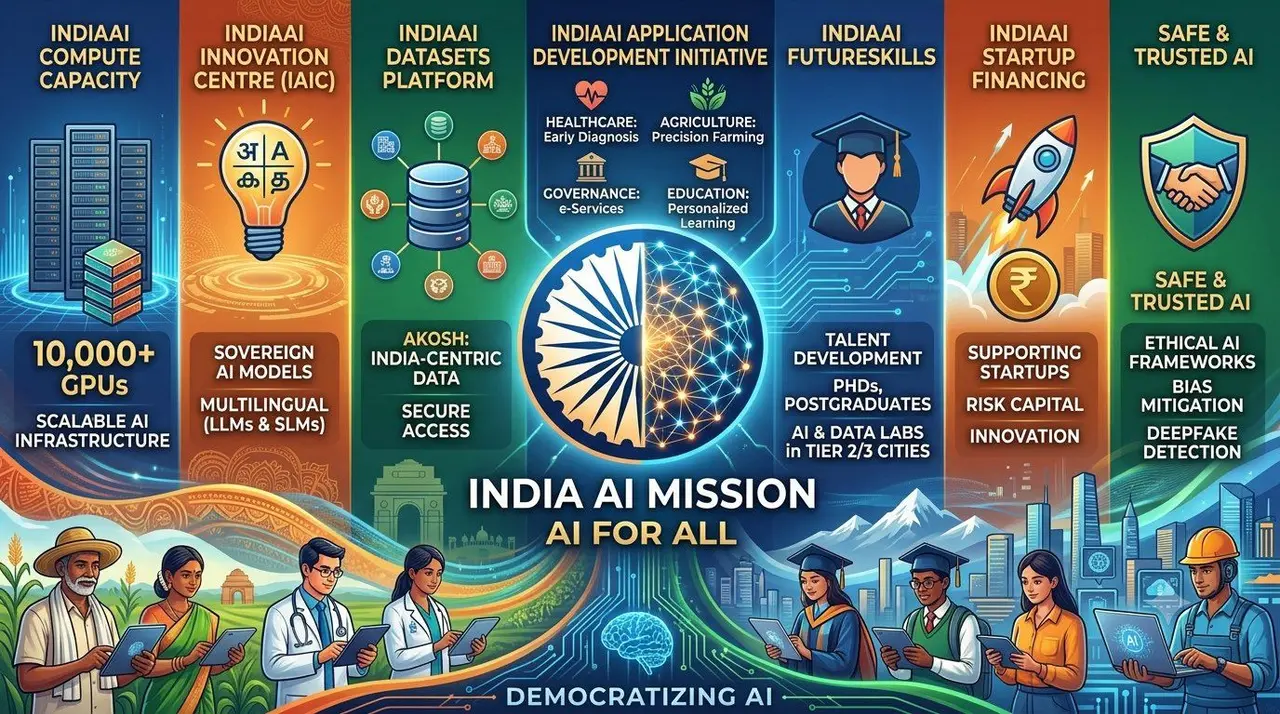
The IndiaAI Mission, approved by the union cabinet in March 2024 with a budget outlay of Rs.10,372 crore over five years, aims to create economic opportunities and employment while addressing risks associated with artificial intelligence. The initiative builds on India's robust IT sector, which generates annual revenue of USD 300 billion and employs 60 lakh people
2
.Among the notable sovereign AI models receiving government backing are Sarvam AI's 30 billion parameter and 105 billion parameter models, Gnani.AI's speech-to-speech model, BharatGen's multilingual foundation models, and Avataar AI's video generation model. Of the 20 models identified, five have already been released
1
. Domain-specific small language models for healthcare, language technologies, and agentic AI systems are at various stages of development and deployment2
.The Ministry of Electronics and Information Technology has empanelled 15 compute providers under the Mission, supporting 237 projects with 93.18 lakh GPU hours sanctioned to enable AI research and development
2
3
.India's focus on developing indigenous AI intensified following recent geopolitical turmoil initiated by US export restrictions on advanced AI models. President Donald Trump's decision to ban exports of the most recent models from Anthropic and OpenAI, except to select "friendly countries," raised concerns among Indian policymakers about AI hegemony
3
. The Ministry of Electronics and Information Technology had received access to Anthropic's Claude Mythos before the export ban, prompting organizations under the ministry to complete security audits of their digital assets3
.Related Stories
The government has launched 12 national-level hackathons and innovation challenges, supporting development of 62 AI prototypes and deployment of 20 AI-based solutions
2
. For talent development, 686 fellowships have been awarded across undergraduate, postgraduate, and doctoral programmes in 178 institutions. The YUVA AI for All programme has been completed by over 26.5 lakh individuals2
3
.
Source: ET
The government has established 27 India Data and AI Labs, providing training to more than 2,500 students, with work underway to establish 188 additional labs. A scheme to create 58 AI Centers of Excellence across States and Union Territories in collaboration with state governments and industry partners has also been approved
2
3
.The IndiaAI Governance Guidelines, released on November 5, 2025, provide a national framework for safe, responsible, and inclusive AI development and deployment
2
3
. Government departments are actively exploring AI applications, with the Union Water Resource Ministry recently engaging with the IndiaAI Mission to identify use cases and bolster cybersecurity—a direct result of Prime Minister Narendra Modi's emphasis on technology adoption, data governance, and process reforms3
.Summarized by
Navi
22 Feb 2025•Technology

05 Apr 2025•Technology

12 Feb 2025•Technology

1
Technology

2
Policy and Regulation

3
Science and Research