6 Sources
[1]
EXCLUSIVE: Meta to put AI chip into production in September as it looks to double computing capacity, memo shows
NEW YORK/SAN FRANCISCO, July 9 (Reuters) - Meta Platforms (META.O), opens new tab plans to start manufacturing an artificial intelligence chip from September as part of its plan to boost overall computing power to 14 gigawatts next year, showed an internal memo reviewed by Reuters. The tech firm's data center chip, code-named "Iris", is part of a four-generation project for Meta Training and Inference Accelerators (MTIA) that it will design in-house. The plan is to use custom-built silicon to improve the AI that powers its Facebook and Instagram social media platforms. Testing the chip took only six weeks and found no major issues, the memo showed. That relatively quick progress signals positive momentum for an in-house effort that has floundered since its launch more than half a decade ago. Meta tailored the chip for its own needs and is working with Broadcom (AVGO.O), opens new tab to help design it and Taiwan Semiconductor Manufacturing Co (2330.TW), opens new tab to manufacture it. The approach is likely to help the firm lower its massive computing costs and gain more independence from chip suppliers such as Nvidia (NVDA.O), opens new tab and Advanced Micro Devices (AMD.O), opens new tab. The bug-testing completion and production timing have not been previously reported. Meta declined to comment. The chip is aimed at augmenting the large quantities of graphics processing units (GPUs) used for AI applications that Meta purchases from Nvidia and AMD. However, adopting the latest GPUs at a firm as large as Meta "has been a heavy lift, and it has cost us time," the memo showed. Meta unveiled Iris under its technical name in March along with three other AI processors. It plans to launch a chip about every six months through 2027, whereas typically firms release AI chips at intervals of a year or more. SEVEN GIGAWATTS OF COMPUTING IN 2026 Meta this year plans to deploy seven gigawatts of computing infrastructure, the memo showed. It plans to double that number in 2027, the memo said. The firm expects to spend as much as $145 billion on AI infrastructure this year, a significant portion of Big Tech's more than $700 billion projected outlay on the technology. To expand computing infrastructure, Meta has secured long-term, multi-year supply agreements, the memo showed. Those include agreements with Samsung Electronics (005930.KS), opens new tab for memory chips, Sandisk (SNDK.O), opens new tab for flash storage and Sumitomo Electric (5802.T), opens new tab for fiber-optic equipment. Such long-term agreements have become critical for data center expansion targets amid a memory chip shortage that has prompted companies such as Apple AAPL.O to raise prices. Sandisk declined to comment. Samsung Electronics and Sumitomo Electric did not respond to requests for comment. Components such as memory and AI chips have experienced a surge in demand as tech companies race to expand data centers to keep pace with AI's thirst for computing power. Memory and other chip prices have risen rapidly and substantially enough that "chipflation" has become a macroeconomic concern, Morgan Stanley analysts said. Reporting by Katie Paul in New York, and Max A. Cherney and Stephen Nellis in San Francisco; Editing by Christopher Cushing Our Standards: The Thomson Reuters Trust Principles., opens new tab * Suggested Topics: * Artificial Intelligence * ADAS, AV & Safety * Manufacturing * Products Max A. Cherney Thomson Reuters Max A. Cherney is a correspondent for Reuters based in San Francisco, where he reports on the semiconductor industry and artificial intelligence. He joined Reuters in 2023 and has previously worked for Barron's magazine and its sister publication, MarketWatch. Cherney graduated from Trent University with a degree in history.
[2]
Meta to put AI chip into production in September as it looks to double computing capacity, Reuters reports
Meta Platforms plans to start manufacturing an artificial intelligence chip from September as part of its plan to boost overall computing power to 14 gigawatts next year, according to an internal memo reviewed by Reuters. The tech firm's data center chip, code-named "Iris", is part of a four-generation project for Meta Training and Inference Accelerators (MTIA) that it will design in-house. The plan is to use custom-built silicon to improve the AI that powers its Facebook and Instagram social media platforms. Testing the chip took only six weeks and found no major issues, the memo showed. That relatively quick progress signals positive momentum for an in-house effort that has floundered since its launch more than half a decade ago. Meta tailored the chip for its own needs and is working with Broadcom AVGO.O to help design it and Taiwan Semiconductor Manufacturing Co 2330.TW to manufacture it. The approach is likely to help the firm lower its massive computing costs and gain more independence from chip suppliers such as Nvidia and Advanced Micro Devices. The bug-testing completion and production timing have not been previously reported. Meta declined to comment. The chip is aimed at augmenting the large quantities of graphics processing units (GPUs) used for AI applications that Meta purchases from Nvidia and AMD. However, adopting the latest GPUs at a firm as large as Meta "has been a heavy lift, and it has cost us time," the memo showed. Meta unveiled Iris under its technical name in March along with three other AI processors. It plans to launch a chip about every six months through 2027, whereas typically firms release AI chips at intervals of a year or more. Seven gigawatts of computing in 2026 Meta this year plans to deploy seven gigawatts of computing infrastructure, the memo showed. It plans to double that number in 2027, the memo said. The firm expects to spend as much as $145 billion on AI infrastructure this year, a significant portion of Big Tech's more than $700 billion projected outlay on the technology. To expand computing infrastructure, Meta has secured long-term, multi-year supply agreements, the memo showed. Those include agreements with Samsung Electronics for memory chips, Sandisk for flash storage and Sumitomo Electric for fiber-optic equipment. Such long-term agreements have become critical for data center expansion targets amid a memory chip shortage that has prompted companies such as Apple to raise prices. Sandisk declined to comment. Samsung Electronics and Sumitomo Electric did not respond to requests for comment. Components such as memory and AI chips have experienced a surge in demand as tech companies race to expand data centers to keep pace with AI's thirst for computing power. Memory and other chip prices have risen rapidly and substantially enough that "chipflation" has become a macroeconomic concern, Morgan Stanley analysts said.
[3]
Meta to put its own AI chip into production in September, aiming to double computing capacity
The move would deepen Meta's effort to wean its data centres off Nvidia GPUs, according to Reuters. Meta plans to put its own artificial intelligence chip into production in September and is aiming to roughly double the computing capacity across its data centres, Reuters reported on Thursday, citing people familiar with the matter. The chip belongs to Meta's in-house silicon line, the Meta Training and Inference Accelerator, or MTIA, which the company has been scaling up as part of a record spending push and a wider effort to reduce its reliance on Nvidia. Meta declined to comment on the specifics, and both the September timing and the capacity target come from anonymous sources rather than any public disclosure. If the timeline holds, it would mark another step in a programme that has moved unusually fast this year. Meta unveiled four new MTIA chips in March, the 300, 400, 450, and 500, and said it would ship them on a roughly six-month cadence rather than the annual pace common across the industry. Those chips are manufactured by TSMC and co-developed with Broadcom, whose partnership with Meta now runs through 2029 and covers several generations of custom silicon. Broadcom has said the newer MTIA parts will be among the first custom AI chips built on a 2-nanometre process. The strategic logic is straightforward. Meta remains one of Nvidia's biggest customers, buying vast numbers of GPUs to train its Llama models and to run recommendation systems for more than 3 billion daily users, and every workload it can move onto its own chips is one it does not have to buy at Nvidia's margins. For now, MTIA has largely handled inference, the day-to-day job of serving predictions once a model has been trained. The MTIA 300 is already in production for ranking and recommendation work, while the 450 and 500, aimed at generative image and video inference, are slated for mass deployment through 2027. A training-capable chip would be a harder test. Training frontier models is the workload where Nvidia's hardware and its CUDA software have proved stickiest, and where in-house alternatives from Google and Amazon have taken years to mature. The capacity ambition sits inside an enormous spending plan. Meta has guided 2026 capital expenditure to between $125bn and $145bn, with nearly all of the increase going towards data centres, GPUs, and custom silicon, and Mark Zuckerberg has floated eventual targets measured in gigawatts. That build-out has grown large enough that Meta is now looking to rent out spare compute to outside customers, echoing a model long used by cloud providers. The company has also hedged its bets on suppliers, signing deals for Amazon's Graviton5 chips and AMD accelerators alongside its standing Nvidia orders. Custom silicon is central to that hedge because it changes the underlying economics. Designing a chip for exactly the models Meta runs, rather than buying a general-purpose GPU, can cut power draw and unit costs at the scale the company operates, provided the software stack keeps pace. The catch is that in-house chips rarely displace Nvidia outright. Analysts tend to frame MTIA as a way to absorb growth and trim the GPU bill at the margins, not to replace Nvidia in the near term, and Meta itself keeps expanding its GPU commitments even as it ramps up custom parts. Reuters' report does not specify which MTIA generation enters production in September, nor how any doubling of capacity would be split between new chips and additional data-centre floor space. Meta has not published a figure that matches the framing. What is clearer is the direction of travel. After years of experiments, Meta's silicon effort has shifted from a side project into a core plank of its infrastructure strategy, and September, if the reporting proves accurate, would be the next milestone to watch. The bigger question is whether the chips can eventually reach the training workloads that still belong almost entirely to Nvidia.
[4]
Meta to start production of Iris AI chip in September 2026
Meta $META plans to begin manufacturing its in-house AI chip, code-named Iris, in September, according to an internal memo reviewed by Reuters. Falling under the umbrella of Meta's MTIA program -- short for Meta Training and Inference Accelerators -- Iris is one of four planned chip generations aimed at strengthening the AI systems running on Facebook and Instagram. According to the memo, the chip cleared its bug-testing phase in roughly six weeks without turning up any significant problems. Broadcom $AVGO is serving as Meta's design partner on the chip, while Taiwan Semiconductor Manufacturing Co. has been tapped to handle its fabrication. By building its own silicon, Meta is seeking to cut spending on compute and loosen its reliance on third-party chip vendors including Nvidia $NVDA and Advanced Micro Devices. March marked Iris's public debut, when Meta introduced it by its technical designation as part of a slate of four AI processors. That cadence -- a new chip approximately every six months until 2027 -- represents a significantly more aggressive schedule than the annual or slower release cycles common across the industry. Adopting the latest GPUs at Meta's scale "has been a heavy lift, and it has cost us time," the memo said. The Iris chip is intended to supplement -- not replace -- the large volumes of GPUs Meta buys from Nvidia and AMD $AMD. The chip production announcement is tied to a broader infrastructure push. The memo also outlined a two-step infrastructure expansion: seven gigawatts of computing capacity coming online in 2026, growing to 14 gigawatts by 2027. Meta's projected AI infrastructure spending for the year reaches as high as $145 billion. Underpinning the expansion, the memo revealed that Meta has locked in extended supply contracts across several hardware categories: memory chips from Samsung Electronics, flash storage from Sandisk, and fiber-optic equipment from Sumitomo Electric. None of the three suppliers provided comment; Sandisk explicitly declined, while Samsung Electronics and Sumitomo Electric had not responded by press time. Meta likewise declined to comment. The Iris production timeline fits into a broader custom silicon strategy Meta formalized with Broadcom earlier this year, when the two companies agreed to expand their partnership on custom AI chips through 2029, covering multiple MTIA generations. That deal included a commitment to deploy more than one gigawatt of computing capacity as an opening installment in a planned multi-gigawatt buildout. Meta has also struck a multiyear agreement with AMD to deploy up to six gigawatts of AMD Instinct GPUs, part of an effort to diversify its compute supply away from a single vendor.
[5]
Meta to put AI chip into production in September as it looks to double computing capacity, memo shows
Meta Platforms plans to manufacture its own artificial intelligence chip starting September. This initiative aims to significantly increase the company's overall computing power by next year. The custom-designed chip, code-named Iris, is part of a multi-generation project. Meta is working with Broadcom and Taiwan Semiconductor Manufacturing Co for design and production. This move seeks to reduce costs and gain independence from external chip suppliers. Meta Platforms plans to start manufacturing an artificial intelligence chip from September as part of its plan to boost overall computing power to 14 gigawatts next year, showed an internal memo reviewed by Reuters. The tech firm's data center chip, code-named "Iris", is part of a four-generation project for Meta Training and Inference Accelerators (MTIA) that it will design in-house. The plan is to use custom-built silicon to improve the AI that powers its Facebook and Instagram social media platforms. Testing the chip took only six weeks and found no major issues, the memo showed. That relatively quick progress signals positive momentum for an in-house effort that has floundered since its launch more than half a decade ago. Meta tailored the chip for its own needs and is working with Broadcom to help design it and Taiwan Semiconductor Manufacturing Co to manufacture it. The approach is likely to help the firm lower its massive computing costs and gain more independence from chip suppliers such as Nvidia and Advanced Micro Devices. The bug-testing completion and production timing have not been previously reported. Meta declined to comment. The chip is aimed at augmenting the large quantities of graphics processing units (GPUs) used for AI applications that Meta purchases from Nvidia and AMD. However, adopting the latest GPUs at a firm as large as Meta "has been a heavy lift, and it has cost us time," the memo showed. Meta unveiled Iris under its technical name in March along with three other AI processors. It plans to launch a chip about every six months through 2027, whereas typically firms release AI chips at intervals of a year or more. SEVEN GIGAWATTS OF COMPUTING IN 2026 Meta this year plans to deploy seven gigawatts of computing infrastructure, the memo showed. It plans to double that number in 2027, the memo said. The firm expects to spend as much as $145 billion on AI infrastructure this year, a significant portion of Big Tech's more than $700 billion projected outlay on the technology. To expand computing infrastructure, Meta has secured long-term, multi-year supply agreements, the memo showed. Those include agreements with Samsung Electronics for memory chips, Sandisk for flash storage and Sumitomo Electric for fiber-optic equipment. Such long-term agreements have become critical for data center expansion targets amid a memory chip shortage that has prompted companies such as Apple to raise prices. Sandisk declined to comment. Samsung Electronics and Sumitomo Electric did not respond to requests for comment. Components such as memory and AI chips have experienced a surge in demand as tech companies race to expand data centers to keep pace with AI's thirst for computing power. Memory and other chip prices have risen rapidly and substantially enough that "chipflation" has become a macroeconomic concern, Morgan Stanley analysts said.
[6]
Meta to put AI chip into production in September as it looks to double computing capacity, memo shows
NEW YORK/SAN FRANCISCO, July 9 (Reuters) - Meta Platforms plans to start manufacturing an artificial intelligence chip from September as part of its plan to boost overall computing power to 14 gigawatts next year, showed an internal memo reviewed by Reuters. The tech firm's data center chip, code-named "Iris", is part of a four-generation project for Meta Training and Inference Accelerators (MTIA) that it will design in-house. The plan is to use custom-built silicon to improve the AI that powers its Facebook and Instagram social media platforms. Testing the chip took only six weeks and found no major issues, the memo showed. That relatively quick progress signals positive momentum for an in-house effort that has floundered since its launch more than half a decade ago. Meta tailored the chip for its own needs and is working with Broadcom to help design it and Taiwan Semiconductor Manufacturing Co to manufacture it. The approach is likely to help the firm lower its massive computing costs and gain more independence from chip suppliers such as Nvidia and Advanced Micro Devices. The bug-testing completion and production timing have not been previously reported. Meta declined to comment. The chip is aimed at augmenting the large quantities of graphics processing units (GPUs) used for AI applications that Meta purchases from Nvidia and AMD. However, adopting the latest GPUs at a firm as large as Meta "has been a heavy lift, and it has cost us time," the memo showed. Meta unveiled Iris under its technical name in March along with three other AI processors. It plans to launch a chip about every six months through 2027, whereas typically firms release AI chips at intervals of a year or more. SEVEN GIGAWATTS OF COMPUTING IN 2026 Meta this year plans to deploy seven gigawatts of computing infrastructure, the memo showed. It plans to double that number in 2027, the memo said. The firm expects to spend as much as $145 billion on AI infrastructure this year, a significant portion of Big Tech's more than $700 billion projected outlay on the technology. To expand computing infrastructure, Meta has secured long-term, multi-year supply agreements, the memo showed. Those include agreements with Samsung Electronics for memory chips, Sandisk for flash storage and Sumitomo Electric for fiber-optic equipment. Such long-term agreements have become critical for data center expansion targets amid a memory chip shortage that has prompted companies such as Apple to raise prices. Sandisk declined to comment. Samsung Electronics and Sumitomo Electric did not respond to requests for comment. Components such as memory and AI chips have experienced a surge in demand as tech companies race to expand data centers to keep pace with AI's thirst for computing power. Memory and other chip prices have risen rapidly and substantially enough that "chipflation" has become a macroeconomic concern, Morgan Stanley analysts said. (Reporting by Katie Paul in New York, and Max A. Cherney and Stephen Nellis in San Francisco; Editing by Christopher Cushing) By Katie Paul, Max A. Cherney and Stephen Nellis
Share
Copy Link
Meta Platforms is set to begin manufacturing its custom AI chip, code-named Iris, in September as part of an ambitious plan to double its computing capacity to 14 gigawatts by 2027. The chip passed bug-testing in just six weeks and represents a significant step in Meta's effort to reduce dependence on external suppliers like Nvidia while controlling its massive AI infrastructure costs projected at up to $145 billion this year.
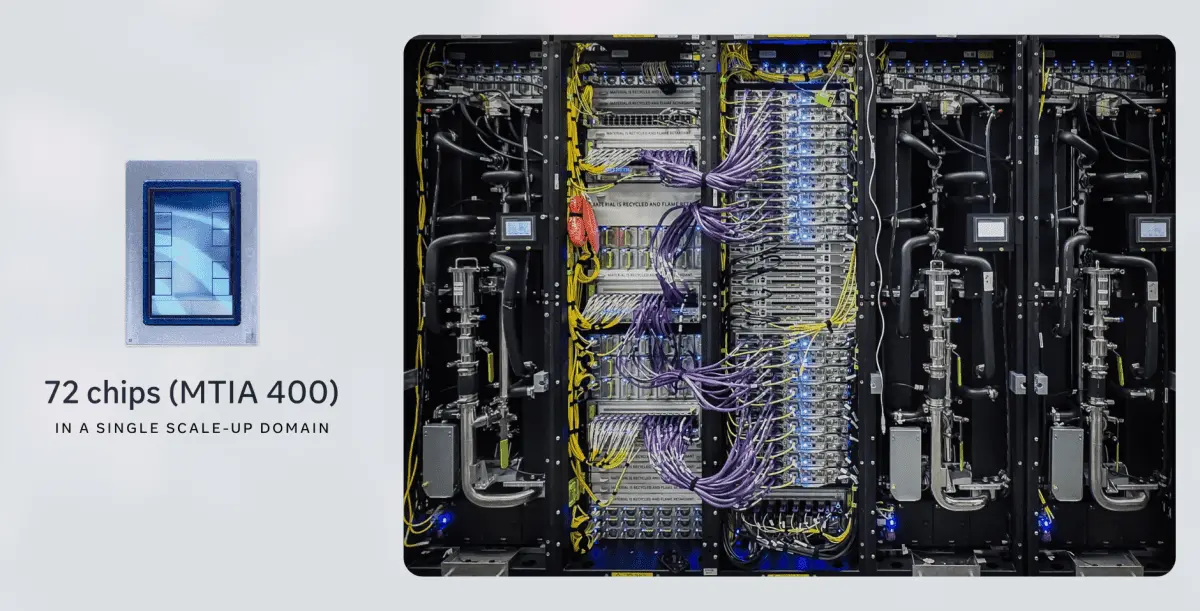
Meta Platforms is preparing to manufacture its custom AI chip, code-named Iris, starting in September 2026, according to an internal memo reviewed by Reuters. The Iris AI chip is part of Meta's four-generation Meta Training and Inference Accelerators (MTIA) project designed to enhance the AI systems powering Facebook and Instagram
1
. This in-house AI chip initiative marks a critical milestone in Meta's strategy to control its computing infrastructure and reduce reliance on Nvidia and other external chip suppliers2
.
Source: ET
The chip cleared its bug-testing phase in approximately six weeks without encountering major issues, signaling positive momentum for an effort that has struggled since its launch more than half a decade ago
1
. Meta is collaborating with Broadcom for chip design and Taiwan Semiconductor Manufacturing Co (TSMC) for manufacturing, a partnership that extends through 2029 and covers multiple generations of custom silicon3
.Meta's infrastructure roadmap reveals an aggressive expansion timeline. The company plans to deploy seven gigawatts of computing infrastructure in 2026, then double that computing capacity to 14 gigawatts by 2027
1
. This massive buildout is supported by projected AI infrastructure spending of up to $145 billion in 2026, representing a substantial portion of Big Tech's more than $700 billion combined investment in the technology5
.To support this expansion, Meta has secured long-term, multi-year supply agreements with Samsung Electronics for memory chips, Sandisk for flash storage, and Sumitomo Electric for fiber-optic equipment
4
. These agreements have become critical amid a memory chip shortage that has affected data center expansion across the industry and contributed to what Morgan Stanley analysts describe as "chipflation" - a macroeconomic concern driven by rapidly rising memory and chip prices .Meta unveiled Iris under its technical name in March 2026 alongside three other AI processors, committing to an unusually aggressive release schedule of launching a chip approximately every six months through 2027
2
. This cadence significantly outpaces the annual or slower release cycles typical across the industry4
.The custom AI chip is designed to augment rather than replace the large quantities of graphics processing units (GPUs) Meta purchases from Nvidia and AMD
1
. According to the internal memo, adopting the latest GPUs at Meta's scale "has been a heavy lift, and it has cost us time"4
. By developing custom silicon tailored specifically for its workloads, Meta aims to lower massive computing costs while gaining greater independence from chip suppliers5
.
Source: Reuters
Related Stories
The Meta Training and Inference Accelerators have primarily handled inference workloads - the day-to-day task of serving predictions once an AI model has been trained
3
. The MTIA 300 is already in production for ranking and recommendation work across Meta's platforms serving more than 3 billion daily users, while the MTIA 450 and 500 chips, aimed at generative AI image and video inference, are scheduled for mass deployment through 20273
.Developing a training-capable chip represents a more challenging test, as AI model training is where Nvidia's hardware and CUDA software ecosystem have proved most difficult to displace
3
. Industry analysts view MTIA as a way to absorb growth and reduce GPU costs at the margins rather than replace Nvidia in the near term, and Meta continues expanding its GPU commitments even while ramping up custom silicon production3
. The company has also diversified its compute supply through a multiyear agreement with AMD to deploy up to six gigawatts of AMD Instinct GPUs4
.Summarized by
Navi
[3]
12 Mar 2025•Technology

27 Feb 2026•Technology

12 Mar 2026•Technology

1
Technology

2
Policy and Regulation

3
Policy and Regulation