Micron champions 96GB VRAM GPUs while abandoning consumer RAM market amid global shortage


2 Sources
2 Sources
[1]
Micron stopped making consumer memory -- now it's reminding you how important GDDR7 RAM will be
* Micron says GDDR7 can enable up to 96GB of VRAM on GPUs for richer textures, larger worlds, and better on-device AI. The chipmaker recently shuttered its Crucial consumer RAM brand. * 96GB VRAM feels extreme amid the ongoing memory shortage and tighter VRAM GPU availability. * It's unclear when GPUs that feature GDDR7 VRAM will release as Nvidia and AMD have reportedly delayed next-gen GPU launches. Micron, the same company that killed off its consumer RAM brand Crucial a few months ago, just published a blog post entitled, "The new performance bottleneck: How more GPU memory unlocks next gen gaming and AI PCs." In the post, Micron unpacks the importance of memory in the next-gen era of PC performance, emphasizing that GDDR7 VRAM is poised to be a game-changer for the GPU industry (via PC Gamer). The company then explains that with GDDR7, the company's new 24GB density enables up to 96GB of graphics memory, "giving GPUs significantly more space for high-resolution textures, expansive worlds, and advanced visual effects." Crucial will no longer sell you RAM as Micron goes business-only It's the end of an era. Posts 2 By Simon Batt Given the ongoing memory shortage, 96GB of VRAM feels extreme It's unclear when GDDR7-equipped GPUs would release Given recent reports indicate that Nvidia has reduced the availability of its two most affordable 16GB GPUs, the RTX 5060 Ti and RTX 5070 Ti, the prospect of a gaming GPU with 96GB of VRAM feels a bit wild amid the ongoing memory crisis. According to Micron, the "push toward cinematic quality gaming" and the "rapid emergence of AI-powered PCs" are driving the need for GPUs equipped with ample GDDR7 RAM. "As worlds grow larger, textures more detailed, and on device AI more integral to responsiveness and personalization, the demands placed on GPU memory have surged," writes Micron. The company also cites real-time ray tracing, massive datasets, lighting maps, shadows, higher-resolutions, and faster refresh rates as another reason GDDR7 RAM-equipped GPUs are on the way. "The problem is that when GPU memory can't hold all this data at once, the system is forced to constantly swap assets in and out. That leads to the issues gamers know too well: texture pop in, mid frame stutters, uneven frame times, and sudden drops during intense ray traced scenes," writes Micron. While all this sounds great, it's important to point out that Micron shuttered its Crucial consumer brand just a few months ago, to focus its efforts on providing memory to tech giant AI datacenters. Though to be fair, this post is focused on GDDR7 RAM designed for VRAM use with GPUs, and not consumer-focused GDDR5 RAM. You can read Micron's full blog post here. Subscribe to the newsletter for GDDR7 VRAM analysis Want clearer context on GDDR7 and massive VRAM claims? Subscribe to the newsletter for concise, jargon-free breakdowns, expert implications, and practical takeaways about GPU memory trends and what they mean for gaming hardware and AI-capable PCs. Subscribe By subscribing, you agree to receive newsletter and marketing emails, and accept our Terms of Use and Privacy Policy. You can unsubscribe anytime. Recent reports indicate that Nvidia won't release its Super RTX 50 series any time soon and that its RTX 60 line has been pushed back as well. AMD has also reportedly decided to delay new GPU releases until 2027. AMD is reportedly pausing new GPU launches until 2027 It's going to be awhile before we see new graphics cards from the industry's second biggest graphics card maker. Posts 4 By Patrick O'Rourke
[2]
Micron wants your next GPU to have 96GB of VRAM in it, but I don't really know who it's expecting will make it for you
Just about the most tone-deaf this brand could be during the RAMpocalypse "The next era of PC performance will be defined not by more compute, but by memory scale", begins a new blog post from former creator of the best RAM for gaming, Micron. The blog post really begins as it means to go on, and by that I mean, it's horrifically tone-deaf. For context, we're in the middle of a global RAM shortage, and about two months ago, Micron decided to shut down its consumer brand, Crucial, meaning gamers and PC builders now have even fewer products to try and get their hands on. The blog post, entitled "The new performance bottleneck: How more GPU memory unlocks next-gen gaming and AI PCs," essentially shines a light on the importance of memory for consumers who are trying to get true next-generation performance out of their machines. It talks about Micron's latest evolution of GDDR7 VRAM density and bandwidth in the best graphics cards, and it's pretty much Micron admitting that RAM and VRAM are going to be pivotal for the best gaming PCs going forward: "Memory capacity and efficiency now determine how smoothly a system can deliver immersive gameplay, intelligent creation tools, and real time simulation, making memory a foundational enabler of next generation visual computing," the blog post summizes. If you were in any doubt about how screwed up the current memory demand situation is, it's being heavily speculated that when Nvidia launches its next generation of graphics cards, they won't even be supplying the VRAM for them for board partners (Asus, Gigabyte, PNY, MSI, and other companies who manufacutre GPUs) to sell onward to consumers. That will almost certainly mean less VRAM in each new GPU SKU, but it will also mean the cost of manufacturing will land at the door of those smaller brands instead of Nvidia, and consumers will then need to pay even more for a new graphics card. To be frank, Micron's blog post seems completely deluded and reads more like a B2B appeal to discrete GPU makers to use its VRAM over Samsung and SK Hynix. For us consumers, it's talking about a future that no one will be able to afford, given the current climate: "Micron's new 24Gb density enables up to 96GB of graphics memory, giving GPUs significantly more space for high-resolution textures, expansive worlds, and advanced visual effects", it continues. Again, just to pull our feet back down to earth before we start dreaming up a reality where 96GB of VRAM is anywhere close to a standard for graphics cards, let me put things in context. The RTX 5080, one of Nvidia's highest-end GPUs from this generation, only has 16GB of GDDR7 VRAM. The RTX 5070 mid-ranger came under so much controversy for only having 12GB. The AMD Radeon RX 7900 XTX and RTX 4090 came out before all of that and went extremely gungho for native performance. They only have 24GB of VRAM. In its latest range of 50 Series GPUs, Nvidia made it seem like it was fighting tooth and nail to part with as little VRAM as possible, which resulted in an emphasis on DLSS upscaling, anger over "fake frames", and a lot of disgruntled PC builders switching to AMD graphics cards. In other words, the thought of a GPU that uses even 30GB of VRAM is laughable on its own, and that's before you take into account that this is being dreamed up by Micron, the brand that abandoned 30 years' worth of consumer loyalty to make a quick buck building data centers for AI companies. And none of that mentions the other elephant in the room, which is that hardly any games today actually utilize that sort of VRAM. Maybe they would if the majority of game optimization today wasn't ignored in favor of AI upscaling slapping a bandage over performance issues, but that isn't the case. Most games today are horrendously optimized for PC, and my personal take is that it's because DLSS and FSR are a much less costly way to ensure a game runs well without the need for launch delays and polish time for game devs. But Micron doesn't seem to realize that: "To keep these visual pipelines running efficiently, the memory subsystem must deliver data rapidly and consistently," the blog post says. Yes, Micron, couldn't agree more, but even in an ideal world where Nvidia wants to give us more native performance, who is going to make that memory for consumers while you're busy servicing AI companies? Micron seems to be particularly idealistic about the future of computing technology. The other week, another Micron blog post detailed that the company is working on producing the world's first Gen 6 SSD. Of course, this is only aimed at AI data centers for now. I've reviewed multiple Gen 5 SSDs, and for years, those have still been pointlessly fast (and expensive) for the majority of applications and games. We're not even close to that type of storage being the norm for consumers yet, and Crucial seems intent on moving onto the next big thing. Well, Micron, it's nice to dream, but as someone currently covering a memory shortage which likely won't be going away for the next three years, I'd suggest we maybe keep expectations a bit more down to earth as to not incite gamer rage. For more on the best gaming PCs, check out the best CPU for gaming, the best computer speakers, and the best gaming PCs in the UK.
Share
Share
Copy Link
Micron published a blog post promoting GDDR7 RAM technology that could enable GPUs with up to 96GB of VRAM for enhanced gaming and AI applications. The timing raises eyebrows as the company recently shut down its Crucial consumer brand to focus on AI data centers, all while the industry faces a severe memory shortage and delayed GPU launches from Nvidia and AMD.
Micron Promotes GDDR7 RAM Despite Consumer Market Exit
Micron recently published a blog post titled "The new performance bottleneck: How more GPU memory unlocks next gen gaming and AI PCs," emphasizing that GDDR7 RAM represents a critical advancement for the GPU industry
1
. The chipmaker argues that the next era of PC performance will be defined by memory scale rather than compute power, with its new 24GB density enabling up to 96GB of VRAM on GPUs2
. This graphics memory capacity would provide significantly more space for high-resolution textures, expansive worlds, and advanced visual effects, according to Micron's assertions.
Source: XDA-Developers
The timing of this announcement appears particularly tone-deaf, coming just months after Micron shuttered its Crucial brand, abandoning 30 years of consumer loyalty to focus exclusively on providing memory to AI companies and data centers
2
. The company's pivot away from consumer RAM occurs precisely when the market faces a severe memory shortage, leaving gamers and PC builders with fewer product options.The Case for Expanded GPU Memory Capacity
Micron's blog post outlines several technical justifications for increased VRAM in next-generation GPUs. The company points to the "push toward cinematic quality gaming" and the "rapid emergence of AI-powered PCs" as primary drivers for GPUs equipped with ample GDDR7 RAM
1
. According to Micron, as worlds grow larger and on-device AI becomes more integral to responsiveness and personalization, the demands placed on GPU memory have surged.The chipmaker identifies real-time ray tracing, massive datasets, lighting maps, shadows, higher resolutions, and faster refresh rates as factors necessitating expanded memory capacity. Micron warns that when GPU memory cannot hold all required data simultaneously, systems are forced to constantly swap assets in and out, leading to texture pop-in, mid-frame stutters, uneven frame times, and sudden drops during intense ray-traced scenes
1
. This performance bottleneck makes memory capacity and efficiency foundational enablers of next-generation visual computing for AI PCs and next-gen gaming applications.Reality Check: Current Market Conditions
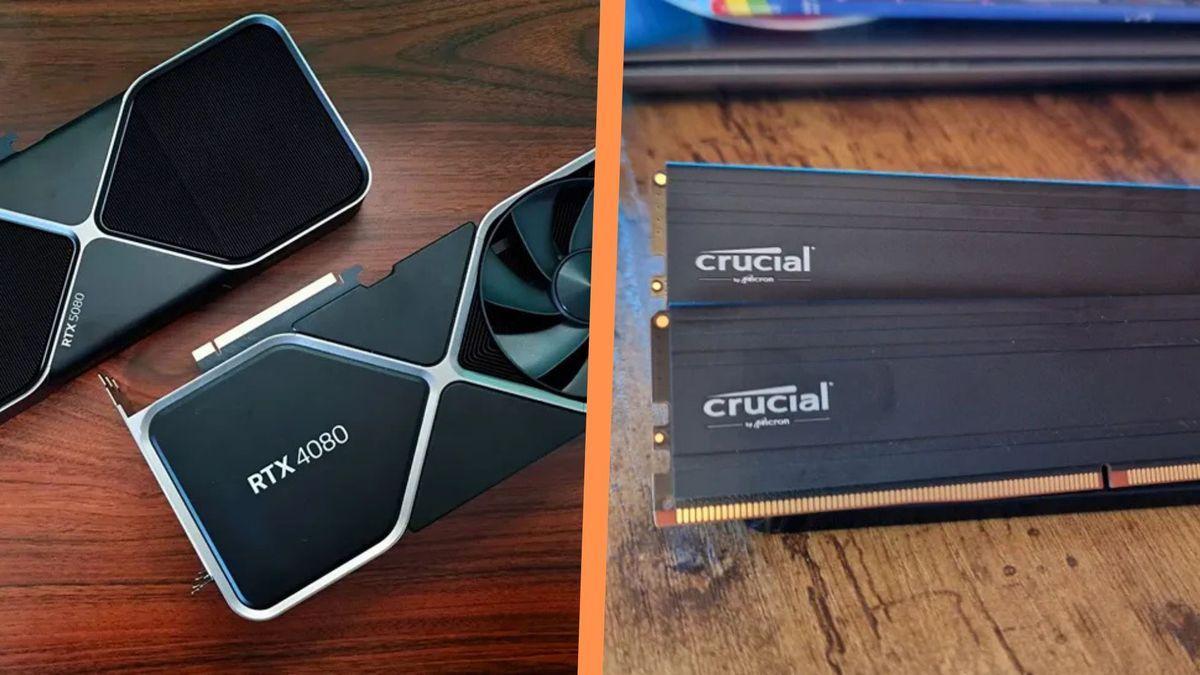
The prospect of 96GB of VRAM feels disconnected from current market realities. Nvidia's RTX 5080, one of the highest-end graphics cards from the current generation, only features 16GB of GDDR7 VRAM, while the RTX 5070 sparked controversy for including just 12GB
2
. Even the AMD Radeon RX 7900 XTX and RTX 4090 top out at 24GB of VRAM. Recent reports indicate that Nvidia has reduced availability of its two most affordable 16GB GPUs, the RTX 5060 Ti and RTX 5070 Ti, amid the ongoing memory crisis1
.
Source: GamesRadar
Speculation suggests that when Nvidia launches its next generation of graphics cards, the company may not even supply VRAM for board partners like Asus, Gigabyte, PNY, and MSI, potentially resulting in less VRAM per GPU SKU and higher manufacturing costs passed to consumers
2
.Related Stories

Delayed GPU Launches and Uncertain Timeline
The timeline for GDDR7-equipped GPUs remains unclear. Recent reports indicate that Nvidia won't release its Super RTX 50 series anytime soon, with its RTX 60 line also pushed back
1
. AMD has reportedly decided to delay new GPU releases until 2027, further extending the wait for next-generation GPUs that might leverage advanced memory technologies1
.Industry observers suggest that Micron's blog post reads more like a business-to-business appeal to discrete GPU makers to choose its VRAM over competitors like Samsung and SK Hynix, rather than a realistic roadmap for the consumer market
2
. For consumers navigating the current memory shortage, the vision of affordable graphics cards with 96GB of VRAM remains distant, particularly as Micron prioritizes AI data centers over the consumer market it once served through the Crucial brand.References
Summarized by

Navi
[1]
Related Stories
RAM prices surge over 500% as AI data centers consume 70% of memory supply, reshaping PC market
14 Jan 2026•Business and Economy
AI Demand Triggers Component Shortage as Dell and Lenovo Plan 15% Price Increases for Servers
03 Dec 2025•Business and Economy

Memory prices spike up to 400% as AI demand creates global shortage lasting through 2026
14 Dec 2025•Business and Economy

Recent Highlights



Recent Highlights
Today's Top Stories












Your Daily Dose of Curated AI News
Don’t drown in AI news. We cut through the noise - filtering, ranking and summarizing the most important AI news, breakthroughs and research daily. Spend less time searching for the latest in AI and get straight to action.

