4 Sources
[1]
DDR5 Prices Drop After Google's TurboQuant News. Don't Expect It to Last
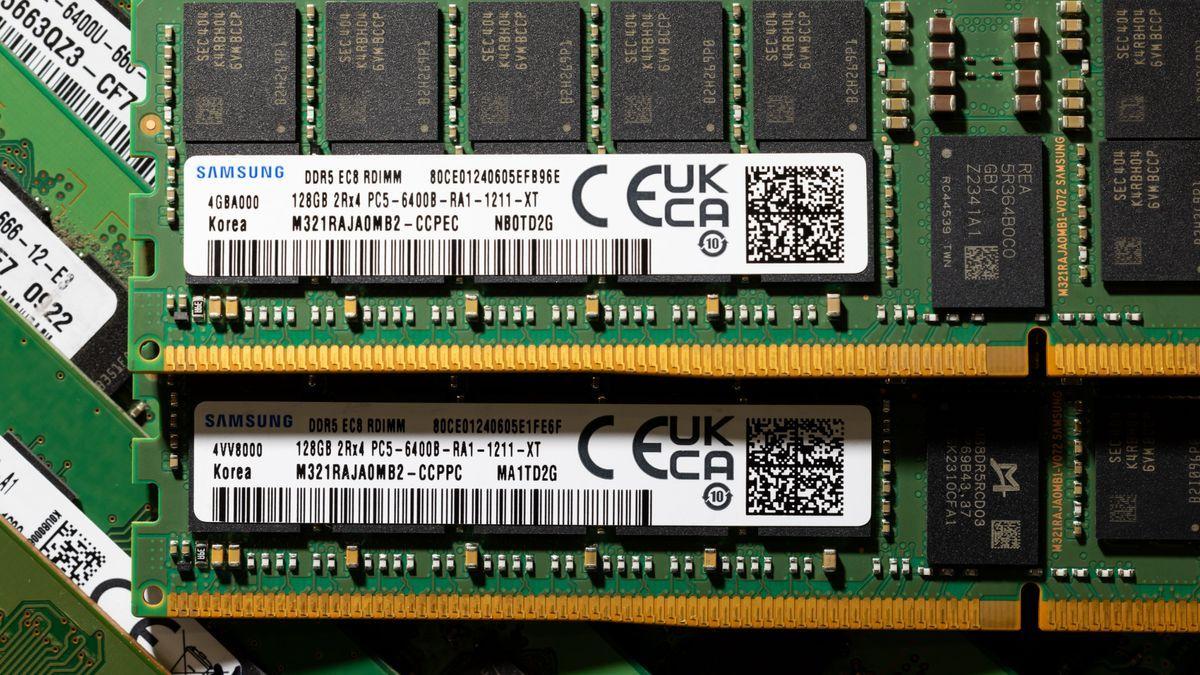
Prices for DDR5 and DDR4 memory kits have fallen in recent weeks, possibly due to investors selling shares in memory makers after Google announced its TurboQuant memory compression algorithm. However, as the Financial Times reports, those cost savings may be short-lived. TurboQuant is more of a proof-of-concept than a proof-of-capability, but it made headlines after researchers claimed it could reduce the amount of "working memory" an AI model requires by at least 6x. That coincided with OpenAI canceling its massive UK Stargate project, which would have required up to 8,000 GPUs -- and enormous amounts of memory. If it's not going ahead, that's a big drop in demand, which could open up supply and production capacity. Indeed, prices for DDR5 memory kits are down by up to 30%, but it may not last. Demand for memory remains astronomical, with Samsung Electronics reporting $50.4 billion in revenue from its memory division in Q1 2026, "marking all-time highs for both DRAM and NAND," according to Counterpoint Research. As TrendForce notes, "the recent declines in retail pricing largely reflect softer consumer momentum, rather than a definitive turn in overall demand." Samsung Security analyst Lee Jong-wook also tells TechRadar that "more efficient models [like TurboQuant] tend to lower overall costs and, in turn, drive greater demand for AI computing. Rather than reducing semiconductor demand, such optimized models are being used to deliver higher-performance AI services with the same chip resources." So, even if shareholders jumped the gun and dumped stock ahead of what they saw as impending price drops, the memory crunch could worsen if TurboQuant is anything as capable as the researchers claim it could be. To see real price drops, we're going to need either a major AI bubble pop or extra production to come online. The latter won't happen until 2027 at the earliest. As for the former? Your guess may be as good as mine.
[2]
Will Google's TurboQuant algorithm hurt AI demand for memory chips?
Samsung Electronics' blowout first quarter has eased investor concerns that a new Google algorithm might threaten the AI-driven boom in South Korea's memory chip industry. Citing an "unprecedented supercycle" in the memory chip market, Samsung this week estimated higher profits in a single quarter than in the whole of last year, with no sign that memory was becoming less of a bottleneck for AI companies. The earnings guidance sent Samsung shares close to all-time highs and eased two weeks of anxiety sparked by TurboQuant, a technology outlined in a Google Research blog post in late March, which promises to drastically reduce the amount of memory required for AI. The post ignited a fierce and ongoing debate about future demand for high-bandwidth memory, the advanced chips made by Samsung and its South Korean rival SK Hynix that power AI servers. Some investors believe the memory boom will turn to bust, others think TurboQuant will have little impact, while optimists argue that if the technology does make AI cheaper, it will simply create demand for even more AI, and thus more chips. TurboQuant "potentially slashes the cost of running large language models by a factor of four to eight", said Kwon Seok-joon, a professor at Sungkyunkwan University in Seoul. "At first glance, this appears to threaten demand for high-bandwidth memory chips." However, "dramatically cheaper inference unlocks workloads previously too expensive to run", such as real-time coding assistants and multiple AI agents running at the same time, added Kwon, "driving total compute demand higher, not lower". TurboQuant works by compressing the so-called key value cache -- the short-term memory that allows AI models such as ChatGPT and Claude to retain conversational context -- and reconstructing it when needed, with little apparent loss in accuracy. As AI interactions lengthen and user numbers rise, demands on the KV cache are surging, putting strain on how much memory AI services can afford to use. TurboQuant offers a way out, reducing the "cost per token", the amount of computing and memory expense required to process each unit of data handled by an AI system. Google's researchers claim the approach could cut memory usage by as much as sixfold. The blog post caused shares of Samsung and SK Hynix to fall sharply last month. But analysts and researchers now suggest that if TurboQuant does work, it is more likely to expand overall memory demand than reduce it -- an example of the Jevons paradox, in which greater efficiency increases overall usage of a resource. Economist William Stanley Jevons noted in his 1865 book The Coal Question that James Watt's more efficient steam engine had resulted in greater usage of the fuel because it made coal-powered technologies economically viable in far more contexts. Han In-su, one of the researchers upon whose work TurboQuant is based, told the FT that the algorithm "can serve as a foundation for realising previously impossible high-difficulty tasks, such as processing much longer contexts within limited memory resources without sacrificing accuracy, or implementing high-performance AI on smaller devices". In a research note, Kim Young-gun of Mirae Asset Securities invoked "déjà vu" over Kubernetes, a Google-designed "containerisation" technology that made it possible to run multiple applications on a single server, greatly improving hardware efficiency. Upon its widespread adoption in the late 2010s, there were concerns that demand for servers and memory would fall as companies would need fewer resources to produce the same results. In practice, the opposite occurred, with lower costs encouraging much greater usage. "The market has largely misread TurboQuant," said Ray Wang of research firm SemiAnalysis. "We continue to believe that increasing memory demand will be required for both training and inference as AI models evolve and innovation advances." Any potential blow to the South Korean chipmakers would be cushioned by the increasing use of long-term contracts from AI service providers seeking to lock in supply, said Wang. "Memory is becoming a bit less cyclical, driven by accelerating and sustainable AI demand," he said. "Contract pricing now matters more than spot pricing." At Samsung's annual meeting last month, co-chief executive Jun Young-hyun said the company was pursuing "contracts of three or five years with major clients, shifting from the existing quarterly and annual terms". For now, TurboQuant remains a concept in a blog post. Its real-world impact will become clear after it is presented at the International Conference on Learning Representations in Brazil in late April and people outside Google are expected to be able to test it. Its ultimate success will depend on whether the largest tech groups are able to use it at scale. "We never imagined that a technology that started from the academic question of 'How can we compress data more perfectly?' would cause such a huge social and economic ripple effect," said Han.
[3]
Google's TurboQuant Made The Memory Industry Fear The Boom Was Over; Even The Researcher Behind It Is Shocked By The Reaction
The memory industry saw a rollercoaster ride in the past few weeks following the debut of Google's TurboQuant, but the idea of shortages being over is seen as a "misinterpretation", to say the least. With DDR prices coming down over the past few days, we did discuss the role of Google's TurboQuant algorithm; however, tying it to the end of memory shortages was a mere misperception, according to The Financial Times' latest report. Following the blog post about TurboQuant, we saw a huge sell-off in the memory market, affecting suppliers like Micron, Samsung, and SK hynix, and it instilled widespread panic, not just among retailers but also RAM scalpers, who thought it was finally the end of DRAM inflation. However, recent indicators, including revenue figures and the demand outlook, suggest that shortages are here to stay. We never imagined that a technology that started from the academic question of 'How can we compress data more perfectly?' would cause such a huge social and economic ripple effect. - Han In-su via Financial Times While going into the technical details of TurboQuant would make this coverage much longer, the idea with the compression algorithm is to run LLMs on accelerators while reducing memory consumption, thereby making memory use much more efficient. Many experts have drawn a TurboQuant analogy with Jevon's Paradox, but in terms of actual memory demand, it appears the cycle is now transitioning from aggressiveness to broader adoption and, indirectly, longer as well. This is clearly seen in how DRAM suppliers are now entering into multi-year contracts with hyperscalers to gain a clearer view of demand. In Samsung's recent Q1 revenue report, we saw the company generate up to $37 billion from its DRAM segment alone, with operating figures on par with those of mainstream hyperscalers. At the same time, it is reported that DRAM contract pricing is expected to grow in the upcoming quarters, and that memory is now entering a phase in which no entity in the AI world can 'survive' without it. Dell's CEO, Michael Dell, recently noted that demand could skyrocket to unprecedented levels, driven by a dramatic rise in per-processor memory consumption. The only situation in which we could see memory shortages easing is when new production capacity comes online, since demand is unlikely to drop. From this perspective alone, memory shortages could persist through H2 2027 and even beyond, depending on how quickly suppliers can bring new production lines online.
[4]
Google's TurboQuant may drive more memory demand not less, analysts say
It doesn't take a genius to figure out that making memory for AI datacenters is way more profitable than making it for your gaming rig and that most of these big companies are not coming back to the consumer market. However, Google announcing TurboQuant and causing Micron's stocks to fall and then RAM prices going down ever so slightly gave us that slight sliver of hope. That hope may be short-lived. Also read: Why are RAM prices falling, and is it the best time to upgrade? When Google Research published its TurboQuant blog post in late March, the reaction was swift and visceral. SK Hynix lost 7.3% of its market value within 48 hours. Samsung fell sharply. Cloudflare's CEO called it Google's "DeepSeek moment." The narrative wrote itself, an algorithm that compresses AI memory usage sixfold must surely be bad news for the companies selling that memory. Except analysts aren't so sure. In fact, many think the market got this completely backwards. Chae Min-suk of Korea Investment & Securities said in a report that the sell-off stemmed from "an interpretation error caused by confusing the roles of memory capacity and memory bandwidth." The argument the bulls are making hinges on the Jevons Paradox, a 19th century economic observation that when a resource becomes more efficient to use, total consumption tends to go up because efficiency makes it viable in far more contexts. When DeepSeek launched dramatically more efficient inference in early 2025, the same fear spread, and high bandwidth memory (HBM) demand climbed anyway. The market has now seen this exact movie twice, but panicked both times. Also read: Google's TurboQuant explained: The JPEG approach to AI compression The technical reality supports this reading. TurboQuant only addresses inference memory - specifically the KV cache. Training a model requires fundamentally different memory driven by activations, gradients, and optimizer states. TurboQuant has zero effect on any of that. There's also the matter of actual order books. Micron's CEO stated plainly that the company's entire 2026 HBM supply is already sold out, not a company facing a demand destruction event. Meanwhile, Ray Wang of SemiAnalysis said "the market has largely misread TurboQuant," adding that "increasing memory demand will be required for both training and inference as AI models evolve." For consumers hoping TurboQuant would be their ticket back to affordable RAM, the picture is bleak. The structural shift toward AI datacenter memory was never going to be reversed by a compression algorithm. If anything, cheaper inference means more applications become economically viable, which means more infrastructure, which means more chips. The cruelest irony of TurboQuant may just be that the very efficiency it promises could end up making the memory boom bigger, not smaller.
Share
Copy Link
Google's TurboQuant algorithm triggered sharp stock sell-offs for Samsung and SK Hynix, with DDR5 prices dropping up to 30%. But analysts argue the memory compression technology will likely expand overall memory demand rather than reduce it, citing the Jevons Paradox where greater efficiency drives increased usage.
When Google Research unveiled its TurboQuant memory compression algorithm in late March, the market reaction was immediate and severe. SK Hynix lost 7.3% of its market value within 48 hours, while Samsung and Micron saw their stock prices tumble as investor concerns spread across the semiconductor industry
4
. DDR5 memory kit prices dropped by up to 30% in the following weeks, fueling speculation that the AI-driven memory boom might be ending1
. The technology promised to reduce working memory requirements for AI models by at least 6x by compressing the key-value cache—the short-term memory that allows Large Language Models (LLMs) like ChatGPT to retain conversational context2
.

Source: Digit
Despite the initial panic, analysts and researchers now suggest the market fundamentally misread TurboQuant's implications for demand for memory chips. Han In-su, one of the researchers whose work underpins the algorithm, expressed shock at the response, telling the Financial Times: "We never imagined that a technology that started from the academic question of 'How can we compress data more perfectly?' would cause such a huge social and economic ripple effect"
3
. Chae Min-suk of Korea Investment & Securities attributed the sell-off to "an interpretation error caused by confusing the roles of memory capacity and memory bandwidth"4
. The technical reality supports this assessment—TurboQuant only addresses inference memory, specifically the KV cache, and has zero effect on training requirements driven by activations, gradients, and optimizer states4
.
Source: FT
Many experts have drawn parallels to the Jevons Paradox, a 19th-century economic observation that when a resource becomes more efficient to use, total consumption tends to increase because efficiency makes it viable in far more contexts
2
. Kim Young-gun of Mirae Asset Securities invoked "déjà vu" over Kubernetes, a Google-designed technology that improved server efficiency in the late 2010s. Despite initial concerns that demand would fall, the opposite occurred as lower costs encouraged much greater usage2
. Samsung Security analyst Lee Jong-wook explained that "more efficient models tend to lower overall costs and, in turn, drive greater demand for AI computing. Rather than reducing semiconductor demand, such optimized models are being used to deliver higher-performance AI services with the same chip resources"1
.Samsung Electronics' first-quarter results provided concrete evidence that AI memory demand remains robust. The company reported $50.4 billion in revenue from its memory division, with the DRAM segment alone generating up to $37 billion—"marking all-time highs for both DRAM and NAND," according to Counterpoint Research
1
3
. Samsung estimated higher profits in a single quarter than in the whole of last year, citing an "unprecedented supercycle" in the memory chip market2
. The earnings guidance sent Samsung shares close to all-time highs and eased two weeks of anxiety sparked by TurboQuant2
. Micron's CEO stated plainly that the company's entire 2026 HBM supply is already sold out4
.Related Stories
The memory industry is transitioning from volatile spot pricing to more stable long-term arrangements. At Samsung's annual meeting, co-chief executive Jun Young-hyun said the company was pursuing "contracts of three or five years with major clients, shifting from the existing quarterly and annual terms"
2
. Ray Wang of SemiAnalysis noted that "memory is becoming a bit less cyclical, driven by accelerating and sustainable AI demand. Contract pricing now matters more than spot pricing"2
. DRAM suppliers are entering multi-year contracts with hyperscalers to gain clearer visibility into future demand, with contract pricing expected to grow in upcoming quarters3
.Despite recent DDR5 price drops, memory shortages are likely to persist. TrendForce notes that "the recent declines in retail pricing largely reflect softer consumer momentum, rather than a definitive turn in overall demand"
1
. The only scenario in which memory shortages could ease is when new production capacity comes online, which won't happen until 2027 at the earliest1
. Memory consumption per processor is rising dramatically, with Dell CEO Michael Dell noting that demand could skyrocket to unprecedented levels3
. For consumers hoping TurboQuant would bring affordable RAM, the outlook remains bleak as the structural shift toward AI datacenter memory continues unabated4
.Summarized by
Navi
26 Mar 2026•Technology

23 Oct 2025•Business and Economy

26 Mar 2026•Technology

1
Health

2
Technology

3
Policy and Regulation