9 Sources
[1]
Microsoft to fund Mistral's European AI expansion in multibillion-dollar deal
SAN FRANCISCO, July 21 (Reuters) - Microsoft (MSFT.O), opens new tab has agreed to spend billions of dollars on Mistral's computing infrastructure in Europe under a deal that will also expand distribution of the French AI startup's technology through the U.S. cloud and software giant, the companies said on Tuesday. As part of the agreement, Microsoft Azure customers will be able to develop software using Mistral's data centers in France, giving Microsoft more capacity in Europe and regulated industries an alternative to U.S.-controlled infrastructure. Mistral, meanwhile, has added its AI models called Medium 3.5 and OCR 4 to Microsoft's app builder known as Foundry. Microsoft Copilot Studio has brought on Medium 3.5 â as well. Finally, businesses with independent data centers that access Microsoft services via Azure Local will have the option to run Mistral's "open" models, which give customers license to develop AI as their own. The deal underscores growing interest in Europe and elsewhere to reduce dependence on U.S. technology so other countries may have greater say in their future society and economy. It may also help Microsoft meet rising demand for open models. Though the push for "sovereign" AI is now years old, a U.S. decision last month to pause foreign access to two advanced models from San Francisco-based Anthropic has made technology independence a more urgent issue in Europe. In a joint interview with Reuters, Microsoft President Brad Smith and Mistral CEO Arthur Mensch said the partnership aimed to deliver such sovereignty while allowing access to U.S. software and security features. "By â putting Mistral's models on Azure Local and on Mistral's computational capacity, we can combine American and European technology and do it in a way that provides continuous and assured access," Smith said. STAYING IN AI RACE Decoupling Europe from U.S. technology would be a tall order. Nvidia (NVDA.O), opens new tab chips powering the global AI boom, also key to Mistral's data-center buildout, are American-designed. Nvidia, like Microsoft, is a Mistral investor. Smith said the deal announced on Tuesday did not â include any new financial stake in the startup, and Mensch declined to comment on a Bloomberg News report, opens new tab that Mistral was in talks to raise around â¬3 billion ($3.4 billion) at a â¬20 billion valuation. The Paris-based lab has come to represent one of Europe's top hopes in AI. So far it has targeted â manufacturing, financial services and defense sales and has won business from France's armed forces. Its valuation remains dwarfed by U.S. peers such as Anthropic. Still, Mensch said the deal showed how Microsoft and Mistral were "working together on closing the gap on the infrastructure side in â Europe." Mistral is targeting 1 gigawatt of compute capacity by 2030, and the Microsoft agreement - specifics of which Mensch declined to provide - validates its strategy. The companies are working on a joint go-to-market plan, they added. "This is going to help both of our companies grow our businesses, unquestionably," Smith said. Reporting by Jeffrey Dastin in San Francisco; Editing by Sayantani Ghosh and Jamie Freed Our Standards: The Thomson Reuters Trust Principles., opens new tab * Suggested Topics: * Artificial Intelligence Jeffrey Dastin Thomson Reuters Jeffrey Dastin is a correspondent for Reuters based in San Francisco, where he reports on the technology industry and artificial intelligence. He joined Reuters in 2014, originally writing about airlines and travel from the New York bureau. Dastin graduated from Yale University with a degree in history. He was part of a team that examined lobbying by Amazon.com around the world, for which he won a SOPA Award in 2022.
[2]
Microsoft to fund Mistral's European AI expansion in multibillion-dollar deal
The cash and chips come without a new equity stake, a structure that reads as a careful answer to Brussels. Microsoft has agreed to bankroll a large slice of Mistral AI's European build-out, extending a partnership that already binds the Paris lab to the American giant's cloud. The two companies announced the expanded agreement on Tuesday, describing it as a multibillion-dollar commitment to compute infrastructure across the continent. What is clearer is the shape of it: Microsoft will fund Mistral's growing base of GPUs in Europe while stopping short of taking a new equity stake, a distinction that matters given the EU's earlier antitrust scrutiny of the relationship. Under the terms set out in the companies' joint announcement, Mistral will add thousands of NVIDIA's latest Vera Rubin chips to its European capacity. Azure customers, in turn, gain access to Mistral's French data centres, while its Medium 3.5 and OCR 4 models land inside Microsoft Foundry and Copilot Studio. Brad Smith, Microsoft's vice chair and president, framed the agreement in sovereignty terms. "Europe should have access to the world's most capable AI without compromising control over their data, operations or digital future," he said in the statement. That language is not incidental. Mistral has spent two years positioning itself as the European answer to OpenAI and Anthropic, with chief executive Arthur Mensch repeatedly arguing that the continent should own and operate its own AI infrastructure rather than rent it from US hyperscalers. The tension, of course, is that the partner writing the cheques is one of those hyperscalers. Microsoft already holds a small stake from a 2024 investment, and Brussels examined whether that arrangement handed it "decisive influence" over the startup. The new deal appears structured to avoid the same charge, leaning on compute spending, joint go-to-market plans, and Azure credits for customer trials rather than fresh ownership. It is a design choice as much as a commercial one, and regulators will read it closely. Mensch, for his part, stressed continuity of control. "Our mission has always been to put frontier AI in the hands of every organisation while keeping them in control," he said, adding that the tie-up would carry Mistral's models to enterprises and public institutions "at global scale." The commercial logic runs both ways. Microsoft gets a credible European model to offer regulated customers wary of American-only stacks, especially after Washington tightened access to some Anthropic models abroad, while Mistral gets the capital and chips to keep pace in a race where compute has become the binding constraint. The chips feed a longer plan. Mistral is aiming for one gigawatt of compute by 2030 under its Mistral Compute programme, with an interim target of up to 200 megawatts by 2027. Money has not been the lab's problem lately. It is reportedly in talks to raise around â¬3bn at a â¬20bn valuation, roughly double the figure it commanded when ASML led its Series C last September, though Mensch has declined to confirm those discussions. It has also been building on its own account, securing $830m in debt earlier this year to construct its own data centre near Paris. The Microsoft agreement layers hyperscaler money on top of that, which is either a pragmatic hedge or a quiet concession that going it alone is expensive. Whether regulators see it that way is the open question. The European Commission has shown appetite for probing AI partnerships between incumbents and startups, and a fresh multibillion-dollar arrangement between the region's flagship lab and a US cloud leader is unlikely to escape notice. For now, both companies are selling the deal as the opposite of dependence. The reality is that American infrastructure and European models can coexist, giving regulated buyers frontier AI they can actually control, and the coming months, along with any word from Brussels, will test how convincing that turns out to be.
[3]
Microsoft expands Mistral partnership with multibillion-dollar AI deal
Under the agreement, Microsoft will use capacity from Mistral's Europe-based data centers to serve its cloud and AI customers. Mistral is expanding that infrastructure using thousands of NVIDIA Vera Rubin GPUs, which will support training, inference and large-scale AI deployment. Microsoft declined to specify the exact dollar amount of its commitment. Two of Mistral's models -- Medium 3.5 and OCR 4 -- have been added to Microsoft Foundry, the company's application development platform. Mistral Medium 3.5 is also available in Microsoft Copilot Studio. The models can be deployed across cloud environments as well as Azure Local, a Microsoft offering that allows customers to run workloads in their own data centers, including in fully disconnected configurations with no external connectivity.
[4]
Microsoft strikes deal for Mistral's AI computing power
Paris (France) (AFP) - Microsoft on Tuesday sought to reassure European users with a "multi-billion-dollar" deal to rent AI infrastructure from Mistral, hoisting the French developer into the lucrative business of renting compute capacity. Mistral's own AI models will also be offered directly to Microsoft clients through its tools including AI assistant Copilot. The agreement "strengthens Europe's AI infrastructure while helping Microsoft meet growing demand for cloud and AI services" on the continent, the two companies said in a joint statement. Neither company specified the exact dollar value of the deal or the amount of computing power Mistral would supply. But the French firm has targeted 200 megawatts of capacity by 2027 and aims by 2030 to reach one gigawatt -- roughly equivalent to the output of one of France's dozens of nuclear reactors. Mistral told AFP that the tie-up "gives us greater visibility to speed up the financing and development of Mistral Compute", its cloud and AI infrastructure business. Founded three years ago and with 1,000 staff, Mistral is ploughing four billion euros ($4.6 billion) into data centres in France and Europe, with one already operational outside Paris and another under construction in Sweden. Its ambitions remain relatively small compared to the hundreds of billions of dollars and gigawatts of compute being built by American firms. But it joins the multiple generative AI developers now selling computing power to others as the industry expands and high-end chips grow scarce. For instance, Elon Musk's SpaceXAI struck a deal with Anthropic in May. The AI lab behind the Claude chatbot is also in talks for a deal worth billions to use infrastructure belonging to Facebook and Instagram parent Meta, according to media reports. Microsoft insisted that using infrastructure located physically in Europe could address clients' growing concerns about dependence on US tech firms in a time of transatlantic discord. "Europe should have access to the world's most capable AI without compromising control over their data, operations or digital future," Microsoft President Brad Smith said in the statement. The company has sought to position itself as the cloud computing provider most compatible with European tech sovereignty concerns. Clients could run the Mistral models available through Copilot on Microsoft's cloud computing infrastructure or their own local hardware, the American company said.
[5]
Mistral AI strikes multibillion-dollar deal with Microsoft to build out Azure infrastructure in Europe
French artificial intelligence startup Mistral AI SAS has struck a multibillion-dollar deal with Microsoft Corp. to expand its computing infrastructure in Europe and increase the availability of its top large language models in the U.S. In an announcement today, Microsoft said that Azure cloud customers will soon be able to develop software using Mistral's data centers located in France. The agreement gives Microsoft more capacity to cater to AI customers in Europe, while enabling regulated industries to access an alternative to U.S.-owned models and computing infrastructure. The deal also sees two of Mistral's top models listed in Microsoft Azure's Foundry, which is a cloud-based service for developing AI applications. Mistral Medium 3.5 and OCR 4 have both been added to Foundry's model catalog. The former is an open-weight model that can be customized and deployed within managed Azure environments, while the latter is designed for structured document processing workloads, automation and agentic workflows that require data to be extracted from business documents. With Azure Foundry, businesses can discover, customize and deploy AI models and agents within the Azure cloud. The platform extended these capabilities to Azure Local environments that are located close to their customer's data, employees and physical operations to address data residency requirements. With these models, companies will be able to develop AI applications once and then deploy them in different environments, based on regional data laws, and also their operational and connectivity requirements. For example, a European manufacturer might want to use locally deployed models to analyze its production facilities and quality data while protecting its intellectual property. Alternatively, a healthcare organization might want to implement AI-enabled workflows while adhering to strict privacy and data residency laws. Europe reaching for AI independence The announcement underscores the renewed push by European governments to reduce their dependence on U.S.-made technology and ensure they have more control over their future economies. While the push for "sovereign" AI is nothing new, it has taken on greater urgency in recent weeks after America shocked some of its European allies by blocking their access to leading models from Anthropic PBC and OpenAI Group PBC due to what it said were "security concerns." Microsoft President Brand Smith told Reuters in an interview that the partnership will enable this sovereignty while still providing European firms with access to cutting-edge U.S. software capabilities and security features. "By â putting Mistral's models on Azure Local and on Mistral's computational capacity, we can combine American and European technology and do it in a way that provides continuous and assured access," he promised. While the partnership may seem promising for sovereignty efforts, there's a long way to go before European countries can claim true independence from U.S. technology. For instance, European-designed and manufactured chips are almost non-existent. Even in Mistral's European data centers, the vast majority of the AI chips will be supplied by Nvidia Corp. and others, such as Advanced Micro Devices Inc. Mistral Chief Executive Arthur Mensch declined to comment on a report published by Bloomberg last week that his company is looking to raise â¬3 billion (around $3.4 billion) at a â¬20 billion valuation, and also said Microsoft won't be increasing its stake in the company through today's deal. Like Nvidia, Microsoft is a key investor in Mistral. The Paris-based frontier model lab has become one of Europe's brightest lights in the AI industry. While its valuation has not kept pace with U.S. giants like OpenAI and Anthropic, it's regarded as an extremely capable AI developer, with top-performing models targeting areas such as manufacturing, financial services and the defense industry. One of its biggest customers is the French armed forces. Mensch said the deal underscores how Microsoft and his company are making real progress towards "closing the gap on the infrastructure side" in Europe. He has previously said the company aims to have one gigawatt of compute capacity up and running by 2030, and believes today's agreement validates those ambitions.
[6]
Microsoft strikes multi-billion dollar deal to expand France AI firm Mistral
Microsoft and French startup Mistral said Tuesday they had signed a "multibillion-dollar" deal for the US tech giant to use the AI developer's computing infrastructure in Europe. Microsoft has agreed to spend billions of dollars on Mistral's computing infrastructure in Europe under a deal that will also expand distribution of the French AI startup's technology through the US cloud and software giant, the companies said on Tuesday. As part of the agreement, Microsoft Azure customers will be able to develop software â using Mistral's data centres in France, giving Microsoft more capacity in Europe and regulated industries an alternative to US-controlled infrastructure. Mistral, meanwhile, has added its AI models called Medium 3.5 and OCR 4 to Microsoft's app builder known as Foundry. Microsoft Copilot Studio has brought on â Medium 3.5 as well. Finally, businesses with independent data centres that access Microsoft services via Azure Local will have the option to run Mistral's "open" models, which give customers license to develop AI as their own. The deal underscores growing interest in Europe and elsewhere to reduce dependence on US technology so other countries may have greater say in their future society and economy. It may also help Microsoft meet rising demand for open models. Read moreEU orders Google to share search data and open Android system to AI rivals Though the push for "sovereign" AI is now years old, a US decision last month to pause foreign access to two advanced models from San Francisco-based Anthropic has made technology independence a more urgent issue in Europe. Read moreAnthropic disables access to top-tier AI models after US ban on foreign use In a joint interview with Reuters, Microsoft President Brad Smith and Mistral CEO Arthur Mensch said the partnership aimed to deliver such sovereignty while allowing access to US software and security features. "By putting Mistral's models on Azure Local and on Mistral's computational capacity, we can combine American and European technology and do it in a way that provides continuous and assured access," Smith said. The AI lab behind the Claude chatbot is also in talks for a deal worth billions to use infrastructure belonging to Facebook and Instagram parent Meta, according to media reports. Staying in the AI race Decoupling Europe from US technology would be a tall order. Nvidia chips powering the global AI boom, also key to Mistral's data-center buildout, are American-designed. Nvidia, like Microsoft, is a Mistral investor. Watch moreCan Europe own its digital destiny? EU unveils tech sovereignty roadmap Smith said the deal announced on Tuesday did not include any new financial stake in the startup, and Mensch declined to comment on a Bloomberg News report that Mistral was in talks to raise around â¬3 billion ($3.4 billion) at a â¬20 billion valuation. The Paris-based lab has come to represent one of Europe's top hopes in AI. So far it has targeted manufacturing, financial services and defense sales and has won business from France's armed forces. Its valuation remains dwarfed by US peers such as Anthropic. Still, Mensch said the deal showed how Microsoft and Mistral were "working together â on closing the gap on the infrastructure side in Europe". Mistral is targeting 1 gigawatt of compute capacity by 2030, and the Microsoft agreement - specifics of â which Mensch declined to provide - validates its strategy. The companies are working on a joint go-to-market plan, they added. "This is going to help both of our companies grow our businesses, unquestionably," Smith said. (FRANCE 24 with Reuters and AFP)
[7]
Microsoft to fund Mistral's European AI expansion in multibillion-dollar deal
As part of the agreement, Microsoft Azure customers will be able to develop software using Mistral's data centers in France, giving Microsoft more capacity in Europe and regulated industries an alternative to U.S.-controlled infrastructure. Microsoft has agreed to spend billions of dollars on Mistral's computing infrastructure in Europe under a deal that will also expand distribution of the French AI startup's technology through the U.S. cloud and software giant, the companies said on Tuesday. As part of the agreement, Microsoft Azure customers will be able to develop software using Mistral's data centers in France, giving Microsoft more capacity in Europe and regulated industries an alternative to U.S.-controlled infrastructure. Mistral, meanwhile, has added its AI models called â Medium â 3.5 and OCR 4 to Microsoft's app builder known as Foundry. Microsoft Copilot Studio has brought on Medium 3.5 as well. Finally, businesses with independent data centers that access Microsoft services via Azure Local will have the option to run Mistral's "open" models, which give customers license to develop AI as their own. The deal underscores growing interest in Europe and elsewhere to reduce dependence on U.S. technology so other countries may have greater say in their future society and economy. It may also help Microsoft meet rising demand for open models. Though the push for "sovereign" â AI is now years old, a U.S. decision last month to pause foreign access to two advanced models from San Francisco-based Anthropic has made technology independence a more urgent issue in Europe. In a â joint interview with Reuters, Microsoft President Brad Smith and Mistral CEO Arthur Mensch said the partnership aimed to deliver such sovereignty while allowing access to U.S. software and security features. "By putting Mistral's models on Azure Local and on Mistral's computational capacity, we can combine American and European technology and do it in a way that provides continuous and assured access," Smith said. Staying in AI race Decoupling Europe from U.S. technology would be a tall order. Nvidia chips powering the global AI boom, also key to Mistral's data-center buildout, are American-designed. Nvidia, like Microsoft, is a Mistral investor. Smith said the deal announced on Tuesday did not include any new financial stake in the startup, and Mensch declined to comment on a Bloomberg News report that Mistral was in talks to raise around â¬3 billion ($3.4 billion) at a â¬20 billion valuation. The â Paris-based lab has come to represent one of Europe's top hopes in AI. So far it has targeted manufacturing, financial services and defense sales and has won business from France's armed forces. Its valuation remains dwarfed by U.S. peers such as Anthropic. Still, Mensch said the deal showed how Microsoft and Mistral were "working together on closing the gap on the infrastructure side in Europe." Mistral is targeting 1 gigawatt of compute capacity by 2030, and the Microsoft agreement - specifics of which Mensch declined to provide - validates its strategy. The companies are working on a joint go-to-market plan, they added. "This is going to help both of our companies grow our businesses, unquestionably," Smith said.
[8]
Microsoft and Mistral Expand AI Push Across Europe | PYMNTS.com
The partnership brings Mistral's AI models across Microsoft's AI platform, with Mistral Medium 3.5 and OCR 4now available in Microsoft Foundry, and Mistral Medium 3.5 now in Microsoft Copilot Studio, the companies said in a Tuesday (July 21) press release. With access to these offerings, organizations can select from Mistral's frontier, efficient and multilingual models and from flexible deployment options that range from cloud to fully disconnected environments, according to the release. The partnership also includes a new multibillion-dollar agreement to expand AI infrastructure in Europe. The agreement will see Mistral increasing its compute availability by adding thousands of GPUs, and Microsoft expanding its capacity footprint in Europe and supporting the European Digital Commitments it announced in 2025, per the release. The European Digital Commitments announced by Microsoft in April 2025 include building a broad AI and cloud ecosystem across Europe, upholding Europe's digital resilience even when there is geopolitical volatility, continuing to protect the privacy of European data, helping to protect and defend Europe's cybersecurity, and helping to strengthen Europe's economic competitiveness. In June 2025, Microsoft introduced its sovereign public cloud offering for all European data center regions, saying this offering keeps the data in Europe, complies with European laws and is controlled by European personnel. Microsoft Vice Chair and President Brad Smith said in the Tuesday press release: "By bringing Mistral's frontier European models into our sovereign cloud portfolio and enabling them across public cloud, cloud-connected and fully disconnected environments, we are honoring the European Digital Commitments we made and giving customers a trusted foundation for AI they can operate on their own terms." Mistral Co-founder and CEO Arthur Mensch said in the release: "With Microsoft as our partner, our models reach enterprises and public institutions at global scale -- delivered through a platform trusted for the most demanding, regulated workloads and available everywhere our customers operate." Mistral announced in February that it plans to invest $1.4 billion to construct new data centers in Sweden, marking the company's first facility of that kind outside France, its home country.
[9]
Microsoft Follows Up on Sovereign AI with a Multibillion Dollar Partnership with Mistral
Talk about business pivots and Microsoft appears to have pulled off a masterful one. The company, which has been at loggerheads with US AI startups' locked-in systems in recent weeks, has struck a multi-billion dollar deal with French AI startup Mistral AI SAS to expand compute infrastructure in Europe and increase the availability of its top LLMs in the United States. Both companies announced the deal last night in which Microsoft said Azure cloud customers would soon be able to develop software using Mistral's datacentres located in France. The agreement also ensure the US tech giant more capacity to reach AI customers in Europe while also allowing regulated industries to access an alternative to US-owned models and compute. The move appears to be a direct follow up of Microsoft CEO Satya Nadella's rants at how American AI companies are attempting to "gobble up the economy". He had warned that AI users are paying twice, knowingly spend for AI token usage while also handing over valuable data in the process. In some ways, he likens proprietary models to Trojan Horses. In addition to the access, the deal between the two companies also involves two of Mistral's top models getting listed on Microsoft Azure's Foundry. Mistral Medium 3.5 and OCR 4 are being added to the catalogue with the former an open-weight model that can be customised and deployed within managed Azure environments. That the move is purely strategic and has got little to do with moral of ethical questions around AI in the United States is quite obvious. Azure Foundry is a great way for Microsoft to customise and deploy AI models and agents within its cloud but located close to their customer's data, employees and physical operations. That would definitely tick the data residency requirements. What's more, the customers too will benefit as they can develop AI applications once and deploy them across different environments based on regional data laws as well as operations and connectivity requirements. A typical use-case could be a European carmaker using locally deployed models to analyse its production and quality data. "Microsoft will leverage Mistral's expanded Europe-based GPU infrastructure to increase capacity for AI development and to support the delivery of MSFT's cloud and AI services. This represents a multibillion dollar commitment from Microsoft and an important way for Microsoft customers to benefit from Mistral's scientific and compute innovations," the company said. The move also underscores the push from European governments to reduce their dependence on US-made technology in the wake of President Donald Trump's repeated actions of blocking its use by other countries. Microsoft President Brad Smith and Mistral CEO Arthur Mensch told Reuters in a joint interview that the partnership aimed to deliver tech sovereignty while allowing access to U.S. software and security features. "By â putting Mistral's models on Azure Local and on Mistral's computational capacity, we can combine American and European technology and do it in a way that provides continuous and assured access," Smith said. However, the one missing piece in the story relates to the investment size. Mensch refused to comment on a report published by Bloomberg last week about Mistral seeking to raise about $3.4 billion at a valuation of roughly $22 billion. He also noted that Microsoft would not be increasing its stake in the company through the latest deal. All he would reveal is that the deal underscores the progress that both Microsoft and Mistral are making towards "closing the gap on the infrastructure side" in Europe. Mensch had said earlier that the company would have a one gigawatt of compute capacity by 2030, and probably believes that the latest step is one that would bring his ambitions to fruition sooner. "Our mission has always been to put frontier AI in the hands of every organization while keeping them in control of their technology," Mensch says. "With Microsoft as our partner, our models reach enterprises and public institutions at global scale -- delivered through a platform trusted for the most demanding, regulated workloads and available everywhere our customers operate." Of course, the latest deal between the two companies might promise more sovereignty but there's lots to be done by Europe before it can claim true "liberation" from US technology. For starters, European designed and manufactured microprocessors are non-existent and its datacentres in Europe are powered by Nvidia chips as well as AMD processors. The Paris-based Mistral AI lab is one of Europe's top names in the AI industry, largely owned by the US startups like OpenAI and Anthropic as well as old warhorse Google. In recent times, the Chinese too have made a breach into what was essentially an American hegemony. For Mistral, the Microsoft deal may just be the boost it requires to push its top-performing models in target areas such as manufacturing, financial services and defence. Both companies also announced that they'd be working on a joint go-to-market plan. "This is going to help both of our companies grow our businesses, unquestionably," Smith said. And Mistral would be adding its GPU capacity, drawing on thousands of the latest Nvidia Vera Rubin GPUs to increase AI compute availability for customers and provide a shared platform for training, inference and large-scale deployment.
Share
Copy Link
Microsoft has committed billions to fund French AI startup Mistral's computing infrastructure across Europe, expanding Azure's presence while addressing sovereignty concerns. The deal avoids new equity stakes, instead focusing on compute capacity and model distribution through Foundry and Copilot Studio as European nations seek alternatives to U.S.-controlled AI infrastructure.
Microsoft has agreed to a multibillion-dollar deal with French AI startup Mistral that will fund the company's European AI expansion while carefully avoiding new equity investments. The agreement, announced Tuesday, positions Microsoft to fund Mistral's growing GPU infrastructure across Europe as Azure customers gain access to European data centers and regulated industries secure alternatives to U.S.-controlled AI infrastructure
1
. The structure reads as a deliberate response to earlier EU antitrust concerns, with Microsoft providing compute spending and joint go-to-market plans rather than taking fresh ownership stakes2
.
Source: PYMNTS
Under the Microsoft Mistral deal, Azure customers will develop software using Mistral's data centers in France, giving Microsoft expanded capacity in Europe while offering regulated sectors access to infrastructure physically located on the continent
1
. Mistral has added its AI models, including Mistral Medium 3.5 and OCR 4, to Microsoft's Foundry platform, with Medium 3.5 also integrated into Copilot Studio1
3
. Businesses using Azure Local will have the option to run Mistral's open models in their own data centers, including fully disconnected configurations with no external connectivity3
.The partnership reflects growing pressure for European AI sovereignty as nations seek greater control over their technological futures. Microsoft President Brad Smith emphasized this positioning, stating that "Europe should have access to the world's most capable AI without compromising control over their data, operations or digital future"
4
. The urgency intensified after the U.S. paused foreign access to advanced models from Anthropic last month, making tech sovereignty a more pressing concern across the continent1
.Mistral CEO Arthur Mensch positioned the agreement as validation of the company's infrastructure strategy, noting that Microsoft and Mistral are "working together on closing the gap on the infrastructure side in Europe"
1
5
. The Paris-based lab has positioned itself as Europe's answer to OpenAI and Anthropic, targeting manufacturing, financial services, and defense sectors, with France's armed forces among its customers1
5
.
Source: France 24
Mistral is targeting ambitious compute capacity goals, aiming for 200 megawatts by 2027 and one gigawatt by 2030âroughly equivalent to the output of a French nuclear reactor
4
. The company is investing â¬4 billion ($4.6 billion) into European data centers, with one operational facility outside Paris and another under construction in Sweden4
. Mistral will add thousands of NVIDIA Vera Rubin chips to support AI training and inference workloads at scale2
3
.The deal gives Mistral greater visibility to accelerate financing and development of Mistral Compute, its cloud and AI infrastructure business
4
. The company reportedly secured $830 million in debt earlier this year to construct its Paris-area data center and is in talks to raise approximately â¬3 billion at a â¬20 billion valuation, though Mensch declined to confirm these discussions2
5
.
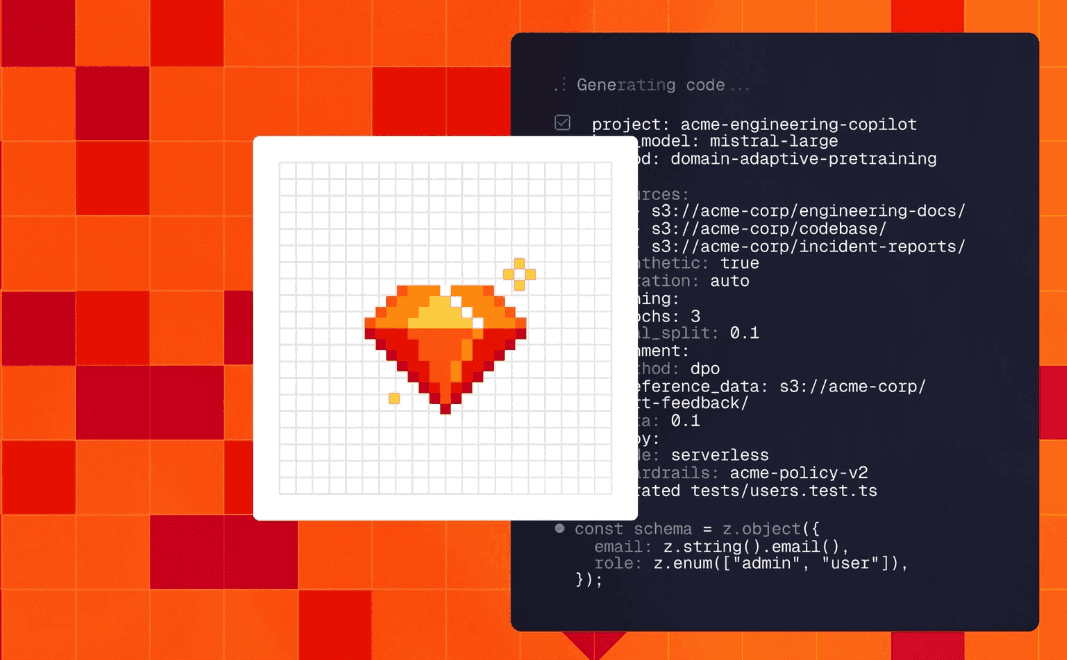
Source: SiliconANGLE
Related Stories

The integration of large language models into Microsoft's Foundry platform enables enterprises to discover, customize, and deploy AI applications while addressing data residency requirements
5
. European manufacturers can analyze production facilities and quality data while protecting intellectual property, while healthcare organizations can implement AI-enabled workflows adhering to strict privacy laws5
. Mistral's OCR 4 model specifically targets structured document processing, automation, and agentic workflows requiring data extraction from business documents5
.The deal's structure appears designed to sidestep EU antitrust concerns that previously examined whether Microsoft's 2024 investment gave it "decisive influence" over Mistral
2
. By focusing on Mistral's AI computing power and distribution agreements rather than equity, both companies are positioning the arrangement as compatible with digital autonomy goals2
. However, true independence from U.S. technology remains distant, as even Mistral's European data centers rely heavily on American-designed chips from NVIDIA and others1
5
. The European Commission has shown appetite for probing AI partnerships between incumbents and startups, making regulatory response to this arrangement worth monitoring2
. For cloud and AI customers, the partnership offers frontier capabilities with greater control, though whether regulators accept this framing will test the viability of hybrid sovereignty models combining American infrastructure with European operations.Summarized by
Navi
02 Dec 2025â¢Technology

12 Jun 2025â¢Technology

05 Aug 2026â¢Technology

1
Science and Research

2
Technology

3
Technology