Nokia and Nvidia Complete World's First AI-RAN Call, Turning Cell Towers Into AI Computing Hubs


6 Sources
[1]
'This is a wow moment': T-Mobile has made the world's first AI-RAN call, and it could mean huge changes for the next generation of staying in touch
* T-Mobile, Nokia, and Nvidia claim the first AI-RAN call through a commercial cell site in Bellevue, Washington * The call ran Nokia's radio software on Nvidia GPUs, but no AI performance data was provided * Commercial AI-RAN gear is due in 2027, with 6G networks expected around 2030 T-Mobile,
[2]
NVIDIA, Nokia and Leading Telecom Operators Turn Networks Into Distributed Intelligence Platforms
* Leading global telecom operators are expanding NVIDIA-powered computing across their networks to deliver advanced services closer to people and businesses, improve wireless experience and automate network operations. * T-Mobile completes the world's first AI-RAN call on a commercial network,
[3]
NVIDIA, Nokia and Leading Telecom Operators Turn Networks Into Distributed Intelligence Platforms
Leading global telecom operators are expanding NVIDIA-powered computing across their networks to deliver advanced services closer to people and businesses, improve wireless experience and automate network operations. NVIDIA today announced that leading global telecom operators are turning their
[4]
Nokia and Nvidia seek to turn 5G antennas into mini data centers
What if cell towers were no longer used solely to transmit data, but also to run artificial intelligence? Nokia and Nvidia are taking their partnership to the next level by integrating AI directly into the operation of mobile networks. The development could open up a new market for both companies,
[5]
Nvidia Corporation, Nokia Corporation and Leading Telecom Operators Turn Networks into Distributed Intelligence Platforms
NVIDIA Corporation announced that leading global telecom operators are turning their networks into distributed intelligence platforms, adding NVIDIA accelerated computing to centralized data centers, metro sites and cell sites so they can serve models and applications closer to the people,
[6]
Nokia expands collaboration with NVIDIA to integrate AI into telecom networks
Nokia announces a new stage in its collaboration with NVIDIA, with new capabilities enabling AI to be integrated into radio signal processing, intelligence capabilities to be deployed closer to data sources, and the use of supervised AI agents to be expanded to the management of different network
Share
Copy Link
Nokia, Nvidia, and T-Mobile completed the world's first AI-RAN call on a commercial network in Bellevue, Washington. The breakthrough transforms traditional cell towers into distributed intelligence platforms, with Deutsche Telekom reporting 10% to 15% uplink throughput gains in lab tests. Commercial AI-RAN deployments are slated for 2027.
Nokia and Nvidia Achieve World's First AI-RAN Call on Live Network
Nokia, Nvidia, and T-Mobile have completed the world's first AI-RAN call on a commercial network in Bellevue, Washington, marking a turning point for next-generation networks
1
2
. The call ran over T-Mobile's live production network using a Nokia Massive MIMO radio, Nokia's 5G anyRAN software, and servers built on Nvidia's NVIDIA Aerial RAN Computer (ARC) platform1
. The site connected to T-Mobile's existing 5G Standalone core and a commercial smartphone, demonstrating that the technology works outside controlled lab environments1
.
Source: TechRadar
How AI-RAN Transforms Traditional Radio Access Networks
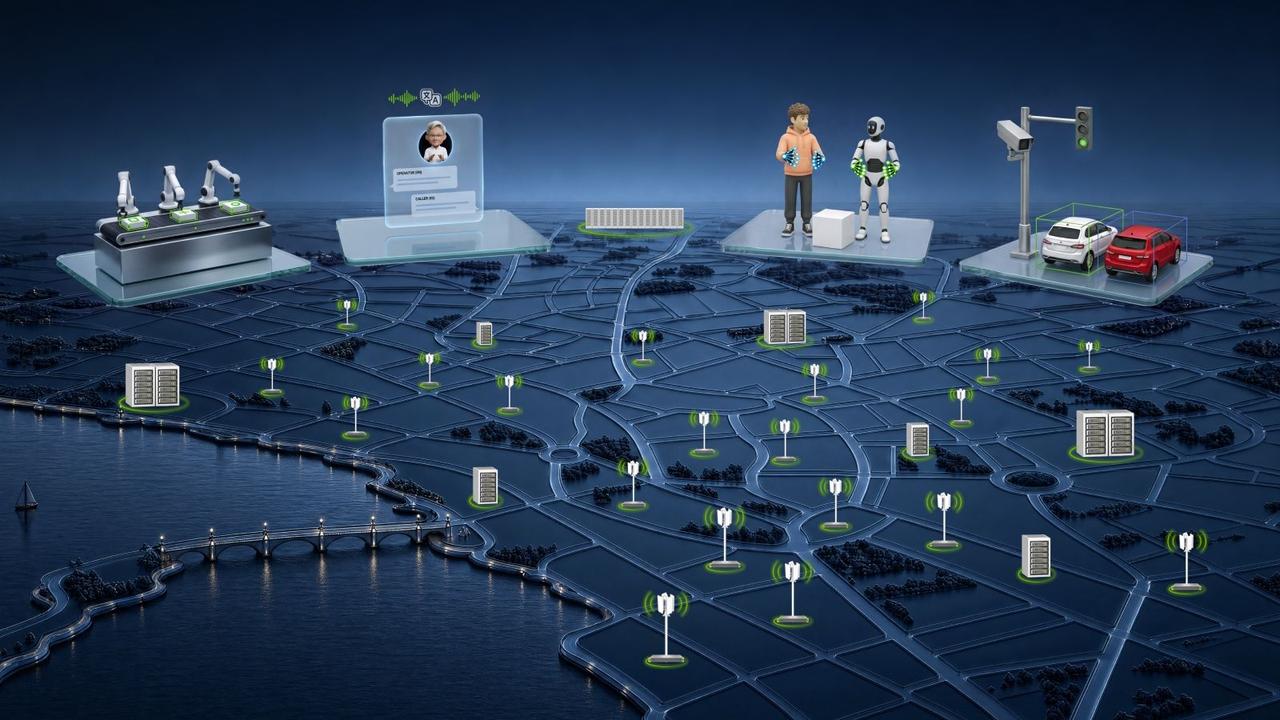
Artificial Intelligence - Radio Access Network technology moves radio signal processing from custom chips onto accelerated hardware—specifically Nvidia GPUs running Nokia's CUDA-based radio software
1
. The radio access network is the part of a mobile network that includes antennas, radios, and baseband computers at each cell site1
. By running on the same platform as advanced services, AI-RAN allows the same hardware to run AI models that fine-tune radio links while renting out spare capacity to other AI jobs1
. Jensen Huang, founder and CEO of Nvidia, framed the shift: "Telecom networks were built to carry the world's conversations. Now, they will also carry the world's intelligence"2
3
.
Source: NVIDIA
Spectral Efficiency Gains Drive Telecom Operators to AI-Native 5G
The primary benefit of AI-RAN is spectral efficiency—squeezing more data through the same slice of airwaves
1
. Nokia's chief technology and AI officer Pallavi Mahajan stated, "With AI-RAN, we are on a path to 2x spectral efficiency"1
. Nokia's July 2026 platform launch claims efficiency gains of more than 20% so far, with 50% targeted for 2027 and more than 100% for 20281
. Deutsche Telekom reported typical uplink throughput gains of 10% to 15% from AI-based channel estimation in initial tests in Bonn and Oulu1
4
. Omdia senior principal analyst Gabriel Brown called this "a wow moment," noting the gains came from software updates to equipment already in the field1
.
Source: Market Screener
Related Stories


European Telecom Operators Build Distributed Intelligence Platforms
Nine operators across Europe, the Middle East and Africa (EMEA) are building or expanding NVIDIA-powered infrastructure across centralized and distributed locations
2
3
. Deutsche Telekom plans to expand its NVIDIA-powered Industrial AI Cloud, which hosts open models including NVIDIA Nemotron and Soofi, and serves robotics companies such as Agile Robots2
3
. Orange is hosting open models, including NVIDIA Nemotron, as a managed service on its Live Intelligence trusted AI platform, enabling new advanced services for enterprises2
3
. Orange is deploying NVIDIA Aerial RAN Computer for voice intelligence applications using Nemotron Speech, demonstrating services to help emergency and field services teams translate across multiple languages in real time with low latency2
3
. Elisa has deployed NVIDIA Aerial RAN Computer at a distributed network location, running a voice intelligence application that serves as an enterprise assistant2
3
. Elisa completed Europe's first field trial of AI-RAN, running voice, mobile data and vision AI together on a single accelerated computing platform over 5G2
3
. BT is preparing live AI-RAN trials in Birmingham, England, with Nokia and Nvidia in 20275
.Commercial Deployment Timeline and Investment Questions
Nokia's AI-RAN products enter pilot deployments around the end of this year, with commercial availability slated for 2027
1
. T-Mobile CTO John Saw said field trials would help the carrier get "a sense of what the total cost of ownership is," and when asked about Nokia's spectral efficiency claims, he told Fierce that "the proof is going to be in the pudding"1
. Installing additional computing capacity requires significant investment in an industry where telecom operators are already closely monitoring their spending4
. Nokia argues that AI-RAN could improve the profitability of existing network infrastructure and drive new investments4
. Nearly 20 telecom operators have publicly announced AI-RAN collaborations using Nokia anyRAN software and NVIDIA Aerial RAN Computer3
. For Nvidia, every cell site that gets a GPU represents a sale as the company chases its next multi-billion-dollar growth idea, betting on reprogrammable AI infrastructure and targeting custom ASICs in multiple industries1
. T-Mobile opened its AI-RAN Innovation Center with Nvidia, Ericsson, and Nokia in 2024, and T-Mobile chief network officer Ankur Kapoor argues that "AI-RAN is a continuum, not a single product"1
. Watch for field trial results from Deutsche Telekom in 2027, competitive pressure from AI-driven telecom networks running on vendor-specific silicon, and edge AI applications that justify the infrastructure investment as AI-native 5G matures toward 6G networks expected around 20301
.References
Summarized by

Navi
[2]
[3]
[4]
Related Stories
Recent Highlights


Recent Highlights
Today's Top Stories








Don’t drown in AI news. We cut through the noise - filtering, ranking and summarizing the most important AI news, breakthroughs and research daily. Follow topics that matter to you and stay ahead.


