Nvidia CEO Jensen Huang says the future of AI is both open and proprietary, not one or the other


2 Sources
2 Sources
[1]
The Future of AI Is Open and Proprietary
AI leaders -- including the CEOs of Mistral, Perplexity, Cursor and Thinking Machines Lab -- agree that open model efforts are beneficial for innovation across the AI ecosystem. AI is the defining technology of our time, quickly becoming core business infrastructure. It's fueled by a diverse ecosystem of models: large and small, open and proprietary, generalist and specialist. This variety is essential for a future where every application will be powered by AI, every country will build it and every company will use it. And it's not a debate between open versus closed innovation. As NVIDIA founder and CEO Jensen Huang told attendees at a special session on open frontier models at NVIDIA GTC, "Proprietary versus open is not a thing. It's proprietary and open." That's why the future of AI innovation isn't about a single massive model. Every industry -- healthcare, finance, manufacturing -- tackles its own unique challenges. They all need AI that can reason about their data and workflows in various ways. And that requires systems of models, tuned and specialized for different modalities, domains and organizations, working together to solve a specific business problem. NVIDIA is a major contributor to open source AI: it's now the largest organization on Hugging Face, with nearly 4,000 team members. And at GTC, the company announced the NVIDIA Nemotron Coalition, a first-of-its-kind global collaboration of model builders and AI labs working to advance open, frontier-level foundation models through shared expertise, data and compute. The first project stemming from the coalition will be a base model codeveloped by Mistral AI and NVIDIA, with coalition members contributing data, evaluations and domain expertise to support the model's post-training and continued development. It'll be shared with the open ecosystem and underpin the next generation of NVIDIA Nemotron models, which have been downloaded more than 45 million times from Hugging Face. Several Nemotron Coalition members joined other leaders building and consuming open models for a back-to-back panel session at GTC. The first panel featured LangChain cofounder and CEO Harrison Chase, Thinking Machines Lab founder and CEO Mira Murati, Perplexity CEO and cofounder Aravind Srinivas, Cursor CEO and cofounder Michael Truell, and Reflection AI cofounder and CEO Misha Laskin. The second included Mistral cofounder and CEO Arthur Mensch, OpenEvidence CEO Daniel Nadler, and Black Forest Labs cofounder and CEO Robin Rombach, alongside Hanna Hajishirzi, senior director of natural language processing at Ai2, and Anjney Midha, founder of AMP PBC. Five key points stood out from the conversation: 1. AI agents are becoming highly capable coworkers. "We're soon going to see agents really be coworkers that can take on tasks that take many hours or many days, and do incredibly complex workloads," said Cursor's Truell. 2. AI is not a single model -- it's an orchestrated system. "What you want is a multimodal, multi-model and multi-cloud orchestra," said Perplexity's Srinivas. "All you've got to do is delegate your task. You don't have to worry about which model is good at what -- it's for the orchestration system to figure it out." 3. Openness fuels innovation across the model ecosystem. "Models are fundamental knowledge infrastructure, and fundamental knowledge infrastructure yearns for openness," said Reflection AI's Laskin. "There's a flourishing ecosystem of powerful, closed models but equally capable open models that are going to be coming over the next couple years." This combination of open and proprietary models drives advancements at frontier AI companies as well as in academia. "There's a lot of study to be done, and it cannot be done completely in the large labs," said Thinking Machines Lab's Murati. "This is where openness can be very helpful...it advances the science of AI, the science of intelligence." 4. Open systems are trustworthy and accessible. "At the end of the day, you're delegating trust...and it's much easier to trust an open system," said AMP PBC's Midha. With a trusted system, developers can deploy long-running AI agents that can tackle virtually any task. "The models and the systems orchestrating the models are going to get much more capable," said LangChain's Chase. "And so you'll be able to have personal productivity agents that can take on more complex tasks that run for longer." Open ecosystems also foster collaboration, helping democratize access to AI. "We believe that open-wide models should be the basis for building all the AI software in the world," said Mistral's Mensch. "By having an open ecosystem of people that have aligned incentives to create assets that are going to be great for humanity, we can accelerate progress and make sure that everybody gets access in a fair way across the world to artificial intelligence." 5. Society needs generalist and specialist AI to provide value. "You have to sort of shape AI the way you shape society," said OpenEvidence's Nadler, describing how hospitals are organized into generalists working alongside world-class specialists. "I think the shape of AI is going to reflect that." Specialized AI is on the rise because it lets organizations combine open foundations with their own proprietary data. That unique data is where they unlock real, differentiated value across business and academia. "These days you might argue that progress in AI is getting limited into a few closed labs, but it's actually very important to the vast majority of academia and researchers, or nonprofit and other places who want to also be part of this progress," said Ai2's Hajishirzi. "And we've seen that all this progress already has happened by everything being open." "It's actually one of the most exciting times to work on either the frontier models, the big models or more specialized open models that then get deployed on device," said Black Forest Labs' Rombach. "There's so many different frontiers, and all of them should have some open component." Watch the GTC session highlights on YouTube and start building with NVIDIA Nemotron open models.
[2]
Nvidia CEO Jensen Huang says of AI that 'open is not a thing, it's proprietary and open', sparking a conversation about bot orchestras
It's happened, the AI bros think they're conducting symphonies. The world of AI boffins really is baffling, sometimes. I'm finally used to the idea that I can chat to a non-sentient, very knowledgeable and occasionally hallucinatory machine, and already we're talking about AI models interacting with AI models. It's only in such a world that Nvidia CEO Jensen Huang could think to utter the seemingly contradictory statement: "Proprietary versus open is not a thing. It's proprietary and open." He said this in a recent GTC panel discussion with various AI company CEOs, and the entire discussion is framed around this mix of open and closed models. The others seem to agree with the Nvidia CEO that open plus proprietary is the way. It's important to note that they aren't saying that you can have proprietary open-source code, as that would indeed be a contradiction. You can have a company make its code open to public viewing but requiring permission to actually use, but this wouldn't make it open-source, as open-source code must have a license from the Open Source Initiative (OSI), which requires the code to be allowed to be "freely used, modified, and shared." Instead, they mean that there exist broader open foundation models alongside more specialised proprietary ones, and this is becoming increasingly relevant as AI "orchestration systems" are starting to crop up, which interact with other tools. These tools can and presumably will -- assuming the AI industry continues on an upward trajectory -- use AI themselves. So, we're essentially talking about AI interacting with AI, orchestrated by AI. Cursor CEO Michael Truell explains this system: "I think we're going to see the rise of these compound agents that can be smarter than any one model on their own and mix them all together... All you have to do is delegate your task. You don't have to worry about which model is good at what; it's for the orchestration system to figure it out. These sub-agents are like musicians, and the models are just instruments, and the work that AI gets done for you is the symphony or the music that they play." Jensen agrees: "Even in a closed-model company, I really believe that open models will be used as part of the agentic system, where the closed model is your crown jewels." So, if you've only just started getting used to chatting to a single AI model, the bad news is the AI industry has already ploughed ahead into more complicated pastures. Anyone who's been paying attention to the hype surrounding OpenClaw will probably already know this, though. This is an open-source AI that essentially acts as a middleman between your various accounts, applications, and, importantly for this discussion, your other AI subscriptions. I suppose it is a little like a conductor of an orchestra. A very mechanical, lifeless, orchestra. And when our software and even our operating systems are becoming more *gulp* agential, it's not difficult to envision a world where open-source AI models interact with proprietary agential ones, and we oversee the former. But just to fan the flames against techno-determinism for a moment, why couldn't all these models be open-source? Reflection AI CEO Misha Laskin seems to agree: "I think the other big misconception is on open models, that somehow open models are fundamentally going to be behind the frontier... I think that's just an artifact of the time where we are today. There's nothing fundamentally different between an open and a closed model." In which case, why not have it all open? I suppose the argument would be that there will always be a need for proprietary models for different use cases. And there might always be room for specialism when it comes to data sets, training, and implementation. On that note, I'll let Huang take us over the finish line with a similar sentiment: "We love a world where there's proprietary products, but we also need a world where a whole bunch of companies and different industries in different domains need models as a technology that we could then transform into products." At least, I think that's a similar sentiment. I can't quite tell.
Share
Share
Copy Link
Nvidia CEO Jensen Huang declared that the future isn't about choosing between open versus proprietary AI models—it's about using both together. At GTC, industry leaders discussed how AI orchestration systems will blend open-source AI and proprietary models to create specialized solutions across industries, with Nvidia launching the Nemotron Coalition to advance this vision.
Nvidia CEO Jensen Huang Rejects the Open Versus Closed AI Debate
Nvidia CEO Jensen Huang made a bold statement at a special session on open frontier models at NVIDIA GTC, declaring that "proprietary versus open is not a thing. It's proprietary and open."
1
This perspective challenges the prevailing notion that the future of AI must choose between open-source AI and proprietary models. Instead, Huang argues that both approaches will coexist and complement each other as AI becomes core business infrastructure across every industry and application.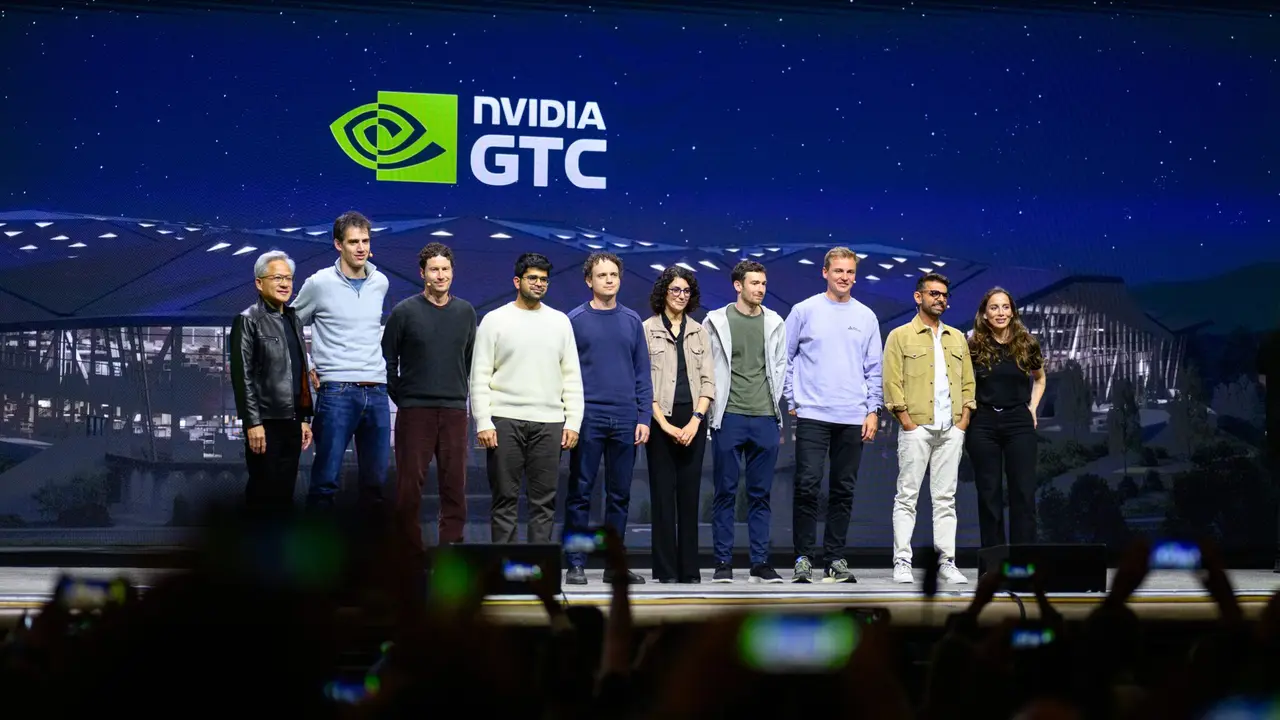
Source: NVIDIA
The panel discussion at GTC featured prominent AI industry leaders including Mistral AI cofounder and CEO Arthur Mensch, Perplexity CEO Aravind Srinivas, Cursor CEO Michael Truell, and Thinking Machines Lab founder Mira Murati. Their consensus: the future of AI innovation isn't about a single massive model but rather systems of AI models—large and small, open and proprietary, generalist and specialist—working together to solve specific business problems.
1
AI Orchestration Systems Will Conduct Multi-Model Symphonies
A key concept emerging from the discussion is AI orchestration systems that coordinate multiple AI models like a conductor leading an orchestra. Cursor CEO Michael Truell explained: "All you have to do is delegate your task. You don't have to worry about which model is good at what; it's for the orchestration system to figure it out. These sub-agents are like musicians, and the models are just instruments."
2
Perplexity's Srinivas emphasized the need for "a multimodal, multi-model and multi-cloud orchestra" where tasks are delegated without users needing to understand which model excels at what.
1
These compound agents will be smarter than any single model, mixing different AI models together to tackle complex workloads. Huang agreed, stating that "even in a closed-model company, I really believe that open models will be used as part of the agentic system, where the closed model is your crown jewels."2
Nvidia Launches Nemotron Coalition to Advance Foundation Models
Nvidia announced the NVIDIA Nemotron Coalition at GTC, a first-of-its-kind global collaboration of model builders and AI labs working to advance open, frontier-level foundation models through shared expertise, data, and compute.
1
The first project will be a base model codeveloped by Mistral AI and NVIDIA, with coalition members contributing data, evaluations, and domain expertise. This model will be shared with the open ecosystem and underpin the next generation of NVIDIA Nemotron models, which have been downloaded more than 45 million times from Hugging Face.1
Nvidia is now the largest organization on Hugging Face with nearly 4,000 team members, demonstrating its commitment to open-source AI development alongside its proprietary offerings.
1
This dual approach reflects the company's belief that openness drives AI innovation while proprietary models serve specialized applications.Related Stories



Openness Fuels Innovation and Trustworthiness in the Model Ecosystem
Reflection AI CEO Misha Laskin argued that "models are fundamental knowledge infrastructure, and fundamental knowledge infrastructure yearns for openness."
1
He predicted a flourishing model ecosystem where powerful proprietary models coexist with equally capable open models over the next couple years. Thinking Machines Lab's Murati noted that "there's a lot of study to be done, and it cannot be done completely in the large labs," highlighting how openness advances the science of AI and intelligence.1
AMP PBC founder Anjney Midha emphasized trustworthiness: "At the end of the day, you're delegating trust...and it's much easier to trust an open system."
1
This transparency becomes crucial as AI agents evolve into highly capable coworkers that can handle complex tasks spanning hours or days. Mistral's Mensch added that "open-wide models should be the basis for building all the AI software in the world," enabling fair access to artificial intelligence across the globe through collaboration.1
Every Industry Needs Generalist and Specialist AI Working Together
The panel stressed that every industry—healthcare, finance, manufacturing—faces unique challenges requiring AI models tuned and specialized for different modalities, domains, and organizations.
1
This diversity is essential for a future where every application will be powered by AI, every country will build it, and every company will use it. LangChain cofounder Harrison Chase predicted that "the models and the systems orchestrating the models are going to get much more capable," enabling personal productivity AI agents that can handle increasingly complex, long-running tasks.1
Huang concluded by emphasizing the need for both worlds: "We love a world where there's proprietary products, but we also need a world where a whole bunch of companies and different industries in different domains need models as a technology that we could then transform into products."
2
This vision of bot orchestras conducting multi-model systems represents the next phase of AI innovation, moving beyond debates about open versus closed to embrace the complementary strengths of both approaches.References
Summarized by

Navi
[1]
Related Stories
Recent Highlights
1
Apple Plans Major Siri AI Overhaul in iOS 27 With Third-Party Chatbot Integration
Technology

2
OpenAI shuts down Sora after six months, ending Disney's $1 billion licensing partnership
Technology

3
AI chatbots validate you too much, making you less kind to others, Stanford study reveals
Science and Research
Recent Highlights
Today's Top Stories









Your Daily Dose of Curated AI News
Don’t drown in AI news. We cut through the noise - filtering, ranking and summarizing the most important AI news, breakthroughs and research daily. Spend less time searching for the latest in AI and get straight to action.

