Nvidia unveils BlueField-4 STX to eliminate storage bottlenecks stalling agentic AI inference


4 Sources
[1]
Nvidia launches BlueField-4 STX storage architecture for agentic AI at GTC 2026
Nvidia announced BlueField-4 STX at GTC 2026 on March 16, a modular reference architecture for accelerated storage designed to address the data access bottleneck limiting agentic AI inference. Built around a new storage-optimized BlueField-4 DPU and ConnectX-9 SuperNIC, the platform targets GPU
[2]
Nvidia BlueField-4 STX adds a context memory layer to storage to close the agentic AI throughput gap
When an AI agent loses context mid-task because traditional storage can't keep pace with inference, it is not a model problem -- it is a storage problem. At GTC 2026, Nvidia announced BlueField-4 STX, a modular reference architecture that inserts a dedicated context memory layer between GPUs and
[3]
The convergence of context: Why Nvidia's BlueField-4 STX marries the network and storage admin - SiliconANGLE
The convergence of context: Why Nvidia's BlueField-4 STX marries the network and storage admin For years, the "wall" between storage and networking administrators has been a fixture of the enterprise data center. I spent the early part of my career as a network engineer and the arena of storage
[4]
Nvidia introduces BlueField-4 STX reference architecture for AI storage systems - SiliconANGLE
Nvidia introduces BlueField-4 STX reference architecture for AI storage systems Nvidia Corp. today launched a reference architecture that hardware makers can use to build storage equipment for artificial intelligence clusters. The BlueField-4 STX made its debut at the company's GTC developer
Share
Copy Link
Nvidia announced BlueField-4 STX at GTC 2026, a modular AI storage reference architecture that inserts a dedicated context memory layer between GPUs and traditional storage. The platform delivers 5x the token throughput and 4x better energy efficiency compared to CPU-based storage, targeting the key-value cache bottleneck that causes GPU underutilization during extended AI agent sessions.
Nvidia Targets Storage Bottleneck Limiting Agentic AI Performance
Nvidia announced BlueField-4 STX at GTC 2026 on March 16, introducing a modular AI storage reference architecture designed to address the data access bottleneck that limits agentic AI inference . Built around a new storage-optimized BlueField-4 Data Processing Unit (DPU) and ConnectX-9 SuperNIC, the platform targets GPU underutilization that occurs when AI agents operating across extended sessions and expanding context windows exceed the throughput of conventional storage paths
1
. Nvidia claims BlueField-4 STX delivers up to 5x the token throughput and energy efficiency, 4x better energy efficiency, and 2x the data ingestion speed compared with traditional CPU-based storage architectures2
.Context Memory Layer Solves Key-Value Cache Management Crisis
The specific challenge that BlueField-4 STX addresses is key-value cache management during transformer inference
1
. Large Language Models (LLMs) compute KV pairs for every token in context, which must be stored and retrieved for each subsequent generation step. As context windows grow into hundreds of thousands of tokens, the KV cache outgrows GPU HBM capacity, forcing offloads to host DRAM or NVMe storage that pass through the CPU, adding latency that compounds with context length and stalls GPU execution1
.
Source: VentureBeat
The context memory layer that STX introduces between GPUs and traditional storage is designed to maintain coherent working memory across sessions, tool calls, and reasoning steps without forcing round trips through general-purpose storage
2
. "Traditional data centers provide high-capacity, general-purpose storage, but generally lack the responsiveness required for interaction with AI agents that need to work across many steps, tools and different sessions," Ian Buck, Nvidia's vice president of hyperscale and high-performance computing, said in a briefing2
.AI-Native Infrastructure Built on Extreme Co-Design
BlueField-4 STX bypasses the host CPU by routing data through a dedicated accelerated storage layer via RDMA over Spectrum-X Ethernet
1
. The BlueField-4 processor manages NVMe SSDs directly and handles data integrity and encryption for the KV cache, keeping context accessible at the storage processor rather than transiting the host1
. The full stack runs on the Vera Rubin platform and integrates the Vera CPU alongside ConnectX-9, Spectrum-X Ethernet, DOCA software, and AI Enterprise software1
. The architecture employs what Jensen Huang calls extreme co-design, a multidisciplinary engineering approach that treats the entire data center as a single integrated unit to eliminate traditional silos between networking and storage3
. "AI systems that reason across massive context and continuously learn require a new class of storage," Jensen Huang, founder and CEO of Nvidia, said at GTC1
.Related Stories

CMX Platform and Partner Ecosystem Signal Industry Shift
The first rack-scale implementation built on BlueField-4 STX is the Nvidia CMX context memory storage platform, which extends GPU memory with a high-performance context layer designed specifically for storing and retrieving KV cache data generated by Large Language Models during inference
2
. Storage vendors co-designing systems based on STX include DDN, Dell Technologies, HPE, IBM, NetApp, and VAST Data, alongside manufacturing partners AIC, Supermicro, and Quanta Cloud Technology1
.
Source: SiliconANGLE
Eight cloud providers including CoreWeave, Lambda, Mistral AI, and Oracle Cloud Infrastructure committed to early adoption for context memory storage
1
. Buck confirmed that STX ships with a software reference platform alongside the hardware architecture, with Nvidia expanding DOCA to include a new component called DOCA Memo2
. STX-based platforms are expected from partners in the second half of 20261
. The combination of enterprise storage incumbents and AI-native cloud providers signals that Nvidia is positioning STX as the reference standard for anyone building storage infrastructure serving agentic AI workloads, which within the next two to three years is likely to include most enterprise AI deployments running multi-step inference at scale2
. For long-context reasoning tasks that define agentic AI, improved agentic AI throughput means the difference between scaling AI factories or watching expensive GPUs sit idle waiting for data3
.References
Summarized by

Navi
[2]
[3]
Related Stories
NVIDIA Open-Sources cuFile API and Launches Storage-Next Initiative With 40+ Industry Partners
04 Aug 2026•Technology
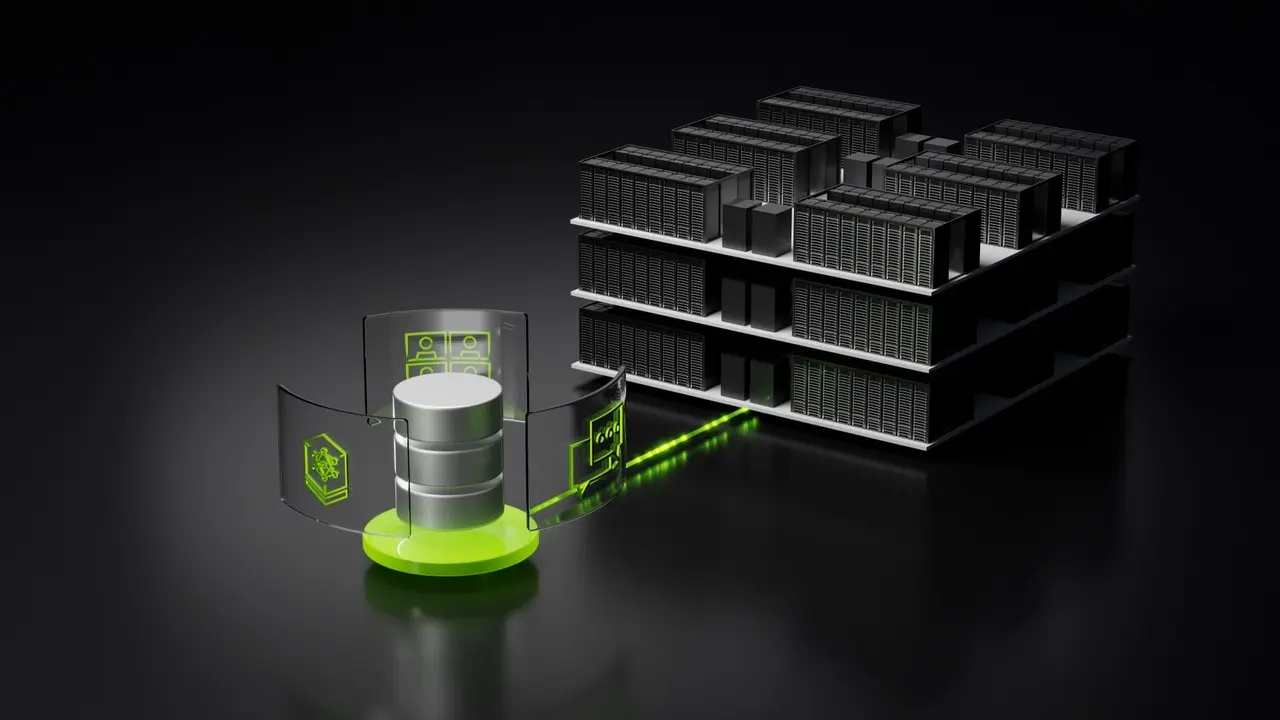
NVIDIA Expands AI Infrastructure with New Storage Certification and Reference Architectures
19 Mar 2025•Technology
AI storage becomes the bottleneck as agentic AI pushes infrastructure beyond GPU limits
08 Jul 2026•Technology

Recent Highlights



Recent Highlights
Today's Top Stories












Don’t drown in AI news. We cut through the noise - filtering, ranking and summarizing the most important AI news, breakthroughs and research daily. Follow topics that matter to you and stay ahead.


