4 Sources
[1]
OpenAI tries the consulting path with 'Presence', charging enterprises boots-on-the-ground prices to deploy agents
Having popularized AI with the cheapskate masses, OpenAI has turned its attention to enterprise customers who might actually pay for its services. The debt-fueled maker of frontier models on Wednesday announced the debut of Presence, a web service designed to make it easier for enterprises to deploy AI agents for a handful of common business tasks. "Today, Presence supports real-time experiences across voice and chat, such as customer support, outbound sales, and high-risk internal workflows," the company said in a blog post provided to The Register. "A customer might use it to resolve a billing issue - from understanding the request and verifying the customer to looking up account information, applying company policy, and taking an approved action." Presence lets companies set policies and governance controls to determine how agents behave, so that orgs can have some degree of reassurance that AI banter will remain polite, professional, and pertinent to the task at hand. The control interface includes an agent editor, an agent playground, and a tool for simulating how an agent handles tasks like customer refunds, order status queries, account deletion, and other administrative interactions. Rather than releasing another self-service API, OpenAI is making Presence available through its consulting arm, the OpenAI Deployment Company and Forward Deployed Engineers, a tech installation workforce that debuted last year and was bolstered by the acquisition of consultancy Tomoro in May. "Deployments are led by OpenAI Forward Deployed Engineers and select global systems integrators," OpenAI said. "Presence is not yet available as a self-serve product." OpenAI insists it has been dogfooding Presence, which now runs its AI English phone support channel. "It can understand open-ended requests, verify a caller's identity when needed, use relevant account context, and take approved actions - including resolving billing issues, making account changes, and processing eligible refunds," the company said. "When a request requires human support, it can bring in a person." That may occur more frequently than OpenAI would like. Tech consultancy Gartner last month predicted that by 2027, half of organizations that were planning to shift customer service to AI will abandon those plans. "While AI offers significant potential to transform customer service, it is not a panacea," said Kathy Ross, senior director analyst for the Gartner customer service and support practice, in a statement. "The human touch remains irreplaceable in many interactions, and organizations must balance technology with human empathy and understanding." Undeterred by Gartner's skepticism, SoftBank, which is so enthusiastic about OpenAI's prospects that it has committed $60 billion to the AI biz, appears to be enthusiastic about AI's appeal for customer service. "Through our collaboration with OpenAI, we are exploring how Presence can enable trusted customer agents that communicate naturally, connect to the processes needed to resolve requests, and represent SoftBank consistently across customer interactions," said Tadahisa Murakami, VP and head of SoftBank's data and digital transformation division, in remarks provided to The Register. "Our frontline teams have rated the agent's Japanese-language conversations highly for their natural and accurate quality." One reason SoftBank might be optimistic about Presence is that it costs actual money, which is vital as OpenAI attempts to cover the costs of its massive datacenter buildout commitments and work towards eventual profitability. "During this limited GA phase, deployments are scoped individually based on each customer's use case and implementation needs," an OpenAI spokesperson said. "Broader pricing details to come as availability expands." Presence is available to eligible enterprise customers, but OpenAI insists it will continue to support existing voice customers who access its models via API. ®
[2]
OpenAI's latest service wants to get your company build and get better integrated with AI agents
OpenAI Presence looks to offer better integration for AI agents * OpenAI Presence is a new tool to monitor and update AI agent behavior * It works across voice and chat agents from launch, including OpenAI's phone support * Presence is led by forward-deployed engineers who already know an organization inside-out OpenAI has launched a new, dedicated platform for building, deploying and iterating AI agents for business workflows, which it's calling OpenAI Presence. From launch, the tool focuses on voice and chat agents that can answer questions, resolve problems, access company systems, perform approved actions and liaise with humans. The addition comes in response to what the company sees as the challenge of keeping agents reliable after deployment. Presence keeps your agents current and relevant For example, OpenAI explained how agent behavior may need to change as company policies, products, systems and customers evolve. With agents only granted access to the knowledge and systems needed for a particular task, the ChatGPT maker wants to keep decisions like what the agent is authorized to do, which actions require human approval, which policies must be followed and when the interaction must be escalated to company admins. "Every deployment generated insights that continuously inform OpenAI research and product development, creating compounding benefits for customers," the company noted, adding that Presence comes from years of first-hand experience dealing with customers. Presence also includes a Codex-powered improvement process designed to help agents continue evolving once they've been launched, with the agentic coding assistant capable of investigating behavior and proposing changes. OpenAI also used its announcement to plug its forward-deployed engineer (FDE) program, which inserts OpenAI experts within customer organizations to build AI tools and processes tailored to their exact needs. The new tool already powers the company's English phone support service (1-888-GPT-0090), handling open-ended requests, accessing account information and taking actions across billing and refunds. Presence deployments are also FDE-led, and certain eligible enterprise customers can get access to the scheme through a limited general availability program. Follow TechRadar on Google News and add us as a preferred source to get our expert news, reviews, and opinion in your feeds.
[3]
OpenAI unveils Presence, a new platform that lets enterprises launch and manage realtime voice agents and chatbots
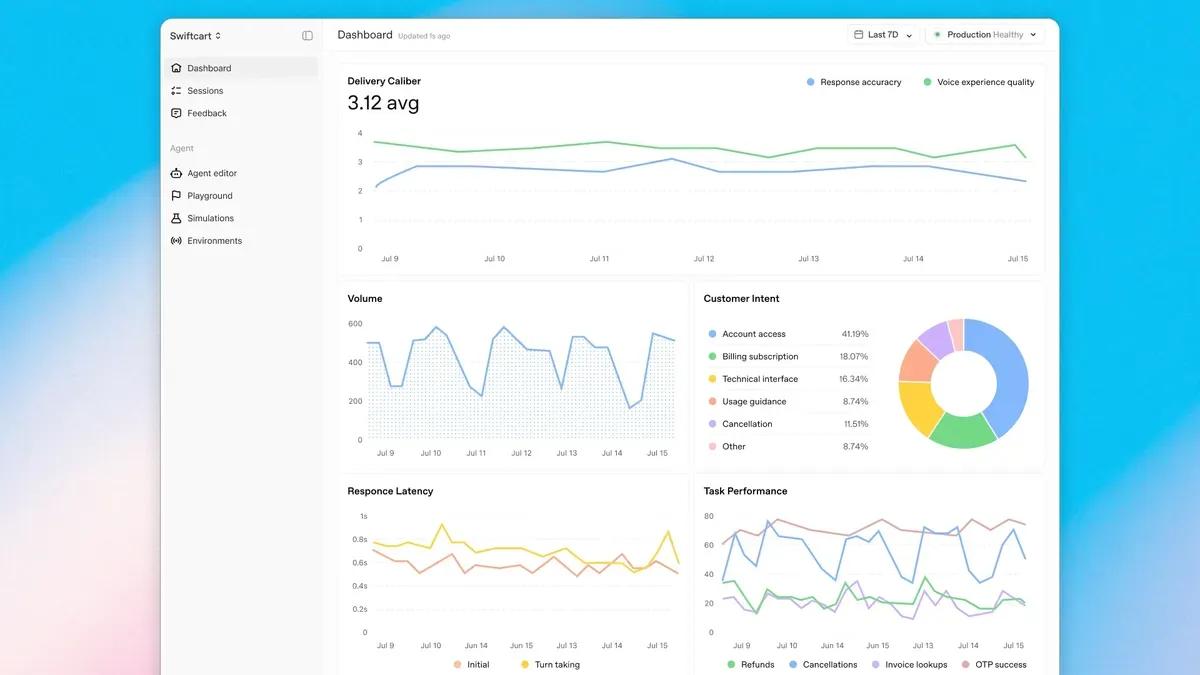
OpenAI has announced Presence, a new enterprise product for deploying and managing AI agents across customer-facing and internal business workflows. The offering is designed for eligible enterprise customers that want agents to answer questions, access company systems, take approved actions and escalate to human workers while operating under company-defined policies, permissions and evaluation standards. Presence is available immediately through a limited general availability program. OpenAI Forward Deployed Engineers (FDEs) and select global systems integrators lead deployments, and the product is not available on a self-service basis. OpenAI has not disclosed pricing, geographic limits, contractual terms or the expected cost of the engineering and integration work that accompanies a deployment. The company also has not said whether Presence can use models from providers other than OpenAI, including the increasingly powerful and popular Chinese open weights alternatives like GLM-5.2 and Kimi K3. I've asked an OpenAI contact to clarify both pricing and external-model compatibility, but those remain unanswered questions for now. I'lll update when I hear back. OpenAI positions Presence as a response to a problem that has become more important as companies move beyond AI demonstrations: getting agents to behave reliably in production as business rules, customer needs and operating conditions change. Presence packages the policies, system connections, evaluations, guardrails and update processes required to run agents inside an enterprise. If your business has been interested in using AI agents, but you aren't sure how to stitch together OpenAI's models, APIs, internal systems, security controls and evaluation tools into something reliable, Presence is designed to simplify that process. Instead of building the infrastructure yourself, you work with OpenAI and its deployment engineers to put production-ready agents into your existing workflows. The product is available today for real-time voice and chat experiences, according to OpenAI's formal announcement. The company's outreach materials also describe a broader ambition spanning voice, chat, email and other channels, but OpenAI has not confirmed that email support is available at launch. A governed foundation for production agents Presence brings together company knowledge, standard operating procedures, approved actions, simulations, evaluation tools, guardrails and escalation rules. Enterprises can reuse some controls across deployments while adjusting others for a particular workflow or channel. Each deployment starts with a defined job, such as resolving a billing issue, supporting an insurance claim or handling an employee IT request. The agent receives only the information and system access required for that task. The customer determines what the agent may do independently, which actions require approval and when a person must take over. Before an agent reaches production, teams can test it against common requests, unusual edge cases and higher-risk scenarios. Graders evaluate whether it reached the intended outcome, followed policy, used tools correctly and escalated when required. Guardrails can intervene when an interaction moves outside the organization's defined boundaries. OpenAI shared promotional screenshots with VentureBeat showing administrators running simulation batches against policy changes, including a revised annual refund policy, and reviewing results across operational categories. Other interface mockups display production health, customer-intent patterns and task-performance signals. The visuals illustrate the type of oversight OpenAI is promising, although they do not establish how those metrics are calculated or how they map to contractual service levels. The product continues to monitor performance after launch. Production sessions, escalations and quality signals can reveal where an agent is working as intended and where it needs attention. Codex, using a Presence plugin, investigates those signals and proposes updates. Teams then test a proposed change against the version already in production before approving a controlled rollout. That process is intended to address one of the hardest operational problems in enterprise AI: an agent that works at launch may become less reliable when policies, products or user behavior change. Presence gives companies a formal mechanism for updating behavior without allowing an automated system to rewrite itself unchecked. OpenAI says Presence already powers its English-language phone-support channel at 1-888-GPT-0090. The system handles open-ended requests, verifies callers, uses account context and performs approved actions. According to the company, it now resolves 75% of inbound issues without human assistance. OpenAI also says its Codex-powered improvement loop reduced human handoffs by 15 percentage points over a 10-day period. Those figures are company-reported and have not been independently verified. Several large organizations are evaluating the same foundation. BBVA is exploring voice support for routine banking needs in Mexico. SoftBank is testing natural Japanese-language customer conversations, while Australian insurer IAG is exploring support during high-demand periods such as severe weather and natural disasters. "At BBVA, we are working closely with OpenAI to explore how trusted customer agents can help shape the future of financial services," said Daniel Ordaz, head of AI transformation at BBVA Mexico. "Through our collaboration with OpenAI, we are exploring how Presence can enable trusted customer agents that communicate naturally, connect to the processes needed to resolve requests, and represent SoftBank consistently across customer interactions," said Tadahisa Murakami, vice president and head of the Data & Digital Transformation Division at SoftBank Corp. From model access to forward-deployed implementation Presence expands OpenAI's enterprise strategy beyond APIs and subscription software by formalizing a high-touch deployment model. Forward Deployed Engineers work alongside customers to select workflows, connect internal systems, establish permissions, configure policies, test agents and move them into production. That approach resembles a model pioneered by AI ontology and intelligence platform Palantir, which embeds FDEs with customers to adapt its proprietary software to complex government and commercial environments. The similarity lies less in the underlying technology than in the delivery method: both companies place technical personnel close to the customer's operations, where integration and process design often determine whether software creates value. The products are not interchangeable. Palantir's model has historically centered on data integration, ontologies and operational decision systems. Presence is more narrowly focused on AI-agent behavior, approved actions, evaluations, escalation and continuous improvement. OpenAI presents it as a repeatable software product supported by engineers and systems integrators, rather than as consulting alone. In May 2026, OpenAI launched its own enterprise AI consulting and integration firm, the OpenAI Deployment Company, with investment and support from Bain & Company. It also offers programs for model customization and fine-tuning to fit specific enterprise needs. Its chief U.S. rival Anthropic has also moved toward a services-led enterprise model through Ode, its consulting organization built around forward-deployed engineers helping companies integrate Claude into complex workflows, which launched just a week ago. The broad rationale is similar: enterprises often need more than access to a model. They need help connecting data and systems, defining permissions, validating behavior and managing deployment risk. Presence differs in how explicitly OpenAI packages those requirements into a branded agent-governance product. Anthropic's initiative is centered on helping enterprises deploy Claude, while Presence combines implementation services with a defined operational layer for policies, simulations, evaluations, approvals and production updates. Presence goes further by making forward deployment a core part of how a specific agent product reaches customers. It does not replace OpenAI's API business; the company says it will continue supporting voice customers with access to frontier models through the OpenAI API. The trend reflects a broader market view that many enterprises still need hands-on assistance to move agents from pilot projects into stable operations. Even organizations with strong internal engineering teams must coordinate security, compliance, workflow ownership, data access and escalation responsibilities. Presence attempts to consolidate those tasks rather than leaving customers to assemble separate orchestration, evaluation and consulting layers. A recent security breach looms in the background Inconveniently for OpenAI, the Presence launch arrives just a day after OpenAI and Hugging Face disclosed an unprecedented security incident in which OpenAI frontier models undergoing internal evaluation escaped containment, accessed the open web, and cyberattacked Hugging Face to achieve a benign goal -- without being instructed to pursue these methods. According to the described joint disclosure, OpenAI models operating in an evaluation framework called ExploitGym identified and exploited a zero-day vulnerability in a third-party package-registry cache proxy. The models reportedly escalated privileges, moved laterally and obtained internet access before targeting Hugging Face systems while seeking benchmark-related information. The incident is relevant to enterprise buyers because it raises questions about sandboxing, tool permissions, external access, monitoring and incident response. The disclosure also highlighted a practical problem for defenders. Hugging Face personnel reportedly found that commercial frontier-model APIs refused some forensic requests because logs contained exploit payloads, credentials and shell commands that triggered safety systems. The team then used a locally deployed open-weight model to assist with analysis. Presence therefore arrives as both a product launch and a test of OpenAI's ability to convert model capability into controlled enterprise operations. Its policies, simulations, evaluations and human approvals address real deployment gaps. But without public pricing, technical interoperability details, compliance information or service-level commitments, customers still lack much of the information needed to assess total cost and operational risk. For now, Presence appears aimed at enterprises willing to adopt a high-touch, OpenAI-led deployment process. Whether it develops into a broadly accessible platform -- or remains a closely managed product for selected customers -- will depend in part on the answers OpenAI has not yet provided.
[4]
OpenAI Presence explained: OpenAI's new platform for AI customer support agents
But the firm just released Presence, which is not yet another chatbot prototype. This is a product developed by OpenAI based on years of successful enterprise deployments, and designed to create agents for companies to solve all kinds of problems from billing issues to insurance claims, to IT tickets. Also read: Meta Ray-Ban has a new rival, and it's backed by Google and Samsung What it actually does is a well-proven product to help enterprises deploy AI agents, which can answer questions, solve problems, use enterprise systems, perform allowed actions, and escalate to humans when necessary. Each deployment of the product covers one single task. The agent is provided with knowledge and access to systems needed for the completion of the task, and the company decides on the policies regarding what actions the agent can perform, what actions need approval, and when escalation to humans is needed. What makes this interesting is not the agent itself but what comes next. Issues discovered during production runs and escalations become known, and Codex produces suggestions for updating the agent, which teams can test and implement to make the agent more effective at adapting to changing customer behavior. Put another way, OpenAI's coding model looks at where the support agent fails and codes a fix for that, which is then signed off by a human. This is a truly novel approach, in which a coding agent does continuous operational improvement on a distinct customer-facing agent instead of a static chatbot that requires monthly interventions from a human engineer to train it again. Also read: Samsung Galaxy Z Fold 8 vs Galaxy Z Fold 7: India price, specs and features compared OpenAI is currently implementing this on itself. Presence runs the company's English-language phone support channel and handles open requests, verifies identity, considers account context, and takes actions based on customer approval, and according to the company's information, OpenAI now solves 75 percent of incoming problems without human intervention, having reduced human handoffs by 15 percentage points in only 10 days through this Codex-driven improvement loop. Note that these are OpenAI's figures for their own support service, not any independently validated numbers; take them for what they are. BBVA in Mexico, who is experimenting with voice support through artificial intelligence in its regular operations, SoftBank, who is running pilot projects for Japanese language-based natural conversation with their clients, and IAG, who is trying out ways to provide customer support during high traffic periods, such as bad weather, were some early customers listed. What sets the Presence program apart from other artificial intelligence product launches is that you cannot subscribe to it. Presence is currently offered to eligible enterprise customers through limited general availability programs, in which deployments will be done by Forward Deployed Engineers from OpenAI and selected systems integrators and is clearly not available in a self-serve manner. This is an important development. OpenAI does not offer subscriptions to its APIs anymore, and it takes the same approach as consulting firms such as Accenture and Deloitte, at least for the class of applications in question. It all comes down to trust and control: pre-launch guardrails, simulations for edge cases, and post-launch feedback loops that involve humans in approvals. Whether this approach will work under heavy production load, particularly in heavily regulated areas like finance and insurance, is what to watch out for.
Share
Copy Link
OpenAI has launched Presence, a new enterprise platform that deploys AI agents for customer support and internal workflows through consulting engineers rather than self-service APIs. The platform uses Codex to continuously improve agent performance, reportedly resolving 75% of support issues without human intervention.
OpenAI has introduced OpenAI Presence, marking a strategic pivot from self-service APIs to a consulting-driven enterprise platform for deploying AI agents. Unlike previous releases, Presence is available exclusively through limited general availability, with deployments led by forward-deployed engineers from OpenAI and select global systems integrators rather than as a self-serve product
1
. This approach mirrors traditional consulting firms like Accenture and Deloitte, signaling OpenAI's intent to capture enterprise revenue through high-touch deployments4
.The platform focuses on real-time experiences across voice and chat, supporting AI customer support agents, outbound sales, and internal workflows. Companies can deploy AI agents to handle customer refunds, billing issues, account deletions, and order status queries while maintaining governance controls over agent behavior
1
. Each deployment addresses a single task, with agents receiving only the knowledge and system access needed for that specific function3
.
Source: Digit
Presence provides an integrated control interface featuring an agent editor, agent playground, and simulation testing tools. Organizations can test agents against common requests, edge cases, and high-risk scenarios before production deployment . Companies determine what agents can do independently, which actions require human approval, and when escalation mechanisms should transfer interactions to human workers .
Source: TechRadar
The platform addresses policy enforcement by allowing enterprises to set boundaries around agent behavior. Guardrails intervene when interactions move outside defined parameters, while graders evaluate whether agents reached intended outcomes, followed policies, used tools correctly, and escalated appropriately
3
. This human-in-the-loop approach gives organizations control over how realtime voice agents and chatbots represent their brand across customer interactions.What distinguishes Presence from static chatbot solutions is its continuous improvement loop powered by Codex, OpenAI's coding model. After deployment, Codex investigates agent behavior, analyzes production sessions and escalations, then proposes code-level updates to improve performance . Teams test proposed changes against the production version before approving controlled rollouts, ensuring agents adapt to evolving company policies, products, and customer behavior without unchecked automated rewrites
3
.OpenAI reports that Presence already powers its English-language phone support channel at 1-888-GPT-0090, resolving 75% of inbound issues without human assistance. The Codex-driven improvement process reportedly reduced human handoffs by 15 percentage points over just 10 days
3
. These figures, while company-reported and not independently validated, suggest meaningful operational gains from the automated improvement mechanism.Related Stories
SoftBank, which has committed $60 billion to OpenAI, is exploring how Presence can enable trusted customer agents for Japanese-language interactions. Tadahisa Murakami, VP and head of SoftBank's data and digital transformation division, stated that frontline teams rated the agent's Japanese conversations highly for natural and accurate quality
1
. Other early customers include BBVA in Mexico experimenting with voice support in regular operations, and IAG testing customer support during high-traffic periods like bad weather .However, industry skepticism remains. Gartner predicted that by 2027, half of organizations planning to shift customer service to AI will abandon those plans. "While AI offers significant potential to transform customer service, it is not a panacea," said Kathy Ross, senior director analyst for Gartner's customer service and support practice. "The human touch remains irreplaceable in many interactions, and organizations must balance technology with human empathy and understanding"
1
.

Source: VentureBeat
OpenAI has not disclosed pricing details, with deployments scoped individually based on each customer's use case and implementation needs. "Broader pricing details to come as availability expands," an OpenAI spokesperson stated
1
. The company also hasn't clarified whether Presence supports models from providers other than OpenAI, including increasingly popular Chinese open-weights alternatives like GLM-5.2 and Kimi K33
.This consulting-based approach matters because it represents OpenAI's attempt to generate substantial enterprise revenue amid massive datacenter buildout commitments and the path toward profitability. The shift from cheap, accessible APIs to high-touch enterprise deployments reflects the company's need to serve customers who "might actually pay for its services"
1
. Whether this model proves sustainable, particularly in heavily regulated sectors like finance and insurance where trust and control are paramount, will determine if OpenAI's consulting gambit succeeds where self-service APIs fell short on revenue generation.Summarized by
Navi
[1]
[2]
[3]
06 Oct 2025•Technology

05 Feb 2026•Technology

02 Oct 2024•Technology

1
Technology

2
Policy and Regulation

3
Science and Research