NVIDIA RTX 5090 Performance Significantly Impacted by PCIe Bandwidth Limitations in Content Creation Workloads


5 Sources
[1]
Lack of PCIe bandwidth can nerf RTX 5090 by up to 25% in content creation workloads -- Puget data confirms performance hit when using older generations and fewer lanes
Large language model AI workloads are unaffected, but content creation and 3D rendering took a real hit. It's always been clear that PCIe bandwidth has an effect on gaming, especially when playing on some of the most high-end GPUs. But what about content creation? Puget Systems put this idea to
[2]
Impact of PCIe 5.0 Bandwidth on GPU Content Creation Performance
With the release of the NVIDIA Blackwell GPUs and RDNA 4-based Radeon 9000-series GPUs, we finally have consumer video cards that support the PCIe 5.0 standard. Although we have had motherboards with support for it for some time now, we didn't have any devices other than storage that took advantage
[3]
PCIe Lane Configurations can alter up to 25% perf in content creation with RTX 5090
The NVIDIA GeForce RTX 5090 is built with PCIe 5.0 x16 support, offering up to 64 GB/s of bandwidth. This is a notable step up from the RTX 4090, which runs at PCIe 4.0 x16 with 32 GB/s bandwidth. Recently, Puget Systems ran a series of tests to see how different PCIe versions and lane counts
[4]
NVIDIA's flagship GeForce RTX 5090 is over 25% slower without full PCIe bandwidth
As an Amazon Associate, we earn from qualifying purchases. TweakTown may also earn commissions from other affiliate partners at no extra cost to you. NVIDIA's flagship GeForce RTX 5090 loses over 25% of its performance in professional video editing workloads when it isn't fed its full PCIe
[5]

NVIDIA RTX 5090 Loses Over 25% Performance Without Full PCIe Bandwidth, With Noticeable Losses in Rendering Workloads
NVIDIA's flagship Blackwell GPU apparently loses a massive chunk of performance if it isn't operated under the full PCIe bandwidth, in particular with video editing applications. Many factors determine a GPU's performance across multiple workloads, and one important one is the PCIe bandwidth that
Share
Copy Link
Recent tests reveal that NVIDIA's RTX 5090 GPU can lose up to 25% performance in content creation tasks when not operating at full PCIe bandwidth, highlighting the importance of proper system configuration for professionals.
NVIDIA RTX 5090 Performance and PCIe Bandwidth
Recent tests conducted by Puget Systems have revealed that NVIDIA's flagship GeForce RTX 5090 GPU can experience significant performance drops when operating under limited PCIe bandwidth conditions. This finding has important implications for professionals in content creation and other high-performance computing fields
1
2
3
.Impact on Content Creation Workloads
The most notable performance impacts were observed in content creation applications, particularly video editing and 3D rendering:
-
DaVinci Resolve: Performance drops of up to 25% were recorded when the RTX 5090 was limited to PCIe 3.0 x8 or PCIe 4.0 x4 configurations
1
3
. -
After Effects: While less affected, still showed noticeable performance decreases at the lowest PCIe bandwidth configurations
1
2
. -
Unreal Engine 5.5: Virtual production tests revealed about a 7% performance drop in the most bandwidth-limited scenarios
1
4
. -
Blender: A 5% difference was observed between the highest and lowest bandwidth options
1
.
PCIe Configurations and Performance

Source: Guru3D
The tests compared various PCIe configurations:
- PCIe 5.0 x16 (64 GB/s): Optimal performance
- PCIe 5.0 x8 and PCIe 4.0 x16 (32 GB/s): Negligible impact
- PCIe 5.0 x4, PCIe 4.0 x8, PCIe 3.0 x16 (16 GB/s): ~10% performance drop
- PCIe 4.0 x4, PCIe 3.0 x8 (8 GB/s): Up to 25% performance loss
2
3
AI Workloads Less Affected
Interestingly, AI workloads such as large language model benchmarks (e.g., Llama) showed little to no impact from PCIe bandwidth limitations. This is likely due to these applications being more dependent on GPU VRAM rather than PCIe bandwidth
1
4
5
.Related Stories


System Configuration Considerations
Source: Tom's Hardware
The findings highlight the importance of proper system configuration for professionals:
-
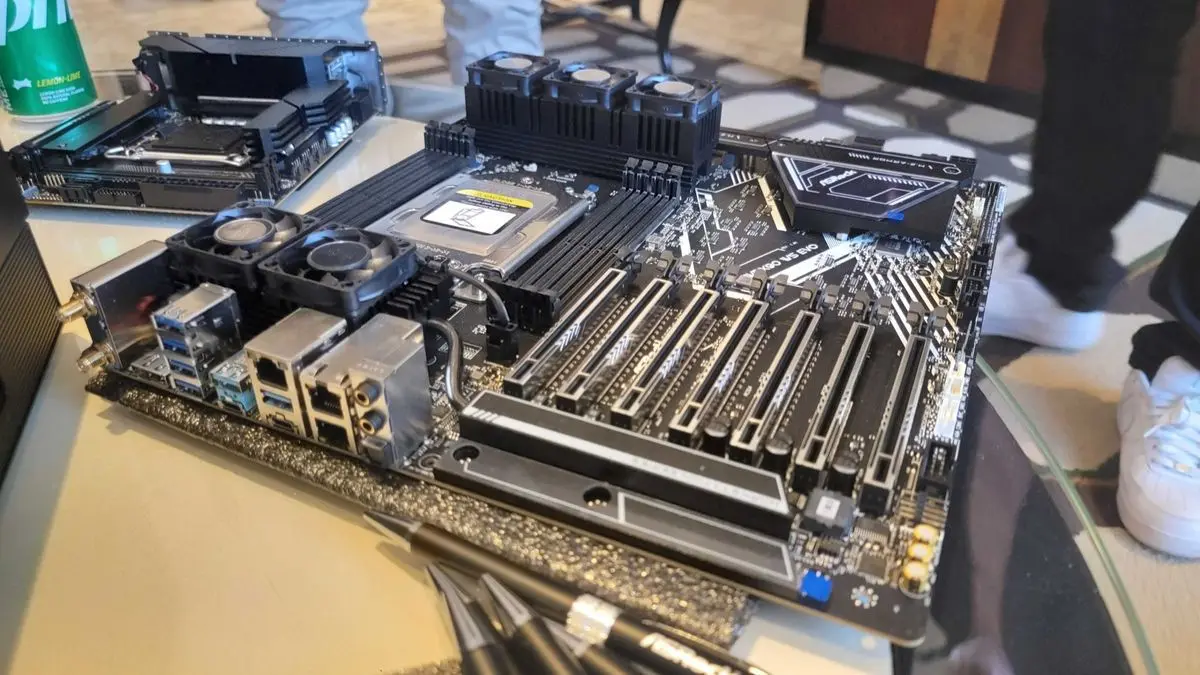
Motherboard Selection: Many consumer motherboards offer limited PCIe lane allocation, potentially forcing GPUs to run at reduced speeds when multiple add-in cards are installed
2
4
. -
Lane Sharing: Installing additional PCIe devices or NVMe SSDs can reduce available lanes for the GPU, impacting performance
1
2
. -
Professional Setups: High-end professional systems, such as those using AMD Ryzen Threadripper CPUs, can mitigate these issues by providing more PCIe lanes
4
.
Implications for Users
-
Content Creators: Those working with high-resolution video or complex 3D scenes should ensure their RTX 5090 is installed in a slot supporting full x16 lanes
3
. -
Multi-GPU Setups: Professionals using multiple GPUs need to be particularly mindful of PCIe lane allocation
3
. -
Gamers: The impact on gaming performance is likely to be less significant, but may still be a consideration for high-end systems
4
. -
Future-Proofing: As GPUs continue to advance, PCIe bandwidth may become an increasingly important factor in system design and upgrades
1
.
Source: Wccftech
This research underscores the complex interplay between cutting-edge GPUs and system architecture, highlighting the need for careful consideration when configuring high-performance workstations for content creation and other demanding tasks.
References
Summarized by

Navi
[2]
Related Stories
Recent Highlights



Recent Highlights
Today's Top Stories



Don’t drown in AI news. We cut through the noise - filtering, ranking and summarizing the most important AI news, breakthroughs and research daily. Follow topics that matter to you and stay ahead.


