Qodo raises $70M to verify AI-generated code as enterprises struggle with trust and quality


2 Sources
[1]
Qodo raises $70M for code verification as AI coding scales | TechCrunch
As AI coding tools generate billions of lines of code each month, a new bottleneck is emerging: ensuring that software works as intended. Qodo, a startup building AI agents for code review, testing and governance, is betting that verification will define the next phase of software development. The
[2]
AI-generated code verification startup Qodo raises $70M - SiliconANGLE
Few areas have felt the impact of generative artificial intelligence as much as software development. Tools such as Anthropic PBC's Claude Code and OpenAI Group PBC's Codex have dramatically accelerated code creation, but that speed comes with a tradeoff: namely, the need to verify that code. Qodo
Share
Copy Link
Qodo, a New York-based startup building AI agents for code review and governance, has raised $70 million in Series B funding led by Qumra Capital. As AI coding tools generate billions of lines of code monthly, the company addresses a critical bottleneck: verifying that AI-generated software works as intended. Major enterprises including NVIDIA and Walmart are already using Qodo's multi-agent system.
Qodo Secures $70 Million to Address Growing Code Verification Crisis
Qodo has raised $70 million in Series B funding led by Qumra Capital, bringing its total funding to $120 million
1
. The round included participation from Maor Ventures, Phoenix Venture Partners, S Ventures, Square Peg, Susa Ventures, TLV Partners, Vine Ventures, and notable individual investors from OpenAI and Meta1
. The New York-headquartered startup is positioning itself to solve what founder Itamar Friedman describes as the next defining challenge in software development: moving from code generation to code verification as AI coding tools scale across enterprises.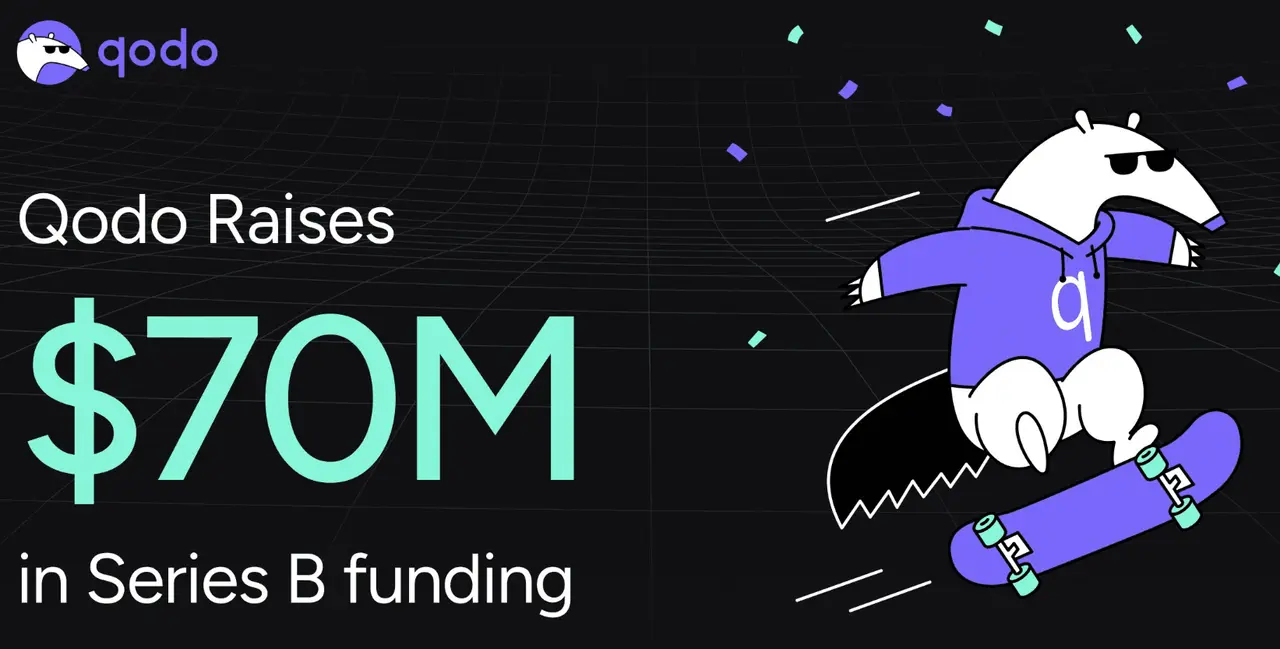
Source: SiliconANGLE
Trust Emerges as the New Bottleneck in AI Coding
As AI coding tools generate billions of lines of code each month, a critical gap has emerged in the software development lifecycle. While 95% of developers don't fully trust AI-generated code, only 48% consistently review it before committing, creating a dangerous disconnect between awareness and practice
1
. Engineering teams are discovering that faster code output from tools like Claude Code and OpenAI's offerings doesn't necessarily translate into reliable or secure software. The problem isn't just volume—it's that teams apply more rigorous validation steps to AI-generated code verification, creating a situation where code is being generated much faster than it can be safely shipped2
.
Source: TechCrunch
Multi-Agent Code Review System Outperforms Competitors
Qodo distinguishes itself through a multi-agent code review system that recently ranked number one on Martian's Code Review Bench with a 64.3% score—more than 10 points ahead of the next competitor and 25 points ahead of Claude Code Review
1
2
. The company recently launched Qodo 2.0, which relies on a multiagent AI architecture where specialized AI agents handle distinct aspects of the code review process, including bug detection, compliance checks, and architectural validation2
. A coordinating layer filters and prioritizes findings, enabling the system to catch tricky logic bugs and cross-file issues without overwhelming developers with false positives.Related Stories


Code Quality Requires Organizational Context, Not Just LLMs
Itamar Friedman, who previously co-founded Visualead and led Alibaba's machine vision business after its acquisition, founded Qodo in 2022 based on insights from his time at Mellanox (later acquired by NVIDIA)
1
. He realized that generating systems and verifying systems require fundamentally different approaches. "Code quality is subjective," Friedman explained. "It depends on organizational standards, past decisions, and tribal knowledge. An LLM can't fully understand that context"1
. Unlike most AI review tools that focus on what changed, Qodo examines how code changes affect entire systems, factoring in organizational standards, historical context, and risk tolerance to help companies manage AI-generated code more confidently.Enterprise Adoption Signals Shift Toward Code Governance
Qodo is already working with major enterprises including NVIDIA, Walmart, Red Hat, Intuit, Texas Instruments, Monday.com, and JFrog
1
2
. This enterprise adoption hints at a broader shift in the AI coding industry. Over the past two years, major players focused on code generation, building copilots and autocomplete systems. But companies are realizing that ramping up productivity alone won't accelerate development—without strong code governance guardrails, AI-generated code remains too risky to deploy2
. The Series B funding will help Qodo scale globally by expanding product and engineering teams and developing additional AI-powered governance capabilities. Friedman frames this transition as moving "from stateless AI to stateful systems—from intelligence to 'artificial wisdom'"1
.References
Summarized by

Navi
Related Stories
Recent Highlights



Recent Highlights
Today's Top Stories








Don’t drown in AI news. We cut through the noise - filtering, ranking and summarizing the most important AI news, breakthroughs and research daily. Follow topics that matter to you and stay ahead.


