8 Sources
[1]
Wistron shares surge in Taiwan after opening of Texas AI superchip plant to supply Nvidia
Wistron Corporation shares jumped 9.7% on Wednesday after the Taiwan-based technology service provider announced the opening of its first U.S. facility to build AI servers for Nvidia. Its D1 AI smart facility, a $700 million, 324,000-square-foot site in Fort Worth, Texas, currently produces Nvidia's GB300 Grace Blackwell Ultra Superchip, an advanced AI processing platform. It will later expand to produce Nvidia's Vera Rubin Superchip, which is critical to powering the next generation of AI computing. "In the next couple of years, this location will be one of the most important, as we build AI infrastructure here in the United States," Wistron Chairman Simon Lin said in the press release. The new footprint highlights a broader trend of Taiwanese tech giants expanding their footprint in the U.S., following TSMC's announcement last week that it is doubling down on its investment in Arizona. Wistron's new facility will ramp up production of Nvidia AI servers, expanding domestic capacity to assemble and test the systems, which integrate into Nvidia's DSX infrastructure to deploy energy-efficient AI factories at scale. Wistron said it is creating a new model for AI infrastructure production built on digital manufacturing, energy optimization and local operations. "Demand for AI factories -- the engine of this next industrial revolution -- is incredible, and they must be produced everywhere," Jensen Huang, chief executive officer of Nvidia, said. Wistron said the Fort Worth plant will serve as the core engine of its U.S. manufacturing operations, adding that the investment reflects the next phase of AI infrastructure development. Nvidia's partner manufacturing facilities span 43 U.S. states, with partners including Wistron, TSMC and Foxconn, contributing an estimated $485 billion to the U.S. GDP in 2026.
[2]
Built in Fort Worth: Wistron Opens Advanced Manufacturing Plant to Produce NVIDIA AI Systems
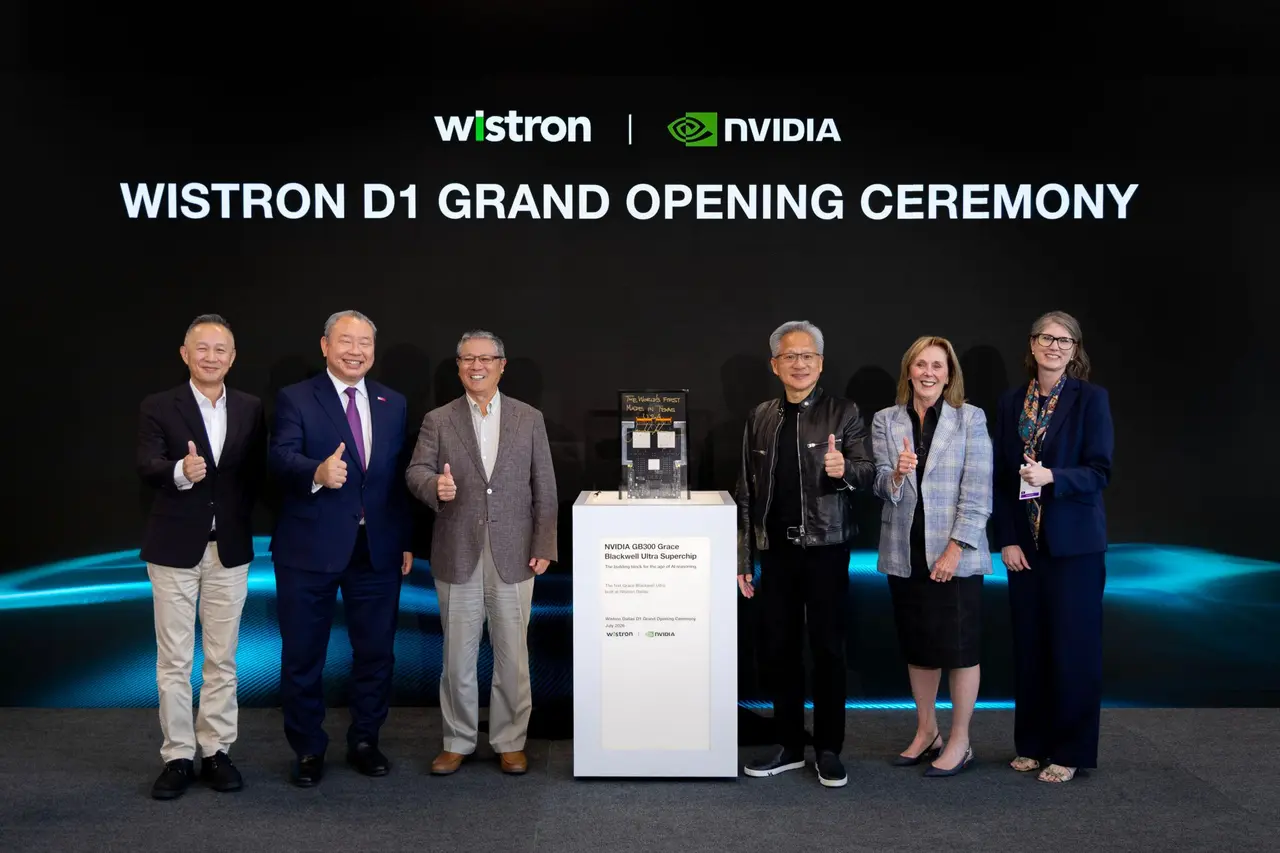
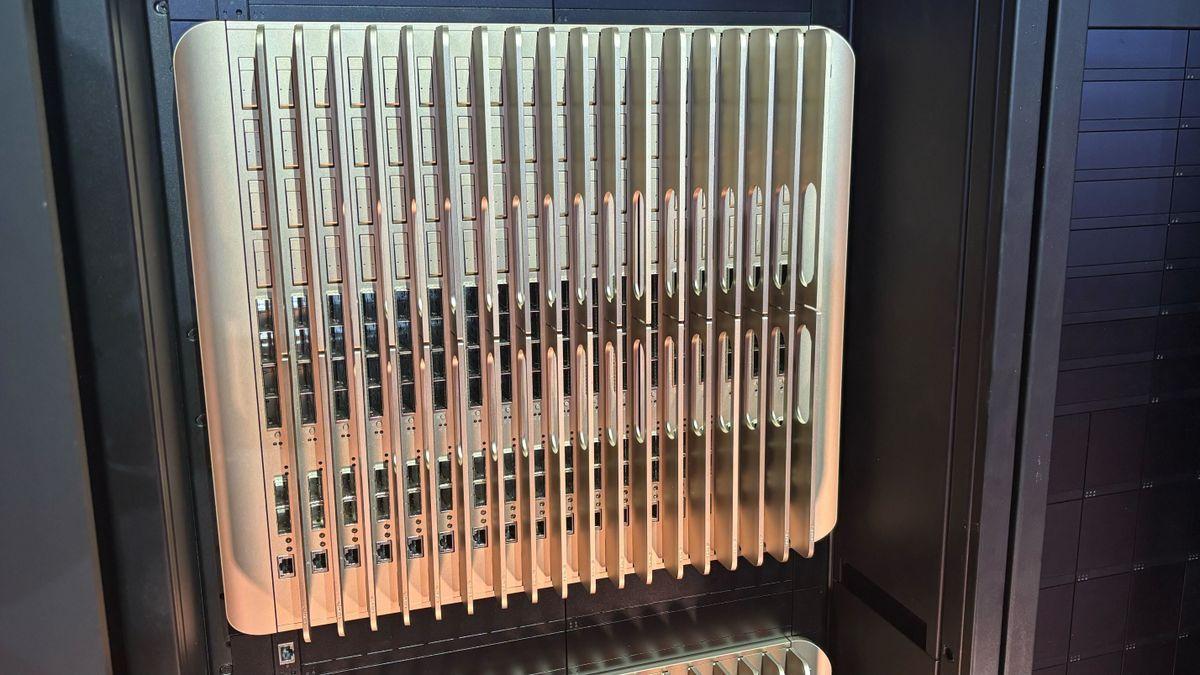
The 324,000-square-foot Texas facility produces NVIDIA Grace Blackwell Ultra and will produce Vera Rubin Superchips -- part of a combined $700 million investment in advanced American manufacturing. The AI era runs on AI infrastructure. Many of these advanced systems are built and tested in Texas. Wistron opened its first U.S. manufacturing facility today in Fort Worth -- a 324,000-square-foot greenfield plant producing superchips at the heart of some of the world's most capable AI systems. In front of an audience of Wistron executives, Taiwan government officials and local Fort Worth leaders, NVIDIA founder and CEO Jensen Huang took the stage with Wistron Chairman Simon Lin at the factory's opening ceremony to talk about what it means to build the infrastructure for the AI era in America. "Manufacturing is an essential pillar for every economy and every country," Huang said. "Building chip plants, packaging plants, computer system plants like this, and AI factories all over the United States, has allowed the United States to really reindustrialize for the first time in a long time." The plant -- Wistron's D1 facility -- currently runs two manufacturing cells: one producing the NVIDIA GB300 Grace Blackwell Ultra Superchip and one that will produce the NVIDIA Vera Rubin Superchip. D1 is scaling up this year to produce tens of thousands of boards per month of the most advanced technology in the industry. Building AI at scale takes more than chips and code. It takes factories, supply chains and skilled workers -- a domestic manufacturing base capable of building at volume and adapting as the technology moves. The Fort Worth plant is where that capacity takes shape. A $700 Million Commitment The state-of-the-art facility represents a $700 million commitment to advanced manufacturing in the U.S. and has created over 500 new jobs across the Texas facility, with plans to expand to 1,000 by the end of the year. "It's creating jobs in plumbing, construction, manufacturing and electricians," Huang said. "So many different types of jobs here in the United States." "From the macro view of the whole AI world, down to community and country -- it's a great vision," Lin said. "I think we're going to enjoy the next era of AI life. I hope that we will be happier and healthier." NVIDIA has committed to manufacturing up to $500 billion in advanced AI platforms in the United States. The Wistron Fort Worth factory is one of the projects making that number real. Building First in a Virtual World Wistron designed and fully simulated the entire facility before construction began in a digital twin built on NVIDIA's open platform, including Nemotron and Cosmos frontier models, Omniverse and Metropolis libraries, and open frameworks including PhysicsNeMo. That enabled Wistron engineers to validate assembly line layouts, optimize production processes and train workers on standard operating procedures virtually -- before any system came online in the real factory. Winning Every Layer The AI era isn't just about chips -- it's about winning at every layer of the stack, from semiconductors to systems to the factories that build them. "Just as agriculture is a fundamental infrastructure of society, in the future these AI factories will be a fundamental infrastructure of society," Huang said. "Today we have roads and agriculture and railroads. In the future we'll have AI factories and the internet. Electricity comes in ... and the tokens get generated in the factories." The ceremony included the unveiling of the first NVIDIA GB300 Grace Blackwell Ultra Superchip produced on site, which Huang signed. Huang described the system built around the NVIDIA GB300 Grace Blackwell Ultra Superchip as "the most powerful AI supercomputer in the world." "It has one-and-a-half million parts inside -- two tons, 4 million dollars -- and we're producing them like phones, right here in Wistron, cranking them out in volume because the world needs all of these machines to drive the intelligence infrastructure," Huang added. Afterward, Huang sat down for interviews with Mike Allen of Axios and separately with Lana Ferguson of the Dallas Morning News -- who also covered Coherent's groundbreaking of a new manufacturing facility in Sherman in June. A new chapter of American manufacturing is taking shape in Fort Worth. Wistron's factory is part of NVIDIA's broader commitment to build in America, for America -- strengthening U.S. supply chains, creating high-skilled jobs and giving American communities a direct role in building the future with AI.
[3]
Nvidia supplier Wistron opens $700m Texas factory to build Grace Blackwell superchips
The Fort Worth plant is the first place Nvidia's GB300 superchip has been mass-produced on US soil. Wistron, the Taiwanese contract manufacturer that builds server hardware for Nvidia, has opened its first factory on American soil, a $700 million plant in Fort Worth, Texas, that is already assembling Nvidia's GB300 Grace Blackwell Ultra superchips. The site held its grand opening on 21 July, and Nvidia says it is the first place the GB300 has been built and mass-produced in the United States. The chip is the current flagship of Nvidia's data centre line, and Fort Worth will eventually turn out its successor too: the Vera Rubin superchips due to follow Blackwell. It is a notable vote of confidence in US-made chips, a category that a year ago barely existed at this scale. The launch sits inside a much larger onshoring push. Nvidia committed in 2025 to half a trillion dollars of American manufacturing and AI infrastructure over four years, and its suppliers have been following the money to Texas. Wistron's plant is one of the more concrete results, a working factory rather than a memorandum of understanding. The facility runs to roughly 324,000 sq ft (about 30,100 sq m). Wistron plans to scale it to tens of thousands of computing boards a month, according to Nvidia, which called Fort Worth its partner's first US manufacturing base. The plant has created more than 500 jobs so far, across construction, plumbing, electrical, and manufacturing roles, with the workforce expected to reach 1,000 by the end of the year. Wistron calls the site its D1 Smart Factory. "The operation here is not typical manufacturing," chairman Simon Lin said. "It is new, very comprehensive, and high-tech." He framed speed as the defining pressure of the moment. "In the AI era, the pressure of speed is also a form of responsibility. We don't just need to build fast; we need to build right." Lin also positioned Fort Worth as central to Wistron's next few years. "In the next couple of years, this location will be one of the most important, as we build AI infrastructure here in the United States," he said. Huang, for his part, kept the message plain: "Manufacturing is an essential pillar for every economy and every country." Building right, in this case, meant building the factory twice. Before breaking ground, Wistron modelled the entire plant as a digital twin using Nvidia's own Omniverse simulation software, testing the layout and workflows virtually before any physical construction started. It is the sort of recursive detail Nvidia enjoys: the company's software used to design the factory that makes the chips that run the software. The product itself is not a modest object. Jensen Huang, Nvidia's chief executive, described a single GB300 system as containing "one-and-a-half million parts inside, two tons, 4 million dollars." Producing tens of thousands of boards a month from a standing start is less a factory ramp than a logistics problem with a clock attached. Investors liked what they saw. Wistron's shares surged in Taiwan after the opening, a reminder that the AI trade now runs well beyond the chip designers themselves and into the contract manufacturers, assemblers, and suppliers wiring the systems together. Fort Worth is quickly becoming a hub for that build-out. The city and the wider state have drawn a run of AI infrastructure projects, including an $810 million data centre bond raise nearby, as cheap land and power pull compute towards Texas. The pressure has rippled up the supply chain as well, tightening the market for the high-bandwidth memory that Grace Blackwell parts depend on. What comes next is a ramp. Wistron has to lift board output through the rest of 2026, hire its way to a thousand workers, and then retool for Vera Rubin, all while the plant is still finding its rhythm. For now, the more symbolic fact is the simpler one: an Nvidia superchip that used to exist only as an import is now being screwed together in Texas.
[4]
Wistron opens first U.S. factory for Nvidia AI servers in Texas
The Taiwan-based manufacturer's Fort Worth facility is the first U.S. site to mass-produce Nvidia's GB300 Grace Blackwell Ultra Superchip Wistron Corporation stock climbed 9.7% on Wednesday after the Taiwan-based technology manufacturer opened its first U.S. facility dedicated to assembling AI servers on behalf of Nvidia $NVDA. The $700 million plant, located in Fort Worth, Texas, covers 324,000 square feet and marks the first time Nvidia's GB300 Grace Blackwell Ultra Superchip has been built and mass-produced on U.S. soil.
[5]
AI revolution arrives in North Texas: Nvidia and Wistron launch manufacturing plant in Fort Worth
On Tuesday, AI giants Wistron and Nvidia held a grand opening celebration at their new manufacturing plant in the Alliance Area of North Fort Worth. This is a first-of-its-kind factory in North Texas, where Nvidia's highly sought-after AI chips and supercomputers will be built by its partners at Wistron. Nvidia is said to be the global leader in the AI revolution, and its CEO Jensen Huang says this is the beginning of a major evolution not only for the AI industry but for Fort Worth as well. "You got all the great companies that are here, we've got a lot of employees that are here and the community," said Huang. "The government is just so accommodating to the businesses and would like us to invest here." Huang believes the future of AI manufacturing is right here in North Texas. He says the innovation that will come out of this facility won't just fuel the high-powered technology spreading like wildfire, but it will also improve the lives of the people it serves. "Most people don't yet realize how incredibly beneficial AI will be to education, to healthcare, to life sciences, to transportation, to every aspect of their lives," said Huang. All of this news comes at a time when the city is at odds over regulations for massive data centers that want to set up shop in a similar way here in Fort Worth. This partnership is expected to bring more than $700 million in investment and 800 jobs to the Fort Worth economy. Leaders say there are also plans for more of these types of factories in our area in the near future. It's something Fort Worth city manager Jay Chapa said he is excited to welcome. "Being here in Fort Worth, it kind of shows that Fort Worth is at the forefront with the rest of the world, the rest of the country, and we have the labor, the infrastructure, and the support needed to make these types of businesses successful here in Fort Worth," Chapa said. The event wrapped with the unveiling of the first Texas-built Nvidia AI chip. "We want America to have a manufacturing ecosystem... manufacturing economy, and this is the best way to bring it back to the United States," Huang said. The leaders behind all of this say there are already some plans to build out more facilities like this one in the area sometime in the future.
[6]
Nvidia supplier Wistron launches $700 million Texas factory for AI system production
The Fort Worth facility manufactures Nvidia's GB300 Grace Blackwell Ultra Superchip. Nvidia CEO Jensen Huang has described the AI system built around the product as "the most powerful AI supercomputer in the world." Wistron said the site is where Nvidia's first GB300 Grace Blackwell Ultra Superchip was built and mass-produced in the United States. Taiwan's Wistron, a supplier to Nvidia, launched a $700 million manufacturing facility in Texas on Tuesday to produce the U.S. chipmaker's latest AI systems, as Taiwanese electronics makers expand U.S. production to meet soaring demand for AI infrastructure. The Fort Worth facility manufactures Nvidia's GB300 Grace Blackwell Ultra Superchip. Nvidia CEO Jensen Huang has described the AI system built around the product as "the most powerful AI supercomputer in the world." Wistron said the site is where Nvidia's first GB300 Grace Blackwell Ultra Superchip was built and mass-produced in the United States. The factory will also manufacture Nvidia's next-generation Vera Rubin Superchip, Wistron said. The factory is expected to scale up production this year to manufacture tens of thousands of computing boards per month, according to Nvidia. The factory has created more than 500 jobs, Nvidia said, adding that it is on track to expand its workforce to 1,000 employees by the end of the year. Nvidia said Wistron's Fort Worth plant forms part of the $500 billion U.S. investment commitment it announced in 2025.
[7]
Nvidia supplier Wistron opens first U.S. factory in Texas By Investing.com
Investing.com-- Taiwan's Wistron Corp (TW:3231), a key supplier to Nvidia (NASDAQ:NVDA), on Tuesday opened its first U.S. manufacturing facility in Fort Worth, Texas, marking a major expansion of its artificial intelligence infrastructure production as demand for advanced AI hardware accelerates. The company said it invested $700 million in a facility, where it has begun mass production of Nvidia's GB300 Grace Blackwell Ultra Superchip, the first of the chips to be built in the United States. Get real-time updates on market-moving news with InvestingPro -- now at 60% off The plant will also manufacture Nvidia's next-generation Vera Rubin Superchip. The factory was inaugurated by Wistron Chairman Simon Lin and Nvidia Chief Executive Jensen Huang. Wistron said the Texas site will serve as a key hub in its global AI manufacturing network and use Nvidia's accelerated computing, digital twin technology and AI models to optimize production and factory operations. The facility expands Wistron's AI server manufacturing beyond Taiwan and is designed to assemble and test Nvidia AI systems for customers in the United States, helping shorten delivery times and strengthen domestic supply chain resilience. "The largest infrastructure buildout in history is underway," Huang said, adding that the partnership would help restore advanced manufacturing capacity in Texas while supporting the growing demand for AI factories.
[8]
Nvidia Supplier Wistron Opens $700 Million Texas Site Producing AI 'Superchips'
By Yang Jie and Sherry Qin Nvidia supplier Wistron Corp. has opened a $700 million facility in Texas, joining the ranks of Taiwanese companies expanding in the U.S. as the Trump administration pushes to reshore manufacturing. The factory in Fort Worth will produce Nvidia "superchips" and forms part of the $500 billion the chip maker has committed to investing in advanced artificial-intelligence platforms in the U.S., Nvidia said in a blog post. Building computer-system plants like the 324,000-square-foot Wistron site is helping the U.S. "really reindustrialize for the first time in a long time," said Nvidia Chief Executive Jensen Huang. Taipei-listed Wistron is building Nvidia's Grace Blackwell chip modules at the Texas facility, and will also make new Vera Rubin products there. Production is set to reach tens of thousands of boards a month later this year. The companies showcased one of the GB300 superchip modules made at Forth Worth at an opening ceremony on Tuesday. "We're producing them like phones...cranking them out in volume because the world needs all of these machines to drive the intelligence infrastructure," Huang said. Like fellow Nvidia supplier Foxconn, Wistron is one of the Taiwanese electronics firms that built their empires manufacturing consumer gear for tech giants like Apple, but are now pivoting toward AI hardware. The U.S.-based supply chain for Nvidia--spanning design in California, chip fabrication in Arizona, and assembly and testing in Texas--reflects the Trump administration's drive to revive American high-tech manufacturing and diversify AI supply chains from Asian sites. "Taiwan is my largest trading partner," Huang said. Last week, contract chip maker Taiwan Semiconductor Manufacturing Co. announced an additional $100 billion investment in Arizona. Other Taiwanese manufacturers have also concentrated operations in hubs across Texas and neighboring Mexican border cities to assemble AI chip modules and servers for North American tech giants. Shares of both Wistron and affiliated cloud-server manufacturer Wiwynn rose by the daily limit of 10% in Taipei on Wednesday.
Share
Copy Link
Wistron launched its first U.S. facility in Fort Worth, Texas, a $700 million AI manufacturing plant producing Nvidia's GB300 Grace Blackwell Ultra Superchip. The 324,000-square-foot site marks the first time Nvidia's flagship AI chip has been mass-produced on American soil, creating over 500 jobs with plans to reach 1,000 by year's end.
Wistron Corporation shares surged 9.7% on Wednesday following the opening of its first U.S. facility, a $700 million AI manufacturing plant in Fort Worth, Texas
1
. The 324,000-square-foot D1 Smart Factory represents a major milestone for both Wistron and Nvidia, as it becomes the first site to mass-produce the GB300 Grace Blackwell Ultra Superchip on American soil3
. The Fort Worth plant currently operates two manufacturing cells, with one producing Nvidia's flagship GB300 and another preparing to manufacture the Vera Rubin Superchip, which will power the next generation of AI computing2
.
Source: NVIDIA
The facility has already created over 500 jobs across construction, plumbing, electrical, and manufacturing roles, with workforce expansion targeting 1,000 employees by the end of the year
3
. "In the next couple of years, this location will be one of the most important, as we build AI infrastructure here in the United States," Wistron Chairman Simon Lin said at the opening ceremony1
. The investment reflects a broader trend of Taiwanese tech firms expanding their U.S. footprint, following TSMC's recent announcement to double down on its Arizona operations.Jensen Huang, Nvidia's CEO, described the GB300 system as "the most powerful AI supercomputer in the world," containing one-and-a-half million parts inside a two-ton structure valued at $4 million
2
. The contract manufacturer is scaling production to tens of thousands of boards per month, addressing what Huang characterized as "incredible" demand for AI factories1
. These AI servers integrate into Nvidia's DSX infrastructure to deploy energy-efficient AI factories at scale, positioning the technology as essential infrastructure comparable to electricity and transportation networks.
Source: CBS
"Just as agriculture is a fundamental infrastructure of society, in the future these AI factories will be a fundamental infrastructure of society," Huang explained during the ceremony
2
. The statement underscores how AI chip production has evolved from a niche technology sector into a critical component of national economic strategy. Nvidia has committed to manufacturing up to $500 billion in advanced AI platforms in the United States, with the Wistron facility serving as a cornerstone of that pledge2
.Before breaking ground, Wistron designed and fully simulated the entire Fort Worth plant using digital twin technology built on Nvidia's open platform, including Nemotron and Cosmos frontier models, Nvidia Omniverse, and Metropolis libraries
2
. This virtual-first approach enabled engineers to validate assembly line layouts, optimize production processes, and train workers on standard operating procedures before any physical system came online. The recursive application of Nvidia's software to design the factory that produces the chips running that same software highlights the integrated nature of modern AI infrastructure development3
."The operation here is not typical manufacturing," Lin noted. "It is new, very comprehensive, and high-tech"
3
. He emphasized that speed has become a defining pressure in the AI revolution, stating that "we don't just need to build fast; we need to build right." This dual mandate of velocity and precision reflects the broader challenge facing U.S. manufacturing as it attempts to compete in AI chip production while maintaining quality standards.Related Stories
Nvidia's partner manufacturing facilities now span 43 U.S. states, with partners including Wistron, TSMC, and Foxconn contributing an estimated $485 billion to U.S. GDP in 2026
1
. Fort Worth city manager Jay Chapa emphasized that the city has "the labor, the infrastructure, and the support needed to make these types of businesses successful"5
. The partnership is expected to bring more than $700 million in investment and 800 jobs to the Fort Worth economy, with leaders indicating plans for additional facilities in the area5
.
Source: ET
"Manufacturing is an essential pillar for every economy and every country," Huang stated, positioning the facility as part of America's reindustrialization
2
. The opening comes as Fort Worth grapples with regulations for massive data centers seeking to establish operations in the region, highlighting the tension between rapid technological expansion and municipal planning5
. As Wistron ramps production through 2026 and prepares to retool for Vera Rubin supercomputers, the facility faces the challenge of scaling output while the plant finds its operational rhythm. The success of this venture will likely influence whether other supercomputer manufacturers follow suit in establishing domestic production capabilities.Summarized by
Navi
[2]
[3]
16 May 2025•Business and Economy

14 Apr 2025•Business and Economy

19 May 2025•Technology

1
Technology

2
Science and Research

3
Policy and Regulation