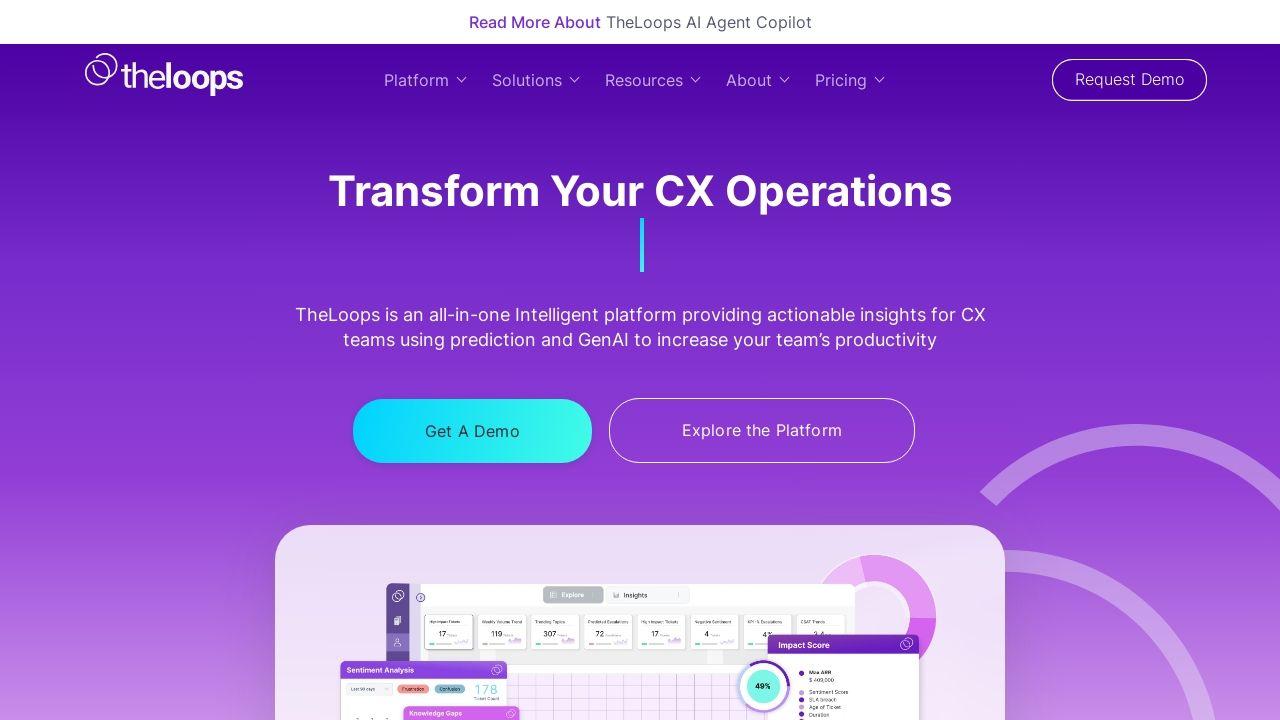
For the past year, Mark Moffat, CEO of enterprise applications vendor IFS, has been making frequent visits to Silicon Valley to meet with AI startups at what he's described as "the next frontier of technology innovation." One target of those visits was revealed today with the announcement that IFS has acquired TheLoops, a platform for building and deploying AI agents to CX workflows across customer support, service and success teams. IFS is already working to roll out this agent technology across its entire product portfolio as a core part of its 'Industrial AI' strategy, with 16 agents already in the pipeline for use cases in industries such as manufacturing, aerospace and defense, energy and utilities, and infrastructure.
TheLoops was co-founded by two machine learning and AI experts. Its CEO Somya Kapoor had previously worked at SAP and ServiceNow, while CTO Ravi Bulusu had worked at a series of start-ups including Aisera, Caspida and VMware. The company launched in June 2021 with an $8.5 million seed funding round led by Dell's corporate venturing arm, with venture firms Tidal Ventures and Westwave Capital also contributing. Its customers are concentrated among SaaS companies, including Alation, Bloomreach, Gainsight, Tricentis and others. Terms of the acquisition were not disclosed.
While IFS will continue to support the existing CX product line, its interest is in adapting the technology for use across its own products. We spoke to Matt Kempson, Global Head of AI Growth Unit at IFS, earlier today to find out more. He says that TheLoops brings essential technology for building agents that can understand the industrial context and perform appropriate actions. He explains:
We've actually been working on the agentic play for more than two years now, and although we have agentic capabilities within our core products, the reality is you need a scalable agentic platform to be able to build and deploy agents that understand context, that [have] that semantic awareness to be able to react and respond differently...
From our perspective, while other vendors may be focused on the head office or on the back office, when you're going to focus on industrial AI, it's a very different set of stakeholders that you're dealing with. It's safety glove, it's goggles, it's helmets, it's boots on the ground. It's a very different level of risk and a different level of reality.
So while TheLoops currently promotes its platform as being specifically tuned to handle customer engagement data and work with content and processes in a Customer Experience (CX) context, that has effectively served as merely a proving ground for the underlying technology. He comments:
What TheLoops is bringing to the table... is the ability to build and scale agents to market way quicker than ever was possible before. That's because of the scalability of the agent framework that they've built, and having tested it out across that CX market, which is incredibly complex, incredibly difficult to do.
IFS has taken that technology and put it to test as a platform for creating and deploying agents in industrial contexts. He goes on:
A big part of the last six months has been working with TheLoops to test the agent framework, to validate that it can be used across these different industrial use cases. And we've been very successful in that respect... We've tested it, we've scaled it, we've built specific agents out...
Technically, it's not a huge leap, because their platform so rich. But the context piece... and the speed at which you can build these agents using this platform is a game changer in its own right.
While TheLoops has brought the technology, an equally important element has been the domain expertise -- what diginomica calls the System of Knowledge -- that IFS brings from the industrial sphere. He adds:
Just because you can build context-rich agents doesn't mean that you know exactly what those businesses and the reality of what that person with the boots on the ground really needs to be able to execute the value for the business more effectively &'151; or the machines or the assets, if it's not people-based. So it's definitely a blending. It's a very complementary marriage of industry and domain expertise on the IFS side, and deep technology capability on the TheLoops side.
Another important aspect of the platform is a low-code connector framework for adding external data sources, which can range from IFS's own back-office systems to other enterprise applications and data stores, as well as third-party resources such as geospatial or meteorological data. He elaborates:
The real joy with agents is that a single-stack, vertical play is just not going to cut it anymore. You need to be pulling in dynamic data from both multiple systems as well as different data sources... You've got all of your people, all of your assets, your lorries, your trucks, your machinery, your warehouses, etc, all in different systems, asset registries, warehouse management. But you've also got geospatial data... getting into things like predicting the weather, or if you look at a different use case, predicting commodities and all of these other things, it's an extremely dynamic environment.
The way TheLoops have built the connectors to be able to seamlessly pull information and react to that information and create agents that can act -- whether that's as a digital co-worker completely, or whether that's to enhance, to be a co-worker to people, to be able to make much smarter decisions, or to trigger chains of events, of decisions and actions around the business -- it is the combination of those two different things, building the agents, scaling the agents and connecting much more quickly and scalably to dynamic data sources across our industry and different industries as well.
IFS already has 16 agents "well down the path of production now" based on the new platform, he says. One example is in the maintenance realm, with an agent taking on the role of a material planner role for part demand fulfilment. This agent keeps track of the various constraints on parts availability and stock movements to provide more accurate, faster information when parts are required.
Another example is an agent that provides intelligent troubleshooting for service techicians. Here the value is in the agent's ability to bring together information from various sources. He explains:
You need to get that very skilled technician running their structured diagnostics ahead of time. But sometimes you're not going to have everything logged in just one place. Sometimes you're going to have multiple user manuals. Sometimes you're going to have multiple asset registries that you need to be able to check. In this particular case, the agent's been designed to guide the technician through that process, from the troubleshooting through to the diagnostics through to how they can search other sources...
Because this is no longer just a vertical system piece, this isn't just limited to what you have in your asset registry. This can go and check online logs from the original equipment manufacturer. This can go and check logs from Reddit or YouTube -- a lot of engineers go and default to that, because the material there is better than what they can find that's readily available elsewhere.
There are various checks and balances built into the platform to validate the reliability of information, he adds, and customers always have control over what resources they choose to connect to.
This is a very significant move by IFS, adding a proven agent platform with the versatility to provide a wide range of capabilities across multiple domains and use cases -- one that, I'm told, was also of interest to other potential acquirers. While IFS already had significant predictive AI capabilities, its agentic story was less persuasive. Its newly acquired toolset changes that picture dramatically and promises to unleash a rapidly growing army of industrial AI agents with the potential to transform productivity in many areas. We'll keep a close eye on what comes next.
