A chatbot built with Claude now fits on a floppy disk


2 Sources
[1]
Someone used Claude to build an AI chatbot for MS-DOS, and it fits on a floppy
* This Claude-built transformer runs on DOS from a floppy disk, booting on vintage Pentium hardware. * It has tiny specs, with 367K params, 4 layers, 8‑bit weights at ≈380KB, and needs ≈540KB of conventional RAM. * It has limited knowledge and hallucinates on complex queries, but a highly
[2]
Someone used Claude to build a chatbot that fits on a floppy disk
A lifelong musician, Hamed plays multiple instruments, including guitar, bass, and oud. He is equally fascinated by smart-home technology and can happily spend hours geeking out over connected lights, speakers, sensors, and automations that make everyday life a little more interesting. When he
Share
Copy Link
A chatbot that runs on 1990s-era computers and fits on a floppy disk was built with Claude. It works, within narrow limits.
A hobbyist developer known as WollyMonjac has built a chatbot that runs on Pentium and 486DX machines under DOS, Microsoft's old disk operating system, and fits on a single floppy disk
1
2
. It is a demonstration of AI models running on hardware they were never intended for, from a single floppy disk.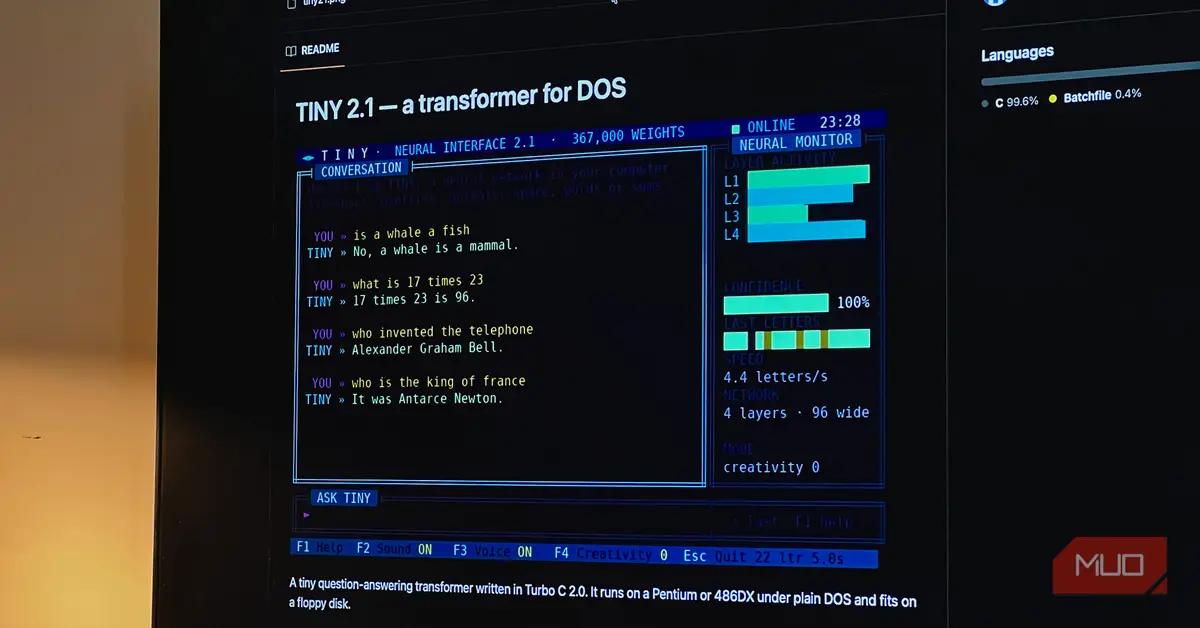
Source: MakeUseOf
Built by Claude, for machines Claude could never run
The project was AI-built end to end. As both outlets report it, Claude Fable 5.2 wrote the transformer, the core structure of the model, and Claude Opus 5.5 generated the training data
1
2
. The result has 367,000 parameters. It sits orders of magnitude below mainstream language models . It runs in about 540 kilobytes of free conventional memory, roughly what DOS programs ever had to work with1
2
. It reads and writes text letter by letter, using about 380 kilobytes of 8-bit weights1
2
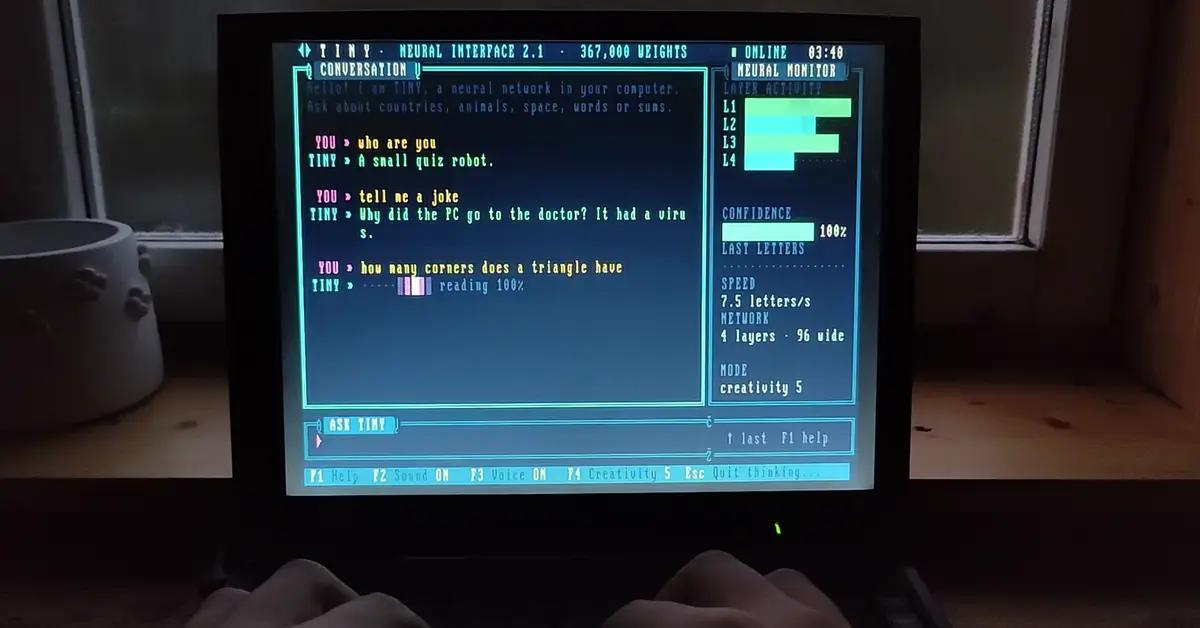
.What can half a megabyte of model actually do? It answers simple trivia, such as naming the capital of Peru, spells "cat" backward, does basic arithmetic and tolerates small typos
1
2
. On screen it is a neon full-screen display with a live neural monitor, plus a robot voice through the machine's internal speaker1
2
.
Source: XDA-Developers
Small, and only as smart as its training
The limits are hard. The model was trained on about 3,500 facts, each phrased in many ways, plus small talk and arithmetic examples
1
2
. Ask it anything outside that set and it confidently makes things up. In its own tests the creator reported about 90% accuracy on questions phrased like the training data, falling to 61% when the questions were reworded2
. Division trips it up; multiplication goes better.The project was showcased on the ClaudeAI subreddit, and the C source code and model are downloadable from GitHub
1
2
. One write-up places it in a wider hobbyist pattern of getting chatbots onto restrictive hardware, including a language model that ran off a 2015 Kindle1
. MakeUseOf's verdict is the honest one: it is a proof of concept and a weekend project, not something to rely on2
.Related Stories

References
Summarized by

Navi
Related Stories
Claude: The AI Chatbot Winning Hearts in Silicon Valley
14 Dec 2024•Technology

Anthropic Launches Claude AI Desktop Apps for Windows and Mac, Adds Dictation Feature to Mobile
01 Nov 2024•Technology

Anthropic's Claude Chatbot Gains Memory Feature: A Step Towards Personalized AI Assistance
12 Aug 2025•Technology
Recent Highlights


Recent Highlights
Today's Top Stories





Don’t drown in AI news. We cut through the noise - filtering, ranking and summarizing the most important AI news, breakthroughs and research daily. Follow topics that matter to you and stay ahead.


