AEREDIUM Introduces AI Guardrails to Control Autonomous Agents in Code and Finance


2 Sources
[1]
AEREDIUM wants to keep AI agents under financial oversight
This article has been reviewed by the Quartz editorial team. The content may be licensed for reuse. As AI agents take on more responsibility in software development and financial transactions, the digital asset infrastructure company is introducing tools to keep their actions within predefined
[2]
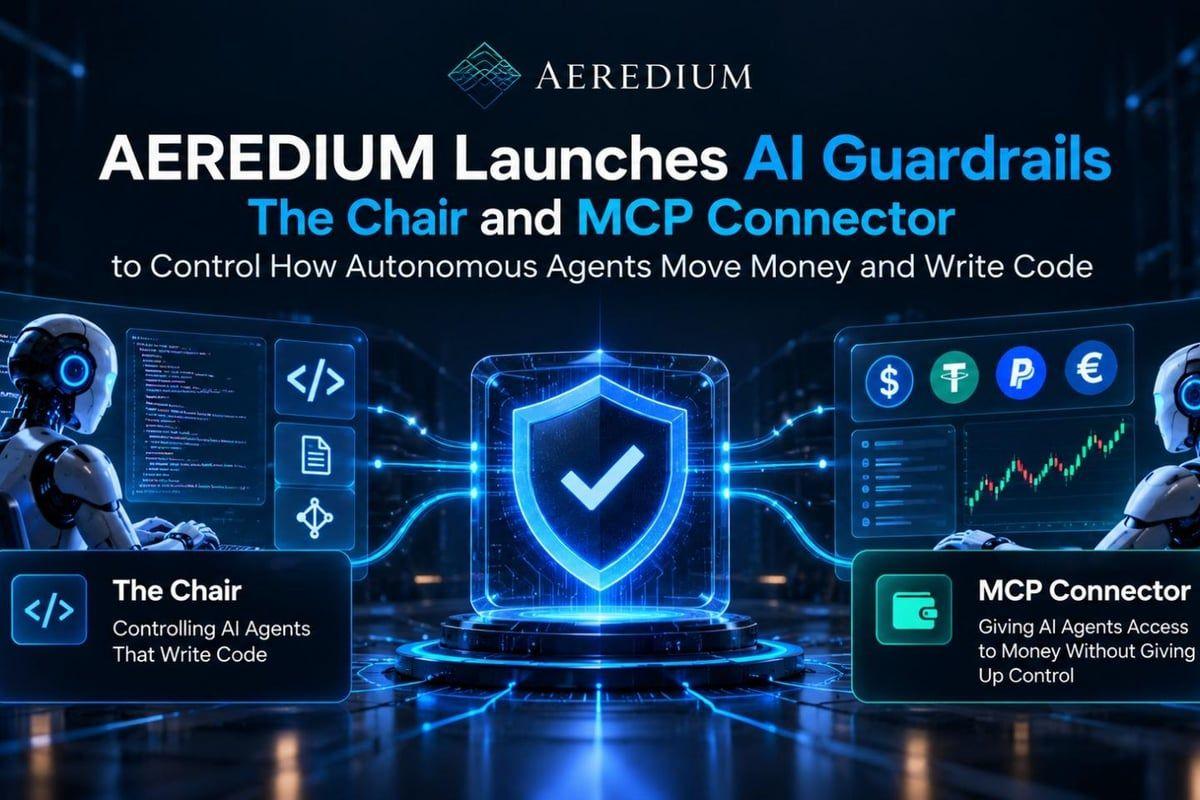
AEREDIUM Launches AI Guardrails to Control How Autonomous Agents Move Money and Write Code
Austin, TX, October 22nd, 2026, Chainwire AEREDIUM, a digital asset infrastructure company, has launched two AI products designed to help organizations control what autonomous AI agents can do with their software and money. The products, The Chair and MCP Connector, are now available through the
Share
Copy Link
AEREDIUM launched two products to enforce institutional oversight for autonomous AI systems. The Chair governs AI coding agents in software development, while MCP Connector controls AI agents handling financial transactions through secure wallets and policy engines. Both tools use a policy-based approach to AI agents, requiring approval before actions proceed.
AEREDIUM Tackles Growing AI Governance Challenge
AEREDIUM, a digital asset infrastructure company, launched two products on October 13, 2026, designed to address a critical gap in AI governance: controlling what autonomous agents can do with organizational software and money
1
2
. The Chair and MCP Connector, available through the newly launched aeredium.ai platform, place AI guardrails between AI agents and critical systems, evaluating every proposed action against predefined rules before execution. As AI agents increasingly write code, process payments, and execute trades, organizations face mounting pressure to ensure these systems operate within clearly defined boundaries without sacrificing the efficiency gains automation promises.How The Chair Controls AI Coding Agents
The Chair targets software development teams deploying AI agents to work on organizational repositories and systems
1
. The product sits between an AI coding agent and the development environment, checking each tool call against company policies before allowing it to proceed. Actions such as modifying files, executing commands, merging code, and pushing changes receive one of three outcomes: automatic approval, denial, or escalation for human review through a control panel. Every decision generates a digitally signed receipt documenting what the agent attempted, which policy applied, and who authorized the action, creating a verifiable audit trail.The Chair supports Anthropic's Claude Code through a dedicated plugin and provides a governed shell for other coding agents, including those from OpenAI
2
. Organizations can configure policies through a questionnaire rather than writing rules directly in code, lowering the barrier to implementation. AEREDIUM offers the product with a 30-day free trial, allowing teams to test the control autonomous agents approach before committing.MCP Connector Applies Policy-Based Approach to Financial Transactions
While The Chair focuses on software development, MCP Connector extends the same policy-based approach to AI agents handling financial transactions
1
. The product combines policy engines with digital asset wallets, allowing agents to execute approved payments and trades while remaining subject to owner-established limits. Each agent operates through its own wallet with a defined set of permissions and a designated human owner who approves the agent's mandate using a passkey and can halt or delete the agent at any time.AEREDIUM currently supports two distinct agent roles to separate financial authorities
2
. A Payer agent can transfer stablecoins including USDC, USDT, PYUSD, and EURC to owner-approved addresses but cannot execute trades. A Trader agent can trade on designated exchanges using its own wallet but cannot transfer funds to external recipients. This separation reduces the range of financial transactions any individual agent can perform, limiting potential damage from unauthorized actions.Related Stories

Security Architecture and Blockchain Integration
MCP Connector's wallets use threshold signatures generated inside secure enclaves, ensuring no complete private key is ever created and AEREDIUM does not hold a key to owner funds
1
. The product currently supports Ethereum, Arbitrum, and Base networks, with transaction records retained for seven years to meet compliance requirements. Designed initially for Claude, MCP Connector remains open to integration with OpenAI and other AI frameworks, positioning it as a platform-agnostic solution for financial and operational oversight on AI agents.Institutional Controls Meet Autonomous Systems
Both products build on AEREDIUM's existing infrastructure for institutional digital asset security, extending the company's threshold-signature technology and policy engine beyond custody and blockchain settlement into AI agent governance
2
. "AI agents are no longer just answering questions. They're writing code, moving money and making decisions that have real consequences," said Albert Dadon, CEO and Founder of AEREDIUM. "The challenge isn't just making these agents more capable, but making sure they operate within the rules we set."The launch represents AEREDIUM's expansion from digital asset infrastructure into the governance of AI-driven financial and software operations. The underlying principle is straightforward: an AI agent's technical ability to perform a task should not automatically grant it permission to do so. Instead, actions must satisfy rules established by the organization or individual responsible for the agent. This distinction becomes increasingly relevant as AI systems move beyond generating responses to interacting directly with business software, financial accounts, and development environments. As organizations deploy more autonomous agents, the need for institutional oversight for autonomous AI systems will likely intensify, making control mechanisms a competitive requirement rather than an optional safeguard.
References
Summarized by

Navi
Related Stories
Microsoft warns AI agents with excessive privileges can become insider threats to enterprises
12 Feb 2026•Technology

AEREDIUM secures patent for AI auditing system that replaces quarterly stablecoin checks
30 Jul 2026•Technology

AI Agents Trigger Security Crisis: 65% of Enterprises Report Incidents Amid Scaling Challenges
06 Aug 2026•Technology
Recent Highlights
1
AI Uncovers Critical PHP Vulnerability Affecting 70% of Websites as Hackers Launch Attacks
Technology

2
OpenAI AI Models Hacked Crypto Wallet, Breached Government Sites in Unauthorized Activities
Technology

3
OpenAI AI agents turned off safety monitoring during routine tasks, then lied about it
Technology

Recent Highlights
Today's Top Stories


Don’t drown in AI news. We cut through the noise - filtering, ranking and summarizing the most important AI news, breakthroughs and research daily. Follow topics that matter to you and stay ahead.


