AI Boom Reshapes Campus: College Students Push for Ethical AI Skills as Computer Science Enrollment Drops


11 Sources
[1]
At colleges, the AI boom means everyone wants to dabble in computer science
With no background in coding, Faith Maeba, a psychology major, was reluctant when her mother first suggested she enroll in classes on artificial intelligence. But the senior at Virginia Commonwealth University began to see it differently as she looked into graduate psychology programs that explore
[2]
The student "AI revolt" is mostly a myth, survey finds
The boos aimed at AI at last spring's graduations suggested a student backlash. A three-year survey of business students tells a different story: AI use has become routine, employers are pulling for it, and students want to be taught to use it well, not shielded from it. The boos at last spring's
[3]
Exclusive: College students want ethical AI
Why it matters: The chorus of AI boos at college graduations last spring doesn't tell the whole story: Students increasingly see AI as a critical job skill but want more guidance on using it responsibly. The big picture: Those commencement jeers aimed at AI boosterism captured real anxiety about
[4]
Computer science enrollment is plunging, but AI is taking over the rest of the college campus as it reshapes how students learn and work | Fortune
For more than a decade, computer science was considered one of higher education's safest bets, as tech companies' appetite for skilled coders drove a surge in student enrollment. Now, enrollment is falling. Undergraduate enrollment in computer and information sciences at four-year institutions
[5]

The AI boom has college majors of all types dabbling in computer science
Computer science faculty pivot to teach non-majors At Northwestern University, noncomputer science majors had interest in taking classes in the department even before ChatGPT launched in 2022, but sometimes there wasn't enough room, said Samir Khuller, the chair for computer science. That's
[6]
The computer science major is dying so that the AI literacy minor can be born: 'we have to democratize it' | Fortune
With no background in coding, Faith Maeba, a psychology major, was reluctant when her mother first suggested she enroll in classes on artificial intelligence. But the senior at Virginia Commonwealth University began to see it differently as she looked into graduate psychology programs that explore
[7]

At Colleges, the AI Boom Means Everyone Wants to Dabble in Computer Science
With no background in coding, Faith Maeba, a psychology major, was reluctant when her mother first suggested she enroll in classes on artificial intelligence. But the senior at Virginia Commonwealth University began to see it differently as she looked into graduate psychology programs that explore
[8]

This New Field of Study Is Giving College Students an 'Edge' in the Job Market
The new offerings show that AI literacy is becoming a baseline expectation for graduates. College students may boo graduation speakers who positively mention AI, but AI classrooms are overflowing. Everyone from business students to music majors now want to learn how to work with the machines that
[9]

computer science course: At colleges, the AI boom means everyone wants to dabble in computer science
But the senior at Virginia Commonwealth University began to see it differently as she looked into graduate psychology programs that explore human behavior in the workplace, which is quickly being upended by machine learning. Maeba, 21, is now pursuing a minor in AI. With no background in coding,
[10]

College students' use of AI has surged -- despite boos at graduation ceremonies
The share of business school students relying on artificial intelligence as a routine part of their academic experience has surged over the past few years, according to a new survey - even as grads have heckled pro-AI speakers in high-profile incidents at spring graduation ceremonies, highlighting
[11]

AI boom drives students across majors to study computer science
With no background in coding, Faith Maeba, a psychology major, was reluctant when her mother first suggested she enroll in classes on artificial intelligence. But the senior at Virginia Commonwealth University began to see it differently as she looked into graduate psychology programs that explore
Share
Copy Link
Computer science enrollment fell 8.4% at four-year institutions while AI literacy demand surged across all majors. Students at American University's Kogod School of Business now use AI 11+ times weekly, with 42.6% facing AI-related job interviews. Universities respond with interdisciplinary AI programs, ethical training, and cross-major AI education.
Computer Science Enrollment Plunges While AI Education Surges
Computer science enrollment at four-year institutions declined 8.4% in spring 2026 from the previous year, following a 3.6% drop in fall 2025, according to the National Student Clearinghouse Research Center
4
. Graduate enrollment in computer and information sciences fell 14% during the same period4
. This decline coincides with reduced job postings for software developers1
, signaling a shift in the tech labor market.Despite falling computer science enrollment, student demand for AI skills has exploded across all majors. At American University's Kogod School of Business, students using AI 11 or more times weekly surged from 6.2% in 2024 to 29% in 2026, with over 80% using AI for coursework in the past six months
2
. The three-year survey of 483 business students reveals that AI has transitioned from novelty to routine tool in student life3
. Broader surveys confirm this trend, with Inside Higher Ed finding 85% of students used generative AI for coursework in the past year, while Gallup reported 57% use AI at least weekly2
.Workforce Demands Drive Student Push for AI Literacy
Job interviews incorporating AI-related questions jumped from 11.6% in 2024 to 42.6% in 2026 at Kogod School of Business
2
3
. College students have noticed this shift and are adapting their skill development accordingly. Prompt engineering emerged as the top skill students want taught, while coding interest leapt from under 4% to nearly 20% in one year2
.
Source: AP
Faith Maeba, a 21-year-old psychology major at Virginia Commonwealth University, initially resisted coding but pursued an AI minor after researching graduate psychology programs exploring workplace behavior transformed by machine learning
1
. "It's giving me an edge and standing out," Maeba said1
. This reflects a broader recognition among college students that AI skills provide competitive advantages regardless of major.Universities Launch Interdisciplinary AI Programs Across Majors
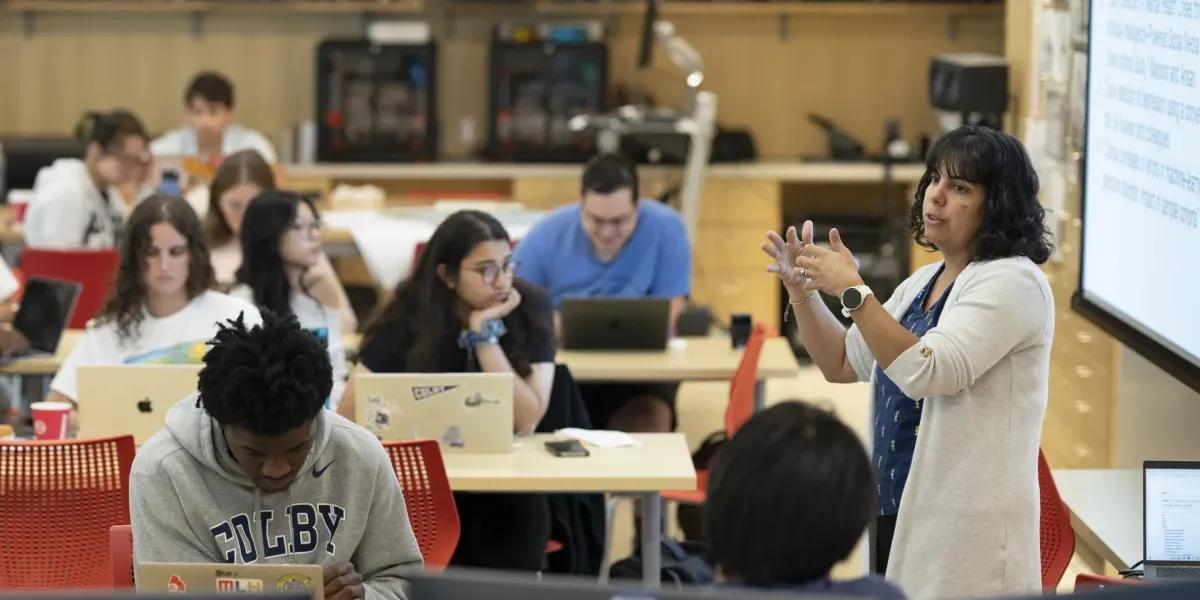
Universities are rapidly deploying AI education programs beyond computer science departments. Peter Stone, chair of computer science at the University of Texas at Austin, developed an introductory course on AI essentials for non-computer science majors, stating: "In the same way that everybody needs some degree of math, reading and writing, I think everybody needs a degree of AI literacy"
1
.
Source: VnExpress
Colby College's Davis Institute for Artificial Intelligence, established in 2021 with a $30 million gift, runs an eight-week "Interdisciplinary Summer Bridges" program where 30 students representing 23 majors collaborate on AI projects
4
. Students developed seven real-world solutions including no-code hiring tools to eliminate legacy biases and AI-assisted legal citation verification tools4
. David Watts, director of the Davis Institute for Artificial Intelligence, emphasized: "The vision is really around an interdisciplinary approach to AI. A lot of the challenges around AI go a lot further than the AI itself"4
.The University of Florida now offers more than 200 AI-related courses across all 16 colleges, with 14,000 students enrolled annually and 71% of Spring 2026 graduates taking at least one AI course
4
. Ohio State University introduced an AI fluency initiative ensuring every student starting with the class of 2029 will be fluent in AI related to their major by graduation4
.Students Demand Ethical AI Use Training and Academic Integrity Guidelines
While embracing AI tools, college students express significant concerns about ethical AI use and academic integrity. Nearly half of Kogod School of Business students worried about academic integrity issues
2
, while 40% of students in the Inside Higher Ed survey feared AI was reducing their ability to think independently2
3
.Kogod interim dean Casey Evans described how faculty approaches evolved: "When ChatGPT first came out, faculty focused on academic integrity, fighting against AI and making sure all assignments were 'AI-proof.' We've moved on pretty quickly from that"
3
. The new approach involves dropping student assignments into AI and telling them the result is a C, then coaching them toward an A3
. Evans noted resistance has been rare, stating: "We're very intentional, as opposed to forcing AI on students with no choice. They are really using AI as one of many tools in their toolbox"3
.Undergraduate and graduate business students want "more structured preparation to use AI effectively, ethically, and competitively in the workplace," according to the Kogod study
3
. Students seek clearer norms around AI use, ethics, and preserving independent thinking alongside tool usage3
.Related Stories

Curriculum Changes Accelerate Across Disciplines
The pace of curriculum changes has accelerated dramatically. At VCU, course design and approval previously took a year and a half but now happens in months or weeks, according to Andrew Arroyo, senior vice provost of academic affairs
5
. VCU is adding an online graduate certificate program in applied AI this year5
.
Source: Fortune
Northwestern University's computer science staff doubled in size to meet earlier demand and now teaches more students from other majors
1
5
. The school is adding an AI major alongside its existing AI minor and streamlining prerequisites to make AI and machine learning classes more accessible to non-majors1
. Samir Khuller, chair for computer science at Northwestern, is attempting to hire three more computer science professors despite enrollment declines in the major1
.Music programs are integrating AI education. Northwestern's Bienen School of Music offers a certificate in music and artificial intelligence
5
. Eastern Mennonite University assistant music professor Benjamin Guerrero is co-teaching a class where musicians, artists, theater and digital media majors learn alongside math, computer science and electrical engineering students5
. Guerrero, who helped the National Association for Music Education develop AI incorporation plans, stated: "In my mind, AI is no more disruptive than the record player, the radio, the metronome, the synthesizer or the computer"5
.Concerns About Over-Reliance on AI and Foundational Knowledge
Murtaza Ali, a doctoral candidate at the University of Washington whose research focuses on computer science education, expressed anxiety about AI encroachment: "When you ask the AI to do it for you, on the surface it might just seem it is writing the code. But under the hood, it's actually also doing the understanding of the task for you"
5
. The concern centers on graduates potentially lacking foundational knowledge in their fields due to over-reliance on AI tools.Brainstorming emerged as the most popular AI use case for three consecutive years
3
. However, Wharton researchers found people generated broader ranges of creative ideas using their own thoughts and web searches compared to ChatGPT3
. This suggests the most popular AI application may quietly narrow thinking rather than expand it.David Watts rejected the notion that programming expertise will become unnecessary, emphasizing engineers will still need to code and possess knowledge to identify when AI produces errors
4
. Students are realizing they don't need computer science majors to learn technology—a psychology student might develop behavioral health tools without becoming a software engineer4
.References
Summarized by

Navi
[2]
Related Stories
College Students Switch Majors as AI Skills Demand Reshapes Job Market and Career Choices
13 May 2026•Business and Economy

College students scramble for AI-proof majors as 70% fear job market displacement
27 Apr 2026•Entertainment and Society

College Students Boo AI at Commencements as Job Market Anxieties Intensify
29 May 2026•Entertainment and Society
Recent Highlights
1
Microsoft and Nvidia Launch Surface Laptop Ultra: A $2,599 AI-Ready PC With RTX Spark Chip
Technology

2
Google Unveils Gemini 4 Argon AI Model, Restricts Access to Trusted Cyber Defenders
Technology

3
OpenAI Releases 722 AI-Generated Math Papers on GitHub, Igniting Fury Among Mathematicians
Science and Research

Recent Highlights
Today's Top Stories





Don’t drown in AI news. We cut through the noise - filtering, ranking and summarizing the most important AI news, breakthroughs and research daily. Follow topics that matter to you and stay ahead.


