AI Data Center Construction Falls for First Time Since 2020 as Power Constraints Bite


4 Sources
4 Sources
[1]
US Data Center Construction Fell Amid Permit and Power Delays
Construction of new data centers in the US fell for the first time since 2020 despite soaring demand for artificial intelligence computing capacity, as developers face delays in permitting, zoning and power procurement. Capacity under construction fell to 5.99 gigawatts at the end of 2025 from 6.35 gigawatts at the end of 2024, real estate brokerage CBRE Group Inc. reported Wednesday. The construction delays and faster long-distance networks are driving development to move outside traditional data center sites like Northern Virginia, Gordon Dolven, CBRE's data center research director, said in the report. The overall vacancy rate in primary markets fell to a record low 1.4% at year-end. "Combined with growing interest in markets that offer available land and power, this is spurring investment beyond traditional hubs and reshaping the North American data center market," Dolven said. Local pushback against massive AI data center projects has intensified in recent months, with the tide turning from welcoming the economic benefits of major construction projects to scrutinizing their resource-intensiveness. Get the Markets Daily newsletter. Get the Markets Daily newsletter. Get the Markets Daily newsletter. What's happening in stocks, bonds, currencies and commodities right now. What's happening in stocks, bonds, currencies and commodities right now. What's happening in stocks, bonds, currencies and commodities right now. Bloomberg may send me offers and promotions. Plus Signed UpPlus Sign UpPlus Sign Up By submitting my information, I agree to the Privacy Policy and Terms of Service. Last week, Illinois Governor JB Pritzker sought to temporarily halt incentives for data centers in a bid to contain soaring power costs. An Oracle Corp. site in New Mexico that scored a package of tax incentives and support from government-backed bonds has prompted protests largely focused on its potential environmental impact. And tensions have flared in Northern Virginia, where some residents are now looking to flee what's become one of the largest data center hubs in the world. AI demand is forecast to require more than $3 trillion in data center investment, including related power supplies, according to estimates from Morgan Stanley and Moody's Ratings. New tenants absorbed a record 2.5 million gigawatts in 2025, up 38% from a year earlier, CBRE said. Construction underway fell 29% in Northern Virginia, followed by a 15% drop in Hillsboro, Oregon, and a 14% decline in Silicon Valley, CBRE reported. Projects soared 169% in Chicago and 15% in Dallas-Fort Worth. Atlanta had more than 2 gigawatts of projects under construction, ahead of 1.9 gigawatts in Northern Virginia, in the second half of 2025.
[2]
Local opposition creates roadblocks for AI boom
By the numbers: According to the most recent report from Data Center Watch, 20 projects representing some $96 billion in investments were blocked or delayed in the second quarter of 2025 alone amid local opposition. * And Wilmer Hale says over 200 bills were introduced in 2025 aimed at regulating the sector across states, 40 of which became law. The latest: The pushback has only intensified since then. Ten new moratorium proposals -- which would freeze data center development -- were filed in the past month alone, according to Sightline Climate. Reality check: Data center capacity is already under stress, with JLL noting that the sector only had 1% vacancies last year. State of play: Communities are increasingly worried about rising energy bills due to data centers, the noise nuisance, water usage, and the potential for AI to eliminate jobs. The big picture: Proposed state and federal regulation are considering ways to address those those concerns, while still allowing data centers to operate. * That could mean pushing builds further out from cities, requiring developers to pay for the own grid and power updates, or have their own power sources. * Those restrictions could be a boon to some industries. For example, forcing data centers into more rural haunts would require more connectivity to be built out, boosting demand for fiber, pipes for cooling, and extra transmission lines. * But it could also increase the cost of compute to the industry, as energy and compliance bills increase for the sector. Time to construction could also increase, as states weigh zoning restrictions. The bottom line: Data center and AI companies will have to evolve fast to address local concerns, or speed up timelines to put those data centers in space.
[3]
US datacenters face slew of problems amid grassroots protests against AI
New constructions delayed or cancelled, raising questions about US's ability to expand infrastructure to support boom Cancellations and delays of new US datacenters have increased as the artificial intelligence boom runs up against a slate of issues, including supply chain snags, energy shortages and tariff-induced restraints. Grassroots opposition from local communities has also derailed some plans, and some investors have grown wary of datacenters amid fears of an AI bubble. Dozens of plans for datacenters were killed or delayed in December or January, according to reports from the investment research firm MacroEdge and climate news outlet Heatmap. MacroEdge's research identified 26 cancellations through January - up from one in October. The complex knot of issues raises questions about the US's ability to quickly facilitate the datacenter boom. Because the increase in production has been powering US growth over the last 18 months, major delays could have broader economic implications, MacroEdge's chief economist, Don Johnson, wrote. "The [Trump] administration is going to be scrambling to find its next growth engine as the datacenter machine winds down as a tailwind," Johnson wrote. Dozens of proposals for new hyper-scale datacenters, which house the infrastructure for artificial intelligence, have been proposed across the US. The centers can consume as much power as the largest US cities, meaning grids need to rapidly expand their infrastructure, adding transformers, circuit breakers, high-voltage cables, steel poles and other pieces of equipment, to connect datacenters to the grid. Connecting to the grid is "the No 1 challenge we're seeing", Marsden Hanna, head of energy and sustainability for Google, said at a utility industry conference last month. "We have utilities in many markets telling us four or five, sometimes 10 years to interconnect," Hanna said, adding that one utility told Google it would take 12 years just to study the interconnection timeline. While the reports suggest an increase in cancellations, tracking the number of proposals and cancellations is difficult, said Douglas Jester, managing partner at the 5 Lakes Energy consulting firm in Michigan, which works on regulatory issues around datacenter construction. No agency keeps tabs on proposals, and the datacenter planning process is long and complex, Jester said. When a datacenter developer such as Google or Oracle wants to build a facility, it approaches energy utilities in multiple regions to study cost and how long it might take to connect to the grid. Developers often propose the same plans in multiple locations around the US and move forward where the costs and conditions are most favorable. That makes it difficult to gauge exactly when a project is legitimately under way. Regardless, centers are increasingly running up against mounting energy grid obstacles, especially a shortage of energy, Jester said. Many grids simply cannot generate enough power, or add it in time to meet datacenter developers' timelines, and the process of adding power supply to the grid is slow. That is partly because it can take regional grid operators, which coordinate the local energy utilities' power generation and transmission, up to five years to review how proposed gas plants, solar fields or other generation sources could affect the grid, Jester said. This protracted process was already slowing the nation's transition to clean energy. It can take five or more solar installations to generate the same amount of power as one gas plant, which means an increase in the review backlog as the clean energy transition accelerates. The sudden datacenter demand piles on to this already difficult problem. "The interconnection process is really getting bogged down, and it has been a problem even before datacenters," Jester said. The review process primarily ensures the new additions will not disrupt supply in the grid, but the Texas grid operator, Electric Reliability Council of Texas (Ercot), has a better approach, Jester said. In short, Ercot - which operates with little federal oversight compared with other operators - quickly adds new energy generation to its grid, then addresses problems if they arise. Meanwhile, the surge in new datacenter projects has hammered energy grid supply chains still recovering from Covid-era snags and that are strained from the clean energy buildout, said Qiuhua Huang, an associate professor of electrical engineering with the Colorado School of Mines, which studies grid supply chain issues. Demand for grid equipment, like transformers, has spiked, but only one plant in the US produces the type of steel needed for many of the pieces. Copper shortages are also slowing the buildout, Huang said. High-voltage transformers that once had lead times of six months now take up to four years to manufacture, for example. Relatedly, a skilled labor shortage represents another restraint, industry experts say. The US utility industry has leaned heavy on utility infrastructure imports from China and other countries, but demand abroad has also spiked. Donald Trump's tariffs have also made the US a less attractive market for foreign producers as prices continue to increase, Jester said. Data shows transformers' costs are up to six times above pre-2022 levels. "The tariffs are exacerbating, if not causing, the problem in the US," Jester said. Grid limitations have stretched the timelines for the new datacenters. PJM, the largest grid operator in the US, is pushing connection times back as far as 2030, MacroEdge noted. "This, of many factors, should put caution into investor minds," Johnson wrote. Some hedge funds and other datacenter investors are growing nervous. Blue Owl, an investor in the highly controversial Saline Township datacenter in Michigan, backed out on its $10bn investment in December. Though Oracle said it would not stop the project, Bain Capital and other investors seem similarly hesitant. Some solutions are in the works, and steel manufacturers are scaling up production. Battery storage is becoming a viable alternative to new power generation, Jester said. Large-scale battery storage that is added to the grid can hold energy for later use, reducing the need for new power plants and grid infrastructure. Oracle recently proposed that such battery storage could help meet its goal to build a 1.4GW datacenter in Michigan, which would require as much power as Detroit, by 2027. DTE Energy, the monopoly utility that serves the region, is near grid capacity and probably could not install a gas plant or enough solar fields to meet that timeline, in part because the review process is so slow. Big tech, which is far more resourced than the utility industry, is also developing new transformer technology that does not demand the same steel or infrastructure pieces, Huang said. "It's in the early phase of mass adoption, but datacenters have a much larger budget than utilities, so they can better handle those technology adoptions, and that will diversify the supply chain," Huang said.
[4]
Why the global AI data center boom is stalling
Why it matters: It's a sign of mounting collisions in the AI race -- from power constraints and grid equipment shortages to rising community opposition. The big picture: As tech giants sprint to build AI infrastructure, the physical -- and political -- limits of the power system are starting to bite. State of play: Up to 11 gigawatts of 2026 capacity "remains in the announced stage with no signs of construction," per the report by Sightline Climate, a data intelligence firm. * With typical build times of 12 to 18 months, that capacity could still come online -- but only with dramatic acceleration, the report states. Yes, but: Development is still surging despite growing hurdles. Data center additions hit a record in 2025, and 2026 is on track to surpass it, Olivia Wang, a Sightline research analyst, told Axios. By the numbers: Nearly six gigawatts came online last year, and five gigawatts are already under construction this year. (One gigawatt can power about 1 million U.S. homes.) * "While power continues to be a constraint, developers that locked in power and equipment contracts early are rapidly bringing capacity online," the report says. Driving the news: With midterm elections heating up, communities are growing restless over rising power prices -- which many blame on data centers that increasingly require city-scale electricity. Zoom in: Sightline has tracked more than 10 new moratorium proposals in the past month alone in U.S. states. * This includes New York, Michigan, Virginia and Oklahoma, Wang says. * "We expect this trend to continue and meaningfully increase the risk of projects being delayed, withdrawn, and ultimately canceled," Wang wrote. * The firm is tracking nine canceled projects in its database, so for now, most are facing delays, not outright cancellations. Flashback: More than one-quarter of the 110 data center projects that were slated to come online last year were delayed. What we're watching: Whether high-profile cancellations rise along with the wave of moratorium efforts.
Share
Share
Copy Link
US AI data center construction dropped from 6.35 to 5.99 gigawatts by end of 2025, marking the first decline since 2020. Local opposition intensifies as communities push back against rising energy bills, while power grid limitations and supply chain disruptions create mounting roadblocks for AI boom despite $3 trillion in forecast investment needs.
AI Data Center Construction Hits First Decline Since 2020
Construction of new AI data center capacity in the US fell to 5.99 gigawatts at the end of 2025 from 6.35 gigawatts at the end of 2024, marking the first decline since 2020 despite surging demand for artificial intelligence computing capacity
1
. The downturn signals that the physical and political limits of the power system are starting to constrain the AI infrastructure buildout that has been powering US economic growth over the last 18 months3
.
Source: Bloomberg
Real estate brokerage CBRE Group Inc. reported that data center development faces mounting delays in permitting, zoning, and power procurement, forcing developers to look beyond traditional hubs like Northern Virginia, where construction underway fell 29%
1
. Construction also dropped 15% in Hillsboro, Oregon, and 14% in Silicon Valley, while projects soared 169% in Chicago and 15% in Dallas-Fort Worth as developers seek markets with available land and power1
.Local Opposition Creates Mounting Roadblocks for AI Boom
Community opposition to data center development has intensified dramatically, with 20 projects representing approximately $96 billion in investments blocked or delayed in the second quarter of 2025 alone
2
. The pushback has accelerated further, with 10 new moratorium proposals filed in the past month across states including New York, Michigan, Virginia, and Oklahoma4
. Wilmer Hale reports that over 200 bills were introduced in 2025 aimed at regulating the sector across states, with 40 becoming law2
.
Source: Axios
Grassroots protests against AI have focused on rising energy bills, noise nuisance, water usage, and concerns about AI eliminating jobs
2
. Illinois Governor JB Pritzker sought to temporarily halt tax incentives for data centers to contain soaring power costs, while an Oracle Corp. site in New Mexico that secured tax incentives and government-backed bonds has prompted protests largely focused on environmental impact1
. MacroEdge research identified 26 project cancellations through January, up from just one in October3
.Power Constraints and Grid Capacity Challenges
Power grid limitations represent the most significant barrier to AI data center expansion. Connecting to the energy grid is "the No 1 challenge we're seeing," said Marsden Hanna, head of energy and sustainability for Google, at a utility industry conference
3
. Utilities in many markets are telling developers it will take four or five, sometimes 10 years to interconnect, with one utility informing Google it would take 12 years just to study the interconnection timeline3
.The interconnection process can take regional grid operators up to five years to review how proposed power generation sources could affect the grid, creating a substantial bottleneck
3
. Data center capacity is already under severe stress, with JLL noting that the sector only had 1% vacancies last year, while the overall vacancy rate in primary markets fell to a record low 1.4% at year-end2
1
.Related Stories

Supply Chain Disruptions Compound Infrastructure Setbacks
Energy shortages combine with severe supply chain disruptions to create additional infrastructure setbacks. The surge in data center projects has strained energy grid supply chains still recovering from Covid-era snags and stressed by the clean energy buildout
3
. High-voltage transformers that once had lead times of six months now take up to four years to manufacture3
. Only one plant in the US produces the type of steel needed for many grid equipment pieces, while copper shortages and skilled labor shortages represent additional constraints3
.Up to 11 gigawatts of 2026 capacity "remains in the announced stage with no signs of construction," according to Sightline Climate
4
. With typical build times of 12 to 18 months, that capacity could still come online but only with dramatic acceleration4
. More than one-quarter of the 110 data center projects slated to come online last year faced permitting delays4
.Economic Implications and Future Outlook
AI demand is forecast to require more than $3 trillion in data center investment, including related power supplies, according to estimates from Morgan Stanley and Moody's Ratings
1
. New tenants absorbed a record 2.5 gigawatts in 2025, up 38% from a year earlier1
. Nearly six gigawatts came online last year, and five gigawatts are already under construction this year, with one gigawatt capable of powering about 1 million US homes4
.Proposed regulatory efforts are considering ways to address community concerns while allowing data centers to operate, potentially pushing builds further from cities, requiring developers to pay for their own grid and power updates, or mandating their own power sources
2
. These zoning restrictions could increase compute cost to the industry as energy and compliance bills rise, while boosting demand for fiber, cooling pipes, and extra transmission lines2
. The complex knot of issues raises questions about the US's ability to quickly facilitate the data center boom, with potential broader economic implications as the datacenter machine that has been powering growth winds down3
.References
Summarized by

Navi
Related Stories
Half of US AI Data Centers Delayed as Power Infrastructure Supply Chain Collapses
02 Apr 2026•Technology

Over 230 groups demand moratorium on AI data center expansion as communities revolt nationwide
09 Dec 2025•Policy and Regulation

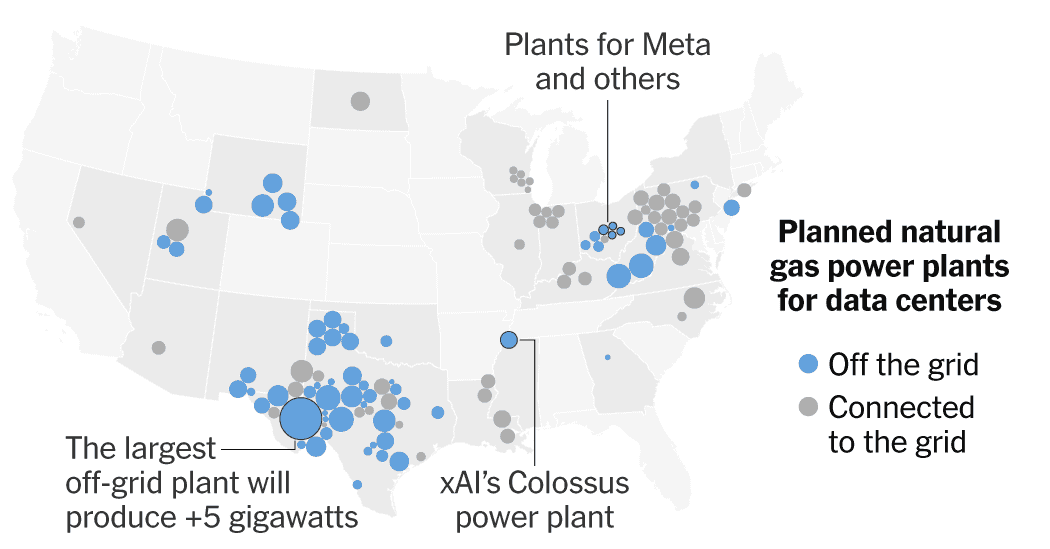
Data Centers Hit Power Grid Limits as Tech Giants Turn to Off-Grid Natural Gas Solutions
18 Mar 2026•Business and Economy
Recent Highlights


Recent Highlights
Today's Top Stories











Your Daily Dose of Curated AI News
Don’t drown in AI news. We cut through the noise - filtering, ranking and summarizing the most important AI news, breakthroughs and research daily. Spend less time searching for the latest in AI and get straight to action.

