AI bot traffic set to surpass human internet use by 2027 as automated activity reshapes the web


4 Sources
[1]
Online bot traffic will exceed human traffic by 2027, Cloudflare CEO says | TechCrunch
Bots are taking over the web, according to Cloudflare CEO Matthew Prince. In an interview at the SXSW conference in Austin this week, he said that with the speed at which artificial intelligence is growing, AI bot traffic will exceed the amount of human traffic that's online by 2027. Prince
[2]
AI and bots have officially taken over the internet, report finds
Traffic from AI agents like OpenClaw grew nearly 8,000% in 2025 over the year prior. The State of AI Traffic report released Thursday by Human Security, a cybersecurity firm, showed that artificial intelligence and bots have officially eclipsed human users. "The internet as a whole was created
[3]
Cloudflare CEO warns AI bots could outnumber humans online by 2027
The internet you use every day could soon be dominated by artificial intelligence. Cloudflare CEO Matthew Prince says that AI bots may generate more traffic than humans within the next year or two, marking a major shift in how the web works. Speaking about the current trends with TechCrunch,
[4]
AI Bot Traffic May Push Out Human Traffic from the Internet by 2027
This is no fantasy state prediction as Cloudflare CEO Matthew Prince who blamed it on the Gen AI growth, prior to which bots accounted only for about a fifth of all traffic A LinkedIn user recently wondered whether a day will soon dawn when posts and the comments on them would both be written by
Share
Copy Link
Cloudflare CEO Matthew Prince warns that AI bot traffic will exceed human traffic by 2027, driven by generative AI's insatiable appetite for data. A new report from Human Security reveals that bots have officially taken over the internet, with automated traffic growing eight times faster than human activity in 2025. This platform shift demands new infrastructure like sandboxing to handle millions of AI agents operating simultaneously.
AI Bot Traffic Poised to Dominate Internet Traffic by 2027
Artificial intelligence is fundamentally reshaping how the web operates. Cloudflare CEO Matthew Prince announced at the SXSW conference in Austin that AI bot traffic will exceed human traffic online by 2027, marking a dramatic platform shift in internet usage
1
. This prediction comes as Cloudflare, which handles one-fifth of all websites, observes unprecedented growth in automated activity across its network. Before the generative AI era, bots accounted for only 20% of internet traffic, primarily from Google's web crawler and other reputable indexing services1
. The remaining bot activity came from scammers and malicious actors. That balance has shifted dramatically.
Source: TechCrunch
Bots Have Officially Taken Over the Internet
The tipping point has already arrived. A report released by Human Security, a cybersecurity firm, confirms that bots have officially taken over the internet, with automated traffic growing almost eight times faster than human activity in 2025
2
. The increase in automated traffic reflects how rapidly AI agents have proliferated across the web. Traffic from AI agents like OpenClaw grew nearly 8,000% in 2025 over the year prior2
. Large language models including ChatGPT, Claude, and Gemini have driven AI traffic up 187% from January to December 2025 alone2
. "Machine-based traffic is effectively replacing humans as the dominant form of traffic on the other side of the internet," said Stu Solomon, CEO of Human Security2
. The company's findings were based on data from its Human Defense Platform, which processed over one quadrillion interactions across its customer base.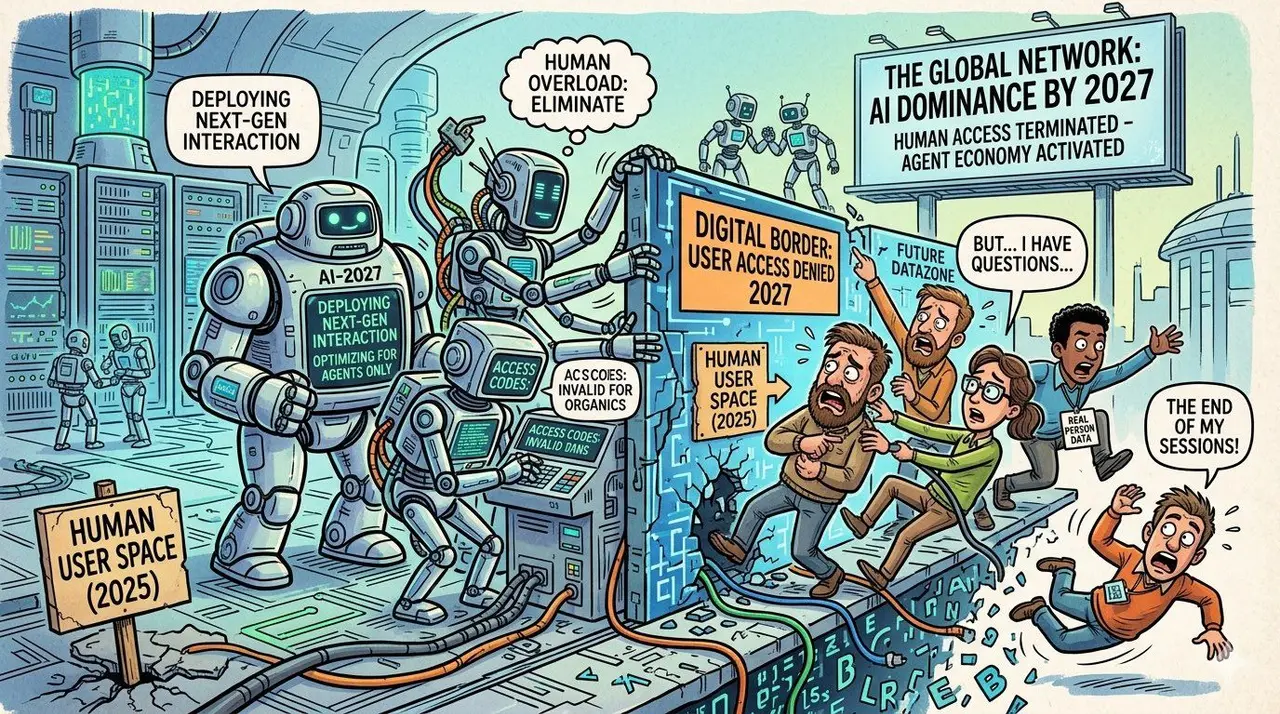
Source: CXOToday
Why AI Agents Generate Exponentially More Traffic
The surge in bot traffic will exceed human traffic because of how AI agents operate compared to humans. Matthew Prince explained that when a human shops for a digital camera, they might visit five websites. An AI agent performing the same task will visit 1,000 times as many sites—potentially 5,000 websites—to gather comprehensive information for users' chatbot queries
1
. "That's real traffic, and that's real load, which everyone is having to deal with and take into account," Prince noted1
. This exponential difference stems from generative AI's insatiable need for data to provide accurate, comprehensive responses. Every query triggers cascading requests across the web, creating traffic volumes that dwarf human browsing patterns.Infrastructure Demands and Sandboxing Solutions
This fundamental platform shift requires developing entirely new technologies to manage the load. Prince envisions sandboxing systems where AI agents can spin up on the fly, complete their tasks, and then tear down when finished
3
. These sandboxed environments would activate when consumers ask AI agents to perform tasks like planning a vacation or researching products. "What we're trying to think about is, how do we actually build that underlying infrastructure where you can—as easily as you open a new tab in your browser—you can actually spin up new code, which can then run and service the agents that are out there," Prince said1
. He anticipates millions of these sandboxes being created every second to handle the volume.The physical internet infrastructure must also expand dramatically. Prince recalled how during Covid, internet traffic increased so rapidly that some parts of the internet nearly buckled under the strain from video streamers like YouTube, Disney, and Netflix
1
. Unlike that temporary spike, current growth continues accelerating without any signs of slowing. Data centers and servers must scale to accommodate this relentless expansion.Related Stories

Business Impact and Strategic Uncertainty
Major retailers are grappling with how to respond to this AI-driven future. Walmart is welcoming bots to research, shop, and transact on behalf of users, but Prince warns this strategy carries long-term risks by disintermediating brands from customers
4
. A bot could eventually bypass retailers entirely and purchase directly from manufacturers. Amazon has taken the opposite approach, bringing lawsuits against companies for deploying bots on their website4
. Target holds middle ground, allowing bots only if they remain on their platform. This strategic uncertainty has led many content creators to hold off on fresh investments and block bots for now4
.The digital advertising industry already feels the impact. Bot detection platform Lunio reported that over $63 billion in global digital ad spend was wasted in 2025 due to bot traffic and ad fraud
4
. The analysis of more than 2.7 billion paid ad clicks across Google, Meta, LinkedIn, and other platforms found that 8.5% of all paid traffic was invalid4
. This means roughly one in every 12 paid clicks came from a bot rather than a potential customer. "Invalid traffic is one of the biggest invisible drains on digital performance," said Nick Morley, CEO of Lunio4
. When polluted data feeds into automated bidding and targeting algorithms, the waste compounds further.Watching the Platform Shift Unfold
Prince compares this transformation to previous platform shifts like the move from desktop to mobile. "AI is another platform shift...the way that you're going to consume information is completely different," he stated
1
. The internet was created with the basic notion that a human being sits on the other side of the computer screen, and that assumption is rapidly being replaced2
. As information consumption evolves, businesses must decide whether to embrace AI agents, restrict them, or attempt to control how they interact with their platforms. The stakes are high, and the timeline is short. With surpassed human traffic already a reality in 2025 and projections showing continued acceleration, organizations have limited time to adapt their strategies, secure their infrastructure, and protect their revenue streams from the DDoS-like effects of relentless automated activity.References
Summarized by

Navi
[1]
[3]
Related Stories
Bot Traffic Surpasses Human Activity on Internet for First Time as AI Agents Surge
04 Jun 2026•Technology

AI Bots Surge to 1 in 31 Web Visits as Publishers Face Traffic Crisis and Arms Race
05 Feb 2026•Technology

Cloudflare CFO: Humans Will Be 'Rounding Error' as AI Traffic Surges 1,000x in Five Years
11 Aug 2026•Technology

Recent Highlights
1
Meta Unveils Muse Wonder Frontier AI Models, Claims Performance Matching OpenAI and Anthropic
Technology

2
IMF Report Warns AI Market Correction Could Spark Global Financial Crisis With $1.4T at Risk
Business and Economy

3
OpenAI Releases 722 AI-Generated Math Solutions, Triggering Existential Crisis in Mathematics
Technology

Recent Highlights
Today's Top Stories









Don’t drown in AI news. We cut through the noise - filtering, ranking and summarizing the most important AI news, breakthroughs and research daily. Follow topics that matter to you and stay ahead.


