AMD Surges Past Expectations as Data Center Revenue Jumps 97% on Agentic AI and EPYC Demand


4 Sources
[1]
AMD beats expectations as agentic AI sparks its data center revenue growth engines
Shares of the chipmaker Advanced Micro Devices Inc. were up more than 5% in late trading today after it delivered solid third-quarter earnings and revenue today, with data center sales almost doubling from a year ago. The company reported earnings before certain costs such as stock compensation of
[2]
AMD forecasts fourth-quarter revenue above estimates on strong AI chip demand
Advanced Micro Devices estimates its fourth-quarter revenue will hit about $17 billion, driven primarily by robust demand for AI chips. Although the company's forecast for adjusted gross margin stands at 55%, it falls slightly short of analyst expectations. A remarkable 97% year-on-year increase in
[3]
Advanced Micro Devices Q3 2026 Earnings Call Transcript - Advanced Micro Devices (NASDAQ:AMD)
Advanced Micro Devices (NASDAQ:AMD) reported third-quarter financial results on Tuesday. The transcript from the company's third-quarter earnings call has been provided below. This transcript is brought to you by Benzinga APIs. For real-time access to our entire catalog, please visit
[4]
AMD Data Center Revenue Soars 97 Percent On AI, EPYC Demand
AMD's record third quarter featured a 97 percent surge in data center revenue as EPYC processors and Instinct GPUs gained momentum, while MI455X, Helios and Venice deployments helped strengthen the chipmaker's AI infrastructure position, Chair and CEO Lisa Su told financial analysts. AMD had its
Share
Copy Link
AMD reported record Q3 earnings with data center revenue soaring 97% to $8.55 billion, driven by strong AI chip demand for EPYC processors and Instinct GPUs. The company forecasts Q4 revenue of $17 billion as agentic AI applications and Helios systems gain traction with Meta, Microsoft, and other hyperscalers.
AMD Delivers Record Quarter on Strong AI Chip Demand
Advanced Micro Devices reported its largest and most profitable quarter in company history, with third-quarter revenue jumping 45% year-over-year to $13.38 billion, surpassing analyst expectations of $13.09 billion
1
. Earnings per share came in at $2.09, beating Wall Street's forecast of $1.95 per share, while net income surged 77% to $3.47 billion1
. Shares climbed more than 5% in extended trading as investors responded to the chipmaker's accelerating momentum in the AI semiconductor market1
.Data Center Revenue Surges 97% on AI-Driven Server Demand
The star performer was AMD's data center business, which generated $8.55 billion in revenue, a remarkable 97% increase from the prior year and well above analyst estimates of $8.20 billion
2
. Data center revenue now accounts for 64% of AMD's total revenue, up dramatically from 47% just one year ago3
. Both cloud and enterprise sales more than doubled year-over-year, significantly exceeding the company's previous outlook of more than 80% growth4
.
Source: Benzinga
EPYC Processors and Agentic AI Applications Drive Growth
AMD's EPYC processors experienced unprecedented adoption across cloud, enterprise, and superintelligence workloads during the quarter
3
. The emergence of agentic AI applications like Meta's Muse has proven particularly beneficial for AMD, as autonomous AI agents run more efficiently on CPUs than GPUs, boosting demand for the company's traditional processors1
. Chair and CEO Lisa Su emphasized this shift during the earnings call, stating that "cloud providers also added significant EPYC capacity in the quarter for personal and enterprise agents, which are quickly becoming the next killer app for CPUs in the cloud"4
.The fifth-generation EPYC Turin processors have become the most widely deployed EPYC generation in the public cloud, with more than 540 instance types available globally from major providers
4
. OpenAI selected EPYC Turin processors as host CPUs for its first custom accelerator platforms4
.Helios Systems and Instinct GPUs Gain Traction in AI Hardware Market
Beyond CPUs, AMD's Instinct GPUs and Helios rack-scale systems are gaining significant momentum in the AI hardware market. The company's MI455X accelerator, bundled within Helios systems, is already deployed at Anthropic, Meta, Microsoft, OpenAI, and Oracle
1
. Lisa Su confirmed that "lead customers including Anthropic, Meta, Microsoft, OpenAI, and Oracle brought their first Helios racks online quickly" and are now running their latest models on the platform4
. Meta's partnership with AMD deepened further as the social media giant revealed that AMD invested $1 billion in its latest equity offering1
.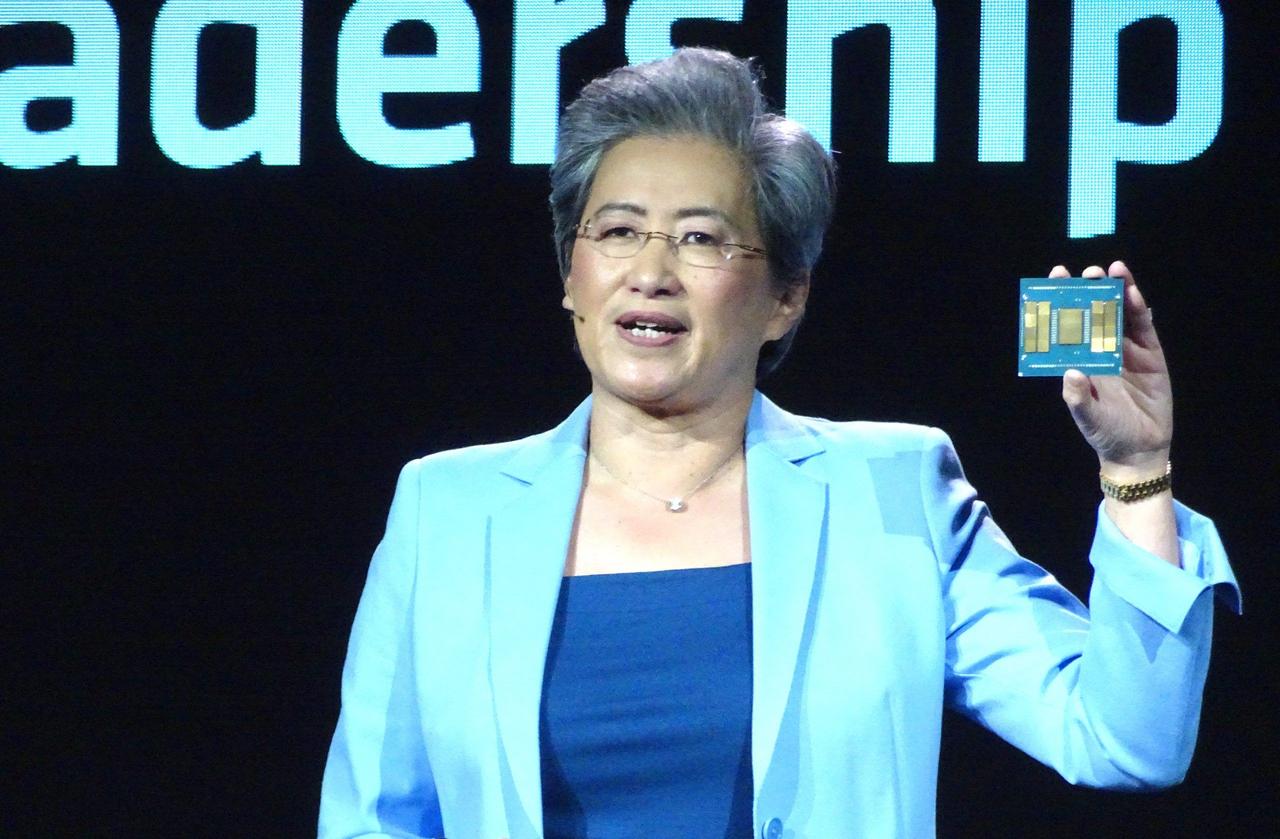
Source: SiliconANGLE
Strategic Investments Strengthen AMD's Superintelligence Portfolio
AMD announced two major acquisitions during the quarter to bolster its position in AI applications. In September, the company revealed plans to acquire World Labs for $8.2 billion in an all-stock deal
1
. Founded by AI luminary Fei-Fei Li, World Labs develops world models that simulate 3D environments to support training of intelligent robots and physical AI applications1
. AMD also acquired Taalas, a startup making model-specific integrated circuits that can be customized to run specific AI models more efficiently, strengthening the company's position in AI inference1
. Both acquisitions are expected to close by year-end4
.Related Stories

Financial Outlook Points to Continued Acceleration
For the fourth quarter, AMD forecasts revenue of approximately $17 billion at the midpoint of its guidance range, significantly ahead of the Street's $16.23 billion consensus estimate
2
. This represents 66% year-over-year revenue growth, driven by a 50% increase in the data center segment3
. Looking further ahead, AMD expects server revenue to double year-over-year in fiscal 2027, with AI growth likely to accelerate even faster than projected three months ago1
. Lisa Su told analysts that "adoption is just starting and we expect demand to grow sharply as agents are deployed more broadly and take on more complex work"1
. By 2027, data center is expected to represent more than 80% of total revenue3
.Supply Constraints and PC Market Challenges
Despite strong AI chip demand, AMD faces supply constraints, particularly in high-bandwidth memory (HBM), a critical component for advanced AI chips
2
. However, Su addressed these concerns during the earnings call, noting that after a high-profile visit to Taiwan last month, AMD has "worked across our supply chain to secure the wafers, substrates, advanced packaging, memory and other key components needed to support much higher growth next year"1
.
Source: CRN
The client and gaming division declined 8% to $3.72 billion, missing estimates of $3.79 billion, with gaming revenue down 40% year-over-year
2
. Lisa Su warned that in 2027, AMD is planning for PC market unit shipments to decline by a double-digit percentage as higher memory and component costs weigh on demand4
. However, strength in the data center unit is more than offsetting these challenges, positioning AMD to capitalize on rising strategic investments in artificial intelligence infrastructure.References
Summarized by

Navi
[3]
Related Stories
AMD Reports Record Q3 Revenue of $9.25 Billion Driven by AI Chip Demand, But Faces Growing Competition
04 Nov 2025•Business and Economy

AMD revenue forecast disappoints investors despite strong AI chips sales and China boost
04 Feb 2026•Business and Economy

AMD's Q2 Earnings: AI Chip Sector Gains and Data Center Growth Boost Optimism
31 Jul 2024

Recent Highlights
1
Google DeepMind unveils Genie 4 world model with audio and 2-minute interactive simulations
Technology

2
Google Unveils Gemini 4 Carbon AI Model With Major Cybersecurity Gains, Beating Claude Opus 5.5
Technology

3
Pope Leo XIV Demands AI Disarmament and Ban on Autonomous Weapons at UN Geneva Meeting
Policy and Regulation

Recent Highlights
Today's Top Stories









Don’t drown in AI news. We cut through the noise - filtering, ranking and summarizing the most important AI news, breakthroughs and research daily. Follow topics that matter to you and stay ahead.


