James Dacombe's Olix AI Chip Startup Triples Valuation to $3.3bn in Six Months


5 Sources
[1]
James Dacombe, 25, triples AI chip start-up's valuation to $3.3bn
James Dacombe's AI chip start-up Olix has raised $312mn from investors including Arm, tripling its valuation to $3.3bn in six months. The company, founded in 2024 by the 25-year-old entrepreneur, has sought new funding in an effort to outpace the many rival start-ups vying to compete against
[2]
A 25-year-old just tripled his London chip startup to $3.3bn, betting against Nvidia and the shortage.
Olix, founded two years ago by a 25-year-old, has tripled its valuation to $3.3bn. Its pitch is an AI chip that skips the components the rest of the industry is fighting over. A London startup two years old has just become one of Britain's boldest bets against Nvidia. Olix has raised $312m and
[3]
James Dacombe's AI chip startup Olix raises $312m By Investing.com
Investing.com -- AI chip startup Olix raised $312 million in a funding round led by Fundomo, the Financial Times reports. SoftBank-backed Arm, Hudson River Trading, and Netflix co-founder Reed Hastings participated in the round. The funding values the company at $3.3 billion, triple its valuation
[4]
How school dropout James Dacombe built a $3.3B AI chip startup and became Britain's newest billionaire at 25
James Dacombe left sixth form after just two days at 16 and, less than a decade later, founded Olix, an AI chip startup valued at US$3.3 billion in its latest funding round, lifting the estimated value of his stake above $1 billion. The milestone came after London-based Olix raised £232 million
[5]
25-year-old school dropout becomes UK's latest AI billionaire
Olix raised £232 million in a financing round led by New York-based Fundomo, with backing from British chip designer Arm, Netflix co-founder Reed Hastings and Sovereign AI, the U.K. government's artificial intelligence investment vehicle, according to British newspaper The Times. Before the
Share
Copy Link
James Dacombe's AI chip startup Olix raised $312mn from Fundomo, Arm, and Reed Hastings, tripling its valuation to $3.3bn in six months. The London-based firm bypasses supply chain bottlenecks with photonic interconnect technology, positioning itself as a specialized alternative to Nvidia in the booming AI infrastructure market.
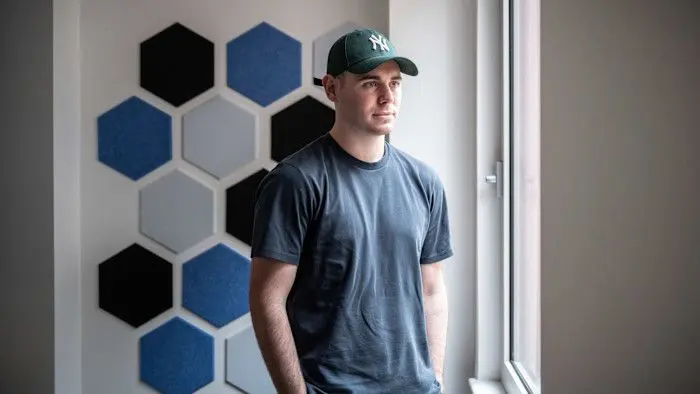
James Dacombe's Olix Raises $312mn, Triples Valuation to $3.3bn
Olix, the AI chip startup founded by 25-year-old James Dacombe, has raised $312mn in a funding round led by New York-based Fundomo, tripling its valuation to $3.3bn in just six months
1
2
. The Series B round attracted backing from SoftBank-backed Arm, quant firm Hudson River Trading, Netflix co-founder Reed Hastings, and the UK government's Sovereign AI fund1
5
. The deal values the London-based company at $3.3bn including the fresh capital, up from just over $1bn in February when Olix raised $220mn1
. Dacombe, who owns more than one-third of Olix through his holding company Bletchley Industries, now holds a stake estimated at approximately $1.27bn, making him Britain's newest AI billionaire4
5
.Betting Against Nvidia with Specialized Semiconductors
James Dacombe argues the era of general-purpose chips handling every AI task is ending. "We are moving into a world of specialisation," he told the Financial Times
1
. His pitch centers on disaggregating AI workloads across specialized semiconductors rather than relying on one chip to do everything2
. Olix develops inference chips designed to run trained AI models more efficiently than conventional processors, positioning itself to compete with Nvidia in the AI chip market4
5
. The company's X-1 platform spreads models across several specialized chips connected by an optical network that moves data with light rather than copper2
. Its DX-1 chip handles the stage where models generate output, and Olix claims it can run faster on less power than general-purpose alternatives for very large models2
.Bypassing Supply Chain Bottlenecks with Photonic Interconnect
Olix's biggest differentiator lies in its use of photonic interconnect, which uses lasers to move data between large clusters of chips faster and with greater energy efficiency
1
. Critically, Olix's chip designs do not rely on semiconductor components currently in shortest supply, such as leading-edge silicon, high-bandwidth memory, or advanced packaging1
2
. Instead, the DX-1 stores models in fast on-chip memory, sidestepping the very components pushing up prices across the tech industry2
. This approach addresses a timely pain point as supply chain bottlenecks continue to constrain AI infrastructure development. "Today, where there is such an economic prize from being able to run very large powerful large language models fast and to a large number of users at a low cost, it really pays to disaggregate and have custom silicon that is good at that," Dacombe explained1
.Racing to Market Against Better-Funded Rivals
Speed matters in the AI chip market, where Olix faces competition from better-funded rivals. Bristol-based Fractile raised $220mn in May, while US startup Etched closed a $300mn round at a $10.3bn valuation from Sequoia and Andreessen Horowitz in July
1
2
. SambaNova raised $1bn at an $11bn valuation led by General Atlantic1
. Despite being smaller than American competitors, Olix is betting on execution velocity. "The velocity and culture of delivering when you say you will deliver is really key," Dacombe said. "We are on track to be the fastest company to go from founding to full chip tape out of any company in this space"1
4
. The company plans to tape out its chips later this year and deliver first products to customers in 20271
2
.AI-Powered Development and Strategic Hires
Olix has made extensive use of AI tools to accelerate AI hardware development, particularly for components like the compiler that enables AI software to run on its chips
1
. Completing that compiler was a crucial proof point for investors in the latest funding round1
. The company now employs more than 140 staff across offices in London, Bristol, Toronto, and Austin, with many hires joining from US Big Tech groups and semiconductor companies1
4
. Alongside the funding round, Olix appointed Matt Briers, former chief financial officer at UK fintech Wise, as its CFO1
2
. The company has also added Nick McKeown, a Stanford professor who helped invent modern networking, to its board2
.Related Stories

From School Dropout to Billionaire Founder
Dacombe's path to building a $3.3bn AI chip startup began unconventionally. Raised in Harrogate, northern England, he taught himself computer programming at 13 and dropped out of sixth form college after just two days at age 16
4
5
. At 17, he founded CoMind, a medical technology startup developing non-invasive brain-monitoring devices, which has raised about $100mn and is currently being trialled at St Bartholomew's Hospital in London1
4
. In 2022, Dacombe joined the Thiel Fellowship, a program established by PayPal co-founder Peter Thiel that provides funding and mentorship for young entrepreneurs pursuing businesses instead of traditional higher education4
. He founded Olix in 2024 through his holding company Bletchley Industries after seeing the soaring demand for computing power driven by AI4
. Reflecting on his early start, Dacombe said: "An advantage of starting my business so young was naivety. You don't have the scar tissues from what hasn't worked, so you just try a lot of things"4
.What This Means for AI Infrastructure
Private investors continue pouring capital into chip startups despite Wall Street anxiety about the scale of increasingly debt-fuelled AI infrastructure spending, which has triggered sell-offs in chipmakers and memory companies in recent weeks
1
. The AI chip market is worth roughly $84bn this year and could approach $1tn early next decade2
. For the UK, Olix represents a rare opportunity to own a significant slice of the AI infrastructure market. Joséphine Kant, head of ventures at Sovereign AI, described Dacombe as "one of the most important founders of his generation," adding that "James not only wants to win globally, but he's also proud of where he's from"5
. Watch whether Olix can deliver on its promise to be the fastest company to go from founding to full chip tape out, and whether its photonic interconnect technology can deliver the performance gains needed to carve out market share from Nvidia when products ship in 2027.References
Summarized by

Navi
[2]
[3]
[4]
Related Stories
High School Dropout James Dacombe Becomes Europe's Youngest Self-Made Billionaire With AI Chip Startup Olix
17 Aug 2026•Business and Economy

AI Boom Creates Over 50 New Billionaires as Startup Investment Surges Past $200 Billion
26 Dec 2025•Business and Economy

CoreWeave CEO's Meteoric Rise: From Crypto Mining to AI Billionaire
27 Jun 2025•Business and Economy

Recent Highlights



Recent Highlights
Today's Top Stories







Don’t drown in AI news. We cut through the noise - filtering, ranking and summarizing the most important AI news, breakthroughs and research daily. Follow topics that matter to you and stay ahead.


