AI-Driven Design of Super-Adhesive Hydrogels Inspired by Nature


4 Sources
[1]
Nature - Rubber stuck
Designing adhesives that remain effective in wet environments is a formidable challenge that can even confound approaches that use artificial intelligence. In this week's issue, Jian Ping Gong and colleagues draw inspiration from nature to develop a data-driven system that analyses adhesive protein
[2]
AI learns from nature to design super-adhesive gels that work underwater
Super-sticky hydrogels that can be used in wet environments are needed for many applications -- for example, as glues to seal tissue and stop bleeding in surgery, as gels that support wound healing and tissue regeneration, and as materials used underwater on ships and offshore structures. However,
[3]
Super-sticky hydrogel is 10 times stronger than other glues underwater
Researchers analysed thousands of natural protein sequences and got assistance from AI in order to design a new hydrogel adhesive that can stay sticky underwater or even within a living body A rubber duck that was stuck to a seaside rock for more than a year has proved the strength of a new sticky
[4]
New adhesive is so sticky it can glue a rubber duck to a seaside rock
New water-resistant hydrogels, designed with the help of machine learning, are more adhesive than any comparable materials found in nature. The hydrogels were developed with the aid of an algorithm trained on the adhesives produced by natural organisms, such as geckos and mussels. The researchers
Share
Copy Link
Researchers use AI and machine learning to develop water-resistant, super-adhesive hydrogels inspired by natural protein sequences, with potential applications in medicine, marine technology, and industry.
AI-Driven Design Process
Researchers have developed a groundbreaking approach to creating super-adhesive hydrogels using artificial intelligence (AI) and machine learning. The team, led by Jian Ping Gong and colleagues, drew inspiration from nature to design materials that can withstand wet environments
1
. The process began by analyzing a dataset of 24,707 naturally occurring adhesive protein sequences to guide the initial design of 180 hydrogels2
.
Source: Nature
The researchers then employed an iterative machine-learning framework to optimize adhesion performance. This data-driven approach allowed them to capture broader sequence logic beyond individual bio-mimic motifs, creating a systematic and generalizable framework
4
. The AI-assisted design process resulted in hydrogels with adhesive properties superior to those found in nature.Exceptional Underwater Performance
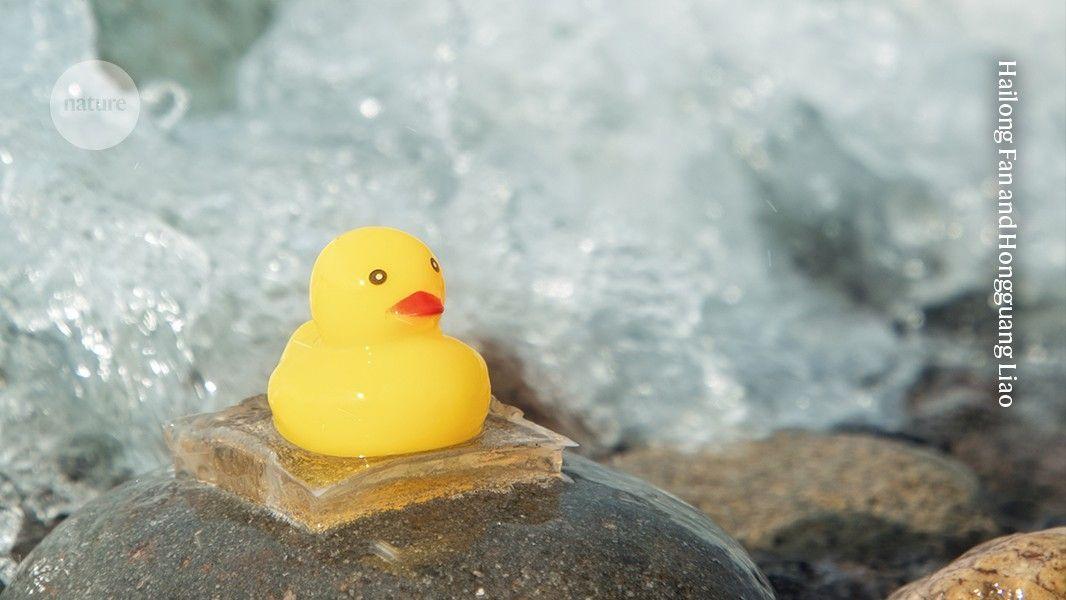
The newly developed hydrogels demonstrated remarkable adhesive strength in various wet environments. One of the most striking demonstrations involved gluing a rubber duck to a seaside rock, where it remained fixed despite continuous wave impacts and tidal changes for over a year
1
3
.In another test, a hydrogel was used to patch a 20-millimeter-diameter hole at the base of a 3-meter-tall water-filled pipe. The patch instantly stopped a high-pressure leak and continued to seal the hole for more than five months
2
. The adhesive strength of these hydrogels underwater exceeded 1 megapascal, approximately 10 times stronger than most soft, sticky materials under similar conditions [3](https://www.newscientist.com/article/2491328-super-sticky-hydrogel-is-10-times-stronger-than-other-glues-underwater()].Potential Applications
The super-adhesive hydrogels developed through this AI-driven process have potential applications across various fields:
-
Biomedical: The hydrogels showed biocompatibility in experiments with mice, suggesting possible uses in prosthesis coatings, wearable biosensors, and as surgical glues
2
[3](https://www.newscientist.com/article/2491328-super-sticky-hydrogel-is-10-times-stronger-than-other-glues-underwater()]. -
Marine Technology: The materials could be used in deep-sea robotics, underwater repairs, and marine farming
4
. -
Industrial Applications: The hydrogels' ability to seal leaks and adhere to irregular surfaces in wet conditions makes them promising for various industrial uses
2
.
Related Stories


Challenges and Future Directions
While the new hydrogels show great promise, some challenges remain. The material must be relatively thick to perform well, and further testing is needed in real-world conditions with rough, contaminated, or moving surfaces
3
. Additionally, the role of human expertise in conjunction with AI should not be understated, as noted by materials scientist Ting Xu4
.The researchers are currently working on customizing the hydrogel for specific applications in medical adhesives, marine repairs, and soft robotics
4
. This innovative approach to designing functional hydrogels could potentially be adapted for other types of soft materials and even automated using robotics in research laboratories2
.References
Summarized by

Navi
[1]
[4]
Related Stories
Recent Highlights



Recent Highlights
Today's Top Stories



Don’t drown in AI news. We cut through the noise - filtering, ranking and summarizing the most important AI news, breakthroughs and research daily. Follow topics that matter to you and stay ahead.


