AI in India now handles 37% of entry-level tasks, outpacing global adoption rates


3 Sources
[1]
Over one-third of entry-level tasks in India done by AI, finds Cognizant-Pearson study
AI is now performing nearly 37% of entry-level tasks in India, exceeding the global average. HR leaders anticipate entry-level roles will evolve to supervising AI systems within five years, with AI also expected to create new job categories. Organizations are increasingly focusing on AI skills for
[2]
Why India's AI Boom is Making 'Human Skills' the Ultimate Workplace Currency
As Indian companies accelerate AI adoption and focus on technical upskilling, new research from International Workplace Group (IWG), the world's leading platform for work, suggests that the next workforce challenge is building the human capabilities needed to use AI creatively and
[3]
AI Now Handles 37% of Entry-Level Tasks in India, Outpacing Global Average
Employers to focus on interdisciplinary skills; expect new hires to supervise AI Cognizant and Pearson today released findings from their joint study, The AI Workforce Pulse: The Adaptability Imperative, highlighting how artificial intelligence (AI) is transforming India's entry-level workforce at
Share
Copy Link
A Cognizant-Pearson study reveals AI performs 37% of entry-level tasks in India, exceeding the 33% global average. HR leaders anticipate entry-level roles will evolve into supervising AI systems within five years, with 96% expecting new job categories. Organizations face urgent reskilling challenges as human skills like empathy and judgment become workplace currency.
AI Performing Entry-Level Tasks at Unprecedented Scale in India
AI in India has reached a critical inflection point, with artificial intelligence now handling 37% of entry-level tasks, outpacing the global average of 33%, according to a comprehensive study by Cognizant and Pearson
1
3
. The research, based on a survey of 750 HR leaders across the US, UK, and India, signals accelerated disruption in one of the country's largest workforce segments. More strikingly, 18% of HR leaders report that AI now handles half or more of entry-level work, fundamentally reshaping how organizations approach talent development and deployment3
.
Source: ET
This AI-driven workforce transformation represents more than automation of routine tasks. India leads the world in workplace AI adoption, with 73% of workers using AI tools like ChatGPT regularly, significantly ahead of the United States at 45% and the United Kingdom at 29%
2
. The rapid integration reflects organizations embedding AI into day-to-day operations at scale, creating both opportunities and challenges for early-career talent.Supervising AI Systems Becomes the New Entry-Level Reality
The nature of entry-level roles is undergoing fundamental redesign. Nearly all HR leaders surveyed—96%—expect entry-level positions to evolve into roles where employees supervise or manage AI systems within the next five years
1
3
. This shift moves organizations from task execution toward working alongside AI systems, with employees increasingly expected to manage AI outputs, validate decisions, interpret results, and apply human judgment.The Cognizant-Pearson study found that 94% of HR professionals expect AI will generate new entry-level roles in the next five years that didn't exist before
1
. This creates a paradox: while AI absorption of routine work has reduced entry-level IT roles by an estimated 20 to 25% in India2
, new categories of positions are simultaneously emerging that require different skill combinations.Human Skills in the AI Era Define Competitive Advantage
As AI handles technical and repeatable tasks, human skills have become the ultimate workplace currency. Research from International Workplace Group reveals that 90% of HR leaders believe failing to prioritize human capabilities risks innovation, marking the emergence of a "Human Skills Economy" where empathy, judgment, creativity, and leadership drive business performance
2
.
Source: CXOToday
The study found that 97% of organizations report soft skills matter more than ever, reflecting heightened demand for adaptability, problem-solving, and human judgment
3
. Two-thirds of HR professionals now say applicants' ability to demonstrate human skills matters most in hiring, ranking above experience, technical skills, and education2
. Notably, 67% report valuing liberal arts degrees more than previously, while 69% say broad, interdisciplinary backgrounds are more important for early-career talent than deep, specialized skillsets3
.HR leaders identify clear boundaries where humans remain essential: 65% say AI will never replicate human empathy, 64% cite complex decision-making as uniquely human, and 53% point to leadership capabilities
2
.Related Stories

AI Skills Gap Widens Despite Training Investments
Nearly all HR professionals—98%—are increasing focus on AI skills even for non-technical roles, with 91% of organizations in India placing greater value on these capabilities
1
3
. Despite this recognition, reskilling for AI presents significant challenges. The study found that 91% of HR professionals report increased employee demand for AI training over the past 12 months, yet 60% say their learning and development programs cannot keep pace with how quickly AI is transforming jobs, with India reporting a similar challenge at 63%3
.While 82% of organizations offer AI training and 63% of Indian companies have allotted dedicated time for upskilling—higher than the US at 49%—only 54% proactively arrange AI training in anticipation of future role evolution
2
3
. This AI skills gap is particularly concerning given that fewer than half of organizations—45%—say they are effectively closing the skills divide2
.Industry body NASSCOM estimates India has the capacity to reskill 8-10 million professionals in AI-related services by 2030, with AI talent demand projected to grow from 600,000-650,000 to more than 1.25 million between 2022 and 2027
2
. However, the shortage of qualified professionals could slow innovation and growth.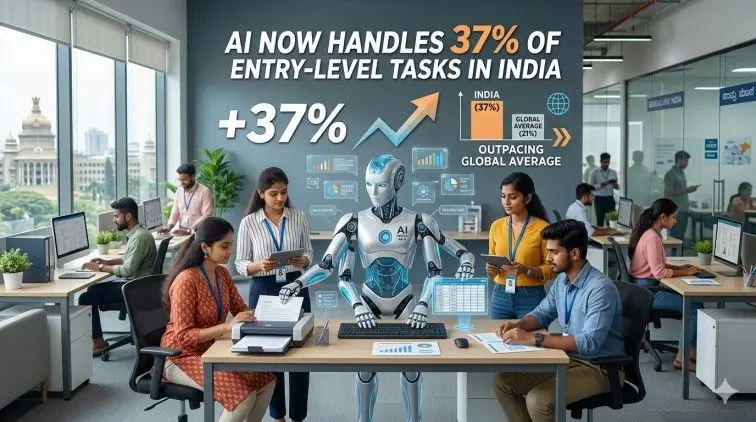
Source: CXOToday
Managerial Effectiveness Critical to AI Adoption Success
Middle managers have emerged as instrumental figures in AI adoption in the workplace. More than 90% of respondents say middle managers are critical to redefining job roles as AI changes the day-to-day work of team members
1
. The study found that 95% of HR leaders consider middle managers critical to ensuring employees use AI effectively, while 92% say they play a crucial role in translating strategy into execution3
.Rajesh Varrier, President - Global Operations and Chairman & Managing Director at Cognizant India, emphasized this point: "India is at the forefront of how AI is transforming entry-level work, with organizations already embedding AI into day-to-day operations at scale. We are seeing a fundamental redesign of roles, where early-career talent is expected to work alongside AI and focus on higher-value outcomes. This shift underscores the necessity for extensive reskilling and improved managerial effectiveness"
3
.In India, 80% of organizations report that AI is enabling employees to focus on higher-value work, compared to 77% globally, reflecting the growing shift toward more strategic responsibilities
1
. Hybrid teams, where 73% already use AI tools, are seen by 55% of HR leaders as among the most effective settings for building empathy, judgment, and leadership skills2
.References
Summarized by

Navi
Related Stories
AI Skills Demand Explodes 17-Fold in India, But Workers Face a Pay Gap Paradox
16 Jul 2026•Business and Economy
AI Skills Gap Widens as Workforce Splits Into Four Groups Despite Rising AI Adoption
30 Sept 2026•Business and Economy

India Leads Global AI Adoption: 94% of Workforce Sees AI Skills as Career Catalyst
04 Feb 2025•Business and Economy

Recent Highlights



Recent Highlights
Today's Top Stories






Don’t drown in AI news. We cut through the noise - filtering, ranking and summarizing the most important AI news, breakthroughs and research daily. Follow topics that matter to you and stay ahead.


