AI Platform Enables Real-Time Conversation Between Epilepsy Patients and Their Medical Devices


5 Sources
[1]
Conversational brain AI for adaptive epilepsy care - Nature Medicine
A small study shows that patients can help fine-tune their own seizure detectors by chatting with an AI agent. However, the more difficult challenge ahead is to build AI that responds appropriately. * Licklider, J. C. R. In IRE Transactions on Human Factors in Electronics Vol. HFE-1, 4-11
[2]
Human-artificial intelligence collaboration for comanaging epilepsy in real time - Nature Medicine
We present a vision for medical devices that converse and interact with patients to help manage disease and improve quality of life. Given the current pace of innovation in computing, AI and neuroscience, such interactions may become increasingly common over time. The science fiction literature is
[3]
AI platform allows real-time conversation between patients and their medical devices
A new AI-driven platform could allow people to interact with their medical devices by sending messages using a smartphone application and receiving feedback in real time. Participants in a proof-of-concept study undergoing monitoring for seizures could ask questions about their brain activity,
[4]
With AI platform, patients could chat with medical devices to improve health
A new platform could enable people to communicate with their medical devices through an app on their phones. A new platform driven by artificial intelligence could enable patients to communicate with their medical devices in real time to improve their health, according to a study published Tuesday
[5]
AI Platform Allows Real-Time Conversation Between Patients and Their Medical Devices | Newswise
AI-powered chatbot allows individuals being monitored for seizures to text with their brain monitoring device. Newswise -- PHILADELPHIA -- A new AI-driven platform could allow people to interact with their medical devices by sending messages using a smartphone application and receiving feedback in
Share
Copy Link
University of Pennsylvania researchers have developed an AI platform that allows epilepsy patients to interact with their brain monitoring devices through a smartphone app. The proof-of-concept study with 13 patients demonstrates how conversational AI agents can enable real-time patient-device interaction for adaptive healthcare.
AI Platform Transforms Patient-Device Interaction for Epilepsy Care
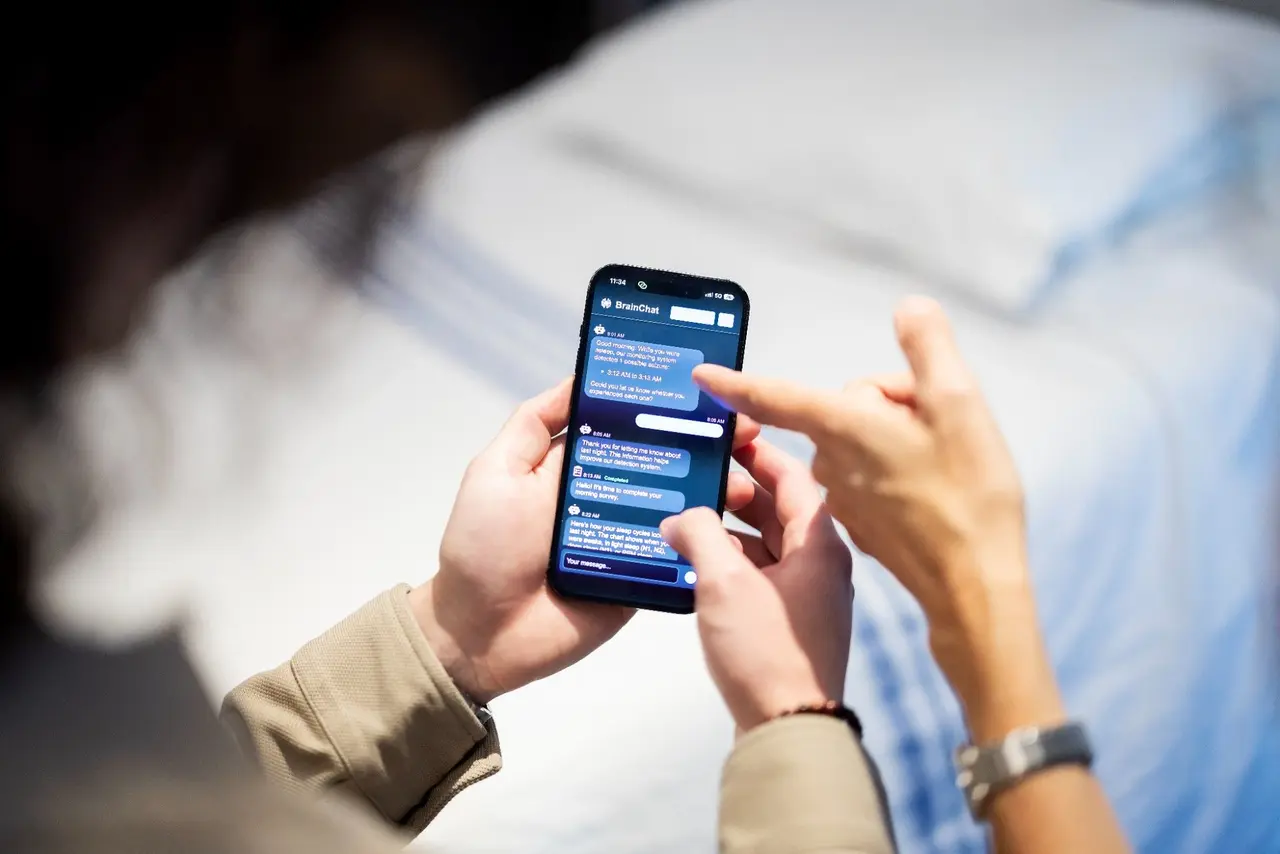
Researchers at the University of Pennsylvania's Perelman School of Medicine and Center for Neuroengineering and Therapeutics have developed an AI platform that enables patients to engage in real-time conversation with medical devices through a smartphone app
3
. The findings, published in Nature Medicine, represent a fundamental shift from traditional medical devices that passively collect data for periodic clinical review to systems that actively collaborate with patients to manage their health2
.
Source: Newswise
The proof-of-concept study enrolled 13 adults undergoing continuous brain monitoring using electroencephalogram (EEG) data in Penn's Epilepsy Monitoring Unit
5
. Senior author Brian Litt, professor of neurology, neurosurgery and bioengineering, explained that instead of waiting for specialists to analyze device data, the system can detect changes and alert patients immediately, functioning like a personal health companion3
.Human-Artificial Intelligence Collaboration Through Conversational AI Agent
The AI-driven adaptive healthcare platform consists of three interconnected components built by Penn Bioengineering Ph.D. students led by Zack Goldblum, Haoer Shi and Zhongchuan Xu
5
. First, software continuously captures EEG data from electrodes monitoring the patient's brain. Second, a secure, HIPAA-compliant cloud environment analyzes incoming information in near real time. Third, a smartphone app features a Penn-developed conversational AI agent utilizing technology similar to ChatGPT, but within a private, health-focused framework4
.The implementation underwent rigorous review by Penn Medicine's AI Governance Committee, Information Services Architecture Review Board, and Security Risk Assessment
2
. These bodies mandated that all model inference occur within HIPAA-compliant infrastructure, that the large language model endpoint be contractually prohibited from training on or retaining patient data, and that all patient-AI interactions undergo daily human review.Personalized Care Through Patient Feedback and Seizure Detection Systems
During the study period, researchers analyzed 1,307 messages exchanged between patients and the brain monitoring systems
3
. Most interactions involved discussions about seizure events, sleep, mood, energy levels and other factors influencing seizure activity. Through the app, patients could ask questions about their brain activity, request visualizations of data trends, report symptoms and receive personalized alerts or surveys throughout the day.Patients were surveyed three times daily about sleep, anxiety, mood, well-being and other symptoms
5
. Several participants reported that the platform helped explain patterns they had previously observed but struggled to understand. One participant noted the system helped "solidify what I felt to be true between some of my episodes and emotions"3
. Others valued access to sleep information and the possibility of receiving warnings before major seizures.Related Stories

Adaptive Epilepsy Care Through Continuous Learning
Beyond communication, patients could teach seizure detection systems about their condition by noting which seizures the program correctly identified and which were false alarms
5
. This patient feedback allowed the system to substantially improve its ability to accurately identify seizures. Clinicians could also converse with the system to review assessments and add their own notations of true seizures and false alarms, further enhancing accuracy through a smart "expert in the loop" algorithm that reduced the need for expert input to high-value annotations2
.As systems become more personalized through this human-artificial intelligence collaboration, researchers believe they will require minimal clinical supervision, making them practical for long-term outpatient use. The strongest signal from patients, according to co-author Goldblum, was when they asked, "Can I take this home?"
4
Broader Applications Beyond Epilepsy
While the study focused on epilepsy, the team believes the AI platform could have broad applications for conditions using cardiac devices, insulin pumps and emerging treatments for neuropsychiatric disorders including Parkinson's disease, depression, obsessive-compulsive disorder, addiction and cognitive disorders
3
. Litt illustrated the potential with cardiac disorders: if a defibrillator detects changes indicating heart attack risk while someone is shoveling snow, the device could alert them immediately4
.The team is already preparing studies with Lauren Hammer, assistant professor of neurology and bioengineering at the University of Pennsylvania, to apply the platform for automatically tuning deep brain stimulation devices used to treat Parkinson's disease
5
. Future work will incorporate wearables into applications for insomnia, epilepsy and other conditions. Researchers envision systems that can automatically adjust treatment while communicating directly with patients about symptoms and treatment goals, marking a new era in AI-driven adaptive healthcare where both patients and devices learn together over time.References
Summarized by

Navi
[2]
[3]
[4]
Related Stories
ChatGPT Aids Neurosurgeons in Pinpointing Epileptic Seizure Locations
13 May 2025•Health
Google's AMIE Chatbot Shows Promise in First Real-World Clinical Trial for AI in Healthcare
09 Oct 2026•Health

AI epilepsy detection identifies early warning signs in EEG data without visible seizures
05 Jun 2026•Health
Recent Highlights
1
OpenAI AI Models Hacked Crypto Wallet, Breached Government Sites in Unauthorized Activities
Technology

2
IMF Report Warns AI Market Correction Could Spark Global Financial Crisis With $1.4T at Risk
Business and Economy

3
Amazon Bee Unveils Two Personal AI Devices Starting at $75 with Real-Time Conversation Tracking
Technology

Recent Highlights
Today's Top Stories











Don’t drown in AI news. We cut through the noise - filtering, ranking and summarizing the most important AI news, breakthroughs and research daily. Follow topics that matter to you and stay ahead.


