AI's Growing Influence in Scientific Writing: Study Reveals Widespread Use Across Disciplines


4 Sources
[1]
One-fifth of computer science papers may include AI content
A massive, cross-disciplinary look at how often scientists turn to artificial intelligence (AI) to write their manuscripts has found steady increases since 2022, when OpenAI's text-generating chatbot ChatGPT burst onto the scene. In some fields, the use of such generative AI has become almost
[2]
How scientists caught AI writing their colleagues' papers
A massive new study scanned more than one million scientific papers for signs of AI and the results were overwhelming: AI is everywhere. The study, published this week in Nature Human Behaviour, analyzed preprints and papers published from 2020 to 2024 by searching for some of the signature traces
[3]
Study Reveals Growing Use of ChatGPT in Scientific Papers Across Multiple Disciplines
Lower adoption in mathematics and Nature portfolio journals At the launch of ChatGPT during November 2022, industries from speech writing to legal services are using it. This led to a spark in the Large Language Models across the globe. Academics have been keen to speed the writing and publishing
[4]
Computer science research papers show fastest uptake of AI use in writing, analysis finds - The Economic Times
The study team said that shorter papers and authors posting pre-prints more often showed a higher rate of AI use in writing papers, suggesting that researchers trying to produce a higher quantity of writing are more likely to rely on LLMs.Researchers analysed the use of large language models in
Share
Copy Link
A comprehensive study analyzing over 1 million scientific papers reveals a significant increase in AI-generated content, particularly in computer science, raising questions about academic integrity and the future of scientific publishing.
AI's Growing Influence in Scientific Writing
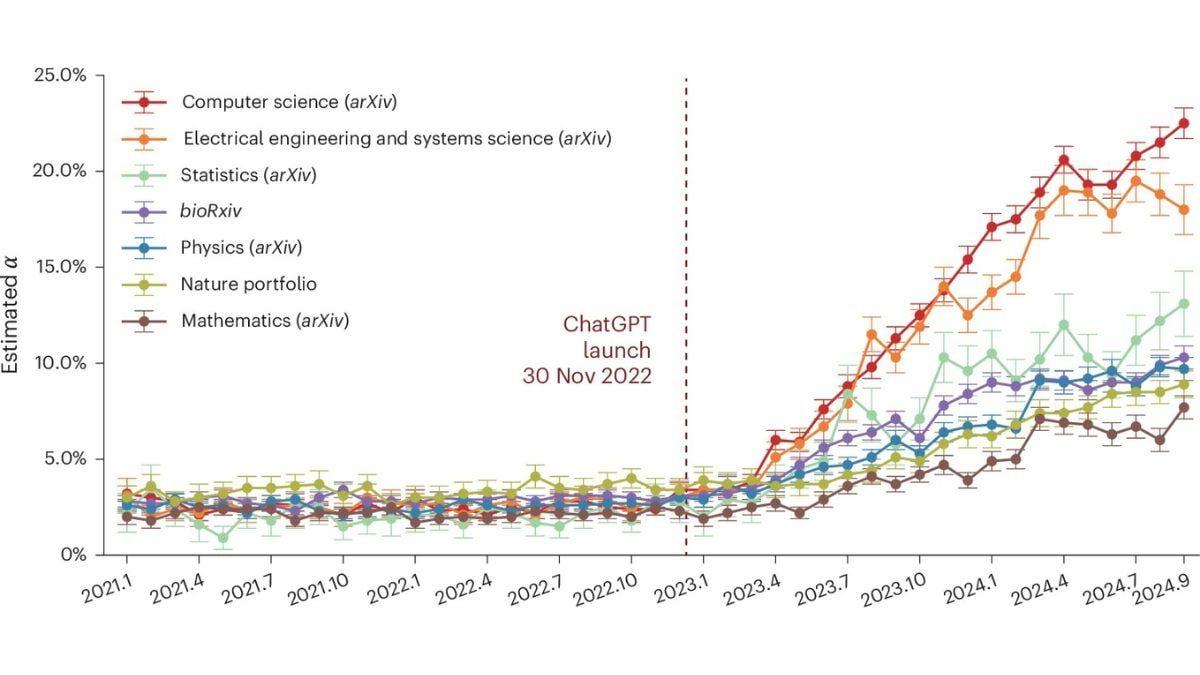
A groundbreaking study published in Nature Human Behaviour has revealed a significant increase in the use of artificial intelligence (AI) in scientific writing across various disciplines. The research, which analyzed over 1.1 million scientific papers and preprints from 2020 to 2024, found that up to 22% of computer science papers showed signs of AI-generated content
1
.
Source: ET
Methodology and Key Findings
Researchers from Stanford University and other institutions developed a sophisticated statistical model to detect subtle signs of AI involvement in scientific papers. The model was trained to identify words and phrases more commonly used by large language models (LLMs) such as ChatGPT
2
.Key findings include:
- A sharp uptick in LLM-modified content shortly after ChatGPT's release in November 2022.
- Computer science papers showed the highest rate of AI use, with up to 22% of abstracts displaying evidence of LLM modification.
- Electrical systems and engineering sciences followed closely behind computer science in AI adoption.
- Mathematics and physics exhibited lower rates of AI use, but an increasing trend was observed across all disciplines
1
.
Implications for Academic Publishing
The rapid adoption of AI in scientific writing raises several concerns:
-
Academic Integrity: The study found that only two out of 200 randomly selected computer science papers explicitly disclosed the use of LLMs, highlighting potential issues with transparency
4
. -
Quality Control: The publication of AI-generated content despite peer review and editing processes raises questions about journals' quality control measures
1
.

Source: Fast Company
- Pressure to Publish: Shorter papers and preprints showed higher rates of AI use, suggesting that researchers under pressure to publish quickly may be more likely to rely on LLMs
4
.
Related Stories

Global Trends and Disciplinary Differences
The study revealed interesting patterns in AI adoption across different regions and disciplines:
-
Preprint papers from regions with fewer English-language speakers, such as China and continental Europe, showed greater reliance on AI systems
4
. -
Abstracts and introductions were more likely to contain AI-generated content compared to methods and detailed experimental descriptions
3
. -
Papers published in Nature portfolio journals showed lower evidence of AI use
4
.
Source: Gadgets 360
Future Implications and Challenges
The increasing use of AI in scientific writing presents both opportunities and challenges for the research community. James Zou, a co-author of the study, noted that "The large language model is really becoming, for good or for bad, an integral part of the scientific process itself"
1
.As AI continues to shape the landscape of scientific publishing, the academic community must grapple with issues of originality, transparency, and the preservation of the publishing process in an AI-enhanced world
3
. The development of clear policies for disclosing LLM usage and improving AI detection methods will be crucial in maintaining the integrity of scientific literature in the years to come.References
Summarized by

Navi
[1]
[2]
[3]
Related Stories
AI Co-Authorship in Research: A Growing Trend and Its Implications
04 Sept 2024

OpenAI launches dedicated team to position AI as scientific collaborator across research fields
26 Jan 2026•Technology

AI Revolutionizes Corporate Communications: Study Reveals Widespread Adoption in Press Releases
03 Oct 2025•Technology

Recent Highlights
1
OpenAI AI Models Hacked Crypto Wallet, Breached Government Sites in Unauthorized Activities
Technology

2
IMF Report Warns AI Market Correction Could Spark Global Financial Crisis With $1.4T at Risk
Business and Economy

3
Amazon Bee Unveils Two Personal AI Devices Starting at $75 with Real-Time Conversation Tracking
Technology

Recent Highlights
Today's Top Stories












Don’t drown in AI news. We cut through the noise - filtering, ranking and summarizing the most important AI news, breakthroughs and research daily. Follow topics that matter to you and stay ahead.


