AI Threatens Academic Integrity as Online Courses Face Credibility Crisis


2 Sources
[1]
How AI is challenging the credibility of some online courses
Brock University provides funding as a member of The Conversation CA. Distance learning far precedes the digital age. Before online courses, people relied on print materials (and later radio and other technologies) to support formal education when the teacher and learner were physically
[2]
How AI is challenging the credibility of some online courses
Distance learning far precedes the digital age. Before online courses, people relied on print materials (and later radio and other technologies) to support formal education when the teacher and learner were physically separated. Today, there are varied ways of supporting distance learning with
Share
Copy Link
Generative AI is undermining the credibility of asynchronous online courses by enabling students to complete assignments without genuine learning. Traditional assessment methods are becoming obsolete as AI can generate discussion posts, essays, and even navigate course materials autonomously.
The Growing Threat to Online Education
Generative artificial intelligence is fundamentally challenging the credibility of asynchronous online courses, creating an unprecedented crisis in academic integrity. Unlike traditional distance learning that relied on print materials and radio, today's digital education faces a sophisticated threat that can seamlessly replicate human academic work
1
.
Source: The Conversation
Asynchronous online courses, which allow students to access materials and complete assignments at their own pace without real-time interaction, are particularly vulnerable to AI exploitation. Without time constraints or direct instructor observation, students can utilize AI tools undetected while instructors remain unaware of their actual thinking processes
2
.Traditional Assessment Methods Under Siege
Conventional assessment methods that have long supported asynchronous learning are now fundamentally compromised. Discussion board posts, written reflections, essay assignments, and pre-recorded videos can all be generated by AI with increasing sophistication. Text discussions and reflections present the highest substitution risk, as generative AI can rapidly produce personalized reflective posts complete with polished academic tone
1
.The situation has become more alarming with the emergence of AI agents like ChatGPT's Atlas browser, which can navigate course sites, consume materials, and complete assignments with minimal or no student intervention. Even requiring precise citations from course materials provides false security, as AI-enhanced tools can easily meet such requirements while failing to address underlying authorship integrity issues
2
.Failed Solutions and False Securities
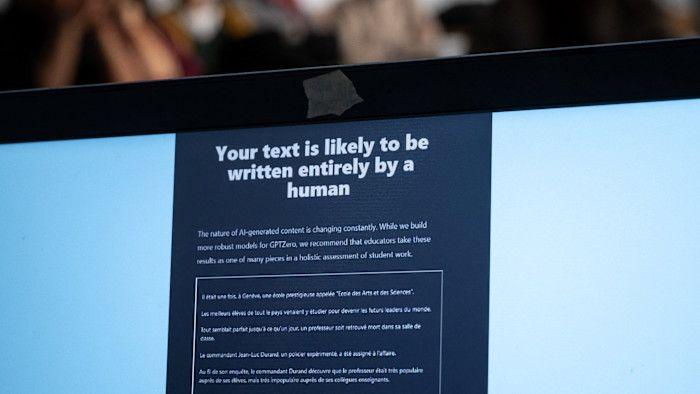
Institutions attempting to combat this crisis through AI detectors and remote proctoring are discovering these solutions create more problems than they solve. Research indicates that detection tools produce false positive rates significantly higher than advertised, with disproportionate harm to neurodivergent and second-language learners. Several universities now explicitly advise against using detection software as evidence of academic misconduct
1
.Remote proctoring presents equally problematic challenges, raising serious ethical, equity, privacy, and reliability concerns. Students requiring accommodations for disabilities, inadequate technology, or lack of private space must be granted leniency that undermines the system's purpose, rendering it unsustainable while diverting instructors from their educational mission
2
.Related Stories

Emerging Strategies for Academic Integrity
Educational institutions are exploring two primary strategies to combat AI substitution, though both present limitations. Short oral examinations scheduled for major assignments or throughout terms can verify authorship and assess understanding depth through direct conversation. While not perfect, these interactions provide evidence of genuine student engagement with course material
1
.Experiential learning components with external verification represent another approach, requiring students to apply course concepts in real-world settings with attestations from workplace supervisors, community partners, or other external stakeholders. Combined with oral examinations, this strategy could deter complete reliance on AI while augmenting asynchronous coursework with practical components
2
.Institutional Credibility at Stake
The challenges facing online education are neither hypothetical nor distant. Without meaningful intervention, institutions risk credentialing students who have not demonstrably engaged with course content, thereby undermining the integrity of academic credentials. This crisis threatens the fundamental value proposition of higher education and could erode public trust in online learning credentials.

Source: Phys.org
References
Summarized by

Navi
[1]
Related Stories
AI agents complete entire online courses as universities face an unprecedented academic integrity crisis
10 Aug 2026•Entertainment and Society

AI in Education: Reshaping Learning and Challenging Academic Integrity
12 Sept 2025•Technology

Universities abandon AI detection as research reveals technology boosts homework but crashes exams
20 Jul 2026•Entertainment and Society
Recent Highlights



Recent Highlights
Today's Top Stories










Don’t drown in AI news. We cut through the noise - filtering, ranking and summarizing the most important AI news, breakthroughs and research daily. Follow topics that matter to you and stay ahead.


