Student AI Use Hits 95% as Universities Struggle With Clear Guidelines and Academic Integrity Concerns


2 Sources
[1]
'Everyone now uses AI': chemistry students share how and why ...
Artificial intelligence (AI) tools like ChatGPT and Copilot are now freely available to chemistry undergraduates and PhD students. From finding research papers and reactions to summarising concepts to writing reports and emails, such tools appear to save students' time and make them more
[2]
Most university students now use AI, but that doesn't mean they like it
The university experience has changed drastically since artificial intelligence (AI) became widely available four years ago. Students are increasingly using AI for around-the-clock feedback, and most are required to use it as part of new assessment redesigns. But as AI is used more in courses and
Share
Copy Link
AI adoption in academia has exploded, with 95% of students now using artificial intelligence tools for their studies—up from just 66% in 2024. But widespread student AI use doesn't mean comfort: 67% limit usage due to accuracy concerns, while universities scramble to provide clearer institutional guidelines on academic integrity.
Student AI Use Surges Across Universities
Artificial intelligence has become nearly universal in higher education, with over 95% of students now using AI in at least one way for their studies, according to a 2026 survey by the UK's Higher Education Policy Institute (Hepi). This marks a dramatic increase from 92% in 2025 and just 66% in 2024
1
. The rapid AI adoption in academia reflects how AI tools like ChatGPT, Microsoft Copilot, and Google Gemini have transformed the student experience since becoming widely available four years ago.Research across four Australian universities—Monash University, the University of Queensland, Deakin University, and the University of Technology Sydney—surveyed more than 10,000 students in 2026 about their AI usage in academic settings. The findings reveal that students use AI for a wide range of tasks, with nearly 70% using it to edit or improve their writing, 64% to generate ideas or examples, and 60% to learn how to do something
2
. Additionally, around half of students seek out information through AI and request feedback on their work.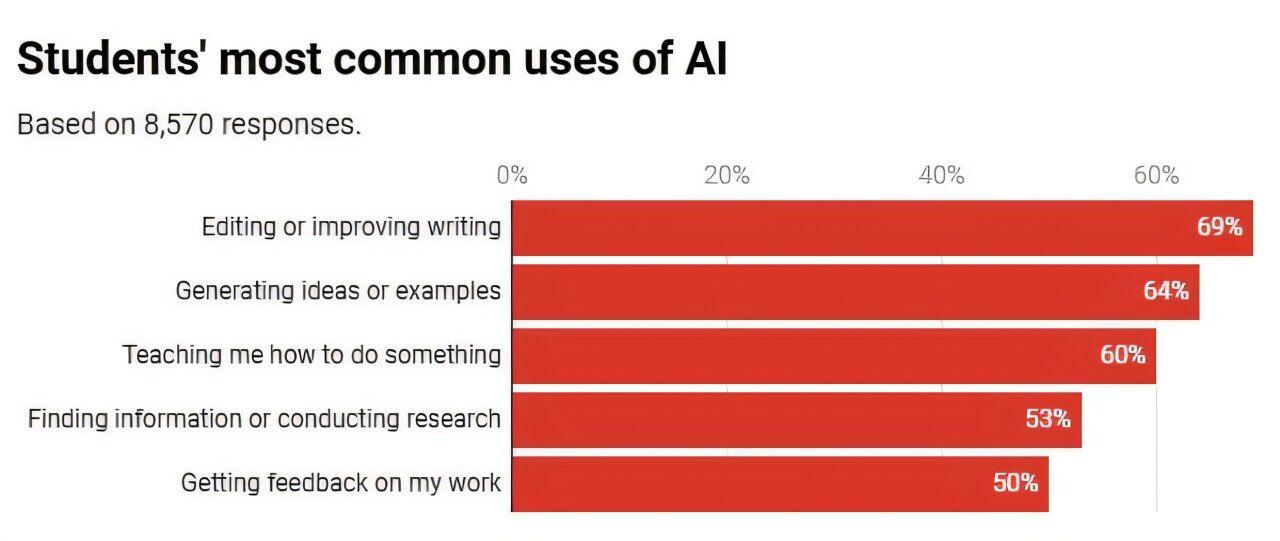
Source: Phys.org
Chemistry Students Embrace AI for Learning
Chemistry students have been particularly active in adopting generative AI for academic tasks. Dion Josh, a second-year chemistry undergraduate student at the University of Oxford, uses AI agents primarily to break down complex concepts into more digestible explanations. He finds this approach works well for inorganic chemistry, which relies heavily on learning trends and facts
1
. However, Josh notes that using AI tools to understand organic reaction mechanisms proves trickier, prompting him to ask several AI agents the same question and request that they show their reasoning.For Josh, AI usage in academic settings has transformed his tutorials, allowing him to reserve professor time for complex questions that AI cannot adequately address. "I don't have to ask the little questions that I don't need a professor for," he explains. "It's only the really intense questions that I don't know—that AI can't teach me—that I need the professors"
1
.Why Students Turn to Artificial Intelligence
The motivations behind student AI use extend beyond simple convenience. About 55% of university students use AI to speed up their working process and overcome mental blocks, while nearly half said they use it to make study easier in general
2
. The technology also appears to support student well-being, with approximately 41% reporting that AI helps reduce stress and around 32% feeling more confident when using AI in their work.The Australian Student Wellbeing Report from 2026 corroborates these findings, showing that 84% of students have used AI tools for assignments and study—a 10% increase from the previous year
2
. Meanwhile, the Hepi survey found that 94% of students used generative AI to help with assessments, up dramatically from 53% in 20241
.
Source: Chemistry World
Concerns About AI Accuracy and Academic Integrity
Despite widespread adoption, students harbor significant reservations about AI in education. The proportion of students who never use AI for their studies decreased only slightly, from 17% in 2024 to 15% in 2026, suggesting persistent resistance
2
. Among those who do use AI, 67% limit their usage due to concerns about accuracy—the most common reason for restricting AI tools like ChatGPT.Ellie Yates, a PhD student at the University of Sheffield working at the intersection of materials chemistry and plasma medicine, highlights the risks of AI hallucinations when using these tools for literature searches. "While it can be good for a quick search to get a list of topics to research yourself, it does more often than not produce lots of 'hallucinated' answers which could lead your research in the completely wrong direction if you're not careful," she warns
1
. However, Yates acknowledges that AI literacy remains essential as these agents improve rapidly.Ethical issues also weigh heavily on students' minds. About 62% said they limited or avoided AI use because it conflicts with their personal learning values, while 57% preferred to do the work themselves
2
. Just under half expressed ethical concerns related to biased information, privacy issues, threats to academic integrity, and environmental impacts of AI technologies.Impact on Critical Thinking Skills
Educators and researchers worry that heavy reliance on AI may hinder the development of critical thinking skills. A recent study found that nearly 30% of science, technology, engineering and maths (Stem) dissertations submitted in the US in 2026 contained AI-generated text—a sharp increase from just under 2% in 2023 when ChatGPT became publicly available
1
. The researchers noted that AI is "displacing a potentially important portion of the work through which scientific expertise is developed."Yates expresses particular concern about students using AI tools for written assessments like lab reports. "Students need to be very careful that they don't miss out on the opportunity to refine their writing skills during their degree," she cautions
1
. The tension between efficiency and skill development represents a central challenge as AI becomes embedded in educational workflows.Related Stories

Universities Scramble to Provide Institutional Guidelines
One of the most significant challenges facing AI adoption in academia has been the lack of clear institutional guidelines. Research shows students have learned more about AI on their own than from their universities
2
. The 2024 survey and focus groups revealed widespread anxiety and confusion among students about using AI for study, partly due to unclear university academic integrity policies around AI rules.One student captured this frustration: "Just have some kind of concrete policy in place that you can look at and go like, 'right, this is OK. This isn't. Thank you.' And even if it's something I would personally disagree with, at least it's set in stone." Another recognized the complexity: "We're in this very gray area where nobody knows what's really happening"
2
.There are signs of progress. Students who reported receiving sufficient guidance from universities rose from 36% in 2024 to 47% in 2026
2
. This improvement may reflect universities setting more consistent AI guidelines across their institutions rather than leaving individual educators to establish rules for each subject. Changes to assessment that incorporate AI usage are also becoming more common.Interestingly, students have become less worried about breaking university rules. In 2026, 56% of participants said they avoided using AI out of fear of being caught—a 7% decrease compared with 2024 data
2
. This shift suggests either clearer policies or growing acceptance of AI usage in academic settings.What Lies Ahead for AI in Education
The rapid integration of large language models into university life raises questions about the future of learning. As students increasingly rely on generative AI for academic tasks, institutions must balance supporting technological literacy with preserving the development of fundamental skills. The challenge extends beyond simply creating policies—universities need to help students understand both the capabilities and limitations of these tools.
Yates emphasizes this point: "It's essential for students and researchers to remain AI literate, understanding both the capabilities and the limitations of these tools rather than just ignoring or avoiding them"
1
. As AI agents continue improving and students are increasingly required to use them as part of new assessment redesigns, the need for clear guidance and thoughtful integration will only intensify. The question is no longer whether students will use AI, but how universities can shape that usage to support genuine learning while maintaining academic standards.References
Summarized by

Navi
[1]
Related Stories
Universities scramble to rethink exams as 92% of UK students now rely on AI for coursework
03 Dec 2025•Entertainment and Society
Universities abandon AI detection as research reveals technology boosts homework but crashes exams
20 Jul 2026•Entertainment and Society
AI in Education: Reshaping Learning and Challenging Academic Integrity
12 Sept 2025•Technology

Recent Highlights



Recent Highlights
Today's Top Stories







Don’t drown in AI news. We cut through the noise - filtering, ranking and summarizing the most important AI news, breakthroughs and research daily. Follow topics that matter to you and stay ahead.


