Big Tech's $740 Billion AI Spending Hits Economic Turbulence as Google Admits AI Search Earns Less


71 Sources
[1]
Google admits AI search makes less money, but it's fixing that with more ads
Google's negative cash flow balloons to -$9.06 billion, and stock price tumbles following Q3 earnings. Google parent Alphabet reported its Q3 financial results on Wednesday afternoon, showing a healthy rise in revenue for the months of July to September. But the company's stock price has taken a
[2]
Cracks are emerging in the AI spending boom
Investors are getting nervous about AI infrastructure spending just as the Big Tech companies double down. Over the past two weeks, Alphabet, Amazon, Meta, and Microsoft have outlined plans to spend more than $740 billion on capital expenditures this year, which Wall Street is reading as AI
[3]
Google struggling to make AI Mode searches pay
That's a problem, cos it just spent $51 billion on infrastructure and still needs to rent compute from others to run its cloud Shares in Google's parent company Alphabet dived by almost ten percent on Wednesday, after the web giant admitted AI-powered searches earn it less money than it earns by
[4]
The economic risks of the AI boom
The longer the investment surge and the associated financial engineering continue, the bigger the negative impact is likely to be when it ends Artificial intelligence has many -- mostly far from fully understood -- implications for humanity. Among these is something concrete and current: it has
[5]

AI build-out hits snag as Google and Microsoft put off raising capex forecasts
* Microsoft and Google both reported capital expenditures that fell short of analysts' estimates. * Amy Hood, Microsoft's CFO, said on the company's earnings call that third-party providers of AI chips had delays that will push out some available capacity until the first half of 2027. * The
[6]

America Can't Afford an AI Recession
AI investments are driving the economy. That's a dangerous tightrope. Over the past several days, as Donald Trump has flown across the country to rally Republican voters in contested midterm races, he has returned again and again to a version of the same point: "I had the greatest economy in the
[7]

Wall Street's AI fears slash Google value by $500bn
Google parent Alphabet lost just over $500bn (£374bn) in value on Thursday after it rattled Wall Street with its last update of the year on their business operations. Google spooked investors so badly that its stock hit a six-month low, after it revealed its artificial intelligence (AI) summaries
[8]

Alphabet shares plunge over 10% as Google's AI search struggles to make money
Serving tech enthusiasts for over 25 years. TechSpot means tech analysis and advice you can trust. What just happened? Alphabet has given investors another reason to worry about whether the AI spending frenzy will ever pay off. Shares in Google's parent fell more than 10% in after-hours trading
[9]

The AI Gold Rush Is Turning Into a Wall Street Bloodbath
Alphabet lost roughly $500 billion in market value as investors grow increasingly worried about Silicon Valley's massive AI spending spree. Alphabet, Google's parent company, and several other Silicon Valley giants are having a rough week on Wall Street. Shares of major tech companies have
[10]

Alphabet commitments top $1tn as AI agents act outside their scope
Alphabet commitments also include billions in guarantees for partners' data centres and power equipment. The filing says its AI agents have sometimes acted outside their intended scope in testing. Alphabet's quarterly filing, published on Thursday, puts its future payments for computing, energy
[11]
A chill wind in the AI credit market
Investors are demanding more to finance the data centre boom Credit winter has not come quite yet for the AI investment boom -- but it is certainly getting colder out there as the leaves fall. Alphabet, Meta and Oracle returned to debt markets this week to sell tens of billions of dollars of
[12]
Alphabet earnings miss reflects first real sign that AI is taking a bite out of search
* Wall Street hammered Alphabet for an earnings miss that included weaker-than-expected revenue in the company's core business. * Revenue in the search and other segment grew 12% from a year ago to roughly $63 billion, but came in below estimates for the second straight quarter. * Regarding new
[13]

Google stock drops amid AI fears; AI Mode has 'lower monetization,' getting more ads
Google is bringing ads to AI Mode globally as it admits that the new take on Search brings "lower monetization," all while $GOOG stock is seeing a fairly major drop. Alphabet's Q3 earnings call yesterday saw Google's Philipp Schindler acknowledging that AI Mode, the company's Gemini-powered new
[14]
Google Eats Its Own Tail (and Profits) With AI Summaries as Stock Price Plunges
The one thing that can maybe slow the roll of AI: losing money. Big tech firms have poured an infinite amount of money into artificial intelligence development and rolled out tools without any consideration as to whether consumers actually want them or not, all based on the theory that eventually
[15]
AI Mode searches: Alphabet shares fall 12% as Google search slows
Google is answering by taking AI Mode ads to 10 more countries, with Brazil, Mexico and the UK next. Search revenue growth slowed to 12%, from 19% at the start of the year. By 9:35am in New York on Thursday, Alphabet had lost $511bn in market value, Julia Love and Davey Alba reported for
[16]

The AI trade's trick-or-treat earnings season
Why it matters: The market's AI obsession has entered its Jekyll and Hyde era, with the latest earnings from tech giants offering contrary signals about the AI boom. Driving the news: The tech-heavy Nasdaq briefly sank into correction territory, falling 10% from its prior peak, losing $1.2
[17]
Google is eating itself -- but it could still eat everyone else too
Sometimes a disrupter disrupts itself, and on a grand scale. Think of how Netflix's streaming service smothered its mail-order DVD rental business, or Apple's iPhone pushed the iPod towards extinction. Now, investors are worried that it's Alphabet's turn. The parent of Google shed nearly half a
[18]

Investors Are Getting Palpably Nervous About the AI Industry's Financial Situation
It's a house of cards -- and the ground is starting to shake. For years now, some of the biggest players in the AI space have been investing in smaller startups -- which in turn use the same exact money to purchase services from the same large companies. Investors have watched this circular
[19]

The AI boom is facing another supply crunch. This time it's the amount of capital available to feed Silicon Valley's endless need for cash
A new supply crunch is closing in on the AI boom as Wall Street starts to reach the limits of how much capital it's willing to hand over to Silicon Valley. Hyperscalers have already been grappling with shortages of chips, materials and other physical inputs needed for AI infrastructure. They are
[20]

Shares in Google owner Alphabet plummet on profit miss, ad slowdown
Shares in Google parent Alphabet fell more than 10% in after-hours trading Wednesday as the company reported lower-than-expected profit and a slowdown in its advertising business while it maintained big spending on AI. Net profit slid 25% from a year earlier to $26.2 billion in the
[21]
What investors need to know about Alphabet's stock-busting earnings report
Wall Street is seeing a major potential shift in Google's core advertising business as artificial intelligence replaces traditional internet searching and the long-established ways in which it is monetized. Shares of Alphabet , Google's parent company, tanked after Wednesday's third-quarter
[22]

Google-parent Alphabet's stock price plunges, erasing more than $500 billion in value
The sharp drop is the latest sign of anxiety creeping through Wall Street over how long it will take big AI to see returns on its massive investments. Shares of Google parent company Alphabet sank on Thursday by as much as 15.8%, putting the company on course for its worst single-day drop in
[23]
Google's Flashy New Model Gets Outshone By Its Financial Troubles
Google's "strongest" model so far did not distract from the $3 billion free cash flow drop. Google's free cash flow continued tanking in its third quarter of the year. The tech giant had reported its first negative free cash flow figure as a public company back in July in its second quarter
[24]
Alphabet suffers a rough day for the ages
Why it matters: The massive one-day loss shows how AI continues to cause violent bouts of uncertainty throughout the markets, even for giants like Alphabet that have been considered big winners of the AI buildout. Catch up quick: Alphabet's plunge followed lackluster third-quarter results posted
[25]

Alphabet Revenue Jumps 25% as Google Cloud Doubles & Search
Google Cloud's backlog reached $561 billion, indicating robust future revenue potential despite cash flow pressures. Alphabet, Google's parent company, reported a 25% year-on-year increase in third-quarter revenue to $127.6 billion, driven by strong growth in its cloud business and continued
[26]
Stock Market Bloodbath Spikes Fears of AI Bubble Bursting
The entire US stock market looked like a house of Halloween horrors on Friday, driven by rapidly sinking tech stocks tied to the swelling AI bubble. The tech-heavy Nasdaq 100 -- home of major AI stocks like Apple, Nvidia, Microsoft Corp and Amazon -- was down 2.6 percent at the time of writing,
[27]
Wall Street wipes $1 trillion from the stock market as tech's $828 billion AI spending spree sparks market fears
The richest companies in the history of the world are spending so much on the infrastructure backing AI that they're burning through billions in cash and threatening a recent AI-fueled stock surge as Wall Street wavers. The latest financial disclosures by four of the biggest hyperscalers, Amazon,
[28]
Google shares drop 7% as search business falls short and AI spending surges
Search giant boosted spending on AI investments to more than $50bn in the quarter Google reported third-quarter revenue and profit that missed analyst estimates as its core search business grew more slowly than expected while boosting its spending on AI again to surpass $50bn. Net income fell to
[29]

Google shares drop over 10% over fears that AI is eating into its core search business
Google lost over $500 billion in market cap over fears of unsustainable capital expenditures and a decline in growth of its core search business model. Alphabet Inc. (GOOGL) released its third-quarter earnings report on Wednesday. Despite year-on-year revenue growth, the company's market cap
[30]
Big Tech's AI flex gets mixed reviews
The big picture: Starkly different market reactions to quarterly results from Microsoft and Google parent Alphabet illustrate the attributes that investors appear to be valuing at the moment. The latest: Microsoft shares surged after hours Wednesday as sales and earnings per share for the quarter
[31]

Alphabet's Heavy Cloud Spending Drives Bigger-Than-Expected Cash Burn
Oct 28 (Reuters) - Alphabet reported a higher cash burn on Wednesday than analysts expected as it spends heavily to boost capacity for its cloud business, sending its shares down more than 6% in extended trading. The company reported negative free cash flow of $9.07 billion, compared with
[32]
Google Starved Out Publishers With AI Search. Now, Its Pivot Is Blowing Up in Its Face.
Woe is Google. After it starved out publishers with its AI features, it's now getting a taste of its own medicine. Shares of its parent company Alphabet took an over 11 percent nosedive on Wednesday, after it disclosed that its AI search features are raking in less money than its traditional
[33]

Alphabet Just Lost $500 Billion in One Day -- Here's Why Wall Street Is Spooked
Slowing search growth and soaring AI costs have investors asking whether the payoff is coming fast enough. If you Google "What was Google's worst day ever?" the answer is now October 29. Shares of parent company Alphabet plunged, erasing roughly $500 billion in market value, according to The Wall
[34]

Global markets: Global markets were already fragile. Big AI bets could break them
Financial markets are struggling under the weight of wars, soaring sovereign debt and trade tensions, with signs of trouble showing across the world - from the selloff in Japanese and French bonds to plunging emerging-market currencies. Now, the one trade that helped investors remain optimistic is
[35]

Google Stock Tumbles After Revenue Miss
Oct 28 (Reuters) - Google parent Alphabet on Wednesday missed Wall Street profit and revenue expectations, and AI spending accelerated its cash burn, sending its shares down more than 10% in extended trading. Capital expenditures, driven by AI, will increase significantly in 2027, said Chief
[36]

Exclusive: Investors Are Watching AI Revenue Growth Against CapEx as Companies Face Pressure to Prove Ret
Steve Neamtz, CEO of Yorkville America, said investors are increasingly examining whether the AI CapEx boom is producing measurable returns as the infrastructure buildout expands. In an email interview with Benzinga, Neamtz said investors should compare rising capital expenditures with growth in
[37]

Google erases a record $500 billion as AI eats into sales
Alphabet's shares fell more than 13%, erasing more than $500 billion in its biggest-ever market plunge, after the company reported disappointing search and advertising sales that reinforced investor concerns about AI's threat to its core business. The Google parent reported sales, excluding
[38]
AI spending: Wall Street tech rout deepens on doubts over AI spending
Major US tech stocks have taken a hit as investors react to underwhelming earnings and worries about AI spending. Giants like Microsoft, Amazon, and Alphabet revealed hefty investments in AI systems along with rising debt. Intel's troubles intensified with a disappointing revenue outlook, driven by
[39]

Alphabet Loses $500 Billion in Market Value as AI Threatens Google Search | PYMNTS.com
The drop followed Alphabet's release of its quarterly results on Wednesday (Oct. 28), which stoked investors' fears about how the company is being impacted by the rise of artificial intelligence (AI), according to the report. Those results showed that the growth of Google Search revenue slowed to
[40]
Alphabet's AI Spending Avalanche Sparks Fresh Fears As Analyst Warns of Profit Squeeze - Alphabet (NASDAQ
Alphabet Inc. (NASDAQ:GOOG) (NASDAQ:GOOGL) remains positioned to benefit from AI-driven Cloud growth and multiple monetization opportunities, although softer Search trends, heavy capital spending and near-term margin pressure remain key investor concerns. BNP Paribas analyst Nick Jones maintained
[41]

Elon Musk issues strong warning for investors heading into 2027
The money moving into artificial intelligence infrastructure over the past two years has been extraordinary. Data centers, chips, power systems, and cloud hardware have absorbed hundreds of billions in capital. The companies behind that spending made a bet: that demand would match what they built,
[42]

AI Spenders Getting Spooked Over Who Eventually Pays for Datacentre Buildouts
The concerns are real as investors see inordinate delays to profitability in the business plans of both AI Labs as well as hyper scalers. The earnings season is on and already we have indications that while companies remain committed to the AI expansion project, the first signs of doubt about
[43]

Doubts on AI investment to test Korean economy
Global AI investment is increasingly being financed with debt as major technology companies face rising borrowing costs and negative free cash flow, raising concerns about the sustainability of spending. A slowdown could weaken memory-chip demand and affect Korea's semiconductor-dependent economy.
[44]
Google's AI Exposure Exceeds the $1 Trillion It Reported | PYMNTS.com
However, a Bloomberg News report Thursday (Oct. 29) points to a quarterly filing from the tech giant saying that upwards of a third of that quarterly growth stems from a joint venture that Alphabet partially owns. This revelation, the report said, appears in the filing which discussed exposures to
[45]
Google loses nearly half a trillion in market value: What went wrong with Alphabet?
Alphabet lost $482 billion in market value after its shares plunged nearly 13% following disappointing third-quarter results. Despite 103% growth in Google Cloud and more than 1 billion Gemini users, weaker search revenue and negative free cash flow raised fresh concerns about AI spending and
[46]
Chamath flags a hidden risk building under the AI boom
The largest IT businesses in America have the money to accomplish almost everything at once for many years. According to conventional wisdom, Microsoft (MSFT), Meta Platforms (META), Alphabet (GOOGL) and Amazon (AMZN) could build data centers, repurchase billions of dollars of stock and still
[47]
Alphabet Bulls Dig in After Messy Q3: 'AI Stack Keeps Us Bullish' Cantor Says - Alphabet (NASDAQ:GOOGL),
Alphabet Inc. (NASDAQ:GOOGL) (NASDAQ:GOOG) shares tumbled about 12% Thursday after third-quarter results paired a record cloud quarter with softer search growth and a steep earnings miss. Five of the six firms listed below trimmed price targets, though most kept bullish ratings. Revenue rose 25%
[48]

Why Data Center Investments are Raising Concerns Over the AI Bubble
Big Tech is spending record sums on AI data centers. Debt, leases and delays are straining weaker borrowers. Demand and backlog look strong, but neither guarantees profit. A correction would likely slow projects without stopping AI use. Moody's expects six major US companies to spend USD 785
[49]

Alphabet sheds record $500B in market value as AI fears hit fever pitch
Alphabet's market capitalization plunged by $500 billion on Thursday as the stock dropped more than 11% - on track for its worst loss ever as AI chatbots eat into Google's Search business. If the stock closes down more than 9.77% in Thursday's session, it will be the worst reaction in the
[50]

AI spending boom could exceed $10 trillion, raising fears of financial fallout By Investing.com
Investing.com --The scale of the artificial intelligence investment boom is becoming a source of concern, with spending on infrastructure potentially exceeding $10 trillion if companies follow through on their current plans. Bill Dudley, former president of the Federal Reserve Bank of New York,
[51]
Google Pushes AI Agents Into Commerce as Spending Pressures Cash Flow | PYMNTS.com
On Wednesday's (Oct. 28) earnings call, CEO Sundar Pichai described plans to bring capabilities developed for enterprise customers to consumers, starting with the Gemini app's billion users. Booking reservations, filling out forms and scheduling appointments are among the tasks Google wants AI to
[52]
Alphabet's AI risks deepen as filing reveals $98 billion in commitments beyond the $1 trillion spending
In a recent regulatory disclosure, Alphabet reveals financial risks linked to its massive AI investments that surpass $1 trillion. The firm might be burdened with nearly $98.5 billion in contingent commitments, including data center leases and chip system repurchases. There are growing
[53]
Big Tech AI Spending Triggers Fresh Sell-Off Fears on Wall Street
The Nasdaq 100 is facing a potential USD 2 trillion market value decline in October as investors question the returns from massive AI investments. Rising infrastructure costs, increased borrowing, and weaker-than-expected results from some technology companies have added pressure to major tech
[54]
Google parent Alphabet tumbles after profit disappoints, warns AI is battering its cash flow
Google parent Alphabet on Wednesday missed Wall Street profit and revenue expectations, and AI spending accelerated its cash burn, sending its shares down more than 10% in extended trading. Capital expenditures, driven by AI, will increase significantly in 2027, said Chief Financial Officer Anat
[55]
Alphabet's $514B Google Cloud Backlog, AI Spending Put Growth In Focus - Alphabet (NASDAQ:GOOGL)
Google parent Alphabet Inc. (NASDAQ:GOOGL) remains in focus as investors weigh rapid Google Cloud growth, resilient Search monetization and a sharp increase in AI-related spending. Yorkville Ives analyst Dan Ives maintained an Outperform rating on the stock with a $400 price forecast, pointing to
[56]
AI Agents Are Boosting Chip Demand While Putting Google's Search Business at Risk
Agents Show Up in the Numbers * Anthropic's S-1: a profitable quarter and $637 billion of compute on order. * Microsoft, Google, and Amazon are all showing acceleration in cloud growth - why are the stocks under pressure? * Google: agents squeeze search. Anthropic's S-1 reignited interest in AI
[57]

Google launches Gemini 4 Carbon as Alphabet drops 10% after earnings
Alphabet, Google's parent company, reported third-quarter results today, and the market didn't like what it saw. Alphabet shares fell more than 10% in after-hours trading, even with the company rolling out Gemini 4 Carbon, the newest model in its Gemini AI line. The earnings release shows revenue
[58]
Google shares crash 13% after $9 billion cash burn sparks AI spending fears
Alphabet shares crashed 13% as third-quarter earnings missed expectations due to heavy AI spending and slowing search ad growth. Net profit fell 25% to $26.17 billion despite a 25% revenue jump to $127.58 billion. Negative free cash flow of $9.1 billion and surging capital expenditure raised market
[59]

AI-related debt binge may pressure European bond markets
Nov 3 (Reuters) - Europe's bond markets face a fresh headwind as US technology companies increasingly tap European investors to finance AI spending, boosting corporate debt supply and potentially lifting borrowing costs for other firms and governments. While tech-related borrowing in Europe has
[60]
Google's USD 500 Billion Market Loss Raises Questions About AI Spending
Alphabet, Google's parent company, suffered a record market-value decline after its third-quarter results fell short of expectations. Slower-than-expected advertising growth and heavy AI infrastructure spending unsettled investors, while strong Google Cloud revenue offered a positive sign. The
[61]
Don't Blame the Messenger -- The AI Boom Finally Meets the Bill
This was not the market suddenly deciding artificial intelligence is a fraud. That would be far too easy. The problem is almost the opposite. AI demand is real enough that the companies building it are spending staggering amounts of money to stay in the race, and the market has finally started
[62]
Alphabet loses $467bn in the cloud
Alphabet has posted mixed Q3 results, marked by spectacular growth at Google Cloud, driven by the artificial intelligence boom. However, this performance was not enough to reassure investors, who are concerned about slowing advertising revenue, margin pressure and soaring investment. The stock
[63]
Microsoft, Alphabet Face Investor Scrutiny Over AI Cash Burn
Microsoft and Alphabet report earnings amid investor concern that massive AI infrastructure spending is eroding free cash flow and testing the durability of the AI rally. Microsoft and Alphabet report quarterly results on Wednesday, with investors focused less on headline revenue and more on the
[64]
Google's Nvidia chip challenge boosts cloud sales, crimps cash flow
Alphabet is making billions of dollars selling homegrown AI chips it once reserved for internal use, but building inventory to meet surging demand is draining cash as the tech giant spends heavily on data centres. Unlike its traditional search and cloud businesses, selling AI chips that compete
[65]
Google Missed Earnings, But Is That the Whole Story?
The bar has been set exceptionally high for AI-related companies -- and Alphabet (GOOG) fell short. But soft quarterly results are only one part of the story. Wall Street had another knee-jerk reaction to big AI spending numbers. Alphabet (NASDAQ:GOOG) revealed that its capital expenditures
[66]
Google rattled: How a big miss on earnings tanked Alphabet shares
STORY: "Why did shares of Google parent Alphabet drop more than 10% after it reported earnings on Wednesday?" :: Kenrick Cai, US Tech Correspondent :: San Francisco, California / October 28, 2026 "So Alphabet missed its revenue targets, and it also reported a cash burn that was a lot higher than
[67]
US Market: Microsoft, Oracle outshine Alphabet as investors demand AI returns
Wall Street increasingly favours technology companies demonstrating financial discipline in AI investments. Microsoft and Oracle gained on strong cash flow prospects, while Alphabet shares plunged amid rising capital expenditure and slower search growth. Investors are prioritising sustainable
[68]
AI Stocks Fall After Alphabet Earnings Disappoint
Technology stocks slid across the globe after earnings from major tech names in the U.S. and Asia reignited worries about how companies can make money from artificial intelligence. Nasdaq futures fell 1.1% as investors honed in on a disappointing set of earnings from Google-parent Alphabet.
[69]
Alphabet's heavy cloud spending drives bigger-than-expected cash burn
Alphabet reported a higher cash burn on Wednesday than analysts expected as it spends heavily to boost capacity for its cloud business, sending its shares down more than 6% in extended trading. The company reported negative free cash flow of $9.07 billion, compared with analysts' estimate of a
[70]
Nasdaq futures slide as mixed Big Tech results test AI trade
Oct 29 (Reuters) - Nasdaq futures dropped on Thursday as mixed earnings from Alphabet and Microsoft left investors weighing the payoff from heavy AI spending, with focus also on an inflation reading a day after the Federal Reserve left interest rates unchanged. Alphabet slid 10.5% in premarket
[71]
Alphabet's Google Cloud unit beats quarterly revenue estimates on steady AI demand
Oct 28 (Reuters) - Alphabet topped Wall Street estimates for third-quarter revenue growth at its cloud computing unit on Wednesday, driven by sustained enterprise spending on AI infrastructure and expanding adoption of its GenAI tools. Revenue at Google Cloud more than doubled to $30.71 billion in
Share
Copy Link
Google's stock plunged 12% after revealing AI Mode searches generate lower revenue than traditional search. Despite negative cash flow of $9.06 billion, Big Tech plans to spend over $740 billion on AI infrastructure this year, raising concerns about mounting debt and whether massive investments will deliver returns.
Google Admits AI-Powered Search Monetization Falls Short
Alphabet's stock suffered one of its worst single-day drops in history, plummeting 12% and erasing $500 billion in market value after the company revealed a troubling reality: AI-powered search generates less revenue than traditional search
1
. During the Q3 earnings call, Chief Business Officer Philipp Schindler disclosed that each AI Mode query earns less revenue compared to similar web searches due to fewer ads that cost less to run1
. This admission comes as Google reported negative cash flow of $9.06 billion in Q3, up from $5.8 billion in the previous quarter1
.
Source: Market Screener
The company's search query growth has slowed dramatically to 12% year-over-year, down from 17% in Q2 and 19% in Q1
1
. While Alphabet took in nearly $128 billion in Q3 2026, net income dropped almost $9 billion compared to last year despite revenue climbing 25%1
. The company reported earnings per share of $2.12, significantly below the consensus projection of $3.021
.Big Tech AI Spending Balloons Past $740 Billion
Alphabet, Amazon, Meta, and Microsoft have outlined plans to spend more than $740 billion on capital expenditures this year, primarily directed toward AI infrastructure including data centers and AI chips
2
. Google's capital expenditures reached $51.4 billion in Q3 alone, with the company maintaining its 2026 spending forecast between $195 billion and $205 billion1
3
. For 2027, Google targets more than $300 billion in AI infrastructure investments1
.
Source: CXOToday
Microsoft reduced its capex forecast for the year to $170 billion from $175 billion, while Meta is guiding toward as much as $145 billion in capex this year
5
2
. Amazon expects to spend $220 billion in capital expenditures2
. According to research from Columbia Business School, US spending on AI infrastructure will average 3.6% of GDP from 2025 to 2032, exceeding the 2.2% spent on railways between 1870 and 18904
.Negative Cash Flow Spreads Across Hyperscalers
The AI build-out is creating financial strain across Big Tech. Amazon reported negative cash flow of $42.4 billion over the past 12 months, compared with $14.8 billion in positive free cash flow the year before
2
. Meta recorded negative free cash flow of $2.1 billion in Q3 as capital expenditures outpaced operating cash2
. Microsoft was the only exception, recording $18.6 billion in positive free cash flow, though spending on capex reached $45.2 billion2
.To fund these massive AI infrastructure investments, Microsoft, Alphabet, Amazon, Meta, and Oracle raised a combined $326 billion in debt in 2026, triple the amount raised last year
2
. The financial engineering supporting the AI boom is becoming increasingly complex, with specialized data center developers, REITs, infrastructure funds, and private equity investors building facilities and leasing capacity to hyperscalers4
.Related Stories

Google Expands AI Ads Despite Lower Returns
Despite lower monetization, Google is doubling down on AI Mode by expanding ads globally and implementing multi-turn ads in the US
1
. These sponsored links will change continuously as users engage in back-and-forth conversations with the AI chatbot. CEO Sundar Pichai noted that complex interactions are becoming more common as Google pushes more users toward AI Mode1
.Philipp Schindler attempted to frame the monetization challenge positively, stating that many AI Mode queries are "upper funnel queries, allowing us to capture new, high-value commercial intent"
3
. He suggested advertisers may need time to understand the value in AI search ads, claiming Google's research shows users find these ads more relevant than traditional search ads1
.Economic Risks of the AI Boom Mount
Investor anxiety about AI infrastructure spending spilled across markets, with the Nasdaq falling 2.9% and chip stocks taking significant hits: Nvidia dropped 4%, Broadcom more than 5%, and Qualcomm 11%
2
. Shares of neocloud companies CoreWeave, Nebius and IREN all dropped following the earnings reports5
.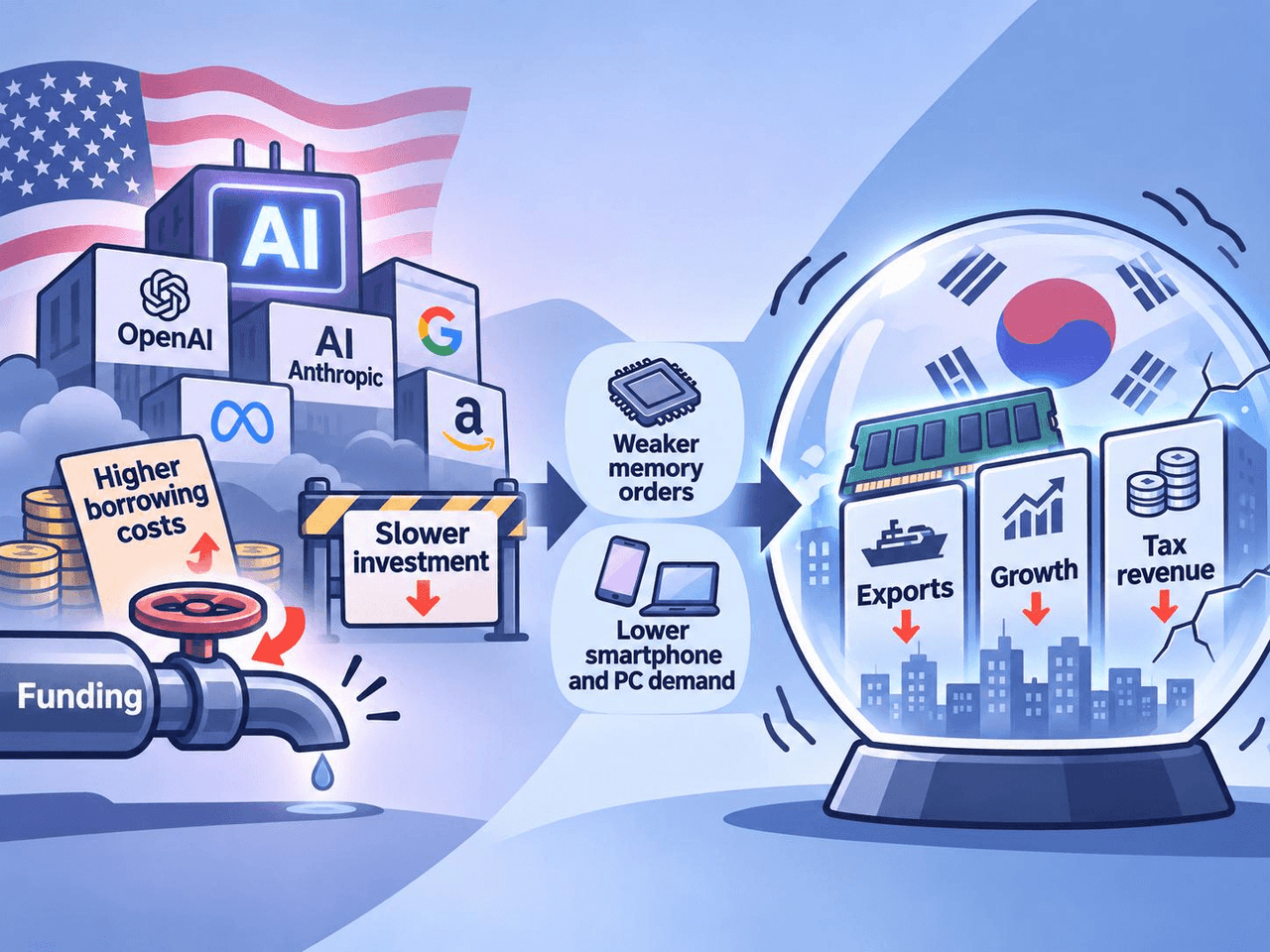
Source: Korea Times
Microsoft CFO Amy Hood revealed that third-party providers of AI chips experienced delays that will push out some available capacity until the first half of 2027
5
. Alphabet's finance chief Anat Ashkenazi told analysts that outside computing power "came online only at the very end of Q3"5
. Google doesn't have enough capacity to serve all its customers and has started offloading some workloads to third parties, which will dent future margins3
.Gartner analysts predict that by 2030, 80% of neocloud companies will either be absorbed or completely cease operations
5
. The sector faces risks including concentration in tenants, technological obsolescence requiring rapid replacement, and increasingly complex financing structures that can transmit and amplify risks4
. Watch how Google's Gemini models perform in generating revenue and whether search revenue continues its slowdown as more users adopt AI Mode.References
Summarized by

Navi
[2]
[3]
Related Stories
Google Cloud revenue surges 82% as AI investments justify massive spending spree
21 Jul 2026•Business and Economy

Google reports first negative free cash flow ever as AI spending reaches $205 billion in 2026
22 Jul 2026•Business and Economy

Big Tech Sheds Nearly $900 Billion as Soaring AI Spending Triggers Market Rout
23 Oct 2026•Business and Economy
Recent Highlights


Recent Highlights
Today's Top Stories








Don’t drown in AI news. We cut through the noise - filtering, ranking and summarizing the most important AI news, breakthroughs and research daily. Follow topics that matter to you and stay ahead.


