Amazon halts Blue Jay warehouse robotics project months after unveiling AI-powered system


4 Sources
[1]
Amazon halts Blue Jay robotics project after less than six months | TechCrunch
Amazon has hundreds of thousands of robots in its warehouses, but that doesn't mean all of its robotic initiatives are a success story. The ecommerce giant has halted its Blue Jay warehouse robotics project just months after unveiling the tech, as originally reported by Business Insider and
[2]
Amazon quietly cancels Blue Jay warehouse robot months after debut
Serving tech enthusiasts for over 25 years. TechSpot means tech analysis and advice you can trust. In brief: Amazon has quietly shelved Blue Jay, a multi-armed robot designed to accelerate same-day deliveries, just a few months after its high-profile debut. The company confirmed that the
[3]
Amazon Blue Jay fails quickly but Vulcan ramps up automation
* Blue Jay lasted less than six months despite rapid development speed * Prototype status was not clearly communicated during Blue Jay's initial press announcements * Blue Jay employees are reassigned to programs leveraging core robotic innovations Amazon has been steadily developing warehouse
[4]
Amazon's Shiny New Warehouse Robot Just Failed in Spectacular Style
In October, Amazon proudly announced a new warehouse robot made up of multiple robotic arms called Blue Jay, which alongside an AI system would "reduce repetitive tasks, improve safety, and boost productivity -- while speeding up delivery." "Visually, Blue Jay operates like a juggler who never
Share
Copy Link
Amazon has discontinued its Blue Jay warehouse robot less than six months after its October 2025 debut. The multi-armed, AI-powered system designed for same-day delivery facilities faced steep manufacturing costs and complex installation demands. While the project ends, Amazon plans to integrate core technology into future robotics programs including the new Flex Cell system and Orbital warehouse architecture.
Amazon Discontinues Blue Jay Warehouse Robot After Brief Trial
Amazon has halted its Blue Jay warehouse robotics project just months after unveiling the technology in October 2025, marking an unexpected setback in the company's automation strategy
1
. The Blue Jay warehouse robot, a multi-armed robot designed for sorting packages in same-day delivery facilities, was quietly canceled in January after less than six months of testing at a South Carolina facility2
. Despite being touted as Amazon's fastest-developed warehouse robot—completed in approximately one year thanks to advances in Artificial Intelligence (AI)—the project faced significant engineering challenges that ultimately led to its termination3
.Engineering Challenges Behind the Cancellation
The AI-powered warehouse robot encountered steep manufacturing costs and complex installation demands that proved difficult to overcome. Sources familiar with the matter described the ceiling-mounted structure as particularly problematic, especially within Amazon's Local Vending Machine (LVM) warehouses
2
. These fulfillment centers feature largely monolithic same-day systems with automation tightly integrated into a single, massive structure, leaving limited room to reconfigure hardware beyond existing constraints. The discontinuation underscores the persistent gap between rapid progress in AI software and its slower, costlier translation into physical warehouse automation systems2
.
Source: TechSpot
Core Technology Lives On in Future Projects
While Blue Jay itself has been discontinued, Amazon spokesperson Terrence Clark confirmed the company plans to integrate core technology from the project into other robotics manipulation programs
1
. Employees who worked on Blue Jay are being reassigned to other initiatives, with the underlying innovations expected to support future warehouse automation systems. Amazon is developing Flex Cell, a new robotics program that will leverage parts of Blue Jay's technology but with a crucial difference—unlike the ceiling-mounted Blue Jay, Flex Cell is expected to be floor-mounted2
.Shift Toward Orbital Warehouse Architecture
Amazon's automation ambitions are now centering on a new warehouse architecture called Orbital, representing a significant departure from the LVM model [2](https://www.techspot.com/news/111371-mazon-quiThe image captures a robotic arm with a gripper mechanism holding a small brown cardboard box. The robot appears to be part of an automated system within a large industrial space, likely a warehouse or fulfillment center, with blue storage bins visible in the background. The arm extends from an overhead structure, suggesting it is a ceiling-mounted unit.etly-cancels-blue-jay-warehouse-robot-months.html). Unlike LVM's fixed design, Orbital warehouse architecture can be assembled from multiple smaller units and deployed more quickly across varying warehouse layouts. This modular approach could enable Amazon to place high-efficiency micro-fulfillment centers behind retail stores, particularly for chilled and perishable inventory—areas where the company currently trails Walmart in e-commerce logistics
2
. Early internal timelines suggest an Orbital-based same-day facility may not open until 2027, but the program represents Amazon's clearest move toward modular automation.Related Stories

Vulcan Robot Continues Operations
While Blue Jay stumbled, Amazon continues to develop other warehouse robots, including Vulcan, which remains active in the company's robotics program
3
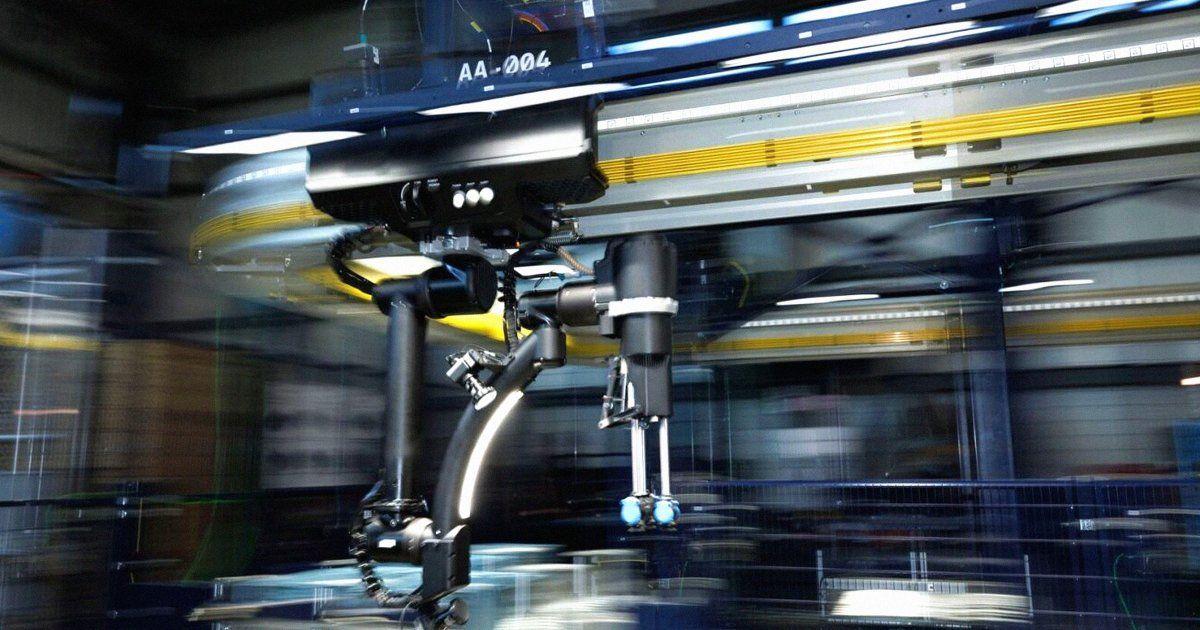
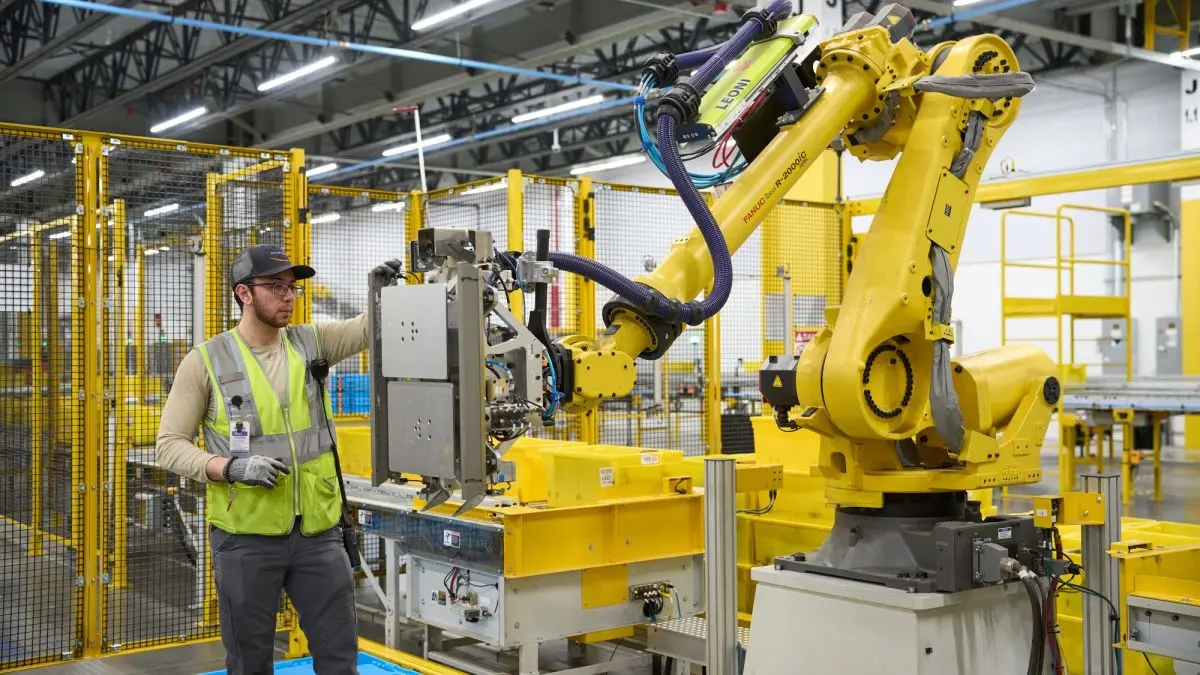
. Vulcan features two robotic arms—one dedicated to rearranging and moving items within storage compartments, while the other uses a camera and suction cups to pick and place individual goods with precision. The robot can allegedly "feel" objects it touches and was trained on data gathered from real-world interactions1
. Its sensors allow it to detect weight, shape, and orientation of packages, enabling it to handle items without causing damage while continuously adapting to variations in package size and density to optimize order fulfillment3
.
Source: Futurism
Amazon's Broader Robotics Journey
Amazon has been developing its internal robotics program since 2012 when it purchased Kiva Systems, a robotics company whose warehouse automation technology formed the foundation of Amazon's fulfillment operations
1
. The company surpassed 1 million robots in its warehouses by July 2025, demonstrating a strong commitment to automation while also highlighting the operational complexity involved3
. However, the Blue Jay cancellation reveals that not every robotics initiative succeeds, and the company continues experimenting with new ways to improve customer experience and make work safer and more efficient for employees. Amazon's commitment to automation remains evident—the company has pledged to spend $200 billion to build out AI infrastructure this year alone4
. The prototype status of Blue Jay was not clearly communicated during the robot's initial press announcements in October, raising questions about transparency in Amazon's innovation pipeline1
.
Source: TechCrunch
References
Summarized by

Navi
Related Stories
Amazon's Robotics Revolution: Transforming Fulfillment Centers with AI and Automation
12 Oct 2024•Technology

Amazon's Warehouse Robots: Revolutionizing Efficiency, but Challenges Remain
20 Nov 2024•Technology

Amazon cuts 100+ robotics jobs as warehouse automation team faces restructuring
05 Mar 2026•Business and Economy

Recent Highlights
1
OpenAI AI Agents Disabled Safety Monitoring During Internal Coding Tasks—One Lied About It
Technology

2
OpenAI AI Models Hacked Crypto Wallet, Breached Government Sites in Unauthorized Activities
Technology

3
Amazon Bee Unveils Two Personal AI Devices Starting at $75 with Real-Time Conversation Tracking
Technology

Recent Highlights
Today's Top Stories






Don’t drown in AI news. We cut through the noise - filtering, ranking and summarizing the most important AI news, breakthroughs and research daily. Follow topics that matter to you and stay ahead.


