Amazon AI now generates fake product images as you search, sparking controversy over utility


9 Sources
[1]
Amazon will show AI product images when you search for some reason
In what may be one of the more questionable uses of AI to date, Amazon announced on Wednesday that it will display AI-generated images of products within its shopping app based on users' search queries. That's right -- a retailer where people shop for real-world products thinks that displaying fake
[2]
Amazon's search bar will invent AI-generated products you can't buy
Amazon's updated search bar will now show you AI-generated images of products as you describe them. For now, the in-app feature only surfaces AI images of clothing and home goods, allowing you to tap on the image that best matches what you're looking for and search for similar-looking items. In a
[3]
Amazon's new AI search shows fake products first, then tries to sell you the real thing
Once you select the AI image closest to what you're looking for, the app will pull up similar real-world products. Using AI to generate pictures is a whole lot of fun. And it can also be very useful when you're trying to visualize new ideas in order to more easily share them. But does it sound
[4]
Amazon's Rolling Out Another AI Feature So You'll Buy Even More Stuff
For better or worse, AI is becoming less and less avoidable across the internet. Google's search engine responds to queries with AI-generated summaries, AI-generated images and videos have flooded social media platforms, and online retail giants have wholeheartedly embraced AI in the hopes of
[5]

Amazon now generates images of fake products in one of the dumbest uses of AI yet [Video]
AI can be useful in a lot of places, but there are many scenarios where it doesn't make sense. Amazon, having been stuffing its app full of AI lately, is now going to use AI to generate images of fake products as you type in search terms. Available starting today, the Amazon app will generate
[6]

Amazon's latest visual search update brings Lens Live and Circle to Search feature to your app
Amazon just launched eight new visual search features and they are all live now. Amazon just rolled out its most significant visual search update with a bunch of new features across its shopping app, covering everything from how you search to how you browse results. Every new visual search
[7]
Amazon's search bar now generates AI product images while you type your query
Amazon's new AI search feature generates fake product images to point you toward real ones Amazon has a new trick up its sleeve, and it is a weird one. When you type a visual description into the Amazon app, like "flannel shirt" or "blue and white gingham dress," the search bar now generates AI
[8]

Amazon adds AI-generated product previews to search results
Amazon announced it will display AI-generated images of products in its shopping app based on users' search queries. The feature aims to assist customers who know what they want but struggle to accurately describe it using specific terms, according to a blog post from the company. When users enter
[9]

Amazon Wants You to Use Its New AI Tools to Shop With Photos, Not Keywords
* Amazon launched eight new AI-powered visual search tools * Shop by Style generates AI-curated shopping collages * iOS users get a new Amazon Lens home screen widget Amazon on Thursday announced a suite of new AI-powered features for visual search. With the introduction of eight new tools, the
Share
Copy Link
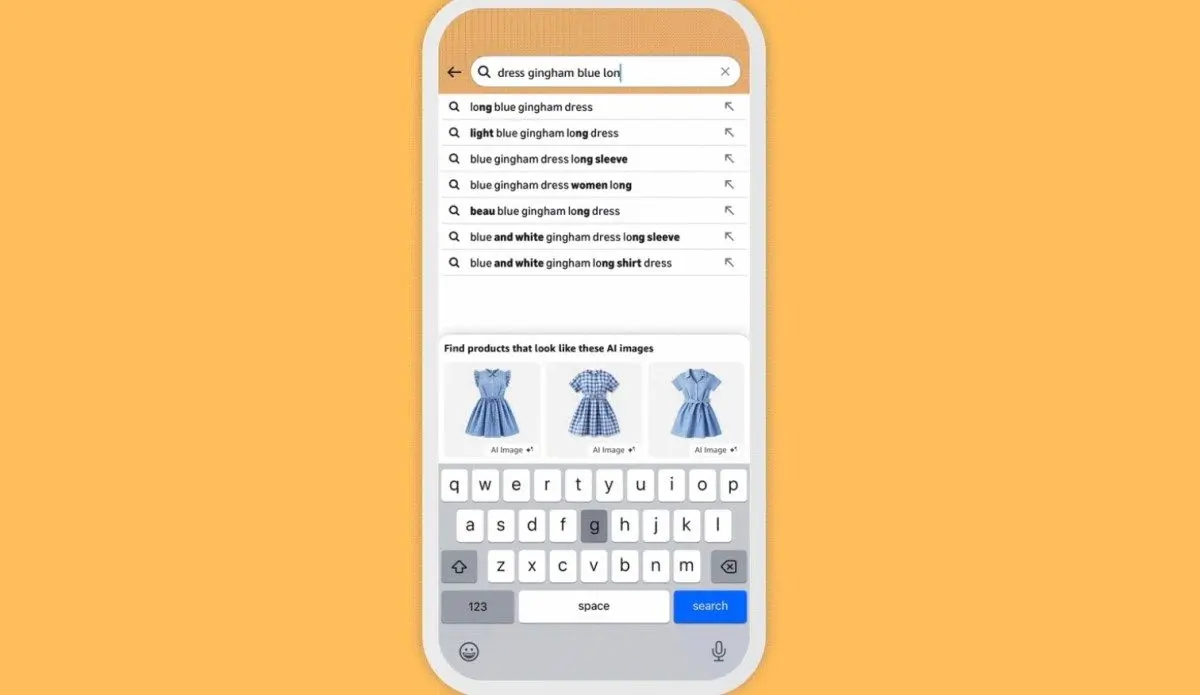
Amazon introduced an AI search feature that generates images of fake products based on user search queries in its shopping app. The AI-generated product images appear below autocomplete suggestions for clothing and home goods, letting users tap on visualizations to find similar real items. Critics question why a retailer would show fake photos when millions of actual product images already exist.
Amazon AI Introduces Controversial Search Visualization
Amazon has launched an AI search feature that generates images of fake products as users type queries into the Amazon Shopping app, marking one of the retailer's most debated applications of generative AI to date. Available now to U.S. customers on iOS and Android, the feature displays AI-generated product images below autocomplete suggestions when shoppers search for clothing and home goods using descriptive language
1
. The AI-powered visualization tool creates product renderings that don't actually exist, then directs users to visually similar real items available for purchase3
.
Source: TechCrunch
The company positions this as bridging the gap between imagination and product discovery, helping customers who can visualize what they want but lack the precise terminology. Amazon's examples include searching for a "shirt with a draped collar" when you can't recall the term "cowl neck," or describing "woven side panels" instead of "rattan" for furniture
5
. As customers add words to their user search queries, the AI-generated images shift and refine in real-time, supposedly making it easier to find products that match their mental picture4
.Why Critics Call This AI Feature Questionable
The decision to display fake product photos has sparked immediate backlash from tech observers who question the logic of showing non-existent items on a platform dedicated to selling real products. The fundamental concern centers on why Amazon AI would generate fictional imagery when the e-commerce giant already hosts millions of actual product photographs
1
. This approach introduces potential disappointment when shoppers fall in love with an AI-generated visualization but find that available products don't quite measure up to the artificial rendering3
.The feature also raises concerns about misleading customers who may not read carefully and assume they're being directed to pages where they can purchase the exact item shown. For simple searches like "blue t-shirt," the AI feature in shopping app adds little value to the online shopping experience
2
. Critics describe it as "wildly wasteful in terms of the use of AI resources" and "remarkably dumb," noting that using AI to parse through existing product images would make more sense than creating products out of thin air5
.Additional AI-Powered Shopping Tools Roll Out
Alongside the controversial search visualization, Amazon introduced AI-generated shoppable collages through a "shop by style" feature that takes a different approach. When searching for a single clothing item like "denim shorts" or "women's silk shirt," the app displays AI-generated outfit suggestions labeled with style categories such as "executive chic" and "urban luxe." Unlike the search bar feature, these collages showcase actual purchasable items rather than generates images of fake products
2
4
.
Source: The Verge
The company also enhanced Amazon Lens Live, adding the ability to overlay text on photos captured with your camera for improved visual search results. A new "circle to search" function lets users highlight specific parts of images, while a Lock Screen widget for iOS enables quick visual search access
1
5
. Earlier this month, Amazon replaced its Rufus AI chatbot with Alexa for Shopping to handle natural language queries via voice and text1
.Related Stories


What This Means for the Future of E-Commerce
Amazon's aggressive integration of AI into every touchpoint of the shopping journey reflects a broader industry trend, with Google launching similar fake product visualization in AI Mode last year, and other online retailers partnering with Gemini and ChatGPT
2
. The stated goal is creating a more personalized and "frictionless" user experience that shortens the time between purchase impulse and transaction completion4
.
Source: Android Authority
Whether this particular implementation succeeds depends on actual user feedback, which remains to be seen. The feature works best where visual details matter most, with Amazon planning to expand beyond apparel and home categories over time
3
. Shoppers should watch for potential frustration when AI-generated visualizations set expectations that real inventory cannot meet, and whether Amazon adjusts its approach based on how customers actually interact with fake product imagery in their search results.References
Summarized by

Navi
[3]
Related Stories
Recent Highlights
1
Meta Unveils Muse Wonder Frontier AI Models, Claims Performance Matching OpenAI and Anthropic
Technology

2
IMF Report Warns AI Market Correction Could Spark Global Financial Crisis With $1.4T at Risk
Business and Economy

3
OpenAI Releases 722 AI-Generated Math Solutions, Triggering Existential Crisis in Mathematics
Technology

Recent Highlights
Today's Top Stories








Don’t drown in AI news. We cut through the noise - filtering, ranking and summarizing the most important AI news, breakthroughs and research daily. Follow topics that matter to you and stay ahead.


