DeepMind's AI weather model gives forecasters an extra day to prepare for deadly tropical cyclones


8 Sources
[1]
Operational Tropical Cyclone Forecasting with AI
We are providing an unedited version of this manuscript to give early access to its findings. Before final publication, the manuscript will undergo further editing. Please note there may be errors present which affect the content, and all legal disclaimers apply. Tropical cyclones are among the
[2]
DeepMind's hurricane model bought forecasters an extra day
In October 2025, a storm brewed over the Caribbean Sea. Weather models differed on its trajectory. Would it remain weak and end up in Haiti, or would it intensify and head to Jamaica? Artificial intelligence model WeatherNext, developed by Google's DeepMind and Google Research, went with the
[3]
DeepMind Says Its AI Can Predict Hurricanes Earlier Than Everyone Else
In October 2025, a storm brewed over the Caribbean Sea. Weather models differed on its trajectory. Would it remain weak and end up in Haiti, or would it intensify and head to Jamaica? Artificial intelligence model WeatherNext, developed by Google's DeepMind and Google Research, went with the
[4]
DeepMind AI gives an extra day of warning ahead of deadly cyclones | New Scientist
DeepMind has developed an AI model that can predict deadly cyclones one day further out than existing methods, potentially saving lives by allowing more accurate and timely decisions about evacuations. Many existing weather forecasts are based on physics simulations run on powerful supercomputers
[5]

Google open-sources an AI model it says can help with earlier hurricane warnings - Engadget
WeatherNext can deliver a 15-day forecast predicting storms' track and intensity. Researchers from the Google DeepMind and Google Research teams have helped train the WeatherNext AI weather prediction model to offer improved cyclone warnings. The National Hurricane Center, the Cooperative
[6]

AI model achieves breakthrough in forecasting cyclones
WeatherNext enables accurate cyclone forecasts that can give an extra day of warning. Now we are open sourcing the model. Predicting how dangerous cyclones develop is a longstanding challenge where every hour counts. Tropical cyclones -- also known as hurricanes or typhoons -- are among the most
[7]

Our WeatherNext 2 AI model demonstrated a massive leap forward in predicting cyclones.
Predicting how hurricanes and cyclones develop is a longstanding challenge, and every hour of warning counts. Tropical cyclones are among the most destructive weather events on Earth, and for meteorologists, issuing accurate, timely warnings is a constant race against time. Today, in a paper
[8]

Google open-sources WeatherNext AI model for hurricane forecasts
Google has open-sourced WeatherNext, an artificial intelligence weather model designed to improve hurricane warnings with 15-day forecasts of storm track and intensity. Google DeepMind and Google Research helped train the model, with contributions from the National Hurricane Center, the
Share
Copy Link
Google DeepMind and Google Research unveiled WeatherNext, an AI operational weather model that predicts tropical cyclone track and intensity a full day earlier than existing systems. Published in Nature, the breakthrough offers forecasters critical extra time for disaster preparedness and evacuations.
WeatherNext Delivers Earlier Hurricane Warnings with AI-Driven Breakthrough
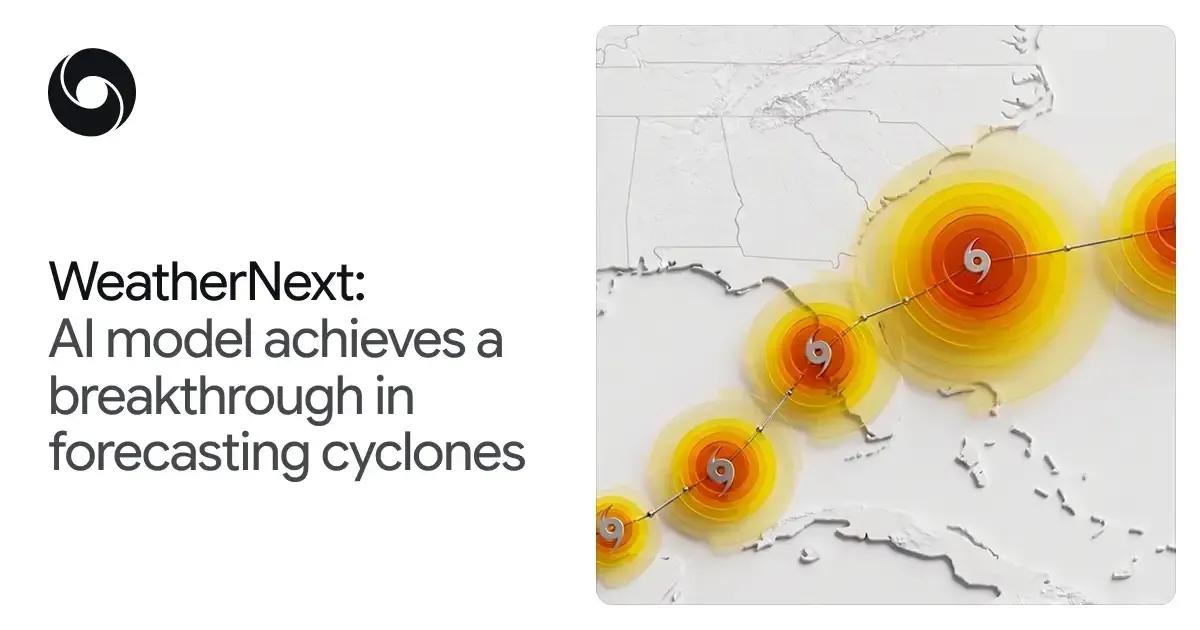
Google DeepMind and Google Research have developed WeatherNext, an AI weather model that provides forecasters with an extra day of lead time when predicting deadly cyclones
1
2
. Published in Nature, the research demonstrates that WeatherNext's predictions three days out match the accuracy of existing models' two-day forecasts3
. This advancement in tropical cyclone forecasting represents progress comparable to a decade of traditional operational development2
.
Source: DeepMind
Mike Brennan, director of the US National Hurricane Center, emphasized the value of this lead time advantage: "Time is really golden when it comes to those types of decisions, so the ability to push forecast accuracy out as much as a day beyond what we've previously been able to do is really valuable"
2
. The extra hours enable critical disaster preparedness activities including organizing evacuations, staging supplies, and positioning emergency resources3
.Predicting Storm Track and Intensity with Coarse Atmospheric Data
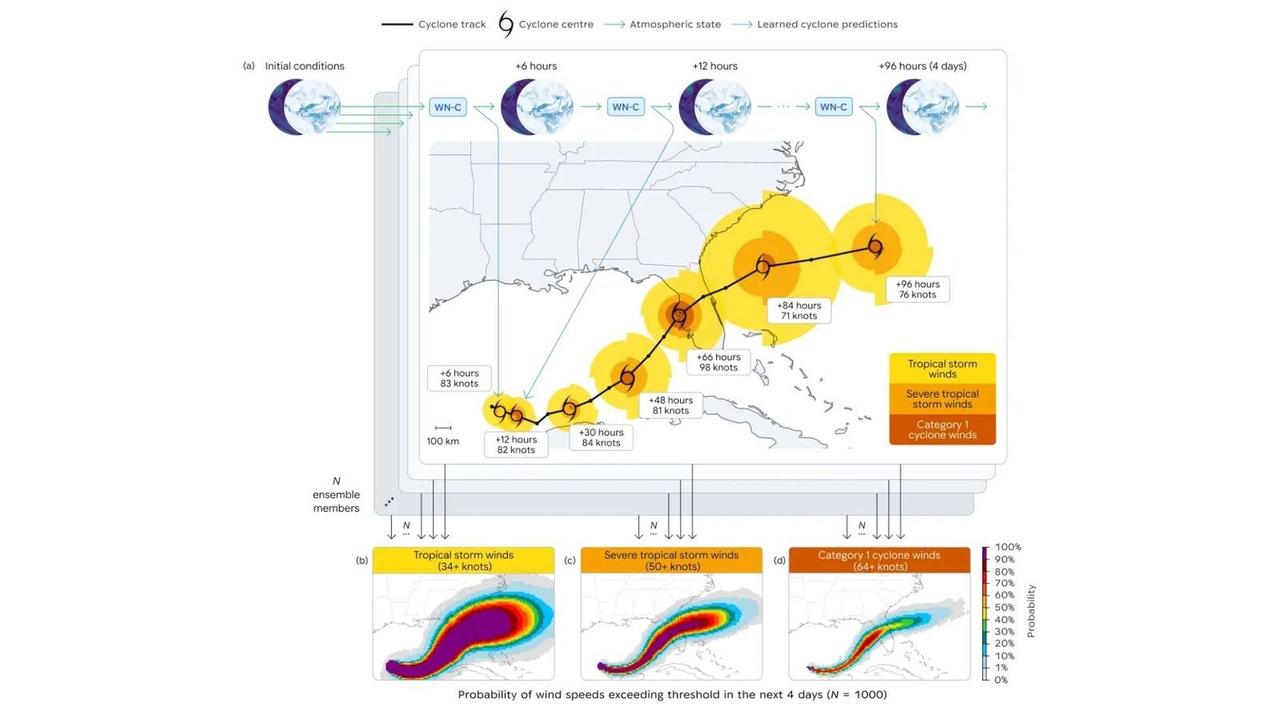
WeatherNext addresses a fundamental challenge in tropical cyclone forecasting by predicting both track and intensity using a single AI operational weather model
1
. The model was trained on nearly 20 terabytes of global atmospheric data combined with 5,000 historical storms from the International Best Track Archive for Climate Stewardship4
5
.
Source: Engadget
What surprised meteorology experts is that WeatherNext achieves state-of-the-art results using atmospheric data with 28 square kilometer resolution—orders of magnitude coarser than regional models typically require for intensity forecasting
1
4
. Ferran Alet, research scientist at Google DeepMind, explained: "When we told the community that our model was only using relatively coarse resolution, they were shocked, because that means that the lower-resolution inputs capture more signal about what's going to happen than previously believed"2
.Hurricane Melissa Demonstrates Real-World Impact
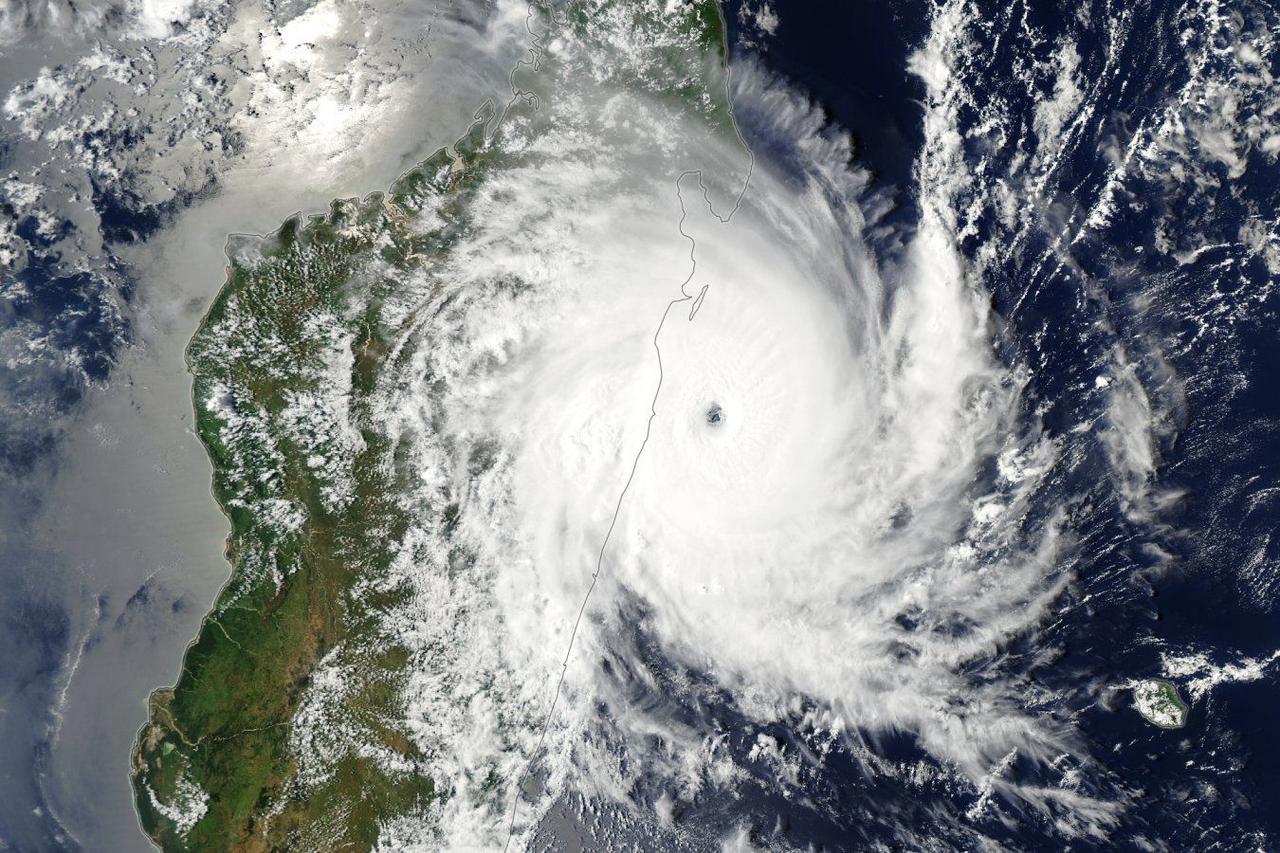
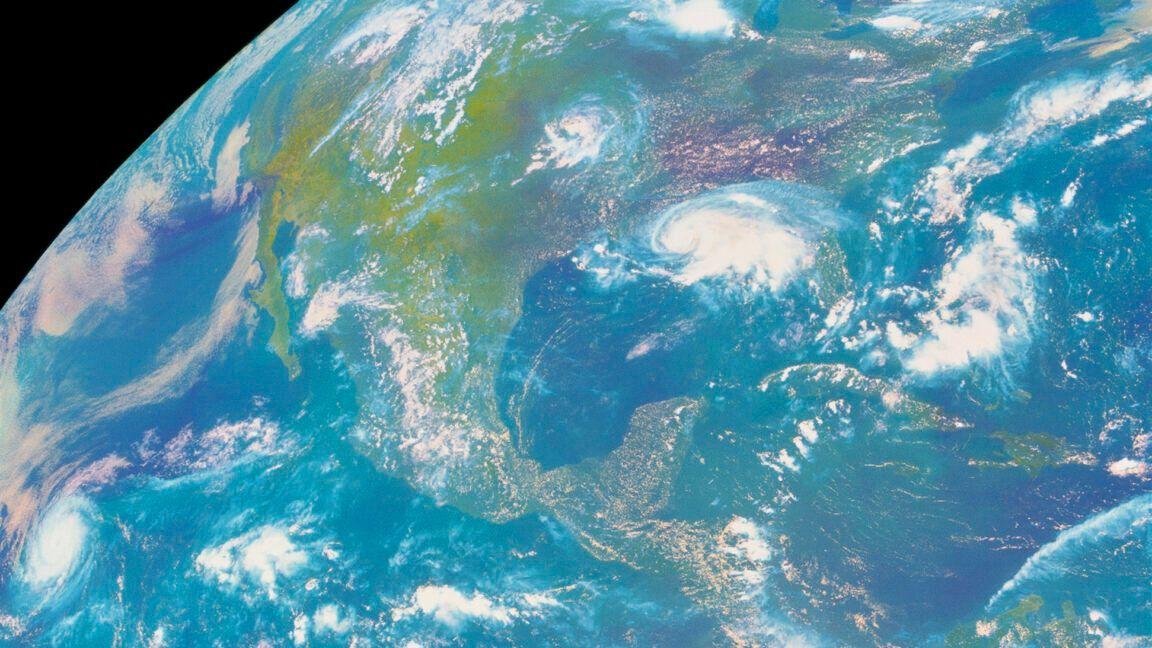
The model's capabilities were dramatically demonstrated during Hurricane Melissa in October 2025. When weather models diverged on the storm's trajectory, WeatherNext predicted with 80 percent confidence that the system would strike Jamaica as a Category 5 hurricane—five days before landfall
2
3
. This marked the first time the National Hurricane Centre successfully predicted a Category 5 hurricane when the storm was only at Category 1 strength2
. Though Hurricane Melissa caused catastrophic flooding and landslides, the earlier hurricane warnings enabled better community preparation3
.
Source: New Scientist
Ensemble Forecasting Captures the Butterfly Effect
WeatherNext generates large ensemble forecasts extending 15 days into the future, producing up to 1,000 possible scenarios per storm
1
3
. This approach captures the butterfly effect, where small deviations can lead to significantly different outcomes3
. The AI operational weather model can deliver a complete 15-day forecast in less than a minute on a single Tensor Processing Unit, compared to days of computation time required by physics-based models4
5
.Kate Musgrave, tropical cyclone group lead at the Cooperative Institute for Research in the Atmosphere, noted the team's initial skepticism: "The results were so good that we were skeptical that we would actually see that in the real-time demonstration. I think everybody was surprised at just how well it did"
2
. Including WeatherNext predictions in consensus ensembles substantially improves overall forecasting skill1
.Related Stories

Open-Source Release Accelerates Meteorology Research
Google DeepMind has made WeatherNext open-source, releasing both code and model weights on GitHub
5
. This enables scientists worldwide to build upon the work and enhance tropical cyclone forecasting capabilities. The National Hurricane Center, UK Met Office, and weather agencies globally contributed to the model's development5
.Hannah Cloke at the University of Reading described the rapid transformation: "This is one of the most exciting fields to work in at the moment, and one of the reasons is the rise in machine-learning forecasting and the absolute speed and power with which we're moving forward in this field"
4
. However, she cautioned that advances outpace academic publication, with cutting-edge developments running 18 months ahead of published papers4
.Questions Remain About Climate Modeling and Anomalous Events
Despite WeatherNext's success, concerns persist about AI weather models' ability to predict truly anomalous events without training data analogues. Tim Palmer at the University of Oxford advocates for testing models on one-off events removed from training data, arguing this capability becomes critical as climate change makes weather patterns increasingly chaotic
4
. Palmer also notes that weather and climate modeling share up to 90 percent of their code, raising questions about implications for climate modeling if physics-based approaches are abandoned4
.The researchers acknowledge WeatherNext remains a "black box"—they don't fully understand how it extracts intensity signals from coarse atmospheric data
2
. Alet noted: "It's a black box at the end of the day, but that gives physicists a signal that something is happening that was not previously understood"3
. This suggests opportunities for new physics insights that could advance both AI and traditional approaches to predict deadly cyclones and improve disaster preparedness worldwide.References
Summarized by

Navi
[2]
Related Stories
Google DeepMind Unveils AI-Powered Weather Lab for Advanced Cyclone Predictions
13 Jun 2025•Technology

Google's AI Weather Model Outperforms Traditional Forecasts in Hurricane Erin Prediction
27 Aug 2025•Technology
Google's WeatherNext 3 AI Weather Model Uses Live Satellite Data for Hourly High-Resolution Forecasts
03 Sept 2026•Technology
Recent Highlights
1
Microsoft and Nvidia Launch Surface Laptop Ultra: A $2,599 AI-Ready PC With RTX Spark Chip
Technology

2
Google Unveils Gemini 4 Argon AI Model, Restricts Access to Trusted Cyber Defenders
Technology

3
Trump Consulted Grok AI Before Ordering Venezuela Invasion and Capture of Nicolás Maduro
Policy and Regulation

Recent Highlights
Today's Top Stories






Don’t drown in AI news. We cut through the noise - filtering, ranking and summarizing the most important AI news, breakthroughs and research daily. Follow topics that matter to you and stay ahead.


