AMD Acquires World Labs for $8.2 Billion, Brings AI Pioneer Fei-Fei Li as Chief Scientist


34 Sources
[1]
AMD acquires World Labs, AI pioneer Fei-Fei Li's world models startup
Chipmaker AMD and world models company World Labs announced that AMD will acquire the AI company by the end of the year, pending regulatory approval. The transaction is valued at $8.2 billion. In 2024, computer vision scientist Fei-Fei Li founded World Labs with fellow researchers Justin Johnson,
[2]
AMD will acquire Fei-Fei Li's World Labs for $8.2 billion
World Labs, one of the leading developers of deep learning models intended to understand physical reality, has been acquired in a $8.2 billion deal, the two companies said today. World Labs justified the deal in a statement saying that AI development required "close collaboration across model
[3]
AMD is acquiring AI company World Labs in a deal worth more than $8 billion
AMD announced today that it's acquiring World Labs, an AI research lab co-founded by the prominent researcher Dr. Fei-Fei Li, in an all-stock deal worth approximately $8.2 billion. World Labs launched in 2024 and was valued at $1 billion in a matter of months. The startup launched its first
[4]
AMD acquires AI legend Fei-Fei Li's World Labs for $8.2 billion -- ImageNet pioneer will become AMD chief scientist as the chipmaker brings her lab in-house
AMD taps World Labs' model expertise to shape future chip and systems design. AMD has agreed to acquire AI model research firm World Labs in an all-stock purchase worth around $8.2 billion. World Labs co-founder Fei-Fei Li will join AMD as executive vice president and chief scientist, reporting to
[5]

AMD bets $8.2B that worlds matter more than words in AI
AMD dove deeper into AI model development on Monday with an agreement to acquire Fei-Fei Li's World Labs in a deal valued at approximately $8.2 billion. The House of Zen claims the all-stock deal is expected to close by year's end pending regulatory approval, and will guide the development of
[6]

AMD agrees to buy World Labs to fill out its AI stack
World Labs will add spatial AI to AMD's software and compute stack, narrowing Nvidia's lead a little. endif; ?> Advanced Micro Devices (AMD) has agreed to buy World Labs, a developer of AI "world models" that incorporate knowledge of the physical world, to extend the AI ecosystem around its
[7]

AMD to acquire Fei-Fei Li's World Labs in $8.2 billion deal
Sept 28 (Reuters) - Advanced Micro Devices (AMD.O), opens new tab said on Monday that it had entered an agreement to acquire Fei-Fei Li's World Labs startup in a deal valued at $8.2 billion. San Francisco-based World Labs, which raised $1 billion in a funding round earlier this year, develops
[8]

AMD to buy Fei-Fei Li's AI start-up for $8bn
AMD has agreed to acquire AI pioneer Fei-Fei Li's start-up World Labs for $8.2bn in an all-stock transaction that will push the Nvidia competitor further beyond chips into model development. Li, the Stanford University researcher described as the "godmother of artificial intelligence", founded the
[9]

AMD acquiring Fei-Fei Li's World Labs AI firm in deal worth $8.2 billion
* AMD announced on Monday that it has entered into an agreement to acquire World Labs, a San Francisco-based AI lab developing a kind of model called a world model, which can be used to simulate 3D environments. * AMD said on Monday that the lab was acquired for about $8.2 billion in an all-stock
[10]

'AI is hobbled in efficiency': Fei-Fei Li on AMD buying World Labs
AMD has agreed to buy World Labs, Fei-Fei Li's AI model startup, for about $8.2bn in stock. Li will join AMD as chief scientist, reporting to CEO Lisa Su. AMD has agreed to buy World Labs, the AI model startup led by Fei-Fei Li, in an all-stock deal valued at about $8.2bn. AMD announced the deal
[11]

Fortune Tech: AMD buys World Labs | Fortune
Good morning. Last year, Fortune brought you the AIQ 50, the inaugural ranking of the Fortune 500 companies making the most headway in integrating AI into their operations. The list was such a success, and the pace of AI is moving so fast within the enterprise, that we decided to expand the list
[12]

AMD acquires Fei-Fei Li's World Labs for $8.2 billion
Following the close, Dr. Fei-Fei Li will join AMD as executive vice president and chief scientist, reporting to AMD chair and CEO Dr. Lisa Su, the company said. The World Labs team will continue to focus on AI model research after the transaction closes. World Labs develops spatial-intelligence
[13]

Nvidia rival AMD bets $8.2bn on the 'godmother of AI' and her virtual worlds
World Labs builds world models, AI systems designed to understand how objects and spaces behave, allowing them to simulate what might happen when something moves or an action is taken. Chip maker Advanced Micro Devices (AMD) is spending $8.2 billion (€7bn) on a company that builds virtual worlds,
[14]

AMD buys firm founded by AI 'godmother' Fei-Fei Li
San Francisco (United States) (AFP) - Chip maker Advanced Micro Devices announced Monday it has acquired World Labs, an artificial intelligence company founded by Fei-Fei Li, one of the field's most prominent researchers, sometimes referred to as "The Godmother of AI." The deal is valued at
[15]

AMD buys Fei Fei Li's World Labs for $8.2bn
Fei Fei Li to lead AMD as its new chief scientist. AMD has agreed to acquire AI pioneer Dr Fei Fei Li's start-up World Labs in an $8.2bn deal, as physical AI systems prove their commercial capabilities across autonomous driving and factory floors. World Labs describes itself as a "spatial
[16]

AMD acquires world model developer World Labs for $8.2B
Advanced Micro Devices Inc. today announced plans to buy World Labs Inc. for $8.2 billion in stock. The move comes seven months after AMD backed a $1 billion funding round for the startup at a $5 billion valuation. The deal also included the participation of rival Nvidia Corp., which is poised to
[17]
AMD acquires startup founded by 'godmother of AI' Fei-Fei Li for $8.2 billion | Fortune
The acquisition will help AMD -- which makes the GPU chips crucial for training and running AI models -- design its products for the evolving applications of AI, and help it better compete with arch-rival Nvidia, which is also expanding into physical AI. "Together, we'll combine World Labs' deep
[18]

AMD to acquire World Labs in an $8.2 billion all-stock transaction
AMD has signed a definitive agreement to acquire World Labs, a San Francisco-based AI company focused on spatial intelligence models. The all-stock transaction is valued at approximately $8.2 billion and is expected to close by the end of 2026, subject to regulatory approvals. Founded in 2024,
[19]

AMD's $8.2 billion World Labs deal is a direct answer to NVIDIA's Hugging Face buy
AMD has agreed to acquire World Labs, the spatial AI startup founded by Fei-Fei Li, in an all-stock deal valued at $8.2 billion. The transaction is expected to close before the end of 2026, pending regulatory approval. According to the company, Li will join AMD as executive vice president and chief
[20]

AMD acquires Fei-Fei Li's World Labs for $8.2B
AMD said it will acquire World Labs for $8.2 billion, adding the deep learning startup founded by AI researcher Fei-Fei Li. The deal will bring Li to AMD as executive vice president and chief scientist, and is expected to close before the end of the year, subject to regulatory approval. AMD said
[21]

AMD acquisition: AMD to acquire Fei-Fei Li's World Labs in $8.2 billion deal
San Francisco-based World Labs, which raised $1 billion in a funding round earlier this year, develops spatial-intelligence models. Advanced Micro Devices said on Monday that it had entered an agreement to acquire Fei-Fei Li's World Labs startup in a deal valued at $8.2 billion. San
[22]

Why AMD Is Spending $8.2 Billion On World Labs - Advanced Micro Devices (NASDAQ:AMD)
Advanced Micro Devices Inc. (NASDAQ:AMD) is pursuing World Labs to gain deeper insight into next-generation AI workloads and strengthen the broader hardware-and-software ecosystem it needs to compete with NVIDIA Corp. (NASDAQ:NVDA) in artificial intelligence. World Labs Could Shape AMD's Chip
[23]

AMD to buy Fei-Fei Li's World Labs AI startup for $8.2 billion
Chipmaker Advanced Micro Devices has agreed to acquire World Labs for $8.2 billion, gaining an artificial intelligence startup founded by industry pioneer and researcher Fei-Fei Li. The all-stock transaction is expected to close by the end of the year, subject to regulatory approvals, the
[24]

AMD Acquires World Labs For $8.2 Billion In What Is Essentially A Talent Grab For Building A Competitor To NVIDIA's Cosmos AI Model
In what is its first major acquisition since entering into a definitive agreement to acquire the inference-focused chip designer Taalas last month, AMD has just announced an agreement to acquire the AI research-focused enterprise, World Labs. AMD to buy Dr. Fei-Fei Li's World Labs in an all-stock
[25]
In 2024, Fei-Fei Li raised USD 230 million to launch World Labs, years later Chip maker AMD acquires artificial intelligence company for USD 8.2 billion, abrupt shift from China to New Jersey changes everything for 'Godmother of AI'
Earlier in February, 2026, Fei-Fei Li's World Labs raised $1 billion in a funding round as the startup accelerates its efforts to advance "spatial intelligence." Chip maker Advanced Micro Devices-AMD has announced that it has acquired World Labs, an artificial intelligence company founded by
[26]

AMD to Acquire World Labs to Advance the Future of AI Compute Infrastructure
AMD announced that it has entered into a definitive agreement to acquire World Labs, an AI model and research lab led by AI pioneer Dr. Fei-Fei Li. The acquisition will bring a world-class team of researchers and model experts to AMD, strengthening its ability to develop AI hardware, software and
[27]
AMD to Buy AI Firm World Labs in $8.2 Billion Deal - Advanced Micro Devices (NASDAQ:AMD)
Advanced Micro Devices Inc (NASDAQ:AMD) stock is trending late Monday after the company announced a deal to acquire World Labs. * Advanced Micro Devices stock is feeling bearish pressure. What's behind AMD decline? AMD To Acquire AI Model and Research Lab AMD announced that it entered into a
[28]

AMD acquires World Labs in $8.2B deal to advance robotics and physical AI
At some point, most of us have admired the 50-year-old "godmother of AI" because of her pioneering, foundational work in computer vision and deep learning, as well as her advocacy for human-centered technology. Fei-Fei Li spent more than a decade as a professor at Stanford before co-founding
[29]

AMD to Acquire World Labs to Advance the Future of AI Compute
Acquisition brings leading AI model research expertise to AMD, helping to shape future AI infrastructure and strengthen the open AI ecosystem. AMD today announced that it has entered into a definitive agreement to acquire World Labs, an AI model and research lab led by AI pioneer Dr. Fei-Fei Li.
[30]

AMD to Buy Fei-Fei Li's World Labs in USD 8.2 Billion AI Deal
AMD will acquire World Labs, the artificial intelligence startup founded by AI researcher Fei-Fei Li, in an all-stock transaction valued at approximately USD 8.2 billion. The deal will bring World Labs' research team and spatial intelligence expertise into AMD as the chipmaker expands its AI
[31]

AMD's $8.2B bet on World Labs is a direct shot at Nvidia's AI dominance By Investing.com
Investing.com -- Shares of Advanced Micro Devices (NASDAQ: AMD) barely flinched in after-hours trading, but the chipmaker just executed a massive structural play: an $8.2 billion all-stock buyout of World Labs, the spatial-intelligence powerhouse led by AI legend Dr. Fei-Fei Li. Slated to close by
[32]

AMD invests in spatial AI by buying World Labs
Advanced Micro Devices (AMD) shares rose up to 1.2% at more than $615 before closing flat Tuesday on Wall Street, a day after the group announced it would acquire World Labs, an artificial intelligence lab founded by Fei-Fei Li, in an all-stock deal worth about $8.2bn. Already an investor in the
[33]
AMD to Buy World Labs for $8.2bn, Bolstering Its AI Ambitions
AMD will acquire World Labs, an artificial intelligence lab founded by Fei-Fei Li, in an all-stock deal valued at about $8.2bn. Already an investor in the startup, the semiconductor maker is making the second-largest acquisition in its history, after Xilinx, bought for about $50bn in 2022. The
[34]
AMD to Acquire AI Research Firm World Labs in $8.2 Billion Deal
Advanced Micro Devices agreed to acquire artificial-intelligence research firm World Labs for in an all-stock deal valued at about $8.2 billion. AMD, a semiconductor company that recently touched a $1 trillion valuation, said the deal would bring leading AI research and development talent and help
Share
Copy Link
AMD announced an $8.2 billion all-stock acquisition of World Labs, founded by AI pioneer Fei-Fei Li. The deal brings world models expertise to AMD as it competes with Nvidia in AI infrastructure. Li will join as Executive Vice President and Chief Scientist, reporting to CEO Lisa Su.
AMD Acquires World Labs in $8.2 Billion Deal to Compete with Nvidia
AMD acquires World Labs
1
2
, the AI startup co-founded by prominent researcher Fei-Fei Li3
, in an all-stock deal valued at approximately $8.2 billion. The transaction, pending regulatory approval4
, is expected to close by the end of the year and marks AMD's second-largest acquisition after Xilinx, which closed at $50 billion in 2022. World Labs launched in 2024 with $230 million in funding and was valued at $1 billion within months of its founding. The acquisition brings not just advanced AI models but also some of the leading research talent working on spatial-intelligence models4
that generate, reconstruct, and simulate 3D environments5
.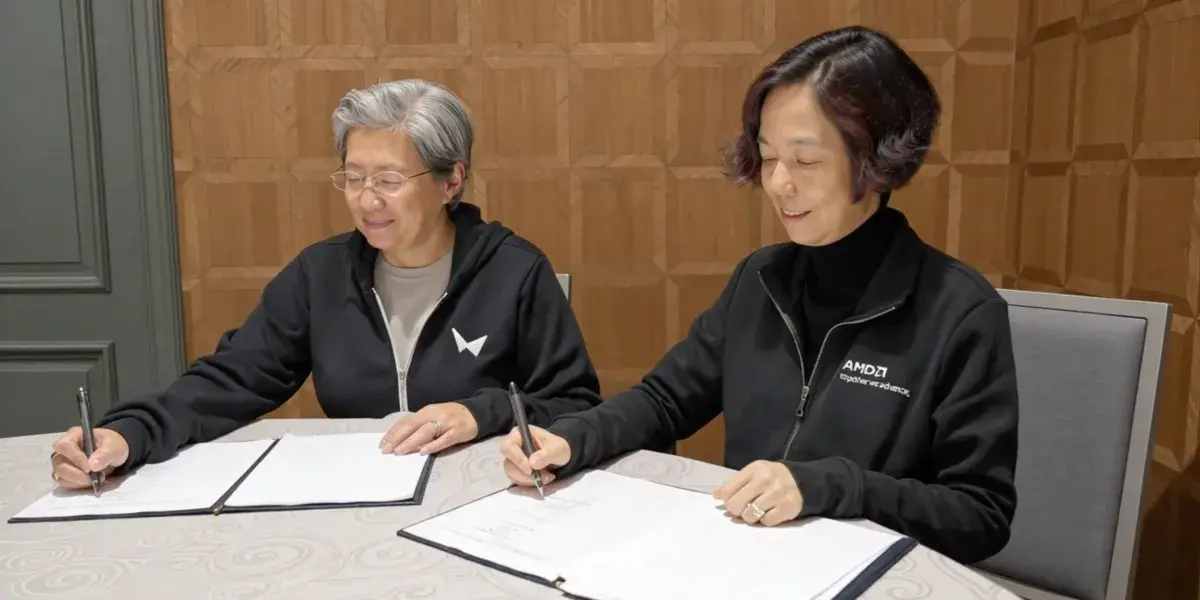
Source: Fortune
Fei-Fei Li Joins AMD as Chief Scientist
Fei-Fei Li will become Executive Vice President and AMD chief scientist
4
, reporting directly to CEO Lisa Su3
. Li, dubbed the "Godmother of AI" for her pioneering work on ImageNet4
and contributions to computer vision, has served as chief scientist of AI and machine learning at Google Cloud and director of the Stanford Artificial Intelligence Laboratory. Her co-founders Justin Johnson and Ben Mildenhall will continue leading the World Labs team as it integrates into AMD to form what the companies describe as a "world-leading frontier research organization"1
. Lisa Su emphasized that "building the compute platforms for the next generation of AI requires a deep understanding of how models are evolving"3
, positioning this AI startup acquisition as essential for shaping future AI chip roadmaps.
Source: Japan Times
World Models and Physical AI Drive Strategic Value
World models
1
are AI systems designed to simulate the physical world by providing predictive simulations of reality, fundamentally different from language models. These spatial-intelligence models work by generating, reconstructing, and simulating interactive 3D environments from text, image, and video inputs rather than predicting word sequences5
. World Labs' first commercial product, Marble1
, generates small 3D spaces using Gaussian splats that can be exported as 3D assets for film production, game development, and robotics and simulation applications. The company has since introduced Atlas4
, another world model that will power future versions of Marble. Li has argued that "language alone isn't sufficient for model development" and that "the universe isn't made up of words; it's made of real things"5
, making physical AI essential for solving problems in science, entertainment, and robotics.
Source: The Register
Synthetic Data Generation for Robotics Applications
One critical use case justifying enormous investment in world models is generating synthetic data generation for training robots
1
. The dearth of useful data to train general-purpose robots means that synthetic data from world models will be key to realizing visions put forward by companies like Tesla and Figure2
. World models are seen as vital in efforts to deploy generative AI deployments on robotic platforms, from autonomous vehicles to industrial robots and general-purpose humanoids. AMD's acquisition announcement emphasizes this angle: "As AI expands into reasoning, robotics, simulation and physical AI, the demands on compute platforms become more diverse"1
. World Labs' expertise in developing advanced models will give AMD deeper insight into how workloads are evolving and help shape its future technology roadmaps.AMD's Strategy to Compete with Nvidia in AI Infrastructure
This acquisition positions AMD to compete with Nvidia
1
in creating a comprehensive ecosystem for AI-specific chips. Nvidia already has a suite of open-weight world models like Cosmos and recently announced it would acquire Hugging Face for nearly $13 billion3
. AMD has produced its own AI models before, including Micro-World, an open-source world model, but has not produced a stack that competes with Nvidia's offerings1
. Compared to Nvidia, AMD's software engineering resources are significantly smaller, and Nvidia's investments in AI development have helped shape not just hardware but also provided enterprises with tools and frameworks5
. The World Labs team essentially provides AMD with an in-house AI development team to guide next-generation AI hardware and software development.Related Stories
Existing Partnership Strengthens Integration Path
AMD and World Labs had already been working together to optimize training and inference for its models, and AMD had invested in World Labs' $1 billion funding round in February
4
. During Lisa Su's keynote at CES in January, Fei-Fei Li appeared as a guest and mentioned that part of World Labs' model ran on AMD's Instinct accelerators4
, with her team using both Instinct hardware and the ROCm software stack to achieve performance improvements. This tuning experience positioned World Labs as one of AMD's showcase customers. Li wrote that advancing AI technology "requires close collaboration across model research, systems and compute"2
and that World Labs needs to get "closer to the hardware"4
, without which AI is "hobbled in efficiency."Implications for Open AI Ecosystem and Future Development
Both companies emphasized their commitment to an open AI ecosystem
3
4
, with World Labs stating it remains committed to "widely accessible open models." The acquisition could also be a hedge that language models, which have fueled the AI bubble to this point, might be a dead end5
. If world models prove to be the path toward true artificial intelligence grounded in physical reality, AMD's early investment could give it a significant advantage in building AI infrastructure necessary to run spatial models at scale. Watch for how AMD integrates World Labs' research into its hardware development cycles and whether this acquisition accelerates AMD's ability to win over enterprise customers who currently favor Nvidia's more mature software ecosystem.References
Summarized by

Navi
[4]
[5]
Related Stories
AMD's Strategic AI Acquisitions: Brium, Untether AI Team, and Enosemi Bolster Competitive Edge Against Nvidia
05 Jun 2025•Technology

AMD Acquires Taalas to Etch AI Models Into Silicon for Faster Inference
07 Aug 2026•Technology

AMD Acquires ZT Systems for $2.7 Billion to Boost AI Server Market Presence
21 Aug 2024

Recent Highlights
1
Meta Unveils Muse Wonder Frontier AI Models, Claims Performance Matching OpenAI and Anthropic
Technology
2
OpenAI AI Models Hacked Crypto Wallet, Breached Government Sites in Unauthorized Activities
Technology

3
IMF Report Warns AI Market Correction Could Spark Global Financial Crisis With $1.4T at Risk
Business and Economy

Recent Highlights
Today's Top Stories





Don’t drown in AI news. We cut through the noise - filtering, ranking and summarizing the most important AI news, breakthroughs and research daily. Follow topics that matter to you and stay ahead.


