AMD's 2nm Leap: Challenging Nvidia's AI GPU Dominance with Next-Gen Instinct MI450


4 Sources
[1]
AMD could beat Nvidia to launching AI GPUs on the cutting-edge 2nm node -- Instinct MI450 is officially the first AMD GPU to launch with TSMC's finest tech
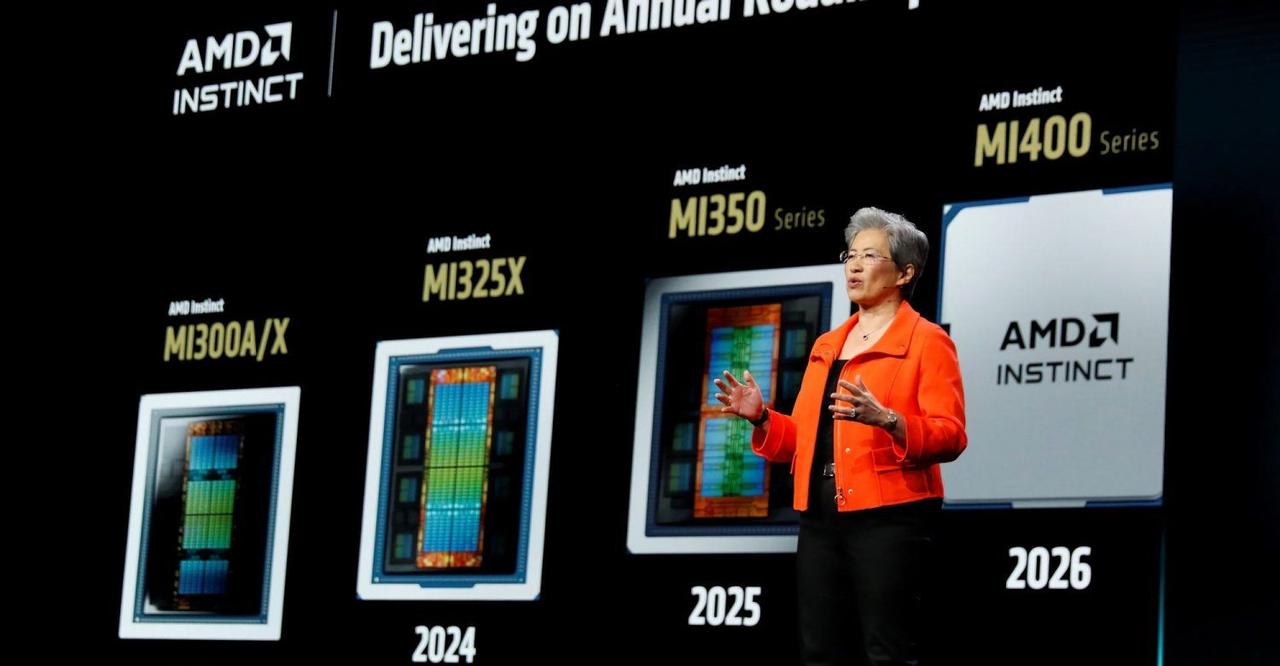
Compute chiplets of AMD's next-generation Instinct MI450-series accelerators based on the CDNA 5 architecture set to be introduced in the second half of next year will be made on TSMC's N2 (2nm-class) fabrication technology, marking the first time the company will use a leading-edge manufacturing
[2]
AMD taps TSMC's 2nm node to challenge Nvidia in next-gen AI compute
Serving tech enthusiasts for over 25 years. TechSpot means tech analysis and advice you can trust. What we know so far: AMD's new Instinct MI450 is a statement of intent. Built on the cutting-edge 2nm process and backed by a major partnership with OpenAI, the accelerator signals a turning point
[3]
Can AMD's 2nm AI chip finally challenge Nvidia's dominance?
AMD's 72-GPU Helios rack with MI450s will feature 51 TB of HBM4 memory significantly more than the 21 TB planned for Nvidia's competing Rubin system. AMD announced its next-generation Instinct MI450 AI accelerators, based on the CDNA 5 architecture, will be manufactured using TSMC's 2nm process
[4]
AMD's Lisa Su confirms next-gen GPUs are 2nm, beating NVIDIA's upcoming Vera Rubin
TL;DR: AMD will launch its next-generation MI450 AI accelerator in 2026 using advanced 2nm silicon technology, surpassing NVIDIA's upcoming 3nm Vera Rubin GPU. This smaller process promises improved efficiency and performance, strengthening AMD's competitive position in AI hardware amid its
Share
Copy Link
AMD announces its upcoming Instinct MI450 AI accelerators will use TSMC's 2nm process, potentially outpacing Nvidia's next-gen 3nm GPUs. This technological advancement, coupled with a major partnership with OpenAI, signals AMD's strong push into the AI hardware market.
AMD's Technological Leap with 2nm AI Accelerators
AMD is set to make a significant technological advancement in the AI hardware market with its upcoming Instinct MI450 series accelerators. In a recent interview, AMD CEO Lisa Su confirmed that the compute chiplets of these next-generation AI GPUs will be manufactured using TSMC's N2 (2nm-class) fabrication technology
1
. This marks the first time AMD will utilize a leading-edge manufacturing process for its AI GPUs, potentially giving the company a competitive edge over its rival Nvidia.
Source: TweakTown
Performance and Efficiency Gains
TSMC's N2 process promises substantial improvements over its predecessors. These include a 10% to 15% performance boost at the same power or complexity, a 25% to 30% power reduction at the same frequency, and a 15% increase in transistor density compared to the N3E process
1
. The use of gate-all-around (GAA) transistors enables developers to optimize designs for maximum efficiency through design and technology co-optimization (DTCO).Hybrid Architecture and Memory Advantages
While the core compute die will use the 2nm process, AMD is adopting a hybrid approach for the MI450. The Active Interposer Die (AID) and Media Interface Die (MID) will utilize TSMC's refined 3nm node
2
. This layered architecture aims to optimize each segment of the GPU design for its specific computational role, addressing the demands of AI workloads that require massive parallel processing and efficient data movement at scale.
Source: Tom's Hardware
Comparison with Nvidia's Next-Gen GPUs
AMD's move to 2nm technology puts pressure on Nvidia, whose next-generation Rubin GPUs are expected to use one of TSMC's N3 technologies
3
. In terms of memory capabilities, AMD's 72-GPU Helios rack with MI450s will feature 51 TB of HBM4 memory and 1,400 TB/s of memory bandwidth, significantly surpassing the 21 TB and 936 TB/s planned for Nvidia's competing Rubin system3
.Strategic Partnership with OpenAI
AMD's technological advancements are complemented by a major partnership with OpenAI. The collaboration involves a "six gigawatt" deployment expected to generate tens of billions of dollars in revenue over the next several years
2
. This deal positions OpenAI as a lead customer for the MI450 generation, validating AMD's investments in AI architectures and data center solutions.Related Stories


Industry Implications and Challenges
The scale of AMD's AI infrastructure development highlights the growing demands of the AI industry. Su emphasized the need for collaboration across the ecosystem, including chipmakers, cloud providers, government, and enterprise, to scale AI deployments effectively
2
. The success of these next-generation AI accelerators will depend not only on raw performance metrics but also on factors such as energy efficiency, scalability, and software ecosystem support.Looking Ahead
With the Instinct MI450 series scheduled for introduction in the second half of 2026, AMD is positioning itself as a formidable competitor in the AI hardware market
4
. The combination of advanced 2nm technology, strategic partnerships, and innovative GPU design could potentially challenge Nvidia's current dominance in the AI accelerator space. As the race to power increasingly complex AI models intensifies, the industry eagerly awaits the real-world performance and adoption of these next-generation AI GPUs.🟡 chivalry=🟡'', 'References
Summarized by

Navi
[1]
Related Stories
Recent Highlights
1
Microsoft and Nvidia Launch Surface Laptop Ultra: A $2,599 AI-Ready PC With RTX Spark Chip
Technology

2
Meta Muse AI Agent Surges to 6.6M Downloads Despite Privacy and Security Controversies
Technology

3
Scientists Build AI Model That Reconstructs Images From Brain Scans in Record Time
Science and Research

Recent Highlights
Today's Top Stories











Don’t drown in AI news. We cut through the noise - filtering, ranking and summarizing the most important AI news, breakthroughs and research daily. Follow topics that matter to you and stay ahead.


