AMD's RDNA 4 GPUs to Support ROCm: Balancing Gaming and AI Capabilities


3 Sources
[1]
AMD VP teases RDNA 4 compatibility with ROCm, but doesn't reveal official launch date
Yesterday, it was reported that AMD's RDNA 4 GPUs will not get ROCm support at launch. Unsurprisingly, this upset many developers who were planning to upgrade their setups and hoped for a seamless transition. However, ROCm support might not be far behind the launch, as AMD's Vice President of AI
[2]
AMD's software stack remains a weak spot -- ROCm won't support RDNA 4 at launch
AMD's upcoming RDNA 4 consumer graphics cards will not get official ROCm support at launch. According to Phoronix, AMD answered a question during its press briefing stating that ROCm support would not arrive for RDNA 4 until sometime after launch day. AMD has since not clarified what the timeline
[3]
AMD's RX 9070 Series GPUs Will Feature Support For ROCm; Team Red Shows A Running Sample As Well
AMD's RX 9070 series GPUs will feature support for Team Red's ROCm software stack, as confirmed by a company's official through a post on X. Well, AMD did finally unveil its RDNA 4 GPU lineup yesterday, and while the announced SKUs did bring a lot to the gaming market, however, it was presumed
Share
Copy Link
AMD confirms ROCm support for upcoming RDNA 4 GPUs, addressing concerns about AI workload capabilities and competing with NVIDIA's CUDA platform.

AMD Confirms ROCm Support for RDNA 4 GPUs
AMD has officially confirmed that its upcoming RDNA 4 GPUs, specifically the RX 9070 series, will support the company's ROCm (Radeon Open Compute) software stack. This announcement comes after initial reports suggested that ROCm support might not be available at launch, causing concern among developers and AI enthusiasts
1
2
.ROCm Compatibility and Its Importance
ROCm is AMD's open-source software stack for GPU programming, enabling graphics cards to be used for high-performance computing (HPC) and AI applications. It's AMD's answer to NVIDIA's CUDA platform, which has been a significant driver of NVIDIA's success in the AI and data center markets
1
.Anush Elangovan, AMD's Vice President of AI Software, demonstrated a potential RX 9070 series GPU running in a dedicated ROCm environment, stating that RDNA 4 is "ROCm'ing on just fine"
1
. This development is crucial for AMD as it seeks to compete with NVIDIA in the rapidly growing AI market.Historical Context and Challenges
AMD has faced criticism for its slow adoption of new ROCm features and limited support for mainstream hardware. Currently, official ROCm support on Windows is limited to select RX 7000 and RX 6000 series GPUs, as well as the Radeon VII. Linux support is more extensive but still limited compared to NVIDIA's CUDA, which supports GPUs dating back to 2006
1
2
.Related Stories

Market Implications
The confirmation of ROCm support for RDNA 4 GPUs is significant for AMD's competitive position:
-
AI Workload Capabilities: While the RX 9070 series may not be optimal for all AI tasks due to VRAM limitations, they offer sufficient capabilities for average consumers interested in edge AI applications
3
. -
Developer Attraction: Timely ROCm support could encourage more developers to consider AMD GPUs for AI and HPC workloads, potentially challenging NVIDIA's dominance.
-
Market Diversification: By balancing gaming performance with AI capabilities, AMD aims to cater to a broader range of users and use cases
3
.
Future Outlook
AMD's commitment to improving ROCm reflects the growing importance of AI in the consumer GPU market. The company is also looking to extend ROCm support to other products:
-
Strix Halo (Ryzen AI MAX 300 series): This upcoming product, with up to 128GB of unified memory, is tailored for LLM inference and development, potentially competing with Apple's M-series silicon
1
. -
Expanded Support: AMD has acknowledged user requests for extending full ROCm support to the 6000-series and Strix/Strix Halo mobile chips
2
.
As the AI industry continues to evolve, AMD's efforts to strengthen its software ecosystem alongside its hardware offerings will be crucial in determining its position in both the consumer and enterprise markets.
References
Summarized by

Navi
[1]
Related Stories
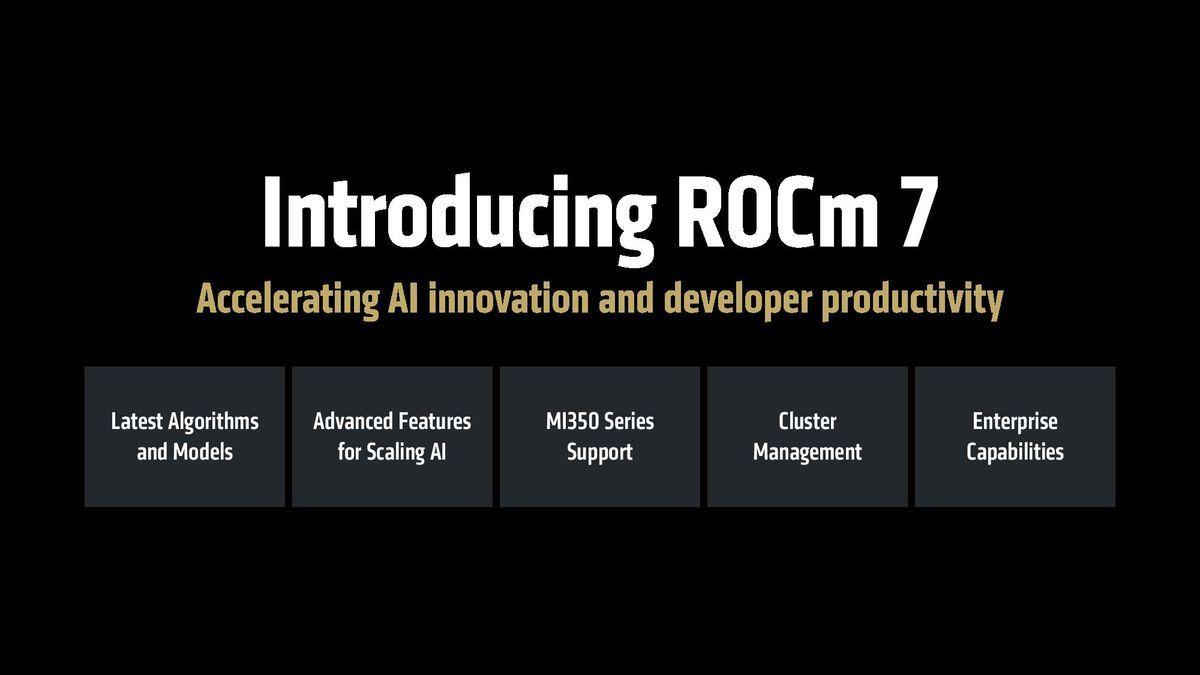
AMD Unveils ROCm 7: A Game-Changer for AI Performance and Accessibility
13 Jun 2025•Technology
AMD Unveils RDNA 4 Architecture and Radeon RX 9070 Series GPUs with AI-Powered FSR 4 at CES 2025
07 Jan 2025•Technology

AMD Quietly Expands AI GPU Portfolio with New Radeon Pro Models and China-Compliant Variants
28 Nov 2025•Technology

Recent Highlights



Recent Highlights
Today's Top Stories





Don’t drown in AI news. We cut through the noise - filtering, ranking and summarizing the most important AI news, breakthroughs and research daily. Follow topics that matter to you and stay ahead.


