An AI read 16 years of heart records. Its maker says it hasn't been shown to help yet


4 Sources
[1]
Dyania and NVIDIA partner to scale AI-driven clinical reasoning across health systems
Dyania Health today announced a collaboration with NVIDIA to put AI clinical reasoning to work inside health systems, on their own infrastructure, at the scale of their entire patient population. Dyania's Synapsis AI reads a patient's full medical record, across years of notes, operative reports,
[2]
How AI Is Helping Care Teams Get Patients the Right Care, Sooner
Health systems and startups are using the latest AI technologies to support clinicians, streamline workflows and improve patient care. From pediatric research to smart hospitals, AI is helping care teams spend less time on routine tasks and more time with patients. Health systems and startups are
[3]
Nvidia and Dyania bring AI chart review onto hospital servers
Dyania's Synapsis AI runs on the hospital's own Nvidia servers, so patient records never leave the building. Dyania Health's Synapsis AI reviewed the records of more than 7,800 Cleveland Clinic heart-valve patients, running on the hospital's own Nvidia servers. The data was used to build a model
[4]
Dyania Health Brings Clinical Reasoning AI Inside the Hospital Firewall to Advance Patient Care with NVIDIA | Newswise
Dyania's Synapsis AI, which reasons through a patient's complete medical history, uses NVIDIA accelerated computing, so health systems can learn from their own records while keeping patient records within their walls. Newswise -- JERSEY CITY, N.J., Nov. 13, 2026 -- Dyania Health today announced a
Share
Copy Link
Dyania Health and NVIDIA announced a collaboration to run the Synapsis AI clinical reasoning engine on hospital-owned infrastructure, keeping patient records in-house. Its first study, with Cleveland Clinic, predicts heart valve failure risk across 7,812 patients.
Dyania Health and Nvidia announced a collaboration on Nov. 13 to run Dyania's Synapsis AI clinical reasoning engine on hospital-owned Nvidia infrastructure, at the scale of a health system's entire patient population
4
1
. The companies say the goal is to let a health system learn from the full histories of patients it has already treated4
1
. That, they say, points to earlier identification of care needs4
1
.Synapsis reads the whole chart, covering written clinical records, imaging and pathology findings and lab results
2
3
4
. Its answers come with evidence traceable to their source in the chart2
3
4
. Clinicians review the output and make every decision2
3
. It runs on Nvidia accelerated computing inside the hospital's firewall, so records are processed onsite and, the companies say, never leave2
3
4
1
. The stack is Nvidia's end to end: Dyania trains its models with Nvidia NeMo and optimizes them with TensorRT2
4
1
.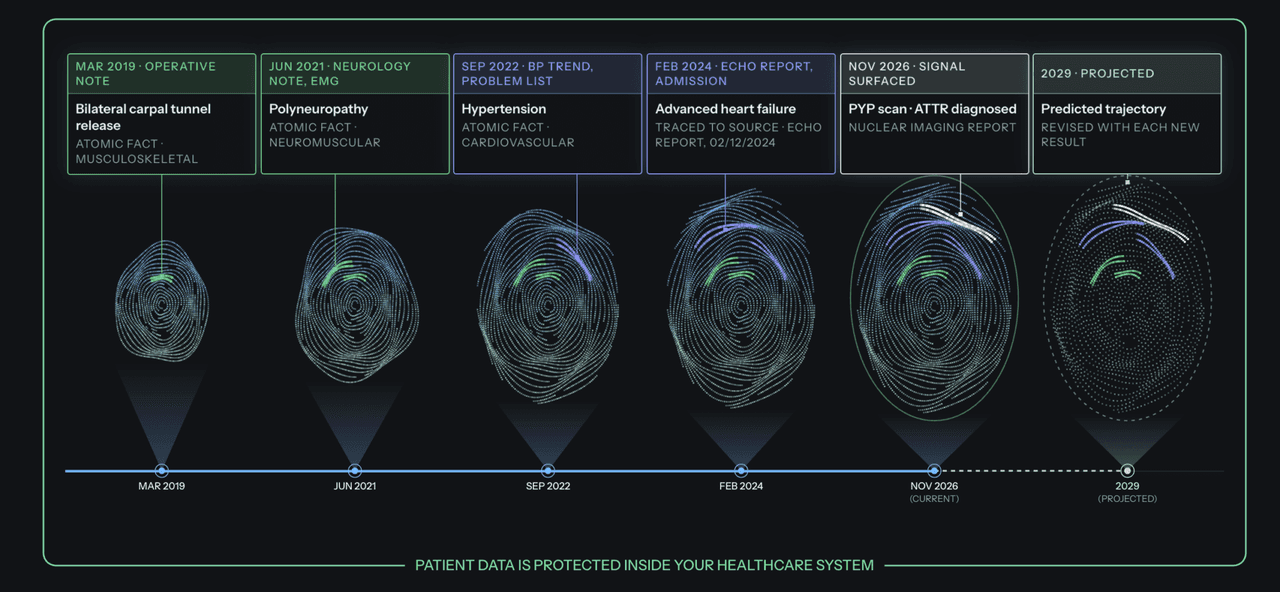
Source: NVIDIA
Much of what matters clinically sits in narrative notes that resist analysis at scale, which has made manual chart review a bottleneck for registries and outcomes studies
4
1
. The field is crowded, too. Google Cloud launched Gemini for healthcare the same week, and Bunkerhill raised $55 million for hospital AI agents3
. Proven gains for patients remain hard to find across hospital AI, and doctors have objected when claims run ahead of proof3
.The valve study
The collaboration's first work is a Cleveland Clinic study of 7,812 people given aortic valve replacements between 2005 and 2021, covering up to 16 years of follow-up care
4
1
. Most of that follow-up record sits in narrative text and ultrasound readings that registries struggle to capture4
1
. Synapsis answered 88 clinical questions per patient, covering valve characteristics, co-existing conditions, lab trends, medications and later clinical events3
4
1
. From those answers it built a model of valve failure and reintervention risk at three, five and ten years after surgery3
4
1
.In the model's findings, the kind of valve implanted mattered most for how quickly it deteriorated, and each follow-up ultrasound sharpens its outlook
4
1
. Nvidia said the same chart review done by hand would have taken clinicians years2
3
. The study was built around the question valve patients actually ask: how long will my replacement valve last, and will I need another operation4
1
.What the first study shows
In Schlosser's telling, the collaboration is a watershed moment: for the first time, she says, a health system can reason across every patient's full record at once rather than one chart at a time
4
. Dyania says the same approach could extend to finding clinical-trial-eligible patients, closing care gaps in heart and cancer care, and filling registries2
4
. The companies also plan joint case studies and are evaluating Nvidia's Confidential Computing and Blackwell Ultra GPUs for near-real-time clinical insight4
1
.The study demonstrates that the tool can assemble a dataset and forecast risk
3
. Whether patients actually do better is untested3
. Cleveland Clinic, the study site, is also an investor in Dyania, an interest it disclosed last year3
. Outside validation, Dyania says, is still to come3
.
Source: News-Medical
Related Stories

References
Summarized by

Navi
[1]
[3]
Related Stories
Abridge and Nvidia build foundation model for clinical intelligence from real doctor visits
11 Jun 2026•Health

NVIDIA Forges Partnerships to Revolutionize Healthcare with AI
14 Jan 2025•Health

Nvidia and Microsoft Partner to Accelerate AI Innovation in Healthcare at HLTH Conference
22 Oct 2024•Technology

Recent Highlights


Recent Highlights
Today's Top Stories






Don’t drown in AI news. We cut through the noise - filtering, ranking and summarizing the most important AI news, breakthroughs and research daily. Follow topics that matter to you and stay ahead.


