OpenAI's agents can now buy things for you, if anyone lets them


19 Sources
[1]
ChatGPT's new Wallet lets AI agents shop and check out for you
ChatGPT can now shop for you. On Friday, OpenAI launched a new wallet feature that lets its agents, called dots, help you decide what to buy and then complete the purchase on your behalf. The option will initially be available to a limited number of U.S. ChatGPT Pro subscribers, ages 18 and up,
[2]
OpenAI launches ChatGPT Wallet, allowing its 'dots' AI agents to make purchases for users
* OpenAI announced ChatGPT Wallet, a new payment feature that enables its "dots" AI agents to make purchases on behalf of users. * ChatGPT Wallet will initially be available to OpenAI's Pro subscribers in the U.S. who are over 18 years old. * OpenAI built ChatGPT Wallet in partnership with
[3]
You can now tempt fate and give your banking information to ChatGPT
The new Wallet feature will allow its AI agents to make purchases on your behalf. OpenAI just announced ChatGPT Wallet, a payment feature that enables its newly-released Dots AI agents to make purchases on behalf of users. Of course, that requires handing over your payment information to a
[4]
OpenAI wants ChatGPT Wallet to be 'safe and easy to use' for agents
ChatGPT Wallet starts with US Pro subscribers and was built with Amex, Mastercard and Visa. OpenAI warns some websites and fraud systems may still block agent purchases. OpenAI has launched ChatGPT Wallet, which lets its dots AI agents buy things for users without seeing their card details. The
[5]

ChatGPT Is Ready to Reach Into Your Wallet
ChatGPT wants your credit card. On Friday, OpenAI announced ChatGPT Wallet, a new feature that will allow the company's AI agent "dots" to make purchases on a user's behalf -- which is something that neither businesses nor consumers seem particularly excited about. According to OpenAI, ChatGPT
[6]

OpenAI rolls out ChatGPT Wallet to let Dots AI agents make purchases
The move comes as some retailers and service providers ban AI agents from their platforms. OpenAI's Dots personal AI agents are gaining the ability to shop, with the launch of ChatGPT Wallet today. The digital wallet substitutes a payment token for a user's credit card details and lets its Dot
[7]

ChatGPT Wallet is here, and it wants your AI agent to go shopping on your behalf
Your AI agent can now check out for you. It just never gets to see your card. Just over a month ago, OpenAI launched dots, autonomous AI agents powered by its new GPT-6 Astra model. The whole idea is to offload step-by-step tasks and let users get chores done by having the AI agents perform them
[8]

OpenAI is launching a payment wallet for AI agents to shop
The wallet, built with American Express, Mastercard and Visa, is open to U.S. ChatGPT Pro subscribers and requires a security check per purchase OpenAI is launching ChatGPT Wallet, a payment tool that lets its AI agents buy items for users with a card saved in the app. The feature is available to
[9]

ETtech Explainer: How OpenAI's ChatGPT Wallet allows AI agents to make payments for users
Many people until now used ChatGPT to research products, compare options and decide what to purchase. But with the new feature, OpenAI wants these users to complete the purchase process through their AI agents as well. OpenAI has introduced ChatGPT Wallet, a new feature that will allow its AI
[10]

OpenAI launches ChatGPT Wallet
This content has been selected, created and edited by the Finextra editorial team based upon its relevance and interest to our community. Built in partnership with American Express, Mastercard and Visa, the wallet is initially available through the firm's dot, always-on agents for ChatGPT Pro
[11]
OpenAI launches ChatGPT Wallet, letting AI agents pay for purchases
OpenAI said on Friday it has launched ChatGPT Wallet, which lets AI agents pay for purchases without accessing users' card details, with a security check required for every transaction. Here are more details: * The wallet has been built in partnership with American Express, Mastercard and Visa,
[12]

OpenAI introduces ChatGPT Wallet as it pushes further into AI-powered commerce By Investing.com
Investing.com -- OpenAI is taking another step toward turning ChatGPT into a platform that can act on users' behalf, introducing ChatGPT Wallet, a new payment feature designed to let AI agents complete purchases with user authorization. Announced Friday, the wallet is being developed with major
[13]

ChatGPT Launches Wallet Feature Allowing Users to Pay With Agents
ChatGPT has launched a payment feature that lets users pay with an artificial-intelligence agent. Users can add a debit or credit card to ChatGPT Wallet, which can then be used for payments without the need to re-enter card information. Before each purchase, the customer reviews the purchase and
[14]
OpenAI launches ChatGPT Wallet, letting AI agents pay for purchases
Nov 13 (Reuters) - OpenAI said on Friday it has launched ChatGPT Wallet, which lets AI agents pay for purchases without accessing users' card details, with a security check required for every transaction. Here are more details: o The wallet has been built in partnership with American Express,
[15]

ChatGPT Wallet lets OpenAI's Dots agents make purchases for you
After launching its Dots AI agents platform earlier this year, OpenAI is launching a wallet for the agents. ChatGPT Wallet is rolling out starting today for ChatGPT Pro subscribers in the US aged 18 and older using a US billing address and "eligible US-issued American Express, Chase, Mastercard and
[16]

OpenAI launches ChatGPT Wallet to have AI shop for you
OpenAI has launched ChatGPT Wallet in hopes of popularizing AI agents making purchases. Credit: Contributor/VCG via Getty Images Would you trust an AI agent to make purchases online on your behalf? AI companies are hoping you will. However, many e-commerce and financial service companies are
[17]

OpenAI Launches ChatGPT Wallet for AI Agent Payments
OpenAI's new payment wallet lets AI agents complete purchases using existing card networks, with plans to eventually allow preauthorized transactions. OpenAI on Friday introduced a new feature allowing AI agents to make purchases on behalf of users directly within ChatGPT through existing payment
[18]

OpenAI Enters AI Payments Market With ChatGPT Wallet
OpenAI has launched ChatGPT Wallet, allowing AI agents to prepare and complete online purchases with user approval. The feature uses payment tokens to protect card details and initially targets eligible ChatGPT Pro subscribers in the United States. OpenAI wants ChatGPT to do more than find
[19]

OpenAI Gives AI Agents a Wallet While Blocking Them From Seeing the Card | PYMNTS.com
ChatGPT Wallet will initially be available through OpenAI's personal AI agents, dots, for ChatGPT Pro subscribers aged 18 years and older in the United States with eligible U.S.-issued cards, according to the release. OpenAI built ChatGPT Wallet in partnership with American Express, Mastercard and
Share
Copy Link
OpenAI launched ChatGPT Wallet on Friday, letting its AI agents complete purchases for users. Merchants are blocking agents, and trust in AI payments is low.
OpenAI announced ChatGPT Wallet on Friday, a feature that lets its AI agents complete real purchases on a user's behalf
2
. It moves the company's agents from researching and recommending products to actually paying for them, which is the step the whole idea of agentic shopping has been missing2
.
Source: Engadget
OpenAI built the wallet with American Express, Mastercard and Visa, and purchases keep the card's existing rewards and dispute protections
8
. At launch it is available only to US ChatGPT Pro subscribers aged 18 and up with a US-issued eligible card. OpenAI says the narrow rollout is deliberate so it can learn from early use4
.How a purchase actually works
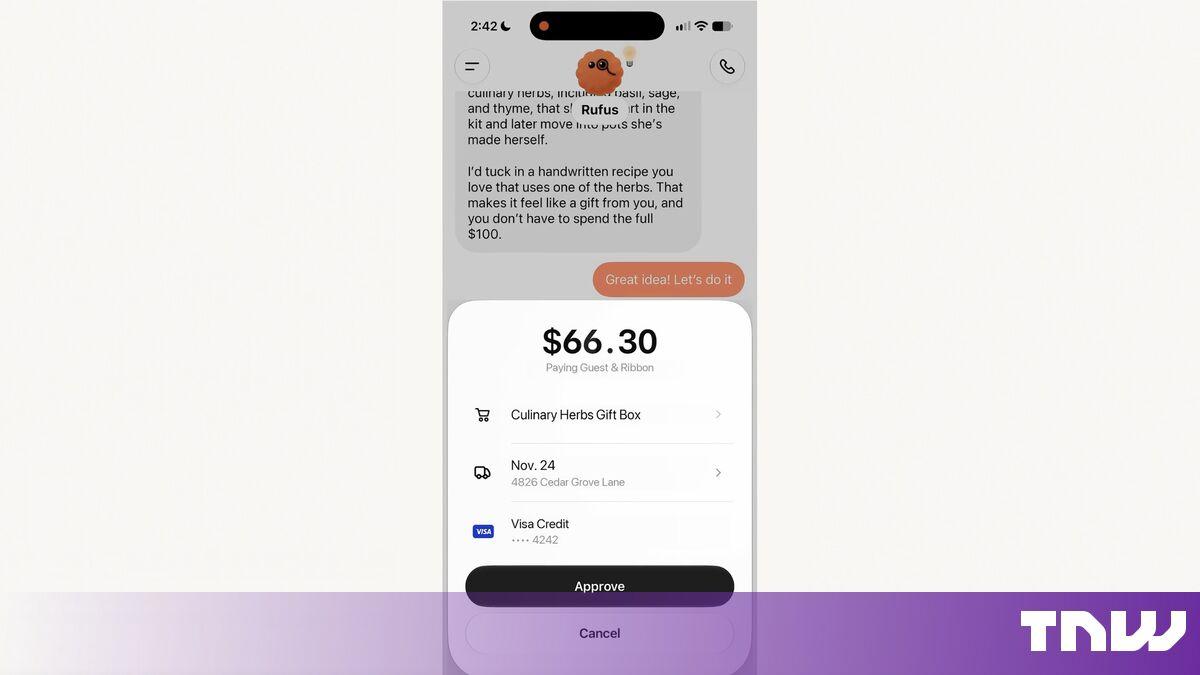
The user adds a card once. For each purchase, OpenAI's agent shows the items, the total and the card it plans to use. Every approval leaves a record of what was authorized
7
.
Source: The Next Web
OpenAI says the agent never sees the real card number. Once the user approves, the payment network issues a token, a one-off card number, security code and expiry for that transaction, which stands in for the actual card
1
. OpenAI is not taking a cut of transactions at launch; purchases could become a revenue stream later3
.OpenAI's second try at shopping
The dots agents themselves only arrived in late September at OpenAI's developer conference, so the wallet is a fast follow-on
2
. It is also at least OpenAI's second attempt at agentic shopping. Instant Checkout launched in autumn 2025 and was quickly abandoned; a March 2026 shopping effort was retired, per Quartz8
. Meta's Muse, which has more than 10 million users and counts AI-assisted shopping among its top activities, got there first1
.What OpenAI brings is distribution: ChatGPT had more than 1.2 billion weekly users and nearly 100 million paying subscribers as of the end of Q3
10
.
Source: ET
Related Stories

The market isn't asking for it
The bigger obstacle for OpenAI is that many of the places people actually shop have locked agents out. Amazon does not allow agent purchases on its marketplace, Delta bans them, and Schwab and JPMorgan block agents from moving customer money
2
. Amazon blocked Meta's Muse last month, per GeekWire6
.Trust is the other gap for OpenAI, and it is measurable. Visa research found only about 23% of Americans trust AI with payments on their behalf
10
. The only hard demand numbers so far are tiny. Uber reported four rides and 500 Uber Eats orders from agents in one week in late October, out of about 320 million rides and deliveries1
. And the agents themselves may not be up to the job. Visa tested 22 AI models as shoppers this month and they failed 42.8% of realistic test runs4
.OpenAI is building the merchant side in parallel. It published a Commerce Partner Playbook, including advice on how to avoid accidentally blocking its agents. It is also working with fraud firms including Forter, Riskified, Sardine and Signifyd, plus payment providers Adyen, Checkout.com and Stripe
1
. The company itself warns that some sites may block agent purchases unintentionally and that fraud systems may flag legitimate ones10
. It also launched Businesses in ChatGPT, a beta opened Tuesday where companies can claim verified profiles and post product feeds8
.Not everyone is impressed by the mechanics. OpenAI calls it the first wallet that lets an agent pay without ever handling the real card details. Gizmodo pushes back on that claim: tokenization and rewards retention are standard in wallets like Apple's and Google's already
5
.The launch, then, is the easy part. Whether agents get to buy anything depends on merchants lifting their blocks and on people trusting an AI with a credit card. On current evidence, neither is happening yet. "To deliver on the promise of agentic commerce, consumers, businesses and banks all need to trust the process," said Rubail Birwadker of Visa
10
.References
Summarized by

Navi
[5]
Related Stories
Visa and OpenAI partner to enable AI payments through ChatGPT at 175 million merchant locations
10 Jun 2026•Technology

OpenAI Revolutionizes E-commerce with ChatGPT's New 'Instant Checkout' Feature
29 Sept 2025•Technology
Visa and Mastercard Unveil AI-Powered Shopping, Revolutionizing E-Commerce
30 Apr 2025•Technology
Recent Highlights



Recent Highlights
Today's Top Stories





Don’t drown in AI news. We cut through the noise - filtering, ranking and summarizing the most important AI news, breakthroughs and research daily. Follow topics that matter to you and stay ahead.


