Anduril raises $5 billion, doubles valuation to $61 billion as defense tech spending surges


3 Sources
[1]
Anduril Raises $5 Billion in Funding and Is Valued at $61 Billion
Anduril, the defense tech company that makes artificial-intelligence-backed weapons, said on Wednesday that it had raised $5 billion in new funding, as modernizing the U.S. military has become a priority for the Trump administration. The financing values Anduril at $61 billion, double the $30.5
[2]
Anduril lands $5B as defense giant builds autonomous warship operation in Seattle
Anduril Industries announced a massive $5 billion funding round Wednesday as the fast-growing defense tech startup ramps up investments in manufacturing and autonomous military systems -- including a quietly expanding maritime operation in Seattle. As GeekWire reported last month, Anduril
[3]
Anduril doubles valuation to $61B in new $5B funding round - SiliconANGLE
A year after closing its previous multibillion-dollar funding round, Anduril Industries Inc. today announced that it has raised another $5 billion at a $61 billion valuation. The Series H deal was jointly led by Thrive Capital and Andreessen Horowitz. Anduril makes defense equipment such as
Share
Copy Link
Anduril Industries closed a $5 billion Series H funding round, doubling its valuation to $61 billion from $30.5 billion just ten months ago. The defense tech company, founded by Palmer Luckey, develops AI-backed weapons and autonomous systems for the U.S. military. Revenue doubled to $2.2 billion in 2025 as the firm expands manufacturing operations in Ohio and Seattle.
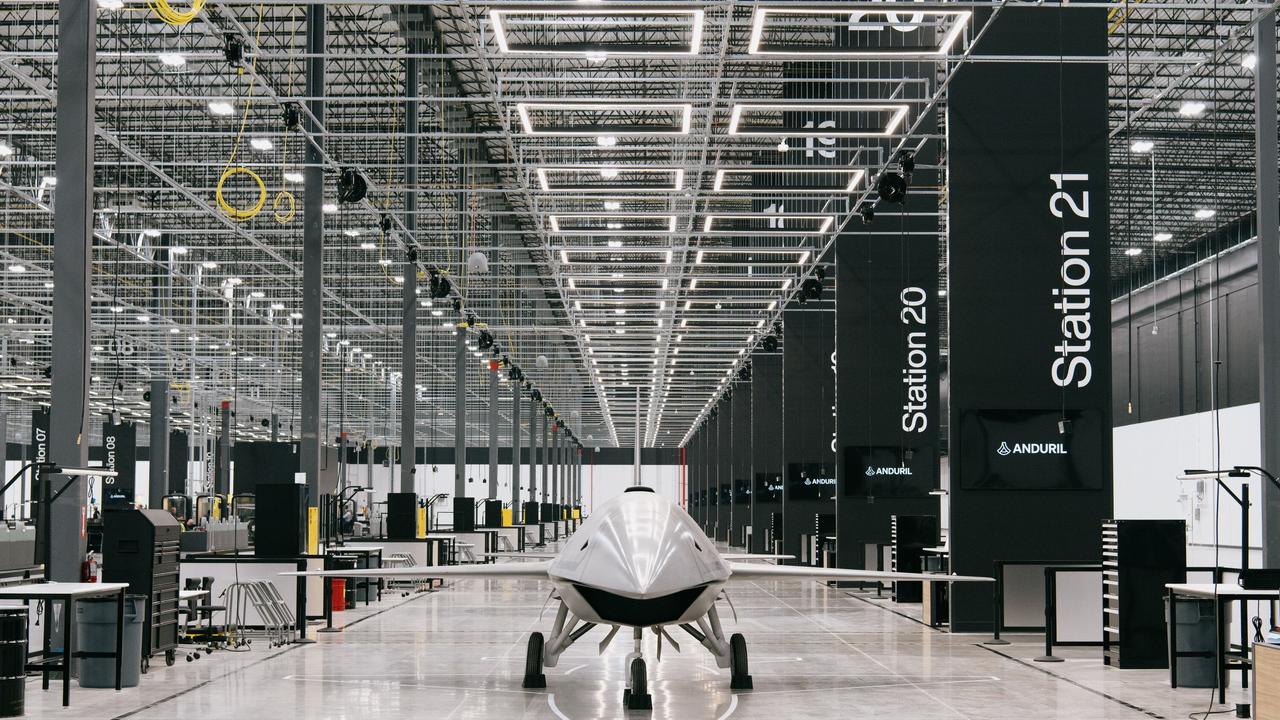
Anduril secures $5 billion in Series H funding
Anduril Industries announced a massive $5 billion Series H funding round on Wednesday, propelling the defense tech company's valuation to $61 billion—exactly double the $30.5 billion valuation it achieved just ten months earlier in June 2025
1
. The financing was jointly led by longtime investors Thrive Capital and Andreessen Horowitz, with participation from Founders Fund and Lux Capital1
. This latest investment brings Anduril's total raised capital to $6.82 billion across eight funding rounds, cementing its position as one of the most valuable private defense companies globally1
.Founded in 2017 by Palmer Luckey, the creator of Oculus VR, Anduril Industries has rapidly transformed from a border surveillance software provider into a comprehensive defense equipment manufacturer
1
2
. The Costa Mesa, California-based company now produces autonomous submarines, weaponized drones, augmented reality helmets, and missile engines1
3
.Revenue doubles to $2.2 billion as contracts expand
In a letter accompanying the funding announcement, CEO Brian Schimpf revealed that Anduril more than doubled its revenue to $2.2 billion in 2025
1
3
. This explosive growth reflects the company's success in securing major government contracts. In March, Anduril signed a 10-year, $20 billion deal with the U.S. Army for software and AI-backed weapons1
. That same month, the company announced participation in a consortium building a $185 billion space-interceptor missile system for the U.S. government, known as Golden Dome1
.Schimpf noted that the company "nearly doubled our work force, won and delivered on our first international program of record to the Royal Australian Navy and demonstrated autonomous flight on an Air Force unmanned combat aircraft program"
1
. When Russia invaded Ukraine in 2022, Anduril began testing AI-backed drones on the battlefield, accelerating development of its pilotless aircraft portfolio1
.Expanding manufacturing capacity across multiple states
Anduril is aggressively investing in manufacturing capacity to meet surging demand for autonomous systems. The company opened Arsenal-1, a $900 million to $1 billion factory in Ohio with more than 5 million square feet of production space—one of the largest industrial facilities in the state
1
3
. The Arsenal-1 plant is designed to accelerate production of weapons systems and represents what the company calls "the future of American defense manufacturing"2
.In Seattle, Anduril has quietly established autonomous warship operations at the historic Foss Maritime shipyard along the Lake Washington Ship Canal
2
. According to a November 2025 press release, this Seattle facility will serve as the U.S. hub for vessel assembly, integration and testing of Autonomous Surface Vessels as part of the U.S. Navy's Modular Attack Surface Craft program2
.Related Stories

AI and software platforms power modern warfare systems
Beyond hardware, Anduril develops sophisticated software platforms that integrate artificial intelligence into modern warfare. Its flagship product, Lattice, visualizes data from thousands of sensors in real-time maps while built-in AI models analyze information to generate decision recommendations
3
. The system relies on Lattice Mesh, a secure mesh network that encrypts transmissions and prioritizes critical traffic when bandwidth is limited3
.The company also produces ruggedized network devices under the Voyager brand, ranging from backpack-sized units to vehicle-mounted systems and compact servers designed for field deployment
3
. Its newest product line includes EagleEye augmented reality headsets that overlay sensor data onto the wearer's field of view and include radio signal detection capabilities3
.Defense tech funding boom reshapes industry landscape
Schimpf emphasized that "when Anduril launched in 2017, defense attracted little venture investment," but investors now increasingly recognize "the scale of the technological and industrial challenges facing the United States and its allies"
2
. The Pacific Northwest is emerging as a strategic hub for next-generation defense technologies, with companies like Armada, Overland AI, and Echodyne benefiting from what has been described as a defense tech funding boom2
.Anduril's meteoric rise signals a broader shift in how the U.S. approaches military modernization. "The convergence of artificial intelligence, autonomy and advanced sensing is reshaping warfare," Schimpf stated
1
. With speculation mounting about a potential public offering in the next year, the company's trajectory will test whether Silicon Valley-style innovation can successfully transform traditional defense contracting1
. As Anduril scales production and expands internationally, the defense industry watches closely to see if resilient production systems and scalable autonomous technologies can deliver on promises to remake American national defense.References
Summarized by

Navi
Related Stories
Anduril pursues $100B valuation funding round, tripling value in months as defense tech surges
24 Jul 2026•Business and Economy

Anduril's $28 Billion Valuation: AI Defense Tech Startup Nears Massive Funding Round
09 Feb 2025•Business and Economy

US Army awards Anduril $20 billion contract to deploy AI-driven counter-drone systems
15 Mar 2026•Technology

Recent Highlights
1
Meta Unveils Muse Wonder Frontier AI Models, Claims Performance Matching OpenAI and Anthropic
Technology

2
IMF Report Warns AI Market Correction Could Spark Global Financial Crisis With $1.4T at Risk
Business and Economy

3
OpenAI Releases 722 AI-Generated Math Solutions, Triggering Existential Crisis in Mathematics
Technology

Recent Highlights
Today's Top Stories








Don’t drown in AI news. We cut through the noise - filtering, ranking and summarizing the most important AI news, breakthroughs and research daily. Follow topics that matter to you and stay ahead.


