5 Sources
5 Sources
[1]
Shield AI, a Start-Up Making Military Drones, Raises $2 Billion
The company, which develops autonomous military technology, also plans to buy a maker of simulation software as interest in next-generation defense soars. Artificial intelligence, autonomous drones and other technologies have transformed battlefields in hot spots like Ukraine and Iran. A tech-driven arms race to develop the tools has put next-generation defense contractors in high demand. Among them is Shield AI, which plans to announce on Thursday that it has raised $2 billion, with some of the proceeds going toward buying Aechelon Technology, a smaller defense-tech start-up specializing in simulation software. The new capital will value Shield AI at about $12.7 billion, more than double the level it achieved in a fund-raising round a year ago. Shield AI's latest money-raising effort underscores the interest in defense technology in Silicon Valley and beyond as investors rush to buy in. "A.I. plus autonomy is changing the game in the military," Gary Steele, a former Cisco executive who is now Shield AI's chief executive, said in an interview. He added, "The capabilities that we can deliver, the cost curve that we can deliver, is fundamentally different than in the past." The role of A.I. in military applications has drawn scrutiny, especially during the Pentagon's dispute with Anthropic, which said it did not want its A.I. used for mass surveillance of Americans or for autonomous lethal weapons. Mr. Steele and Doug Philippone, a Shield AI board member, say their company follows the Defense Department's rules about A.I. use, and Mr. Philippone said he personally favored ensuring that humans could make the final call.
[2]
Shield AI raises $2B at $12.7B for autonomous combat pilot Hivemind
Shield AI, the San Diego defence technology company behind the autonomous pilot system Hivemind, announced on Wednesday that it has raised $2 billion in combined funding at a $12.7 billion valuation. The company will use part of the proceeds to acquire Aechelon Technology, a simulation platform that supports the Pentagon's Joint Simulation Environment. The raise comprises two pieces: a $1.5 billion Series G led by Advent International and co-led by JPMorgan Chase's Security and Resiliency Initiative, and $500 million in preferred equity from funds managed by Blackstone, which also committed an additional $250 million in a delayed-draw facility. Advent's chairman, David Mussafer, will join Shield AI's board of directors, and JPMorgan's Todd Combs will join as a board observer. The valuation represents a sharp acceleration. Shield AI was valued at $5.3 billion as recently as March 2025, when it closed a $240 million F-1 round with strategic participation from L3Harris and Hanwha Asset Management. Before that, it raised $200 million at $2.7 billion in October 2023. In roughly two and a half years, the company's valuation has grown nearly fivefold. Shield AI was founded in 2015 by brothers Brandon and Ryan Tseng and Andrew Reiter. Brandon Tseng is a former Navy SEAL, and the company's origin story is rooted in a specific operational problem: how to conduct reconnaissance and strikes in environments where GPS is jammed or unavailable and communications are severed, conditions the military designates as DDIL (disconnected, degraded, intermittent, or low-bandwidth). The company's answer is Hivemind, an AI pilot that operates aircraft autonomously using onboard sensors and reasoning rather than relying on external navigation signals. Shield AI's Nova quadcopter, powered by an early version of Hivemind, became what The Wall Street Journal described as the first autonomous robot of its kind used in combat when it was deployed with US special operations forces in the Middle East in 2018. Since then, the system has expanded to larger platforms. Shield AI's V-BAT reconnaissance drone, powered by Hivemind, has logged more than 130 sorties in Ukraine since June 2024, operating in conditions of pervasive electronic warfare. Ukrainian forces used the V-BAT to locate a Russian SA-11 Buk-M1 mobile air defence system, a task that required the drone to navigate without GPS in a heavily jammed environment. Hivemind has also been tested on modified F-16 fighter jets as part of DARPA's autonomous dogfighting experiments, and in a separate demonstration it successfully flew Anduril's Fury drone, one of the US Air Force's next-generation uncrewed combat aircraft contenders. Shield AI unveiled the X-BAT in October 2025: a VTOL stealth fighter drone that requires no runway, can be deployed from ships, and is piloted entirely by Hivemind. The company has said its first vertical takeoff flight is scheduled for this year, with operational deployment estimated for 2028. The X-BAT represents Shield AI's move from reconnaissance into strike capability, a significant expansion of the company's addressable market and a direct challenge to larger competitors. The Aechelon acquisition fits into this trajectory. Aechelon builds high-fidelity simulation environments used by the US military and allied forces to train pilots and test autonomous systems before live flights. Its platform supports the Pentagon's Joint Simulation Environment, which is used to evaluate next-generation aircraft and weapons systems. For Shield AI, Aechelon provides the synthetic training data that Hivemind needs to improve across new aircraft types and mission profiles without the cost and risk of live flight testing. Shield AI has described the combination as a "Hivemind Foundation Model for Defence," a domain-specific AI model that integrates simulation data with real-world operational data. Shield AI's raise arrives amid record capital flows into defence technology. Venture capital deals in the sector reached $49.1 billion in 2025, according to PitchBook, nearly double the $27.2 billion recorded the previous year. The largest rounds have gone to a small group of companies building autonomous and AI-powered military systems. Anduril, Shield AI's most direct competitor, raised $2.5 billion at a $30.5 billion valuation in June 2025 and was reported in March 2026 to be pursuing a $4 billion round at a $60 billion valuation. Helsing, the European defence AI company, has also raised at multibillion-dollar valuations. The spending is driven by a combination of factors that have aligned with unusual force: the war in Ukraine, which has demonstrated the decisive role of autonomous systems and electronic warfare in modern combat; growing tensions in the Pacific, which have accelerated procurement of long-range autonomous platforms; and a bipartisan political consensus in the United States that defence modernisation requires working with technology startups, not just legacy contractors. NATO's DIANA initiative, which brings together universities, industry, and governments to work with startups on defence capabilities across more than 200 accelerator sites, is one institutional expression of this shift. The question for Shield AI, and for the sector more broadly, is whether these valuations reflect genuine revenue trajectories or the kind of speculative enthusiasm that has historically accompanied defence procurement cycles. Shield AI has combat-proven technology, a clear operational track record in Ukraine, and contracts with the US Department of Defense. It also has a valuation that has grown from $2.7 billion to $12.7 billion in two and a half years, during a period when the company has been primarily a research and development operation building toward production-scale deployment. Advent International's willingness to lead a $1.5 billion round suggests confidence that the production phase is imminent. Whether the X-BAT delivers on its 2028 timeline, and whether Hivemind can scale across the range of platforms Shield AI has promised, will determine whether that confidence was warranted.
[3]
Shield AI projecting more than $540M in revenue this year as valuation more than doubles to $12.7 billion | Fortune
Global conflicts are awakening governments -- and investors -- to the importance of modernizing military forces, says Brandon Tseng, the cofounder and president of ShieldAI, a maker of AI-powered drones that announced Thursday that it had raised $1.5 billion in Series G funding at a $12.7 billion valuation. The new funding more than doubles the valuation of the San Diego, Calif. defense startup, which was founded in 2015 and was previously valued at $5.6 billion by investors. Shield AI is projecting more than 80% revenue growth by the end of 2026, Shield AI cofounder Brandon Tseng and CFO Kingsley Afemikhe told Fortune. That would equate to at least $540 million in revenue this year, based on Shield AI's 2025 revenue figures. "We don't expect growth to slow down," Tseng said in an interview. Shield's Series G round -- co-led by first-time investors Advent International and JPMorganChase's Security and Resiliency Initiative -- is happening in tandem with two major financial moves: the pending acquisition of the tactical simulation company Aechalon and a non-dilutive $500 million fixed return preferred equity financing deal with Blackstone. The infusion of capital will fund the acquisition, as well as help Shield scale its Hivemind autonomy platform and its V-BAT surveillance drone. The funds will also support the development of a new combat drone that is preparing for its first flight by the end of this year. The deal underscores how global conflict is reshaping venture priorities in Silicon Valley, as a crop of young companies including Anduril and Allen Control Systems produce new tech-driven products designed for a changing battlefield. Shield AI has gained traction from the deployment of its systems in Ukraine, where its V-BAT surveillance drone has been used in active operations. Tseng told Fortune that fundraising discussions began in November, prior to the U.S. military capturing Venezuelan President Nicolás Maduro or the recent strikes in Iran. Tseng says investor sentiment has shifted alongside "a broad observation" that the world has become less stable. "Countries around the world are modernizing their militaries, and obviously the U.S. has pushed for an increase in defense spend among all of its allies and partners," Tseng said. "That certainly is in the background as investors think about investing in defense." Tseng declined to say whether Shield AI's V-BAT drones have been deployed in Iran, but noted the company operates "in almost every single conflict zone." Advent Chairman David Mussafer is joining Shield AI's board as part of the funding deal, while investor Todd Combs, of JPMorgan Chase, will serve as a board observer. Aechelon cofounder and CEO Nacho Sanz-Pastor will continue to lead the business unit and oversee its integration with Hivemind, reporting to Shield AI CEO Gary Steele, according to Tseng. Shield's projection of more than 80% revenue this year does not include the acquisition of Aechelon. The final close of Shield AI's funding round will also be contingent on approval of the Aechelon acquisition. If the deal fails to clear regulatory hurdles, Tseng said the company would "re-evaluate" the financing with investors. Aechelon's platform, which is used across the autonomy sector to simulate battlefield environments and train AI machines, will remain open to other customers following the acquisition, Tseng said.
[4]
Defense startup Shield AI raises $2B, acquires flight simulation company Aechelon - SiliconANGLE
Defense startup Shield AI raises $2B, acquires flight simulation company Aechelon Shield AI Inc. today announced that it's raising a $2 billion funding round at a post-money valuation of $12.7 billion. Three quarters of the capital will be provided through a Series G round led by Advent International, a large private equity firm. The remaining $500 million will come from Blackstone in the form of preferred equity financing. That's a type of transaction in which the investor receives shares and an annual dividend. According to Shield AI, Blackstone will also provide it with a $250 million loan. The defense startup will use some of the proceeds to finance a newly announced acquisition. Shield AI is buying Aechelon Technology Inc., a provider of flight simulation software and data storage systems. The terms of the deal were not disclosed. San Diego-based Shield AI makes hardware and software for the defense sector. One of its flagship products is a drone called the V-Bat (pictured) that takes off vertically like a helicopter and then flies like a plane. Shield AI is also developing a second, significantly larger aircraft called the X-Bat that can cover up to 2,3000 miles per flight. Both drones are powered by an artificial intelligence platform called Hivemind. According to Shield AI, it's optimized to run autonomous flight algorithms and enables the host system to operate without GPS access. Hivemind is built on a middleware engine called EdgeOS that manages low-level tasks such as moving data between software modules. EdgeOS has a deterministic design, which means that it ensures calculations are always carried out within a specific time frame. That prevents unexpected processing delays from slowing down the host system at key moments. Hivemind also includes certain other tools. There's a CI/CD, or continuous integration and continuous delivery, module that helps programmers test AI models before installing them on a drone. It also eases certain related development tasks. Aechelon, the company that Shield AI is acquiring, provides flight simulation software geared towards the defense sector. Its applications generate synthetic aerial footage designed to simulate a pilot's field of view. Aechelon says that its synthetic footage can incorporate weather simulations, radar measurements and infrared data. The company's software can be used to train not only pilots but also autonomous flight algorithms. Hivemind, Shield AI's aircraft operating system, includes a module called Pilot that helps customers implement autonomous flight features. It includes pre-packaged software building blocks that remove the need for developers to create everything from scratch. Aechelon offers its flight simulation software alongside several other products. It sells a line of data storage systems called Nexus that includes an extensive set of cybersecurity features. Another product, Project Orbion, provides a virtual replica of the Earth that is based on satellite imagery and radar data.
[5]
Advent Co-Leads $1.5 Billion Investment In Shield AI
Private equity firm Advent International has signed an agreement to co-lead a $1.5 billion Series G funding round for defense technology company Shield AI. Advent plans to make a $1 billion investment into companies specializing in next-generation defense technologies. * Invesco QQQ Trust, Series 1 stock is facing resistance. What's driving QQQ stock lower? This investment values Shield AI at $12.7 billion and underscores Advent's commitment to companies at the forefront of AI-driven autonomous systems aimed at enhancing air operations and protecting service members, the company stated.. This strategic move aims to bolster its longstanding commitment to national security priorities by supporting firms developing critical technologies such as artificial intelligence and autonomous systems. "We are proud to bring to bear our experience of strategic defense investing and our global network across industry and government to support the next generation of defense technology companies at this critical moment," said Shonnel Malani, Advent's managing partner and global head of aerospace and defense. "We believe Shield AI represents the frontier of this transformation and we look forward to partnering with the company as it scales its vision of AI-driven autonomy, helping shape a future where intelligent systems can enhance resilience, protect service members, and redefine the nature of modern security," Malani added. The transaction with Shield AI is anticipated to conclude in the second quarter of 2026, pending customary regulatory approvals. Advent's investment strategy is focused on identifying and scaling innovative defense technologies vital for modern security needs. The company plans to target unique businesses that offer advanced capabilities, ensuring they are well-equipped to meet the demands of defense modernization. Advent has a solid track record in the defense sector, having allocated over $15 billion since 2020 to various companies, including Cobham, Ultra Electronics, Vantor and Attalon. Photo: Shutterstock This content was partially produced with the help of AI tools and was reviewed and published by Benzinga editors. Market News and Data brought to you by Benzinga APIs To add Benzinga News as your preferred source on Google, click here.
Share
Share
Copy Link
Shield AI announced $2 billion in funding at a $12.7 billion valuation, more than doubling its value from a year ago. The defense technology company will use proceeds to acquire Aechelon Technology, a simulation software maker, as it projects over $540 million in revenue for 2026. The raise underscores surging investor interest in autonomous systems and AI-powered drones for military modernization.
Shield AI announced on Thursday that it has raised $2 billion in combined funding at a $12.7 billion valuation, more than doubling the $5.3 billion valuation it achieved just a year ago in March 2025
2
. The raise comprises a $1.5 billion Series G funding round led by Advent International and co-led by JPMorgan Chase's Security and Resiliency Initiative, alongside $500 million in preferred equity from funds managed by Blackstone2
. Blackstone also committed an additional $250 million in a delayed-draw facility2
. The San Diego-based defense technology startup will use part of the proceeds to acquire Aechelon Technology, a smaller defense-tech company specializing in flight simulation software that supports the Pentagon's Joint Simulation Environment1
.

Source: Benzinga
Shield AI is projecting more than 80% revenue growth by the end of 2026, which would equate to at least $540 million in revenue this year, according to cofounder Brandon Tseng and CFO Kingsley Afemikhe
3
. "We don't expect growth to slow down," Tseng told Fortune3
. The company's valuation has grown nearly fivefold in roughly two and a half years, rising from $2.7 billion in October 20232
. Gary Steele, Shield AI's chief executive and former Cisco executive, emphasized that "A.I. plus autonomy is changing the game in the military," noting that the capabilities and cost curve the company can deliver are fundamentally different from the past1
.At the core of Shield AI's technology is Hivemind, an autonomous combat pilot system that operates aircraft using onboard sensors and reasoning rather than relying on external navigation signals
2
. This enables GPS-independent operation in environments where GPS is jammed or unavailable and communications are severed, conditions the military designates as DDIL (disconnected, degraded, intermittent, or low-bandwidth)2
. Shield AI's V-BAT drone, powered by Hivemind, has logged more than 130 sorties in Ukraine since June 2024, operating in conditions of pervasive electronic warfare2
. Ukrainian forces used the V-BAT surveillance drone to locate a Russian SA-11 Buk-M1 mobile air defense system in a heavily jammed environment2
. Tseng declined to say whether Shield AI's drones have been deployed in Iran, but noted the company operates "in almost every single conflict zone"3
.
Source: SiliconANGLE
The acquisition of Aechelon Technology fits into Shield AI's strategy to build what it describes as a "Hivemind Foundation Model for Defence," a domain-specific artificial intelligence model that integrates simulation data with real-world operational data
2
. Aechelon builds high-fidelity simulation environments used by the US military and allied forces to train pilots and test autonomous systems before live flights2
. Its platform provides synthetic aerial footage designed to simulate a pilot's field of view and can incorporate weather simulations, radar measurements, and infrared data4
. For Shield AI, Aechelon provides the synthetic training data that Hivemind needs to improve across new aircraft types and mission profiles without the cost and risk of live flight testing2
. Aechelon's platform will remain open to other customers following the acquisition, Tseng said3
.Related Stories
Shield AI's raise arrives amid record capital flows into defense technology, with venture capital deals in the sector reaching $49.1 billion in 2025, nearly double the $27.2 billion recorded the previous year, according to PitchBook
2
. Advent International's managing partner Shonnel Malani stated, "We believe Shield AI represents the frontier of this transformation and we look forward to partnering with the company as it scales its vision of AI-driven autonomy, helping shape a future where intelligent systems can enhance resilience, protect service members, and redefine the nature of modern security"5
. The private equity firm plans to make a $1 billion investment into companies specializing in next-generation defense technologies and has allocated over $15 billion since 2020 to various defense companies5
. Tseng told Fortune that fundraising discussions began in November, and investor sentiment has shifted alongside "a broad observation" that the world has become less stable, with countries around the world modernizing their militaries3
.Shield AI faces competition from Anduril, which raised $2.5 billion at a $30.5 billion valuation in June 2025 and was reported in March 2026 to be pursuing a $4 billion round at a $60 billion valuation
2
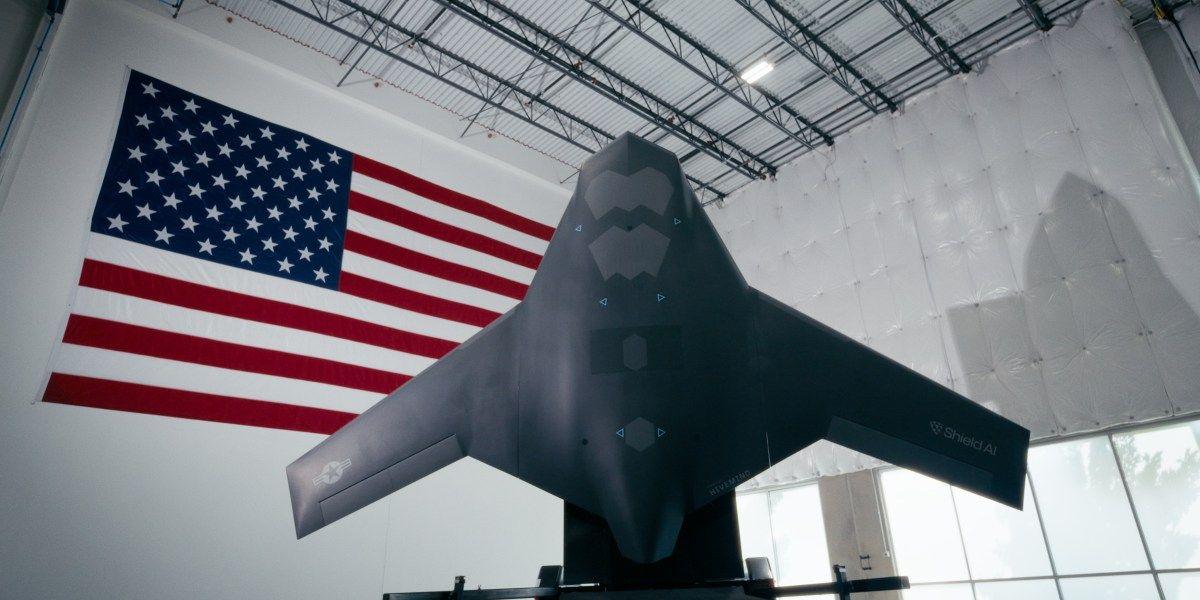
. Shield AI unveiled the X-BAT in October 2025, a VTOL stealth fighter drone that requires no runway, can be deployed from ships, and is piloted entirely by Hivemind2
. The company has said its first vertical takeoff flight is scheduled for this year, with operational deployment estimated for 20282
. The X-BAT represents Shield AI's move from reconnaissance into strike capability, a significant expansion of the company's addressable market2
. The transaction with Shield AI is anticipated to conclude in the second quarter of 2026, pending customary regulatory approvals5
.
Source: Fortune
Summarized by
Navi
[4]
07 Mar 2025•Business and Economy

17 Jan 2025•Business and Economy

09 Feb 2025•Business and Economy

1
Policy and Regulation

2
Policy and Regulation

3
Technology