Antioch raises $8.5 million to build simulation tools that accelerate physical AI development


2 Sources
[1]
This simulation startup wants to be the Cursor for physical AI | TechCrunch
The promise of physical AI is that engineers will be able to program physical agents the same way they do digital ones. We're not there yet. Robotics is still held back by a paucity of data from physical spaces. To train their machines, companies need to build mock-up warehouses to test their
[2]
Antioch prepares to accelerate simulated testing for autonomous robots after raising $8.5M - SiliconANGLE
Antioch prepares to accelerate simulated testing for autonomous robots after raising $8.5M Antioch Inc., a developer of cloud-based simulation software for artificial intelligence-enabled robots, has raised $8.5 million in funding to accelerate the development of more autonomous systems outside
Share
Copy Link
Antioch, a New York-based startup, has raised $8.5 million in seed funding at a $60 million valuation to develop simulation tools for physical AI. The company aims to close the sim-to-real gap by providing cloud-based simulation software that allows robot developers to test AI-enabled robots in virtual environments before deploying them in the real world.
Antioch Secures $8.5 Million to Transform Physical AI Development
Antioch has raised $8.5 million in seed funding at a $60 million valuation, led by venture firm A* and Category Ventures, with participation from MaC Venture Capital, Abstract, Box Group, and Icehouse Ventures
1
. The round, which comes just four months after the startup raised $4.5 million in pre-seed funding, positions the New York-based company to accelerate development of simulation tools that could reshape how engineers build AI-enabled robots2
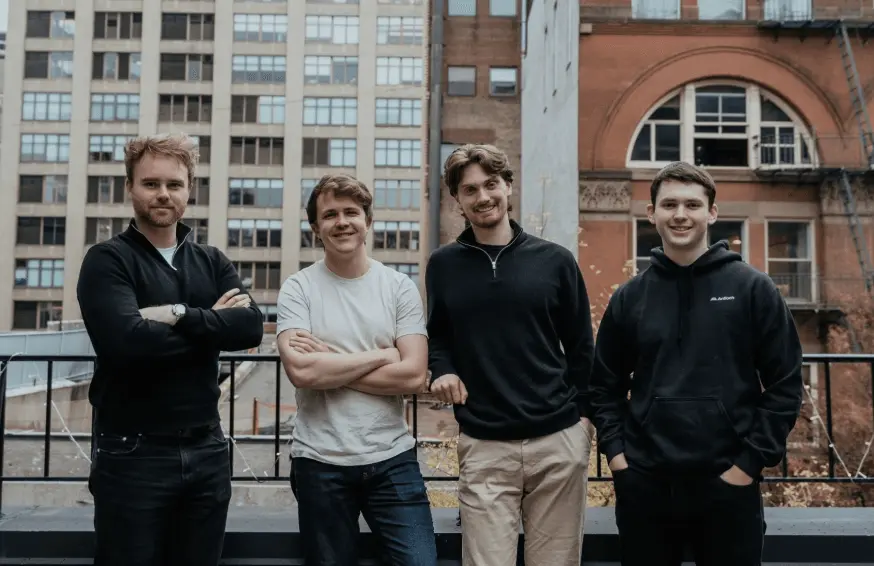
.Founded in May of last year by CEO Harry Mellsop and four cofounders, Antioch addresses a critical bottleneck in physical AI development: the need for scalable, cost-effective robot testing. The company's cloud-based simulation software enables developers to create digital twin simulations of their robots and test them in virtual environments that mimic real-world conditions, eliminating the need for expensive physical testing facilities
2
.
Source: SiliconANGLE
Closing the Sim-to-Real Gap for Autonomous Systems
The promise of physical AI hinges on closing what the industry calls the sim-to-real gap—the challenge of making virtual environments realistic enough that robots trained inside them can operate reliably in the physical world. "How can we do the best possible job reducing that gap, to make simulation feel just like the real world from the perspective of your autonomous system?" Mellsop explained
1
.Currently, robotics companies face significant barriers to testing. They must build mock-up warehouses, rent and prepare physical spaces with different staging environments, and reset hardware after every test run. This process is both expensive and cumbersome, covering only a small fraction of the scenarios most robots will encounter in production environments
2
. "The vast majority of the industry doesn't use simulation whatsoever, and I think we're now just really understanding clearly that we need to move faster," Mellsop said1
.Building the Cursor for Physical AI
Antioch executives compare their product to Cursor, the popular AI-powered software development tool. The platform allows robot builders to spin up multiple digital instances of their hardware and connect them to simulated sensors that mimic the same data the robot's software would receive in the real world
1
. These virtual environments enable developers to test edge cases, perform reinforcement learning, and generate new training data without the constraints of physical testing1
.Mellsop, who previously helped develop Tesla's Autopilot software, built Antioch with a team that brings deep expertise in autonomy systems. Two cofounders, Alex Langshur and Michael Calvey, helped him found Transpose, a security and intelligence startup acquired by Chainalysis. The other two cofounders—Collin Schlager and Colton Swingle—previously worked at Google DeepMind and Meta Reality Labs, respectively
1
.Related Stories

Platform Layer Connecting Developers to Advanced World Models
Antioch's role is to build the "platform layer" that connects developers of autonomous machines to rapidly evolving infrastructure. The company starts with world model technology from Nvidia, World Labs, and others, then builds domain-specific libraries to make them easy to use
1
. Instead of spending hours resetting a robot or moving it from one place to another, developers can click a few buttons to prepare for the next test and carry out thousands of simulated testing for autonomous robots in parallel2
.Working with multiple customers gives Antioch a depth of context for refining its simulations that no single physical AI company could match on its own. "What happened with software engineering and LLMs is just starting to happen with physical AI," Çağla Kaymaz, a partner at Category Ventures, told TechCrunch. "We do a lot of work on dev tools, and we love that vertical, but the challenges are different. With software, you can have these bad coding tools, and the risk is generally pretty contained to the digital world. In the physical world, the stakes are much higher"
1
.Focus on Sensor Systems and Manufacturing Reindustrialization
Antioch's focus now is mainly on sensor and perception systems, which account for the bulk of the need in automated cars and trucks, farm and construction machinery, or aerial drones
1
. While the company's pitch targets startups, some of its earliest engagements have been with huge multinationals already investing heavily in robotics1
.Langshur sees Antioch as serving America's reindustrialization efforts. "The only economically viable path to reindustrialization runs through robotics and automation, and scalable testing is the rate-limiting step," he said
2
. Mellsop points out that while industries disrupted by AI like software and knowledge work represent around $8 trillion of the global economy, manufacturing, logistics, construction, energy and agriculture represent more than $50 trillion. "AI penetration in those industries is basically zero today. The industrial revolution that's coming with physical AI won't be a sequel to the LLM revolution, it will dwarf it"2
.Adrian Macneil, who built data infrastructure at self-driving startup Cruise before founding Foxglove, is backing Antioch as an angel investor. "Simulation is really important when you're trying to build a safety case or dealing with very high-accuracy tasks," he said, validating the critical role of robot testing in advancing autonomy systems
1
. The need for better data generation through simulation mirrors what major companies like Waymo are already doing with world models to test and evaluate their driving systems1
.References
Summarized by

Navi
Related Stories
Former F1 Aerodynamicist Raises $55M to Solve Robot Training Crisis With Human Footage
16 Jul 2026•Startups

XDOF raises $70 million to solve AI robotics' dirty data problem as labs race to build physical AI
18 Jun 2026•Startups
FieldAI Secures $405M Funding to Revolutionize Robotics with Universal AI Brains
21 Aug 2025•Technology

Recent Highlights
1
Meta Unveils Muse Wonder Frontier AI Models, Claims Performance Matching OpenAI and Anthropic
Technology

2
IMF Report Warns AI Market Correction Could Spark Global Financial Crisis With $1.4T at Risk
Business and Economy

3
OpenAI Releases 722 AI-Generated Math Solutions, Triggering Existential Crisis in Mathematics
Technology

Recent Highlights
Today's Top Stories








Don’t drown in AI news. We cut through the noise - filtering, ranking and summarizing the most important AI news, breakthroughs and research daily. Follow topics that matter to you and stay ahead.


