Asus Launches Ascent QN10: World's First 80 TOPS Agentic AI Mini PC With Qualcomm X2 Elite


3 Sources
[1]
Asus's New Mini PC Uses Qualcomm's X2 Elite Chip to Run AI Agents
A new mini PC that can run AI agents locally has entered the market, this time from Asus, which is harnessing chips from Qualcomm. On Thursday, Asus launched the Ascent QN10, a compact desktop PC that features Qualcomm's recently-launched X2 Elite processors, which have already been popping up in
[2]
ASUS Ascent QN10 Mini PC Packs Snapdragon X2 Elite and 80-TOPS NPU
ASUS has announced the Ascent QN10, a 0.7-liter Windows-on-Arm mini PC built around Qualcomm's Snapdragon X2 Elite X2E-88-100 processor. The compact system combines an 18-core third-generation Oryon CPU, Adreno X2-90 integrated graphics and a Hexagon NPU rated for as much as 80 TOPS of INT8 AI
[3]
ASUS Ascent QN10 Worlds First Agentic 80 TOPS NPU AI Mini PC Launches
The ASUS Ascent QN10 is the world's first agentic AI mini PC, designed to deliver advanced AI capabilities in a compact form. Built on the Qualcomm Snapdragon X2 Elite platform, it features an 18-core CPU and a Qualcomm Hexagon NPU capable of performing up to 80 trillion operations per second
Share
Copy Link
Asus unveiled the Ascent QN10, the world's first agentic AI mini PC powered by Qualcomm's X2 Elite processor with 80 TOPS NPU capability. Starting at $1,349 with 16GB RAM, this compact desktop promises local AI agent execution and multi-display support in a chassis 86% smaller than traditional PCs.
Asus Unveils Ascent QN10 With Qualcomm X2 Elite Processor
Asus has launched the Ascent QN10, positioning it as the world's first agentic AI mini PC equipped with Qualcomm's X2 Elite processor delivering 80 TOPS NPU performance
1
. The compact desktop features the Qualcomm Snapdragon X2 Elite X2E-88-100 chip, which integrates an 18-core third-generation Oryon CPU, Adreno X2-90 integrated graphics, and a Qualcomm Hexagon NPU rated for up to 80 trillion operations per second of INT8 AI processing2
. This Windows-on-Arm mini PC is designed to run AI agents locally, including tools like OpenClaw and Hermes Agent, while supporting local LLM inferencing and real-time data analysis1
3
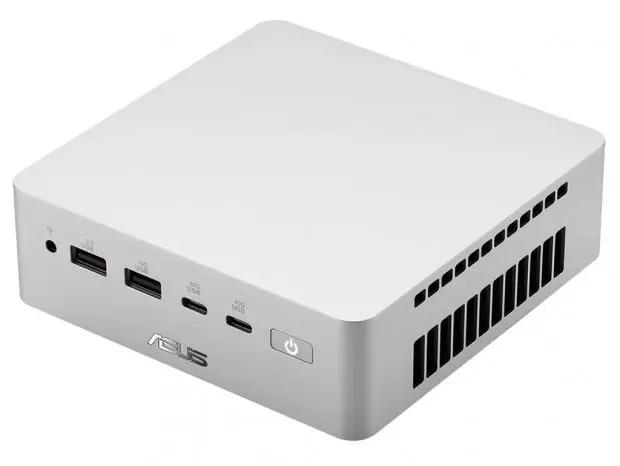
.
Source: Guru3D
The device runs Windows 11 Copilot+ and comes in two configurations: 16GB of LPDDR5x RAM at $1,349 and 32GB at $1,699
1
. The $1,349 model is already available on Best Buy, while the $1,699 version is being sold on Amazon, Newegg, and Asus's online store, though supplies appear limited1
. The soldered LPDDR5x-8533 memory design helps with packaging and bandwidth but prevents future capacity upgrades, which matters for on-device AI processing since 32GB can accommodate more models than 16GB2
.Compact Design Delivers Space Efficiency
The Ascent QN10's ultracompact chassis measures 130 × 130 × 40mm with a volume of less than 0.7 liters and weighs approximately 620g
2
3
. This makes it 86% smaller than traditional 5-liter desktop PCs, offering a space-efficient solution for modern work environments3
. Despite its compact form factor, the 1.65-pound device promises to run cool and quietly while delivering sustained performance1
. Asus has installed a dedicated SSD fan alongside a vapor chamber and processor fan, creating a separate airflow path that should help prevent storage throttling during sustained activity2
.The device operates with minimal noise and power consumption, though it requires an external 180W adapter to cover sustained processor load and attached devices
2
. This energy-efficient design aligns with sustainability goals while maintaining performance capabilities needed for hybrid AI workflows3
.Storage and Connectivity Options
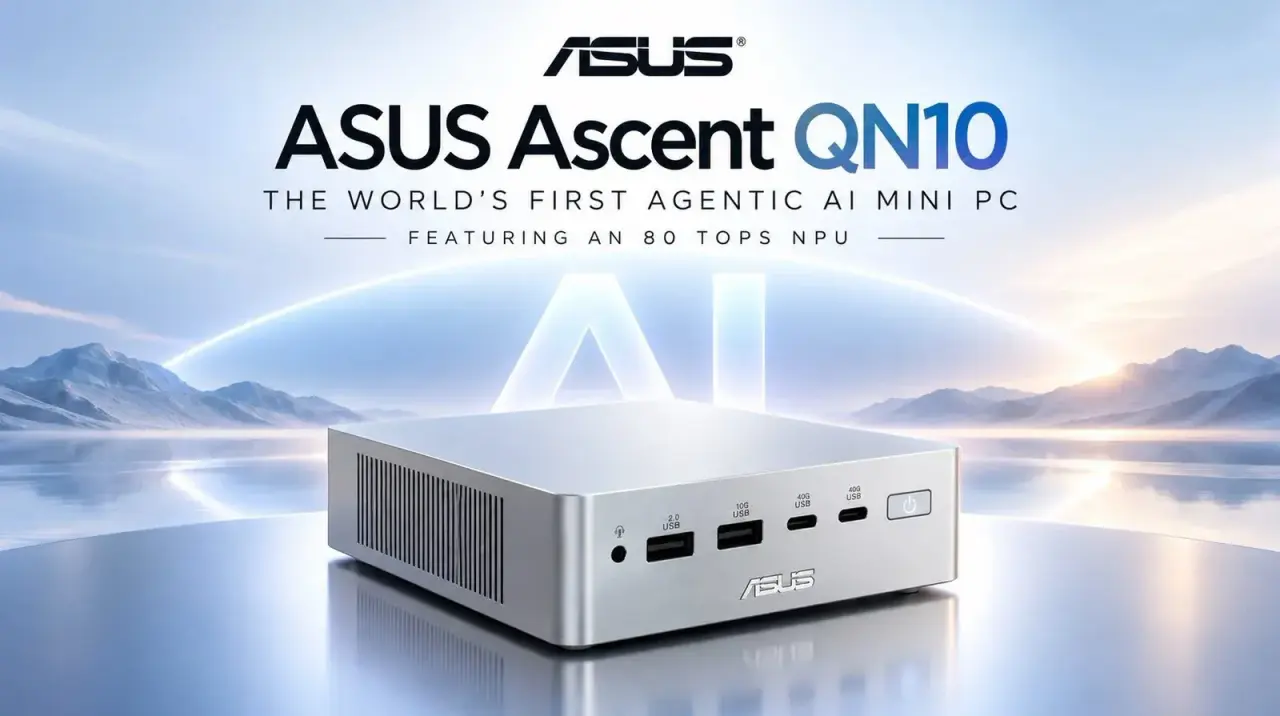
Source: Geeky Gadgets
For storage, the Ascent QN10 offers expandability with a dual SSD design featuring one M.2 2280 PCIe Gen 5 slot and one M.2 PCIe 4.0 slot, supporting up to 4TB total capacity
1
. Factory configurations ship with either 512GB or 1TB NVMe SSDs2
. The storage flexibility contrasts with the soldered memory limitation, giving users more control over capacity expansion for AI model storage and local inference operations.Connectivity includes three USB4 Type-C ports, three USB 3.2 Type-A connections, one USB 2.0 Type-A port, HDMI 2.1, 2.5Gb Ethernet, and an audio jack
2
. The device supports up to four simultaneous 4K displays, enabling seamless multitasking for developers, content creators, and enterprise professionals1
3
. Wireless capabilities include Wi-Fi 7 and Bluetooth 6.0, ensuring high-speed connectivity and compatibility with modern peripherals2
.Related Stories

Security and Developer Features
Security features include fTPM 2.0, Microsoft Pluton, and the Qualcomm Secure Processing Unit, providing a multi-layered chip-to-cloud security framework
2
3
. This makes the QN10 particularly valuable for enterprises and developers handling sensitive data or proprietary AI models3
. The device supports Arm64 editions of Windows 11 and Windows 11 Pro, though buyers should confirm compatibility for specialist peripherals, anti-cheat systems, virtualization tools, and older applications2
.For developers, the Ascent QN10 provides access to pre-optimized AI models through the Qualcomm AI Hub, enabling customization of AI applications
3
. The Adreno GPU enhances graphics performance by 2.3 times compared to predecessors, benefiting content creators requiring high-quality visual output3
. The combination of local NPU capabilities with cloud-based intelligence supports hybrid AI workflows, though actual performance depends on model architecture, precision, memory capacity, and software optimization rather than theoretical TOPS measurements alone2
.Market Positioning and Availability
The Ascent QN10 enters a growing market where AI enthusiasts have been purchasing mini PCs to run AI agents locally at home or in offices
1
. Companies including Apple and Nvidia have been preparing higher-end mini PCs with 96GB and 128GB of RAM capable of running larger AI models directly on hardware1
. Asus positions the Ascent QN10 as an affordable offering and potential alternative to Apple's Mac Mini, which recently received processor upgrades1
. The device's value proposition will depend on whether Qualcomm-accelerated applications can effectively exploit its 80 TOPS NPU and how it performs against x86 mini PCs in real-world AI workloads2
.References
Summarized by

Navi
Related Stories
Snapdragon X2 Elite finally lands in a mini PC as ASUS unveils compact desktop powerhouse
02 Jun 2026•Technology

ASUS Unveils NUC 14 Pro AI: World's First Mini PC with Intel Core Ultra and Microsoft Copilot+
20 Dec 2024•Technology

ASUS NUC 16 Pro delivers 180 TOPS AI performance in compact mini desktop PC form factor
10 Mar 2026•Technology

Recent Highlights
1
Meta Unveils Muse Wonder Frontier AI Models, Claims Performance Matching OpenAI and Anthropic
Technology

2
IMF Report Warns AI Market Correction Could Spark Global Financial Crisis With $1.4T at Risk
Business and Economy

3
OpenAI Releases 722 AI-Generated Math Solutions, Triggering Existential Crisis in Mathematics
Technology

Recent Highlights
Today's Top Stories








Don’t drown in AI news. We cut through the noise - filtering, ranking and summarizing the most important AI news, breakthroughs and research daily. Follow topics that matter to you and stay ahead.


