Atlassian opens Teamwork Graph to third-party agents as Rovo evolves into autonomous executor


7 Sources
[1]
Atlassian Team '26 - new tooling for product teams, same structural pressures
When I covered Atlassian's first State of Product report last September with Tanguy Crusson, Atlassian's Product Lead for Jira Product Discovery (JPD), the diagnosis was sharper than the marketing usually allows. Product managers (PMs) were more empowered than ever and 84% worried their products
[2]
Atlassian opens Teamwork Graph and pushes Rovo into agentic execution at Team '26 - SiliconANGLE
Atlassian opens Teamwork Graph and pushes Rovo into agentic execution at Team '26 Atlassian Corp. today unveiled a sweeping set of artificial intelligence updates at its annual Team '26 conference, headlined by the broad opening of its Teamwork Graph and the evolution of its Rovo AI assistant from
[3]
Atlassian Team '26 - Cisco's Jason Andrews on what "transform, don't migrate" actually looks like
Jason Andrews has told the Cisco story before. 75 tools collapsed onto a single cloud platform, software spend cut by 54%, an additional $5.3 million in annual savings from giving 10,000 users back 15 minutes a week. Andrews is VP of Engineering Operations at Cisco, where he runs operations for a
[4]
Atlassian Team '26 - selling a nervous system, not a clean slate
In one of the press briefings ahead of Team '26, someone asked Mike Cannon-Brookes how Atlassian planned to save customers from their own chaos. The answer came on stage the next morning. Atlassian isn't planning to - it is building the instruments to let you see the chaos clearly, and then handing
[5]
Atlassian Team '26 - Pythian on teamwork graph, MCP and the AI governance hangover
Pythian is a 450-person data, analytics and AI) specialist with around 300 people in customer-facing roles, running 24/7 services for client infrastructure. Not a hyperscaler, but that scale is big enough to expose real complexity, small enough that one person can still see the whole picture. In
[6]
Atlassian Opens Up Its Teamwork Graph to Power Agentic Work Across the Enterprise
At Team '26, the company announces a powerhouse of new AI capabilities built for every corner of modern work Atlassian Corporation today announced the opening of its Teamwork Graph, one of the industry's richest maps of how teams actually work, so Rovo and agents from across the ecosystem can
[7]
Atlassian Team '26 - new products, faster change, more automation, as the agentic pace accelerates
Atlassian's annual user conference has come round again with the usual avalanche of product launches today -- but with a distinct upbeat this year both in the tempo and scale of change and the very nature of those products themselves. Agentic AI is transforming both Atlassian's offer to its
Share
Copy Link
Atlassian unveiled sweeping AI updates at Team '26, opening its Teamwork Graph containing 150 billion connections to outside agents and evolving Rovo from assistant to autonomous agent. The company shipped Jira Product Discovery Enterprise and new Feedback capability while customers like Cisco and Pythian revealed implementation challenges around AI governance and organizational readiness.
Atlassian Team 26 Pushes Teamwork Graph and Agentic Execution
Atlassian Corp. unveiled a comprehensive set of AI updates at its annual Team '26 conference in Anaheim, headlined by opening its Teamwork Graph to third-party agents and transforming Rovo AI from a helper into an agent capable of planning and executing multistep work autonomously
2
. The Teamwork Graph, described as a living shared context layer connecting people, projects, documents and decisions across Atlassian and third-party tools, now contains more than 150 billion connections2
. The company is opening the graph through two new interfaces in open beta: a Teamwork Graph command-line interface for developers and Teamwork Graph tools delivered through Rovo's Model Context Protocol server[2](https://siliconangle.com/2026/05/06/atlassian-opens-teamwork-graph-p ushes-rovo-agentic-execution-team-26/).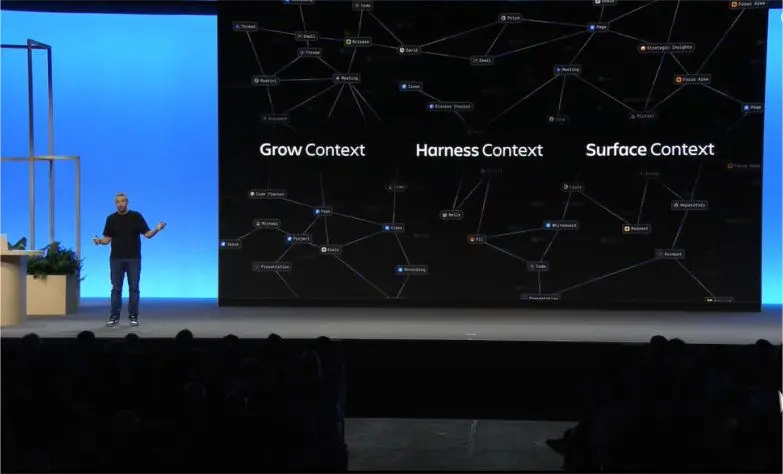
Source: diginomica
The CLI, with more than 300 commands, lets coding agents such as Anthropic's Claude Code and Cursor query work and relationships across Atlassian products through a single interface rather than stitching together individual product application programming interfaces
2
. Atlassian's own benchmarks show that grounding AI responses in Teamwork Graph data delivered 44% more accurate results while using 48% fewer tokens2
. More than 90% of enterprise cloud customers are now using Rovo AI agent, with customers performing more than 14 million Rovo-assisted actions in the past month2
.New Tools Target Product Teams Under Structural Pressure
Atlassian shipped what reads as a prescription for product teams struggling with empowerment without structural support. Jira Product Discovery Enterprise reached general availability, and a new Feedback capability entered early access
1
. The AI-powered Feedback capability captures and synthesizes customer signals directly into prioritization, addressing what Tanguy Crusson, Atlassian's Product Lead for Jira Product Discovery, calls the "second-hand information problem" where product teams rely on distilled one-liners that lack context1
.
Source: diginomica
Crusson explains the technical breakthrough that made Feedback possible: "The reason we didn't ship a feedback app before is we're not even sure that that was actually technically feasible, because it takes a lot of semantic analysis coupled with really good understanding of the domain model of the objects that we are talking about"
1
. The promise is direct natural-language access to customer feedback, weighted and connected back to the customers giving it. Both Feedback and JPD Enterprise sit in a Product Collection alongside Roadway, a dynamic roadmapping app that helps teams rework priorities when goals shift1
.Rovo Studio and Agentic Automations Reach General Availability
Rovo Studio, a no-code environment for building agents and automations grounded in the Teamwork Graph, reached general availability with built-in roles, approvals, versioning and audit controls
2
. Agentic automations across Atlassian's platform are up sevenfold over the past six months2
. The company is adding a new reasoning mode called Max to Rovo Chat, available soon in early access, which breaks complex requests into multistep plans, executes them across connected tools, and loops users back in for review2
.Agents in Jira are now generally available and can be assigned work items with full audit logging
2
. A new Incident Command Center unifies incident detection, investigation and resolution with Rovo-assisted root-cause analysis, while Rovo Service offers autonomous or supervised Level 1 support2
. For engineering teams, Atlassian introduced Agent Experience for measuring how agents interact with codebases, AI Code Insights for tracking AI-generated code at the commit level, and AI Pulse for surfacing AI productivity signals to engineering managers2
.
Source: diginomica
Cisco Case Study Reveals Transform Don't Migrate Reality
Jason Andrews, VP of Engineering Operations at Cisco, presented a candid view of what enterprise AI adoption actually costs. Cisco collapsed 75 tools onto a single cloud platform, cut software spend by 54%, and generated an additional $5.3 million in annual savings from giving 10,000 users back 15 minutes a week
3
. Andrews runs operations for a 20,000-engineer organization shipping more than 60 product lines and over $36 billion in annual revenue3
.The transformation delivered a 3-5% productivity boost across Cisco's engineering teams, though Andrews caveated the measurement: "I didn't have a great way to measure it. But I went through and talked to the 50 engineering leaders, and the average response was three to 5%"
3
. The timeline for Rovo adoption proved rougher than headline figures suggest. It took Cisco a year to get legal and compliance teams to approve use, with false starts when the tool was enabled then pulled back as teams worked through AI governance questions3
.Related Stories
AI Governance Emerges as Critical Adoption Barrier
Kasia Wakarecy, VP Enterprise Applications at Pythian, a 450-person data and AI specialist, deployed Rovo to every single person in the company because it "extrapolated our existing privacy and security policies"
5
. Pythian spent roughly five years getting its data governance foundation straight before plugging AI into core systems5
. Wakarecy warns that many organizations are doing this in reverse: "You cannot have good results unless you have your data shop in order"5
.Connecting third-party applications to Rovo took less than a day at Pythian, but the real work had already been done on data clean-up and permission models
5
. Internal surveys revealed a split adoption pattern: some employees use AI tools daily, while others have never touched them5
. Wakarecy describes the necessary approach as "kindergarten of technology," providing basic reassurance that users can touch the technology without breaking it5
.Context Multiplied by Intelligence Defines Strategic Direction
CEO Mike Cannon-Brookes framed Atlassian's strategic direction around a formula: "Acceleration for your business is about context multiplied by intelligence. Intelligence is the engine, but context is the fuel"
4
. In his view, 2026 marks the year raw model capability stopped being a differentiator, as organizations can "literally buy smarts by the token"4
. What cannot be purchased is institutional memory of failed launches, partial rollouts and incident threads that explain organizational decisions4
.Internally, Atlassian is ingesting "multiple billions of objects every single week" into the Teamwork Graph, with the aim of propagating any change within 10 minutes
4
. Customers are already running 5 million agent invocations a month on top of that context4
. Live demos during the keynote ran on production data, showing Rovo building briefings from 61 different sources spanning 20 years of customer interactions, and code search spanning 11 million files and 1.5 billion lines of code4
. The demonstrations worked, but as Cannon-Brookes acknowledged, "work will always be a little bit messy. That's where the human ingenuity actually lives"4
.References
Summarized by

Navi
[2]
[3]
Related Stories
Atlassian transforms Jira into orchestration hub for developers and AI agents amid productivity gap
16 Jul 2026•Technology

Atlassian's Rovo AI Assistant Now Generally Available, Bringing AI-Powered Productivity to Teams
09 Oct 2024•Technology

Atlassian Expands AI Capabilities: Rovo Goes Free with New Studio App and Enterprise Solutions
11 Apr 2025•Technology

Recent Highlights
1
Microsoft and Nvidia Launch Surface Laptop Ultra: A $2,599 AI-Ready PC With RTX Spark Chip
Technology

2
Google Unveils Gemini 4 Argon AI Model, Restricts Access to Trusted Cyber Defenders
Technology
3
OpenAI Releases 722 AI-Generated Math Papers on GitHub, Igniting Fury Among Mathematicians
Science and Research

Recent Highlights
Today's Top Stories






Don’t drown in AI news. We cut through the noise - filtering, ranking and summarizing the most important AI news, breakthroughs and research daily. Follow topics that matter to you and stay ahead.


