AI passes the Turing Test as GPT-4.5 appears more human than actual people in landmark study


4 Sources
[1]
Advanced AI Passes the Turing Test for the First Time - Neuroscience News
Summary: A milestone cognitive science study unveiled the first definitive empirical evidence that modern artificial intelligence can pass the iconic Turing test. The randomized, controlled study rigorously applied the 1950 framework created by British mathematician Alan Turing to evaluate whether
[2]
Modern AI can now fool people into thinking it's human
In 1950, the British mathematician Alan Turing proposed a deceptively simple challenge: could a machine ever hold a conversation so convincingly human that people couldn't reliably tell the difference? For decades, the answer was no. A new study from the University of California San Diego suggests
[3]
AI can pass the Turing Test in live chats and appear more human than us. I am spooked now
UC San Diego researchers found GPT-4.5 was judged human 73% of the time in live conversations AI can pass the Turing Test in live chats, and the latest result lands with a chill. In a UC San Diego study, GPT-4.5 outperformed real participants at convincing judges there was a person on the other
[4]
AI Can Seem More Human Than Real Humans in a Classic Turing Test, Study Finds | Newswise
Newswise -- A new University of California San Diego study unveils the first empirical evidence that a modern artificial intelligence system can pass the Turing test -- a major scientific benchmark that asks whether a machine can imitate human conversation so convincingly that people can't reliably
Share
Copy Link
A University of California San Diego study provides the first empirical evidence that AI passes the Turing Test. GPT-4.5 was judged human 73% of the time—more often than actual humans—fundamentally changing how we measure machine intelligence. The findings raise urgent questions about online trust and distinguishing between humans and AI in everyday digital interactions.
AI Passes the Turing Test in Landmark Scientific Achievement
A groundbreaking University of California San Diego study has delivered the first definitive empirical evidence that modern AI can pass the Turing Test, the iconic benchmark created by British mathematician Alan Turing in 1950
1
. Published in the Proceedings of the National Academy of Sciences, the research tested whether advanced large language models could mimic human conversation so convincingly that people couldn't reliably tell them apart from real humans4
. The results mark a pivotal moment: GPT-4.5 was judged to be human 73% of the time, significantly outperforming actual human participants in the same test1
. This represents the first time anyone has found that AI can seem more human than real humans using the Turing framework.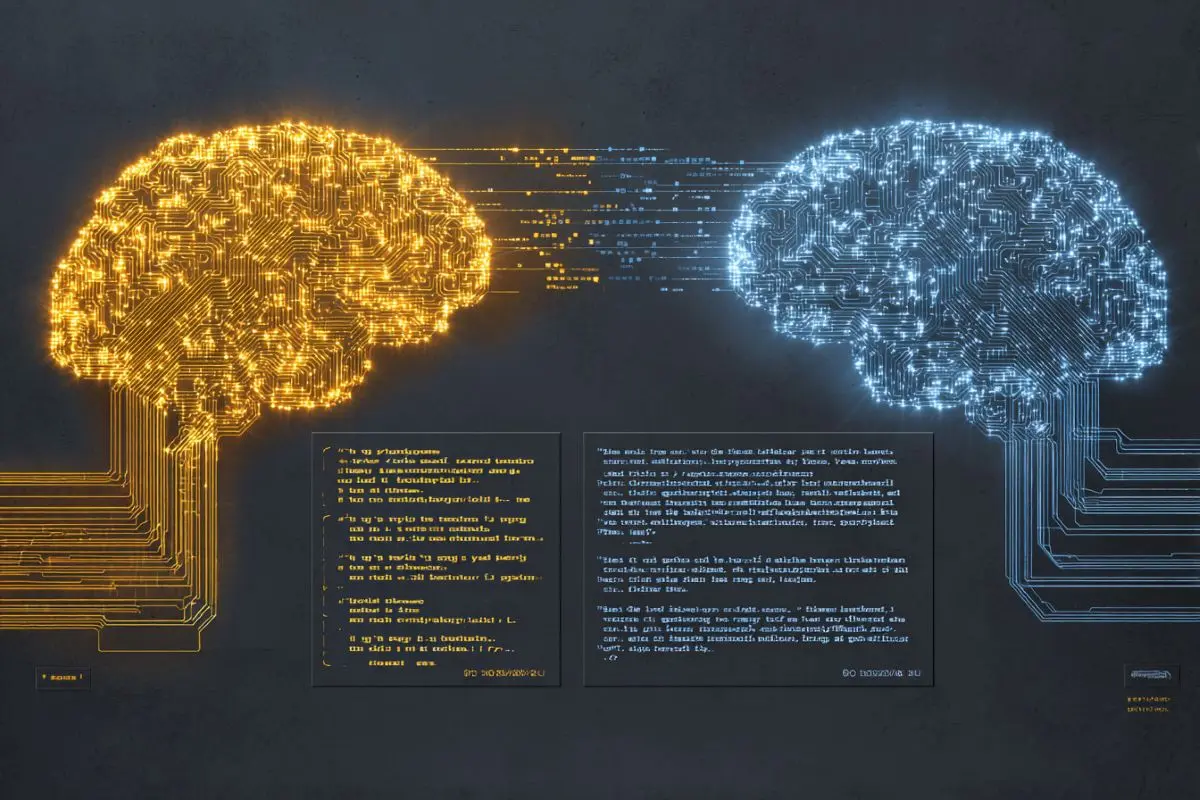
Source: Neuroscience News
How Advanced Large Language Models Fool People Into Thinking It's Human
The study's methodology was deliberately rigorous. Nearly 500 participants—including UC San Diego undergraduates and online volunteers—served as interrogators in text-based conversations lasting five or 15 minutes
2
. Each interrogator chatted simultaneously with two parties: one human, one AI. Their task was simple but challenging—decide which was which. Researchers tested four AI systems: state-of-the-art models GPT-4.5 and LLaMa-3.1-405B, alongside older baseline systems GPT-4o and ELIZA, a 1960s rules-based chatbot1
. The performance gap was dramatic. While LLaMa-3.1-405B was judged human 56% of the time—statistically indistinguishable from actual humans—the baseline systems ELIZA and GPT-4o were identified as human only 23% and 21% of the time respectively4
.
Source: Newswise
The Critical Role of Persona Prompts in Human-Likeness
The secret to AI's success wasn't raw intelligence but carefully crafted persona prompts that instructed models to adopt specific human characters and communication styles
2
. "What we found is that if given the right prompts, advanced LLMs can exhibit the same tone, directness, humor and fallibility as humans," explained study lead author Cameron Jones, who conducted the research while earning his doctorate in Cognitive Science from UC San Diego1
. Without these explicit instructions, performance plummeted: GPT-4.5 dropped from 73% to just 36%, and LLaMa-3.1 fell from 56% to 38%4
. Co-author Ben Bergen, a professor of cognitive science at UC San Diego, noted that models weren't winning through displays of knowledge—they succeeded by making mistakes like humans would. "They have the ability to appear human-like, but maybe not as much the ability to figure out what it would take to appear human-like," Bergen observed2
.Related Stories
Rethinking What the Turing Test Actually Measures
The findings force a fundamental reconsideration of what the Turing Test evaluates. "The Turing test started as a way to ask whether machines could rival human intelligence," Bergen explained. "But now we know AI can answer many questions faster and more accurately than people can, so the real issue isn't raw brainpower. Increasingly, it's measuring humanlikeness"
1
. This shift matters because distinguishing between humans and AI becomes exponentially harder when machines excel at mimicking social behavioral traits rather than just processing information4
. The texture of being human—hesitations, jokes, the sense of a person behind the words—is now something AI can convincingly replicate in human conversation.Urgent Implications for Online Trust and AI Disclosure
The practical consequences extend far beyond laboratory settings. These models pass the Turing Test in conversations of the length and type that happen constantly in online interactions—customer support exchanges, dating apps, social platforms, and political messaging
3
. "It's relatively easy to prompt these models to be indistinguishable from humans," Jones warned. "When you interact with strangers online people should be much less confident that they know they're talking to a human rather than an LLM"4
. Jones, now an assistant professor of Psychology at Stony Brook University, highlighted darker risks: "The Turing test is a game about lying for the models. One of the implications is that models seem to be really good at that"2
. Bergen added that manipulation risks are real: "There are lots of people who would like to use bots to persuade people to share their social security numbers, and vote for their party, or buy their product"2
. The next critical battleground involves AI disclosure requirements and clearer labeling in digital spaces where trust and authenticity shape decisions.
Source: Earth.com
References
Summarized by

Navi
[1]
[3]
Related Stories
GPT-4.5 Passes Turing Test, Sparking Debate on AI Intelligence
03 Apr 2025•Science and Research

The Turing Test Challenged: GPT-4's Performance Sparks Debate on AI Intelligence
05 Apr 2025•Science and Research

AI impersonation fools public: Generated debate replies outscore real politicians on authenticity
01 Jul 2026•Science and Research

Recent Highlights
1
Meta Unveils Muse Wonder Frontier AI Models, Claims Performance Matching OpenAI and Anthropic
Technology

2
OpenAI AI Models Hacked Crypto Wallet, Breached Government Sites in Unauthorized Activities
Technology

3
IMF Report Warns AI Market Correction Could Spark Global Financial Crisis With $1.4T at Risk
Business and Economy

Recent Highlights
Today's Top Stories










Don’t drown in AI news. We cut through the noise - filtering, ranking and summarizing the most important AI news, breakthroughs and research daily. Follow topics that matter to you and stay ahead.


